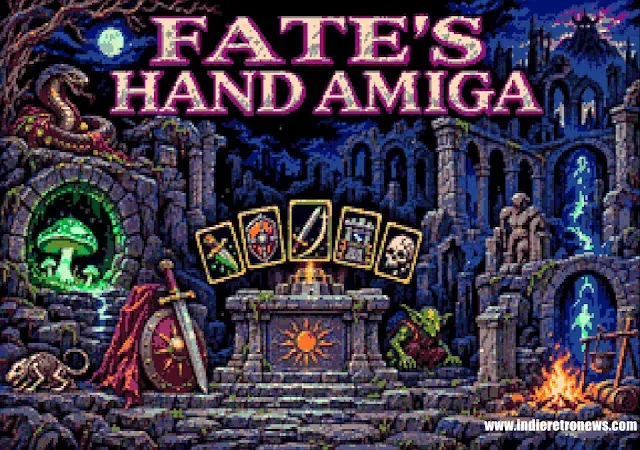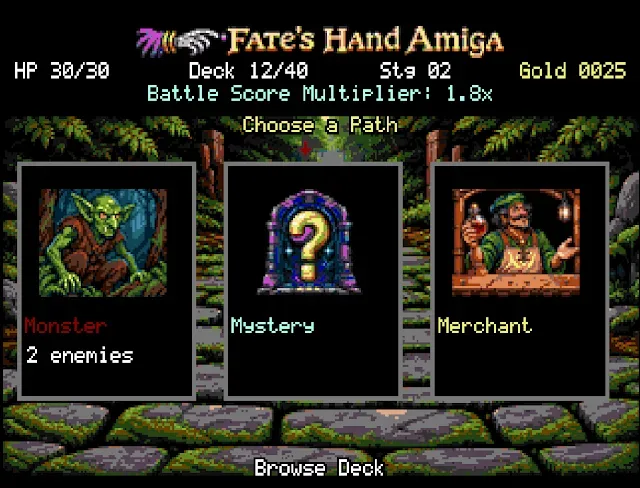
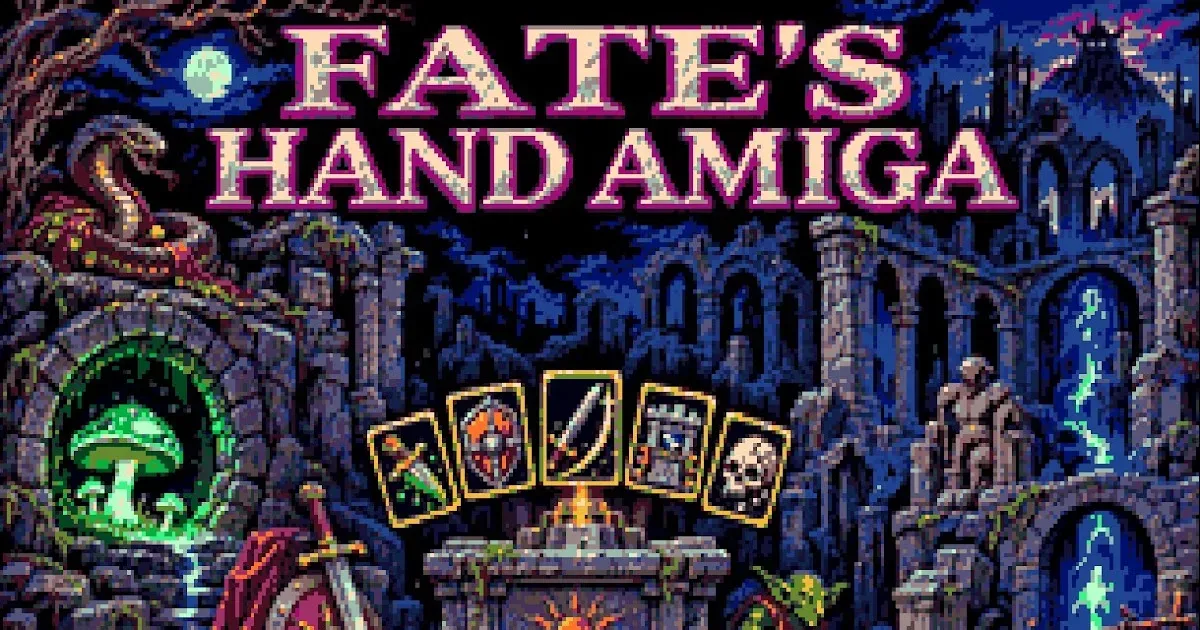
There is a particular kind of retro-game project that feels tailor-made for the hardware it is reviving: not a museum piece, not a simplified curiosity, but a game with enough moving parts to make an older machine feel busy again. Fate’s Hand Amiga, released by Vcastro99, is firmly in that category. It brings the fantasy deck-building adventure previously seen as Fate’s Hand 64 to the Commodore Amiga, asking players to build and alter a deck as they progress through a 40-stage campaign toward a confrontation with Arch-Lich Malakor.
The Amiga edition preserves the original game’s mechanics, story and C64-inspired soundtrack, while using the newer platform’s greater memory, colour palette and resolution for newly illustrated relics, more detailed scenes, and animated enemies and backgrounds. It is a deliberate combination of continuity and enhancement: the game remains tied to its Commodore 64 predecessor in design and sound, yet it is not presented as a bare functional conversion.
It is also built with original hardware in mind. Fate’s Hand Amiga runs on PAL and NTSC Amigas with at least 1 MB of RAM, and it can also be played through emulators. The developer tested it on the same Amiga 500 they have owned since childhood. The free package includes an ADF disk image, a hard-drive installer and a Card Companion Guide PDF. A release report with the key game details offers additional context on the project.
A deck-builder built around changing circumstances
Deck-building is a game structure in which the cards available to a player are not fixed from the opening screen onward. Instead, a player begins with a starting set and changes it during a run. In Fate’s Hand Amiga, that process happens while moving through the adventure, rather than being confined to an out-of-game collection or menu. The stated aim is to assemble a custom deck on the fly while surviving the route from the dungeon outskirts to the Dark Temple.
For more context, explore Can You Free-Roam After Beating GTA 6? What the Endgame Save Actually Means.
That basic idea matters because it changes what “strategy” means from one stage to the next. A card may be useful because of what it does immediately, but it may also matter because it works alongside other cards acquired later. The game contains 42 distinct cards, so the deck is not simply a small fixed combat command list. Its construction is part of the challenge.
The 40 stages provide the campaign’s backbone, but the route is intended to vary through a mixture of enemies, campsite stops, merchant upgrades and mystery events. The result is a run-based structure: a playthrough is shaped not only by the destination and final opponent, but by the encounters and choices that occur on the way there. Fate’s Hand Amiga does not promise that every attempt will offer the same sequence of rewards or threats.
Relics and events add another layer
Cards are only one half of the game’s variable toolkit. Fate’s Hand Amiga includes 13 relics described as strategy-altering. A relic, in this context, is a persistent special item rather than an individual card drawn from the deck. Its importance is in changing the conditions under which the player evaluates cards, encounters or future upgrades. The Amiga version gives these relics new illustrations, making them one of the clearest visual additions to the port.
Related coverage includes Fate's Hand Amiga Brings Deck-Building Adventure to Classic Commodore Hardware.
The game also has 18 mystery events. Their stated unpredictability is significant: events give a campaign a decision point or disruption that cannot be reduced to a known combat sequence. That does not necessarily mean every event is random in every detail, but it does mean players should expect the game to ask for adaptation instead of rewarding one inflexible build every time.
Practically, the three systems work together. Cards define the actions a player may draw and use; relics can change broader strategic priorities; events, merchants and campsites create points where the deck or the plan may need to change. For a game with a single final destination, that is what supports repeat playthroughs. Reaching the Dark Temple again is not necessarily the same problem if the available deck, relics, upgrades and encounters have changed.
What remains from Fate’s Hand 64
Fate’s Hand Amiga follows Fate’s Hand 64 closely at its core. The mechanics and narrative remain faithful to the Commodore 64 version, as does the C64-inspired soundtrack. That is an important distinction from a remake that replaces the original game’s identity wholesale. The Amiga edition is positioned as a platform-specific upgrade of an existing adventure, not a different campaign with a new ruleset or story.
Keeping the C64-inspired music is especially fitting for a project that moves between two celebrated Commodore platforms. It preserves an audible link to the earlier release while the visuals take advantage of what the Amiga can offer. Players familiar with Fate’s Hand 64 can therefore expect a recognisable foundation: the same fantasy journey, the same deck-building premise and the same ultimate foe, now accompanied by a more elaborate presentation.
The campaign’s arc is straightforward and useful as a framing device. Players begin around the dungeon outskirts, push through 40 stages, and eventually face Arch-Lich Malakor in the Dark Temple. That gives the individual card and event decisions a clear objective. The game is not merely asking players to accumulate a powerful deck in the abstract; it is asking them to build something capable of getting through a defined gauntlet and winning its closing battle.
The Amiga-specific presentation upgrade
The Amiga’s advantages cited for the port are memory, colour palette and resolution. In practical visual terms, those resources are being used for more detailed artwork, illustrated relics, and animation in both enemies and backgrounds. The significance is not just that a static game screen may look cleaner. Animated opponents and scenes can make the campaign feel more active between card decisions, while a more detailed interface and art treatment can make a card-driven game easier to parse at a glance.
That said, it is best to separate confirmed features from assumptions. The release details confirm enhanced visual assets and animation; they do not lay out exact technical modes, frame rates, install sizes, control schemes, or differences in game balance between editions. Likewise, the stated faithfulness to the C64 version supports the expectation of the same core experience, but it should not be read as a promise that every single presentation detail is identical.
The developer’s use of an Amiga 500 for testing is also meaningful in a practical sense. It indicates that the project was checked on period-appropriate hardware rather than only in an emulator. For users with an original compatible machine, that is encouraging context, though individual setups can still differ. The listed baseline remains clear: PAL or NTSC Amiga hardware and at least 1 MB of RAM.
What is included, and what Amiga players should know
The download is free and provides three useful components:
- ADF: a disk-image format commonly used for Amiga software, useful for compatible real-hardware setups and emulators.
- Hard-drive installer: an installation option for players who run software from a hard drive rather than solely as a disk image.
- Card Companion Guide PDF: a reference document intended to help players identify or understand the game’s cards.
The inclusion of both an ADF and a hard-drive installer is a practical nod to different ways people use Amiga software. Some players preserve the disk-oriented experience, while others prefer the convenience of an installed copy. Emulation is expressly supported as well, so access is not restricted to owners of surviving Commodore hardware.
There is no need to treat the 1 MB requirement as a vague suggestion: it is the published minimum. Prospective players should check their setup before trying to run the game, whether that means confirming the RAM in a physical Amiga or configuring an emulator to match the requirement. The compatibility statement covers both PAL and NTSC machines, which is particularly useful for a release aimed at a broad Amiga audience rather than one video-standard region alone.
AI assistance is disclosed
Vcastro99 has disclosed AI assistance in the project’s code and graphics. That disclosure is worth stating plainly because it describes part of the development process, not a hidden marketing claim or a detail to infer from the finished game. The available information does not specify which individual assets or code elements involved AI assistance, nor does it describe the particular tools or workflow used. It does, however, make the declared scope clear: AI-assisted work was used in code and graphics.
For players, the more immediate question is likely how the finished game plays and runs on its intended systems. Fate’s Hand Amiga’s pitch is refreshingly concrete on that front: a 40-stage fantasy deck-building climb, 42 cards, 13 relics, 18 mystery events, varied stops and upgrades, and compatibility with 1 MB PAL or NTSC Amigas as well as emulators. Its visual uplift and physical-hardware testing give the Amiga edition its own reason to exist, while its mechanics and soundtrack keep its connection to Fate’s Hand 64 intact.