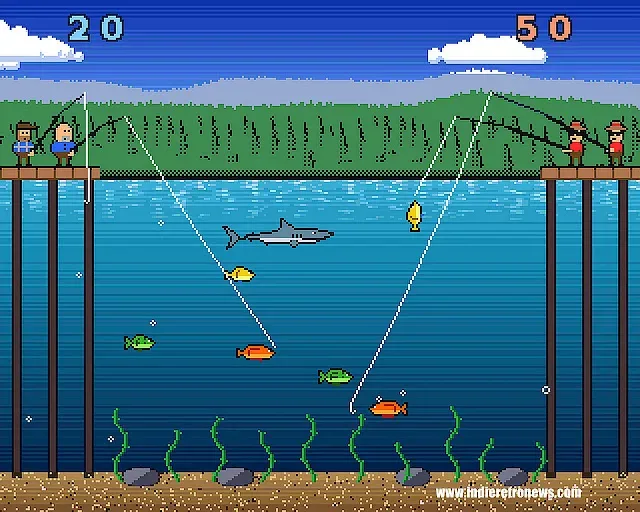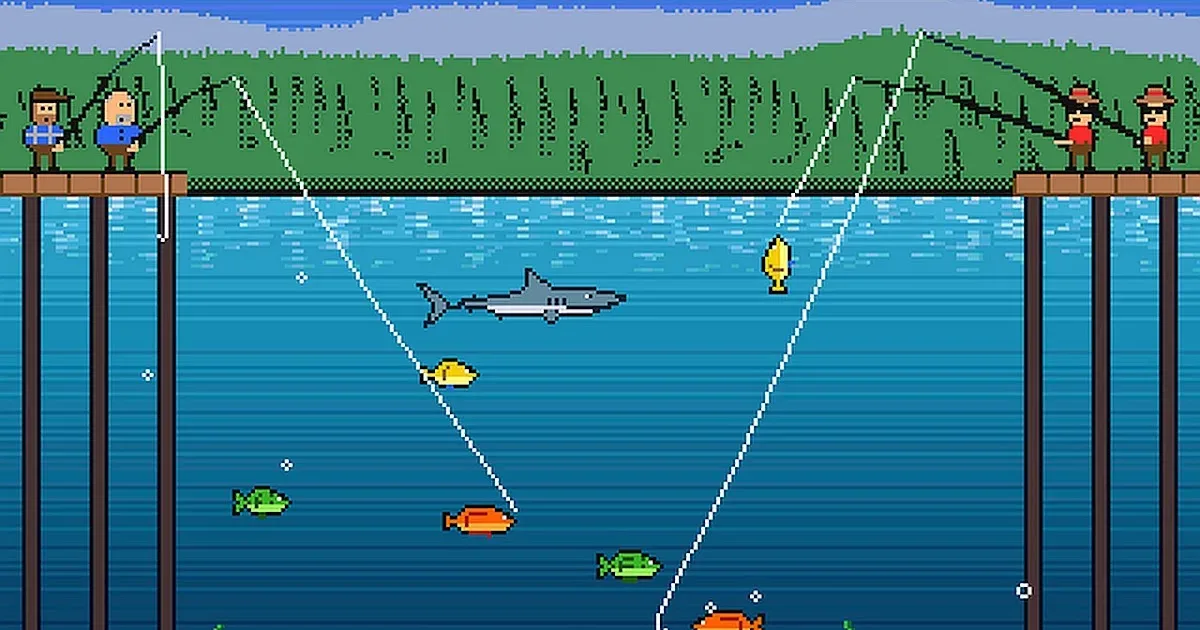
Fishing Derby – Amiga Edition is a new Commodore Amiga remake of Activision’s 1980 Atari 2600 fishing competition. Developed by AmigaLive and written in native 68000 assembly language with AI assistance, the project keeps the original game’s wonderfully direct premise intact: catch fish, reel them in before a shark steals them, and be the first player or team to accumulate 99 pounds.
That sounds serene right up until the shark arrives. The game places up to four players at opposing lakeside piers, creating a contest where a successful hook is only the beginning of the problem. Fish must be brought in quickly, because a great white shark patrols the water and can bite a catch off the line. In a game built around short decisions and immediate reversals, the shark is not background decoration; it is the mechanism that turns a simple race into a scramble.
A small ruleset with a meaningful choice
The remake preserves the original scoring goal: reach 99 pounds of fish before the opposition. Its central decision is easy to explain but carries real consequences. Players can target 2-pound sunfish close to the surface, prioritising quicker catches, or pursue 6-pound snappers near the lake bed. The latter option carries the obvious scoring appeal, but the line has farther to travel and therefore spends longer exposed to the shark.
Put another way, Fishing Derby is a risk-reward game. Risk-reward describes a design choice where the potentially bigger payoff also creates greater danger, cost or uncertainty. Here, the six-pound fish can accelerate a run toward 99 pounds, yet the long retrieve gives the shark more opportunity to intervene. Surface fish offer less weight per catch, but may be the safer path when speed matters or a player wants to keep points from slipping away.
The tension comes from the fact that neither strategy is universally correct. A player who only goes after small catches needs many successful landings to close the gap. A player who continuously chases deep fish can lose valuable time if the shark takes repeated meals. The competition therefore has room for shifting priorities: bank manageable points, take a bigger gamble to swing the score, or react to what opponents are doing at the other pier.
Four-player support changes the shape of the contest
Fishing Derby – Amiga Edition supports as many as four players, with players or teams racing across the two sides of the lake. That matters because the 99-pound target is shared by the competitive format rather than functioning as a purely solitary high-score pursuit. Every fish caught can change not only one player’s total but the pace and pressure of the whole match.
Team play also gives the small scoring system a different emphasis. A large snapper is not merely a personal gamble when it advances a side toward the finishing total. Conversely, a stolen fish can feel doubly painful when others are watching the shark turn a promising catch into lunch. The source material does not detail controller arrangements, modes or team rules beyond players or teams competing to reach the weight target, so those specifics remain unconfirmed. What is clear is that the remake is designed to maintain its performance even with four participants active.
For readers interested in games whose core appeal is immediate local co-op pressure rather than sprawling progression, the same broad appeal can be seen in a very different modern premise in FLING UP TOGETHER’s shared-stakes climbing setup. Fishing Derby’s mechanics are far simpler, but both ideas hinge on how quickly a multiplayer session can turn one mistake into a memorable setback.
Related coverage includes Fishing Derby - Amiga Edition Reels in an Enhanced 68000 Remake.
An enhanced presentation, not a replacement of the premise
The Amiga version adds visual and animation detail around the established competition. Its sky uses a dithered gradient with drifting clouds, while the water includes ripples and rising bubbles. Dithering is an image technique that uses patterns of available colours to suggest intermediate tones or smoother transitions. In this case, it is part of the remake’s attempt to give the lakeside scene a more textured look while remaining tailored to Amiga hardware.
The update also gives the action clearer physical character. Fishermen are animated cranking their reels rather than existing as static markers at the pier. The shark does more than simply remove a fish: it bites and chews its stolen meal before swimming away, ultimately threatening the opposing side again. Those touches do not alter the core objective, but they make the consequences of a lost catch easier to read and potentially funnier to watch in a group setting.
This is an important distinction for an enhanced remake. The described additions are presentational polish attached to an intentionally preserved ruleset, not evidence of a redesigned fishing simulation. There is no indication here of equipment systems, open-water exploration, species catalogues, custom tournaments or other features associated with larger fishing games. The point is concentrated arcade competition: cast for passing fish, choose a depth and weight target, reel fast, and avoid the predator.
What native 68000 assembly means here
AmigaLive says the game was written entirely in native 68000 assembly language, with the help of AI. The 68000, often shortened to 68k, is the processor family referenced by the project’s baseline hardware requirement. Assembly language is a low-level programming language that maps closely to processor operations. In practical terms, writing a game in assembly can give a developer very direct control over how work is carried out by the machine, though it is also a specialised and demanding development approach.
The phrase “with the help of AI” establishes that AI tools were involved in development, but it does not specify how they were used. It would be inaccurate to infer that those tools created particular code, art, audio, design decisions or other components. The supported claim is narrower: this is a native 68000 assembly project for the Amiga in which AI provided assistance.
More immediately useful for prospective players is the stated hardware target. Fishing Derby – Amiga Edition is said to run on any Amiga with a standard 68000 and 512K of chip RAM. Chip RAM is memory available to the Amiga’s custom hardware, making it especially relevant to tasks such as the graphics presentation described here. The project is also said to have frame time to spare in four-player play. “Frame time” refers to the time budget available to produce each screen update; having time left within that budget indicates the game is not claimed to be operating at the edge of its intended update workload in that mode.
That baseline is notable because it keeps the remake aimed at plain 68000-era Amiga hardware rather than making enhanced equipment a stated prerequisite. The available information does not provide a precise list of compatible models, media format, distribution method or release price, so those details should not be assumed from the minimum specification alone.
A clean exit is a small but practical compatibility detail
The project is also described as returning cleanly to Workbench or the CLI when the player quits. Workbench is the Amiga’s graphical desktop environment, while the CLI is its command-line interface. This may be a modest detail compared with animated sharks and four-player matches, but it is meaningful in the context of software designed for an older computer platform: the game is intended to hand control back to the environment from which it was launched rather than leaving the user in an unclear state after quitting.
Fishing Derby – Amiga Edition’s appeal, then, is not built on trying to make the original premise unrecognisable. It preserves the 99-pound finish line, the surface-versus-depth trade-off and the shark’s disruptive role, while using the Amiga version to provide richer scenery, more animated anglers and a more expressive predator. Combined with a stated 68000-and-512K target and support for up to four players, it is a focused remake of a compact competitive idea—one in which the biggest fish is tempting precisely because it is never entirely yours until it reaches the pier.