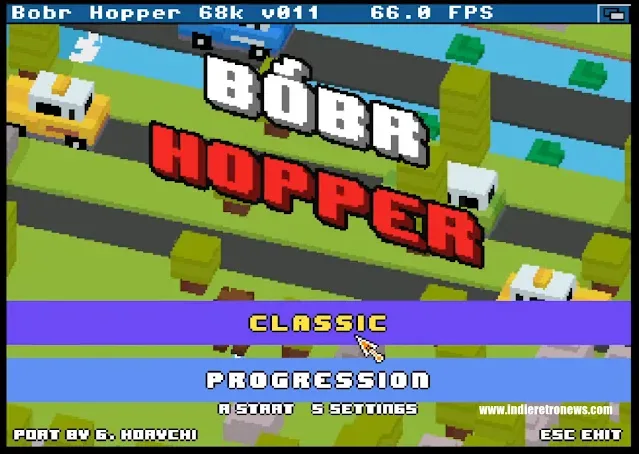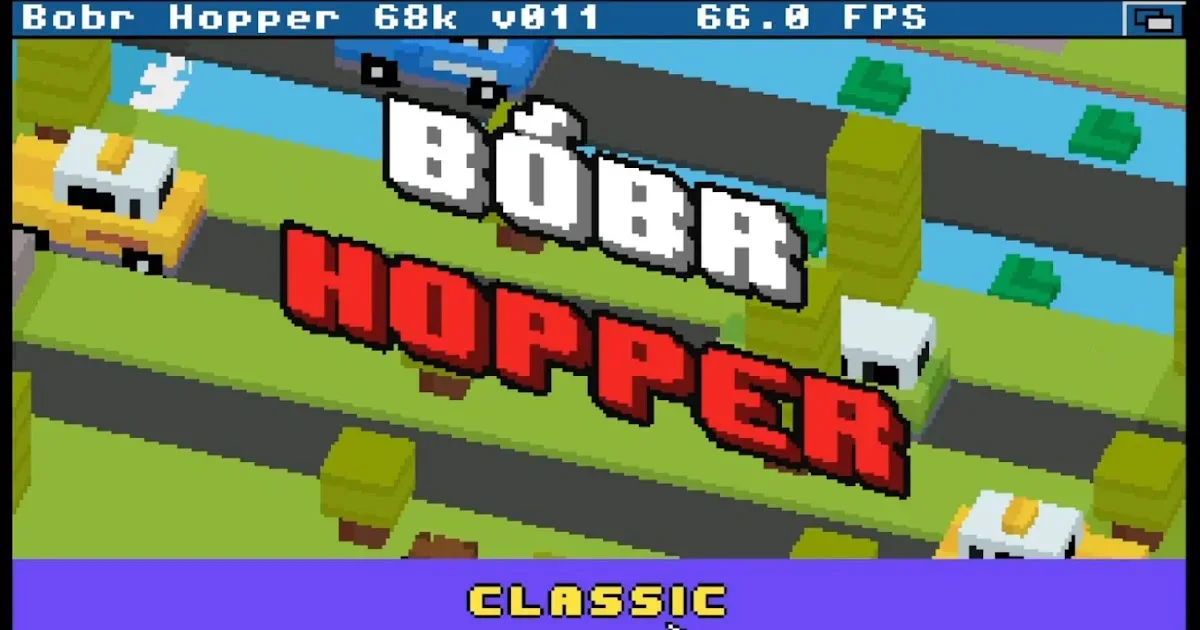
Bóbr Hopper is bringing a familiar arcade proposition to classic Amiga hardware: get a small, vulnerable animal across roads, rivers and train tracks without becoming a cautionary tale. The native AmigaOS version, created by developer angree, lets players guide either a beaver or a chicken through obstacle-filled crossings, with English and Polish language support.
The important detail is not simply that the game follows the lane-crossing arcade tradition. Bóbr Hopper has been rebuilt around the practical realities of Commodore Amiga-era hardware. Its gameplay logic is described as a line-for-line carryover from the developer’s earlier versions for handheld retro systems including the SF2000, GB300 and R36S, while the Amiga engine underneath it was made from scratch.
That distinction makes this less like a quick asset transfer and more like a platform-specific engineering project. The character’s task may be immediately legible—dodge traffic, use river routes, avoid hazards, and keep moving—but the implementation is tuned to make that action work efficiently on an older machine.
Two ways to risk a beaver’s dignity
Bóbr Hopper offers two principal ways to play. One is an endless mode built around pursuing a higher score, a format suited to quick restarts and the repeated attempt to push a little farther through an increasingly hostile crossing. The other is a multi-level progression route with a career mode and ranks.
Those modes give the same core movement challenge two different structures. Endless play turns survival and score into the whole objective. A level-based career path, by contrast, provides a sense of advancement and formal milestones through the ranks. The supplied details do not specify how ranks are earned or how many levels are included, so it would be premature to treat either as a measure of the game’s length. What is clear is that Bóbr Hopper is not confined to a single looping score attack.
The choice of a beaver or chicken also fits the game’s deliberately playful tone. Both characters face the same broad kinds of environmental danger, and the animation work reportedly accounts for a notably wide range of outcomes: 11 poses across 12 directional angles for the hero. That includes movement states as well as squash, stretch and collision animations—useful details in a game where failure needs to be readable as quickly as it is embarrassing.
An Amiga engine designed around the budget
The engine is intended to run smoothly on a stock 68020 processor and does not require an FPU, or floating-point unit. An FPU is specialized hardware used for calculations involving decimal-style fractional values. On a machine where the goal is broad compatibility and predictable performance, avoiding a dependency on that extra hardware matters.
Instead, Bóbr Hopper uses 16.16 fixed-point math. In simple terms, fixed-point math stores a number in a format that reserves part of its precision for fractions, rather than leaning on floating-point operations. “16.16” means 16 bits are used for the whole-number portion and 16 bits for the fractional portion. It is a practical approach when a game needs smooth positioning or movement but must work within older CPU constraints.
Related coverage includes Bóbr Hopper Brings Arcade Crossing Action to Native AmigaOS.
That does not mean fixed-point math is inherently more impressive than floating point; it means it is an appropriate technical choice for this target. It gives the program a consistent representation for coordinates and movement while sidestepping the need for an FPU. For a fast arcade game, the practical aim is straightforward: objects need to appear where they should, update reliably, and not turn a routine crossing into a processor budget crisis.
What an orthographic camera changes
The game also uses a rigid orthographic camera. Orthographic projection is a way of presenting a scene in which objects do not visually shrink as they move farther away. Bóbr Hopper’s objects therefore stay the same on-screen size regardless of their position.
For this kind of crossing game, that choice prioritizes clarity. A car, rock or tree remains a stable visual quantity, rather than growing or shrinking based on depth. It supports the clean, rules-first readability associated with arcade obstacle courses: players can focus on timing and position rather than interpreting perspective changes. It also meshes with the game’s pre-rendered sprite approach, since the engine can draw prepared visual assets in a controlled scene order.
The assets are rendered offline in advance and saved as individual sprites. At runtime, the Amiga paints them from background to foreground. A sprite is a small two-dimensional image used to represent a character, object or effect; drawing by layers helps establish which object appears in front of another. The result is a scene assembled from prepared parts rather than a system that must generate every visual angle on the fly.
Obstacles including cars, trees and rocks have four directional renders, while the player character has the much larger 11-pose, 12-angle set. That uneven allocation of animation detail is sensible: the hero is the part of the scene players watch most closely, particularly when the game is telegraphing a turn, a movement transition or an unfortunate impact.
Pre-rendered visuals, with one moving exception
Bóbr Hopper is not treating every element as a fixed, flat image. Its logs are dynamically clipped at the water line in real time. In visual terms, clipping means hiding the part of an image that should not be visible within a defined boundary. Here, that allows the logs to interact with the water boundary rather than simply appearing as pre-cut pictures placed on top of the scene.
It is a small technical detail with an outsized effect on presentation. The overall system retains the efficiency of pre-baked assets, but the water-line clipping lets the river environment behave with more visual specificity. It is an example of using real-time work selectively, where it adds something noticeable, rather than asking the hardware to perform more general-purpose rendering than the game needs.
That balance is the central technical story of Bóbr Hopper. The game is not chasing a perspective-heavy 3D presentation. It is using prepared sprite data, fixed-point calculations, a fixed orthographic view and carefully bounded dynamic effects to make an arcade format fit the platform. In other words, it is a game that knows exactly what job it is asking the hardware to do.
Two asset sets, and only the data required
The package includes separate graphical sets for two display targets: a 320x240 low-resolution set sized at 1.6 MB and a 640x480 high-resolution set sized at 6.4 MB. The engine loads only the graphic data it needs.
That is a meaningful compatibility-minded design decision. The high-resolution data is four times the size of the low-resolution data, matching the fourfold increase in pixel count between the two resolutions. Loading only the selected set avoids carrying both image collections into memory at once. It does not tell us the precise memory requirements for every configuration, but the intent is clear: support different setups without making each one shoulder unnecessary graphical data.
For players interested in retro software development, this may be as appealing as the premise itself. A game can look simple in genre terms and still involve careful choices about math, asset preparation, drawing order, memory use and machine compatibility. Bóbr Hopper’s crossing challenge is a compact canvas for those choices.
Why the platform-specific rebuild matters
Reusing the established game logic from handheld releases preserves the underlying rules while allowing the Amiga version to be judged on its own technical footing. That is often where a native version earns its name: not by changing a game beyond recognition, but by rebuilding the systems that make it responsive and viable on the target platform.
The approach also avoids treating retro hardware as a single interchangeable destination. A portable retro device and a classic Amiga may both run an arcade crossing game, but the route to a smooth result can be different. Bóbr Hopper’s 68020 target, absence of an FPU requirement, distinct asset packs and custom engine all point to that platform-aware approach.
It is a useful reminder that inspiration and implementation are separate questions. Bóbr Hopper openly draws on arcade-style crossing games, but its identity on AmigaOS rests on how it adapts that format to a particular machine. That wider question of what makes games distinct amid obvious genre touchstones also surfaces in recent discussion around game comparisons and development identity.
For Bóbr Hopper, the immediate promise is delightfully direct: choose a beaver or a chicken, find a safe route through roads, rivers and rail tracks, and try not to turn a high-score run into a very short lesson in traffic safety. Behind that simple loop sits a deliberately constructed AmigaOS engine that appears focused on getting the most out of an older hardware target without demanding extra floating-point hardware.