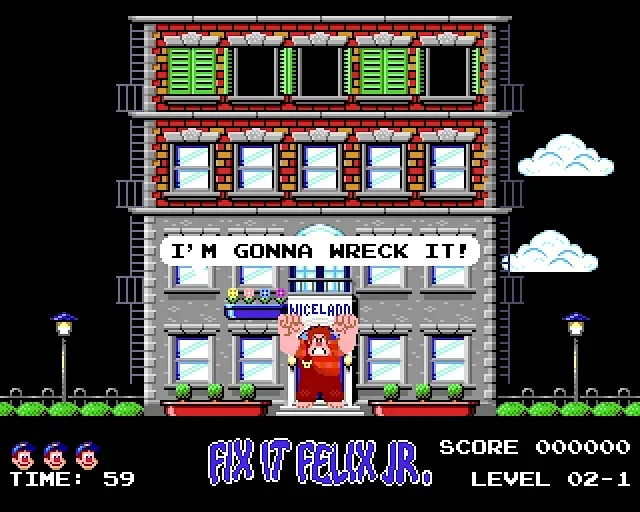
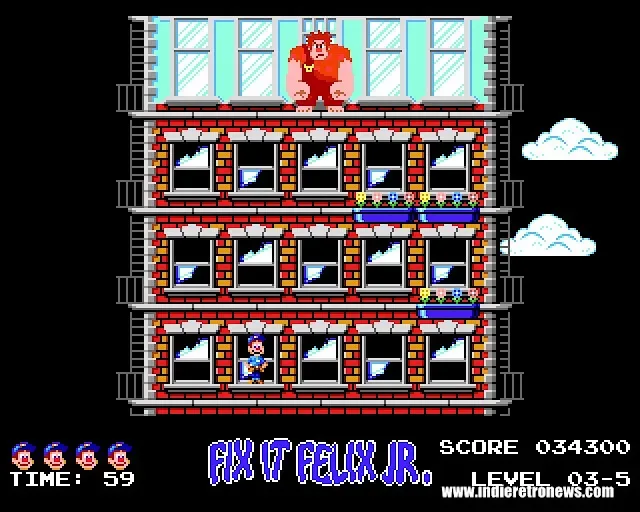
Fix-It Felix Jr., the fictional arcade cabinet at the center of Wreck-It Ralph, has received a new Commodore Amiga conversion from Broken Bytes. The project brings Felix’s window-repairing climb to Amiga hardware with PAL OCS graphics, hardware animation, building scroll, moving clouds, sampled effects and speech, three-channel music, and animated scenes including the rooftop celebration.
The conversion joins prior recreations that brought the movie’s deliberately old-school game concept to Commodore 64 and ZX Spectrum Next, alongside fan-made versions on other platforms. Its premise remains an unusually clean fit for retro hardware: a single building, a hero climbing its floors, hazards falling from above, score-chasing, and a timer that keeps every repair run moving.
There is no release or purchasing information included with the project details, so prospective players should avoid assuming a particular format, price, Amiga configuration, or distribution channel from the announcement alone. What is clear is the creative aim: make a game invented to look like an early-1980s coin-op feel at home on a machine that became a major platform for colorful, audiovisual home games.
Felix’s job is simple; surviving it is the game
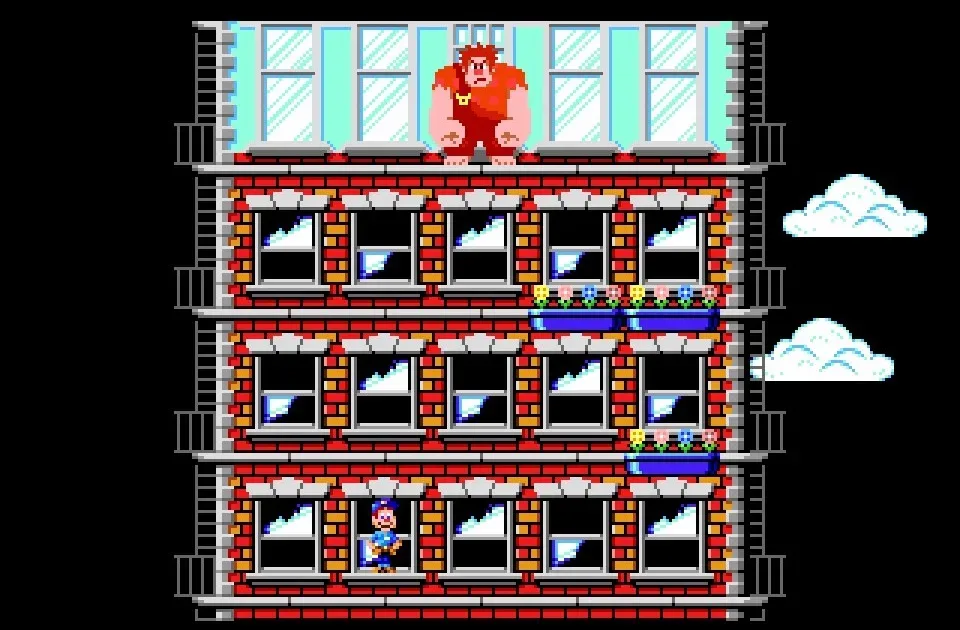
Fix-It Felix Jr. places players in control of the title character after Ralph lashes out at the Nicelanders. Ralph’s forest home has been bulldozed for an apartment building, and his response is to damage its windows. Felix must climb the facade and use his father’s magic golden hammer to mend every broken window before time runs out.
The objective sounds straightforward because it is meant to be immediately readable. Broken windows are the work list; the climb is the route; the hammer is the solution. But that clarity supports the arcade-style pressure underneath it. Ralph throws bricks downward, ducks pass through the action, and Felix needs to keep moving across the structure while choosing when it is safe to stop and make a repair.
The screen-filling building also makes vertical position meaningful. Each step upward brings Felix closer to work still unfinished, while also changing his relationship to falling bricks and passing ducks. In games built around a timer, seconds spent waiting for a safe opening are as consequential as seconds spent moving. That is the core tension of this design: repairing windows advances the goal, but every repair has to happen amid hazards that can interrupt the run.
Apple pies are power-ups, not merely a visual gag
Residents leave hot apple pies on window sills for Felix. Collecting one grants temporary invincibility, the ability to smash bricks, and score multipliers. In practical terms, that means a pie can change the player’s priorities for a short stretch. A route that would normally demand careful evasion may become an opportunity to move aggressively, while the multiplier adds a reason to use that safer, stronger state efficiently.
Temporary invincibility means hazard contact will not immediately end the character’s progress during the effect. Brick-smashing power turns a threat into something Felix can remove rather than only dodge. A score multiplier raises the value of points earned while it is active. Together, those benefits give the collectible both defensive and offensive significance: it reduces risk while rewarding fast, purposeful play.
Related coverage includes Fix-It Felix Jr. Reaches Commodore Amiga in a Feature-Rich New Conversion.
That combination is one reason the concept reads as more than a simple film tie-in novelty. The win condition is easy to understand, but the pies introduce timing decisions and scoring ambition. A player can try to finish the repairs safely, or try to leverage a powered-up stretch to make a higher-scoring run. The supplied details do not set out exact scoring rules or power-up duration, so those particulars remain unconfirmed.
What PAL OCS presentation tells us
The Amiga version is described as using PAL OCS graphics. PAL is a video standard historically associated with territories using that television timing system. OCS, short for Original Chip Set, refers to the original Amiga custom-chip architecture. In this context, the terms signal that the conversion is tailored to classic Amiga audiovisual capabilities rather than simply using the platform as a generic target.
The announced feature set leans into that identity. Hardware animation is listed alongside smooth building scrolling and moving clouds, with original art supporting the presentation. Rather than treating the structure solely as a static board, the conversion appears designed to give Felix’s climb a more animated backdrop. The detail matters for a game set against one tall apartment block: scrolling and cloud movement can reinforce the sensation of upward travel without changing the premise that the player is working across a facade.
Fully animated cinematic cutscenes are also part of the package, including the rooftop victory celebration. Cutscenes are non-interactive sequences used to establish or punctuate events. Here, their inclusion suggests the project is preserving not just the moment-to-moment repair challenge but also the characterful framing associated with the fictional cabinet’s screen life.
It is worth separating that claim from assumptions about performance. The available information identifies smooth scrolling and fluid hardware animation as goals and features, but provides no frame-rate measurement, model-by-model compatibility list, or technical breakdown of memory and storage requirements. The strongest conclusion is that Broken Bytes is presenting an Amiga-specific audiovisual interpretation, not that every implementation detail has been documented.
Sound is another major part of the conversion
Audio is described as featuring sampled sound effects and speech, plus three-channel music. Sampled effects use recorded audio snippets instead of representing every sound as a simple tone. Speech samples can give game events a more characterful response than short bleeps alone, while a three-channel musical arrangement means multiple musical parts can be heard in combination.
Those choices suit Fix-It Felix Jr.’s arcade-inspired identity. Repetitive arcade play benefits from a strong sound vocabulary: repair actions, incoming hazards, collection events, and transitions all need to be legible while players are concentrating on movement. Meanwhile, the project credits distinguish music and sound design from the original score and tunes, acknowledging the separate jobs of adapting music for the platform and shaping the effects that accompany play.
For players interested in games that translate a clear arcade loop to legacy machines, the appeal is in that whole package rather than graphics alone. The gameplay has a compact, score-aware structure, and the Amiga version adds visual motion, presentation sequences and audio elements around it. That approach is especially relevant to retro-game enthusiasts who value platform-specific conversions instead of viewing every port as interchangeable.
For another example of how classic-style game design can reward route knowledge and hazard awareness, see our Castlevania: Belmont’s Curse tips guide.
Creative credits behind the Amiga edition
Antonio Savona of Broken Bytes is credited for the Amiga conversion. Steven Day is credited for graphics and visual art. Aldo Chiummo handled music and sound design, while Saul Cross is credited for the original score and tunes. The original concept and lore are credited to Tobikomi Company and Walt Disney Animation Studios.
- Amiga conversion: Antonio Savona (Broken Bytes)
- Graphics and visual art: Steven Day
- Music and sound design: Aldo Chiummo
- Original score and tunes: Saul Cross
- Original concept and lore: Tobikomi Company / Walt Disney Animation Studios
The credits underline a useful distinction in projects like this. A conversion is not only the act of moving gameplay from one platform to another. It can require a specific visual treatment, platform-appropriate audio work, and attention to the presentation surrounding the game itself. Here, the named feature list—from clouds and scrolling to speech and cinematics—makes that broader production effort visible.
Fix-It Felix Jr. was already constructed as a fictional artifact with arcade-era rules: a villain causes damage, a hero fixes it, threats fall, power-ups bend the rules temporarily, and scores matter. The Amiga conversion’s stated features build outward from that compact foundation. For fans of the movie’s made-up cabinet and Amiga-focused retro development alike, it is a notable new attempt to make that imaginary arcade game feel native to another piece of gaming hardware history.