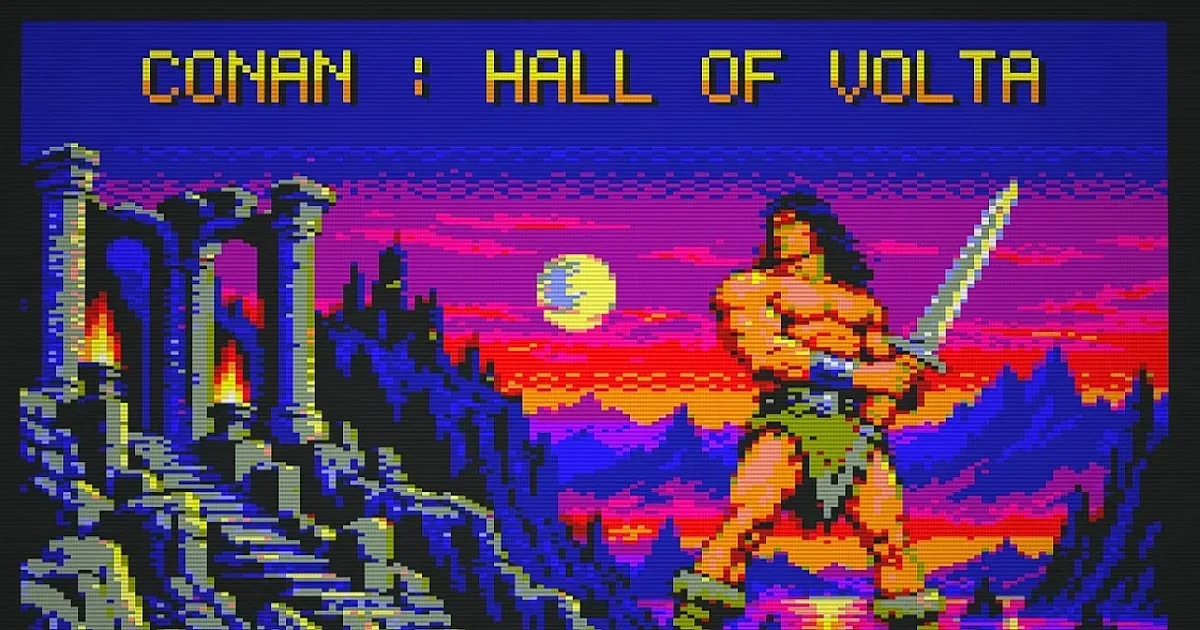
Conan: Hall of Volta, Datasoft’s 1984 fantasy action game, has received an unofficial Amstrad CPC 6128 conversion from Oldschool Is Beautiful. The project carries the original campaign to the CPC while aiming to preserve the underlying play behaviour of the Commodore 64 version: the hidden layouts, enemy movements and precisely timed hazards are intended to match.
That makes this more than a visual remake with a familiar name. The port is described as a reverse-engineered conversion in which the game’s core logic was moved instruction by instruction from the Commodore 64’s 6502 processor to the CPC’s Z80 processor. Around that retained game logic, the team rebuilt the presentation for the target machine, including new sound work for the Amstrad’s AY-3-8912 chip and a custom 16-colour loading screen.
For retro players, the result is a notable preservation-minded approach to bringing a game between systems that use fundamentally different CPUs. It also adds another chapter to the continuing stream of projects for classic machines, following other recent retro-system tributes such as a Commodore 64 shooter homage to The Greatest American Hero.
Seven stages and three gemstones
In Conan: Hall of Volta, players control the famed barbarian hero through seven dangerous stages. The journey crosses caverns, castles, aerial hazards and the domain of the wizard Volta. Conan’s overarching task is to recover three enchanted gemstones, then end Volta’s reign.
That structure matters to the conversion because it establishes the scope of what has been carried over. The CPC edition is said to cover the entire campaign through to the original game’s ending screen, rather than adapting only an opening segment or a selection of levels. Secrets, enemies and obstacle timing are all areas where a port can subtly diverge even when it broadly resembles its source. Here, matching those details is presented as a central goal.
The claim of comparable “frame-perfect” timing deserves a little unpacking. In games, a frame is a single visual update. A frame-perfect jump, dodge or movement sequence is one that must happen within an extremely narrow update window. If obstacle behaviour shifts by even a small amount, an experienced player’s learned timing can stop working. The port’s instruction-level approach is meant to minimize that kind of difference.
That does not mean that two different computers are literally the same machine. The Commodore 64 and Amstrad CPC use different processors and different audio and graphical hardware. Rather, the stated ambition is behavioural equivalence: the player should encounter the same level arrangements, patterns and demands despite the code having been translated for another architecture.
What instruction-by-instruction porting means
The original Commodore 64 game was built around the 6502 processor family, while the Amstrad CPC relies on a Z80 processor. Those CPUs do not share a single interchangeable instruction set. An instruction set is the collection of basic operations a processor understands, such as loading data, comparing values, branching to another section of code or performing arithmetic.
Related coverage includes Conan: Hall of Volta Rebuilt for Amstrad CPC 6128 in Unofficial Fan Port.
As described, the port first reverse-engineered the Commodore 64 version and then transferred the core logic one instruction at a time to equivalent Z80 behaviour. Reverse engineering in this context means examining an existing program to understand how it works, rather than starting from its original development materials. The supplied details do not establish exactly how every routine was handled, but the stated outcome is clear: preserve the original mechanical rules while expressing them in code the CPC can execute.
This distinction is important. A conventional remake may reproduce a game’s premise and stages while rewriting movement, collision detection or enemy routines from scratch. That can be effective, but it can also introduce tiny changes that add up to a different feel. A logic-focused port instead places a premium on repeatability. If an enemy appears in a particular rhythm or a trap demands a particular response, that behaviour is part of the game being preserved.
The project was made with the help of AI, but that broad phrase should not obscure the technical work claimed for the release. The available information specifically identifies reverse engineering, an instruction-by-instruction translation from 6502 to Z80, CPC-targeted audiovisual changes and fitting the completed package on one disk side. It does not detail which portions of the process were AI-assisted or what tools were used, so those particulars remain unspecified.
CPC-specific audio and visuals
Although the mechanics are intended to remain unchanged, the audio and visual side has been re-engineered for the Amstrad CPC. Before the game begins, players see a custom 16-colour loading screen. The port then continues through the full adventure and its endgame screen.
The sound has been completely rewritten around the CPC’s internal AY-3-8912 sound chip. In plain terms, that means the conversion is not simply carrying across the original game’s audio routines unchanged. It is creating a CPC-specific sound implementation suited to the hardware in the target system. This is an important piece of adaptation, since sound chips are dedicated components with their own capabilities and programming methods.
Rather than treating the CPC’s hardware as a limitation to work around, the conversion’s stated design uses it as the basis for a distinct presentation. That balance is a practical priority in cross-platform retro development: preserve the part that defines the game’s play while allowing the version’s graphics and sound to speak the language of its own machine.
For players familiar with the Commodore 64 original, that can make the CPC release particularly interesting. It is designed to retain the old game’s layout and timing while delivering a different audiovisual interpretation. For CPC owners and enthusiasts, it puts a complete version of the 1984 campaign on their system without suggesting that it should be identical in every hardware-level detail.
Performance and the one-disk-side target
Oldschool Is Beautiful also reports that the CPC version runs at the same fluid pace as the 1984 original. Maintaining pace is a significant target for a game built around enemy patterns and tight hazards. Smoothness is not only a cosmetic concern when players must react to motion at reliable intervals; it contributes directly to whether learned timing transfers between versions.
The conversion was optimized to fit on a single disk side. That is both a storage constraint and a design challenge. The project has to contain the translated logic, complete campaign data, revised sound and presentation materials without exceeding the space available to it. The supplied information does not provide a capacity figure or describe the optimization methods, so it would be premature to assume how assets or code were compressed and arranged. What is established is the final packaging target: one disk side.
That compact footprint complements the port’s philosophy. It is not framed as an expanded edition with new stages, altered mechanics or modern conveniences layered over the original. Instead, it is a complete CPC conversion that emphasizes fidelity to the 1984 game’s systems while supplying platform-specific art and sound work.
Why unofficial conversions matter
Unofficial fan ports occupy a valuable place in retro computing because the machines themselves had separate libraries, audiences and technical conventions. A game’s absence from one platform can become part of that platform’s history, even decades later. Bringing it across does not change the original release record, but it can give users of the target machine a new way to encounter an older design.
In this case, the attention to direct logic translation gives the release an archival angle as well as a creative one. Rebuilding a program for Z80 hardware requires interpretation and implementation choices, but a focus on original layouts, patterns and timing provides a concrete standard against which those choices can be judged. The stated objective is not merely that Conan reaches Volta’s hall on the CPC; it is that the journey works in a recognizably equivalent way.
For anyone approaching the game for the first time, the basic proposition remains straightforward: guide Conan through seven hostile stages, locate three magical gemstones and confront Volta. For veteran players, the more technical appeal is the promise that familiar secrets and hazards survive the jump from 6502-based Commodore 64 code to a Z80-based Amstrad CPC 6128 release.