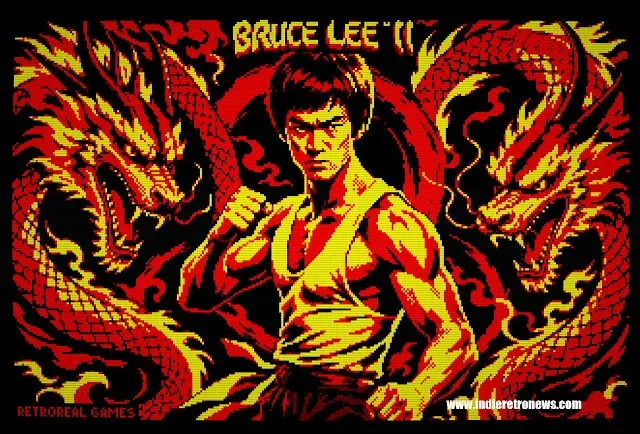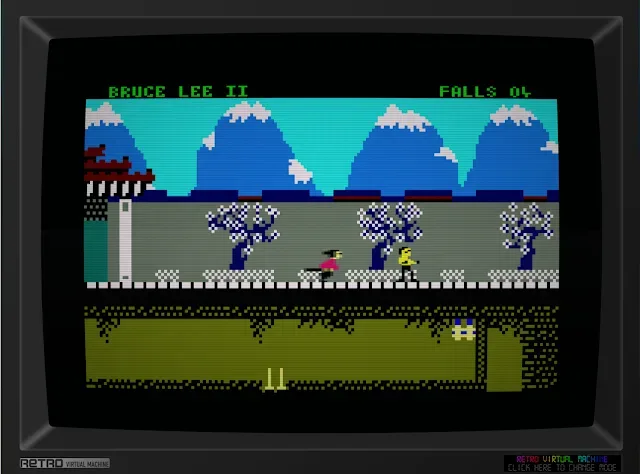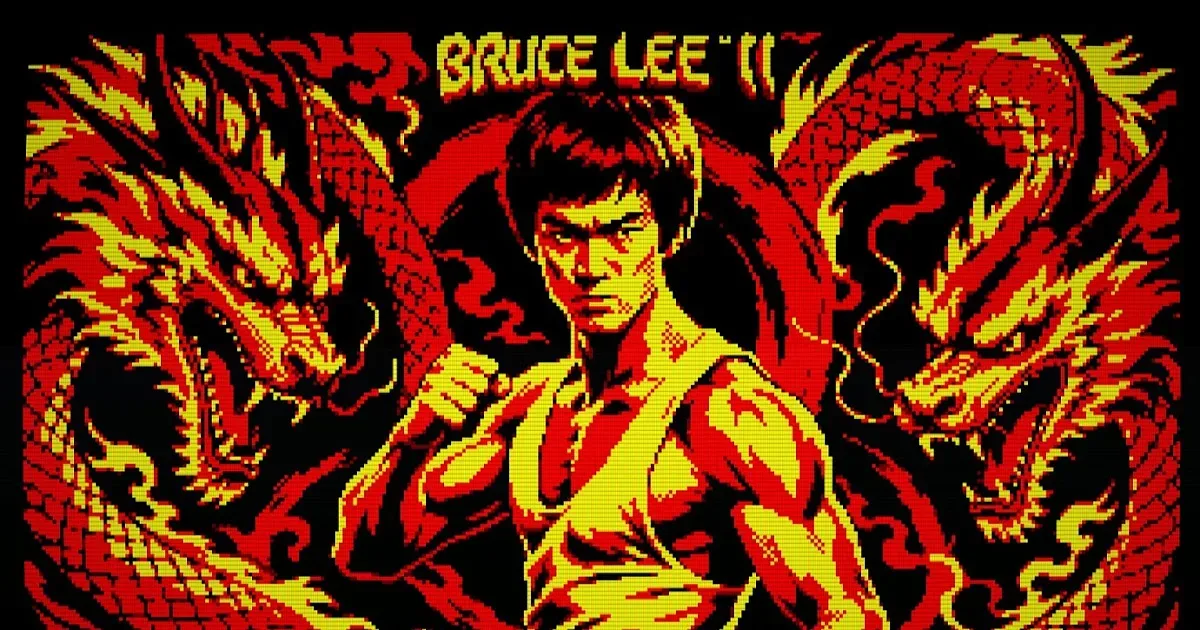
Bruce Lee II has arrived on the Amstrad CPC through RetroReal Games, completing an unusually satisfying circle for a sequel that was designed with the classic machine firmly in mind. The game began life as a fan-made PC follow-up by Bruno R. Marcos in 2013, but its visual foundation was tied closely to the CPC edition of the original Bruce Lee. Now the sequel has been converted for the hardware that helped inspire it.
That relationship makes this more interesting than a routine retro port. The CPC is not merely another destination for a game associated with an 8-bit hit. Marcos used the CPC version as the key graphical reference point for the PC sequel and included a display option intended to evoke the machine’s distinctive look. The new conversion therefore brings the project to a platform it was already trying to honor from afar.
Why the original Bruce Lee mattered
Datasoft published the first Bruce Lee in 1984, and it became a major success across 8-bit home computers. Its appeal rested on a combination that is easy to describe but difficult to balance: platforming, exploration and combat all occur in the same compact spaces, with the player regularly pressured by two persistent opponents.
The ninja provides speed and mobility, while the green Yamo is positioned as the heavier threat. Their presence creates the game’s famously frantic rhythm. Progress is not simply a matter of landing a jump or defeating an enemy in isolation; movement, attacks and positioning are intertwined. A route through a room can change immediately when either recurring opponent enters the action.
That design is a useful example of what people mean when they call an older game “accessible” without calling it simplistic. An accessible layout gives players readable spaces and a clear enough immediate goal to understand what they are doing. Challenge can still come from execution, timing and the interaction of systems. In Bruce Lee, the controls and basic rules are direct, but the pressure created by the ninja and Yamo gives familiar rooms a hectic edge.
The Amstrad CPC release, distributed by U.S. Gold, developed a strong following in particular for responsive control and its colorful presentation. Those traits matter to the sequel’s story. The CPC version was not treated as a peripheral variation on the original; it became the visual touchstone for a later fan project.
A sequel built around familiar fundamentals
Marcos’ Bruce Lee II keeps the core premise of the older game’s play style intact while widening the range of situations around it. Its story concerns a mission to rescue Bruce’s sister from Tao-Bao. Rather than replacing the original formula, the PC sequel built upon it with more involved environments and a larger set of hazards and traversal ideas.
The additions cited for the sequel include switches, traps, moving platforms and underwater swimming sections. Each has a specific practical effect on the sort of platform-action experience established by the original:
- Switches introduce cause and effect. A player is asked not just to reach a point, but to consider what operating it changes elsewhere in the environment.
- Traps make observation and timing more important, since danger can be part of the room itself rather than only an enemy’s attack.
- Moving platforms turn traversal into a timing problem, asking players to judge both their own movement and an object’s motion.
- Underwater sections broaden the game’s movement vocabulary by adding swimming to a formula otherwise associated with grounded platform action.
Those mechanics can make level design more complex, but the project’s stated goal was fidelity to the classic feel. The sequel retained the original’s straightforward physics and intuitive approach. In practical terms, that means expansion without abandoning the immediate readability that helped make the 1984 game work: more environmental possibilities, but not a reinvention of its basic action-platform language.
The game also adds adversaries inspired by martial-arts figures Chuck Norris and Kareem Abdul-Jabbar. Their inclusion fits a sequel built around the larger cultural shadow of its title character while preserving the combative pressure that defined the original’s encounters.
The CPC conversion is more than a visual callback
Retro conversions are often discussed primarily as technical curiosities: can a later game be made to run on older hardware, and what compromises does that require? That remains a natural question here, but Bruce Lee II has a more specific creative connection to the CPC. Its earlier PC version already looked back to that platform’s aesthetic. A CPC edition reverses the usual direction of influence.
Instead of a modern or PC-era work being reduced to fit a classic platform with no prior relationship to it, this is a work returning to an environment that informed its identity. That does not erase the difference between the 2013 PC original and a CPC conversion, nor does it establish that every element will translate identically. It does, however, give the port an unusually coherent premise: the visual language was part of the sequel’s conception before this release.
The distinction is important for retro players. A conversion can be judged on whether it preserves a game’s rules, pacing and character, not just whether individual screens resemble the original release. Here, the supplied background points to the key throughline: responsive, approachable action-platform fundamentals; a colorful CPC-inspired presentation; and a sequel that expands environmental challenges through switches, traps, moving platforms and swimming.
What “faithful” means in this case
Faithfulness is an elastic term in retro-game discussion. It can refer to graphics, controls, level structure, sound, difficulty, or even the less tangible pace of play. In the case of Bruce Lee II, the available details support several concrete meanings rather than a vague claim of nostalgia.
First, the sequel follows the original’s mixture of combat, exploration and platforming. Second, it retains simple physics and intuitive gameplay rather than replacing them with a fundamentally different system. Third, its visual approach deliberately references the Amstrad CPC edition. Finally, its design extends the original’s style with more complicated environments rather than treating the older game as a template to discard.
That is a stronger definition of homage than copying a sprite style alone. The visual tribute is significant, but the structural tribute is just as central. The added mechanics point toward greater complexity, while the retained fundamentals suggest an effort to keep that complexity legible.
A preservation-minded release with a specific audience
The conversion will naturally be of interest to Amstrad CPC enthusiasts, but its significance also reaches players who follow fan-made sequels and the continuing life of 8-bit game design. It demonstrates how a later project can have a genuine relationship with a platform even when it did not originally debut there.
It also sits comfortably within the wider conversation about keeping games and game culture reachable across changing technology. That debate is not limited to vintage hardware; it includes questions of access, platforms and long-term availability, themes explored in the discussion around digital game ownership. A CPC conversion is not a universal answer to preservation concerns, but it is a concrete example of a game being carried into another meaningful format rather than remaining tied solely to its original PC release.
Most importantly, this is not presented as a new official chapter in the historic series. It is a fan-made sequel by Bruno R. Marcos, now adapted by RetroReal Games for the Amstrad CPC. That distinction respects the project for what it is: an affectionate continuation built around a beloved 8-bit formula, finally reaching the computer whose palette and visual personality helped guide its creation.