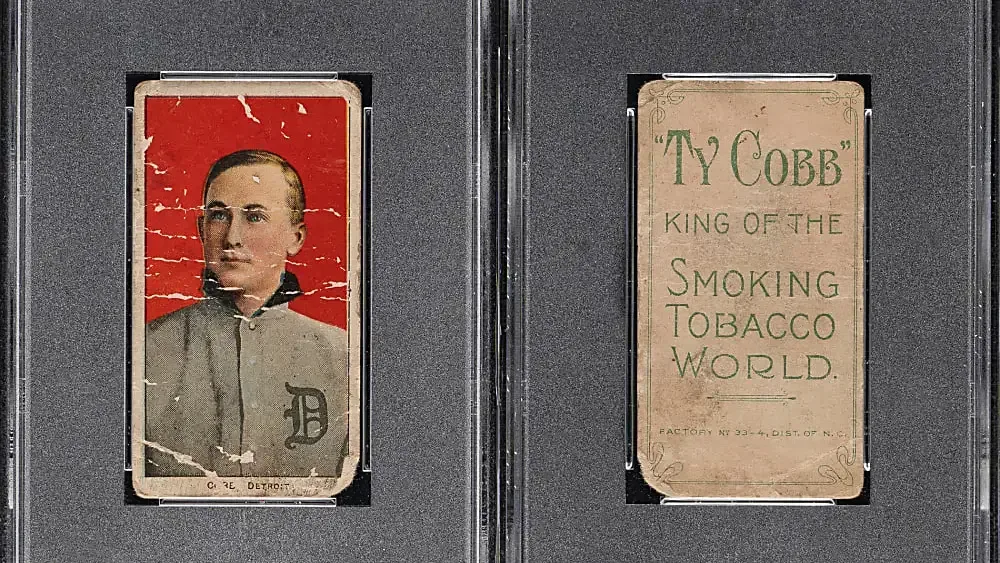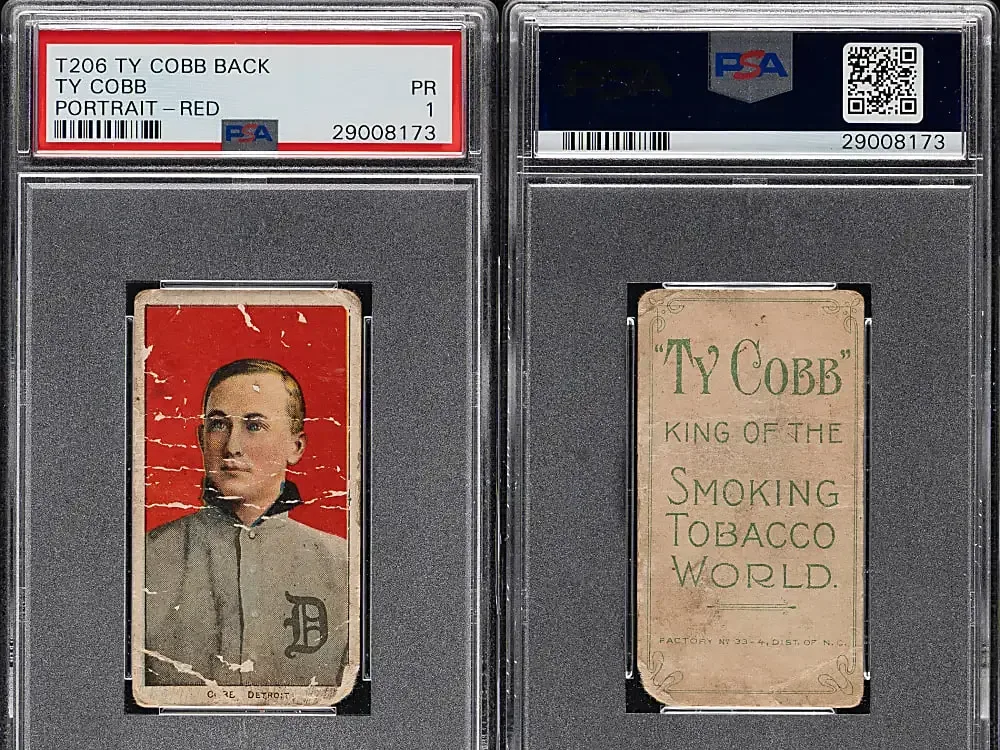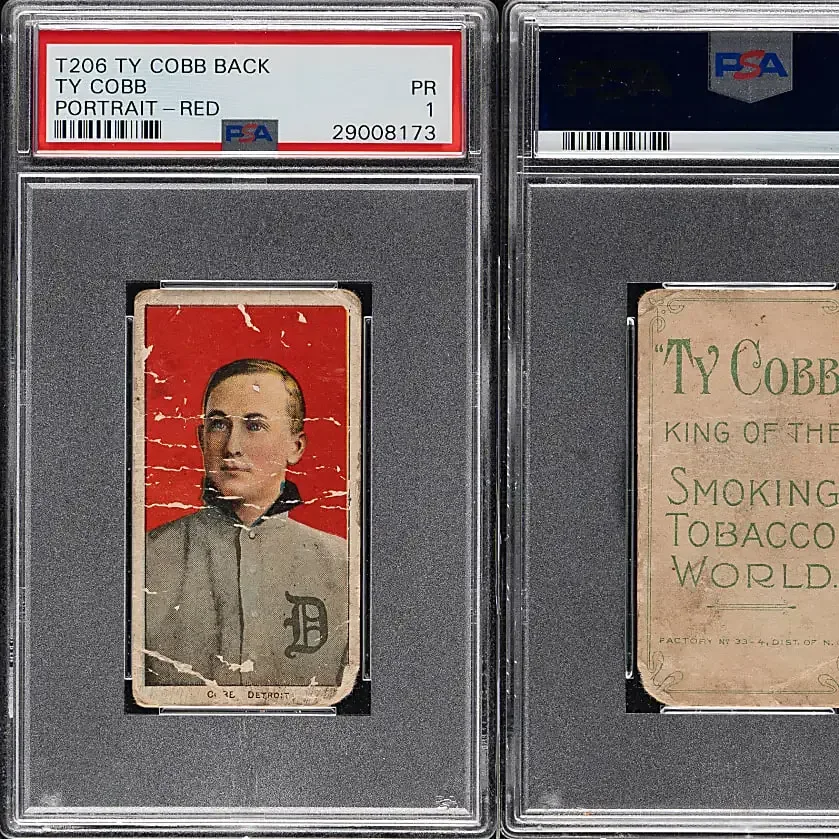
One of baseball card collecting’s oldest lessons got another emphatic auction-room replay: historical significance can outweigh condition by a very wide margin. A 1909-11 T206 White Border Ty Cobb card with a red background and a Ty Cobb back sold for $153,750 in an October auction that featured more than 6,000 lots.
The result is especially notable because the card carried a PSA POOR 1 grade. In modern card shorthand, a numerical grade of 1 represents the bottom end of a major third-party grading scale, signaling substantial condition issues. It is not a designation collectors normally associate with marquee prices. But vintage cards are not valued only through surface gloss, corner sharpness and centering. The issue, the player, the particular variation and the card’s survival all matter—and, in this case, a very old Cobb card with an unusual back proved extremely desirable.
Cobb was baseball’s career hits leader with 4,189 until Pete Rose surpassed him. That stature has long made Cobb a major figure in the hobby, and the auction’s highest baseball-card result went to a card tied to one of the era’s best-known issues.
Why the Cobb result stands out
The T206 designation refers to a White Border card issue produced from 1909 through 1911. Within that issue, collectors encounter different player poses, background colors and advertising backs. The auction-leading Cobb was a red-background example with a Ty Cobb back. Those details are not incidental catalog language; they identify the precise version that bidders were pursuing.
For more context, explore DGA Women’s Steering Committee Reveals 2026–27 SQUAD Mentor and Mentee Class.
That specificity explains why a low-grade card should not be read as a low-value card. Condition is a central part of valuation, but it is one input among several. For an early 20th-century card, the combination of a famous subject and a distinctly identified variation can create demand that is not remotely comparable with a later, more plentiful card in similarly worn shape.
The sale is also a useful reminder that grading describes condition, not the full collecting case for an item. A grader’s number helps buyers communicate about physical state without having the card in hand. It does not erase rarity, player importance, issue history or variation. Collectors weighing vintage purchases should therefore read the full card description—year range, issue, front design, back and grading company—not simply compare the number on the holder.
More Cobb cards placed near the top
The red-background T206 was not the only Cobb card to draw strong bidding. A 1909-11 T206 White Border Ty Cobb Portrait Green Background, graded PSA VG-EX+ 4.5, sold for $34,440. Meanwhile, a 1910-11 M116 Sporting Life Ty Cobb Blue Background, graded SGC EX+ 5.5, brought $33,210, an auction record for that grade.
Related coverage includes Ty Cobb Cards Lead Strong Results in REA October Auction.
The three results illustrate a point that can be easy to lose in a headline built around one six-figure card: Cobb collecting is not a single-market category. Different issues and visual variants can command their own attention, while third-party grades provide a condition framework for each individual copy. A “record for the grade” is more narrowly defined than a record for the card overall. It means the sale set a high-water mark among examples carrying that stated numerical assessment, not necessarily among every known example of the issue.
That distinction is worth making because auction records can sound broader than they are. The M116 result is still meaningful: buyers established a new benchmark for an SGC EX+ 5.5 copy. Yet its relevance is most direct when collectors compare cards with the same issue, subject, grader and grade level.
Ted Williams cards supplied several major results
Cobb may have supplied the auction’s headliner, but Ted Williams appeared repeatedly among the leading sales. A 1954 Topps #1 Ted Williams graded PSA 8.5 sold for $41,820. A 1954 Wilson Franks Ted Williams, graded SGC VG 3, realized $34,440. And a 1940 R335 Play Ball #27 Ted Williams, graded PSA 8, sold for $15,375.
Together, those figures demonstrate how a player’s collectibility can extend across sharply different card releases and condition levels. The 1954 Topps card was the strongest Williams result among those listed, but the Wilson Franks card is a vivid example of why set and type matter. Its $34,440 result came on a VG 3 grade, substantially below the PSA 8.5 attached to the Topps card. The numbers are not a contradiction; they underscore that a grade is meaningful only in context.
The Williams sales also show why collectors should avoid turning broad auction activity into a simplistic rule such as “higher grade always sells for more.” Grade matters enormously when like is compared with like. Across different releases, however, the card itself changes the equation. Age, production context, design, scarcity and the specific collector base for an issue can each alter the outcome.
Rookie and highest-graded examples add their own premium logic
Other highlights included a 1960 Topps #148 Carl Yastrzemski Rookie in PSA 9, which sold for $35,670. Rookie cards often receive special collector attention because they represent a player’s earliest major card appearance within a given card tradition. Here, the sale pairs that rookie status with a high numerical grade.
A 1961 Topps #415 Hank Aaron graded PSA 9 brought $28,290. The example was identified as the highest graded copy of the card, and the sale established a record. “Highest graded” carries a distinct meaning from an ordinary grade label: it places a card at the top of the known grading population described for that issue. That can make even a card from a familiar vintage set a singular collecting proposition.
For buyers, the practical takeaway is not that every high-grade or highest-graded card will behave the same way. It is that labels such as “rookie,” “record for the grade” and “highest graded” refer to different kinds of appeal. A rookie designation speaks to the card’s place in a player’s collecting story. A record for the grade is a transaction benchmark for a specific condition tier. Highest graded points to population standing. Each can influence bidding, but none replaces the need to identify the exact card and exact grading context.
How to read a sale like this without overgeneralizing
Large auctions can offer useful snapshots of collector demand, particularly when their top results span prewar cards, mid-century issues, rookies and condition rarities. This October event was among the auction house’s largest, with more than 6,000 lots, and its headline results show deep interest in historically prominent baseball names and carefully identified card variations.
Still, individual hammer totals should be handled as specific results, not universal price guides. The T206 Cobb sale was for a red-background, Ty Cobb-back example graded PSA POOR 1. The other T206 Cobb was a green-background portrait at PSA VG-EX+ 4.5. Their prices tell us something concrete about those copies and their bidding environments, but they should not be treated as automatic values for every Cobb card, every T206 card or every card with the same grade.
That is particularly true for vintage collecting, where details that appear small to newcomers can be decisive. “Back” can identify a different variation. A half-point grade can separate condition tiers. The identity of the grading company is part of how a card is described in the market. And record language must be read with its qualifier attached.
The auction’s results ultimately make the clearest case for careful specificity. Cobb’s $153,750 card was visibly compromised enough to receive a grade of 1, yet it was still the sale’s biggest baseball-card result because it was a historically resonant T206 variation. At the same event, stronger-condition cards by Williams, Yastrzemski and Aaron generated substantial totals for different reasons. In collecting, the label tells part of the story. The card’s exact identity tells the rest.
“Collectors turned out for this big event and prices were strong throughout, including countless new all-time highs set on a wide variety of items,” auction house president Brian Dwyer said.