Topps Fire occupied an unusual lane in modern baseball cards: a comparatively accessible hobby product with loud, stylized designs, autographs, and a price point that once sat below $100 per hobby box. Its final release came in 2022 after product-line changes under Fanatics’ ownership of Topps. Yet the brand’s best cards have aged into a far more serious market than that mid-level positioning might suggest.
The five biggest documented Topps Fire baseball sales are concentrated almost entirely around two modern stars: Shohei Ohtani and Aaron Judge. That concentration is not a verdict on every card in the set, nor does it turn every Fire parallel into a premium collectible. It does, however, show how quickly the ceiling changes when several desirable traits overlap: a rookie-year issue, an autograph, memorabilia, severe scarcity, and strong third-party grading.
Four of the five sales below belong to Ohtani. The exception is a one-of-one Aaron Judge rookie autograph. Together, they offer a clear snapshot of where Topps Fire’s highest-end appeal resides—and why collectors should separate eye-catching design from the details that actually underpin a specific card’s market position.
The five biggest Topps Fire sales
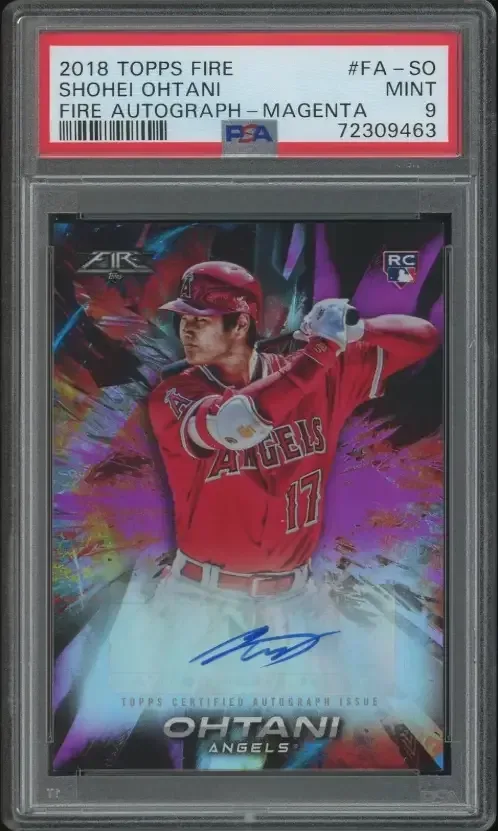
5. 2018 Shohei Ohtani Magenta Autograph /25, PSA 9 — $14,500
The fifth-largest sale is a 2018 Shohei Ohtani rookie-year Magenta autograph numbered 25/25 and graded PSA Mint 9. It sold for $14,500 on April 8, 2026 through a best-offer transaction.
The card pictures Ohtani at the plate, with the bat resting on his shoulder. Its appeal starts with the simple combination of a rookie-season issue and autograph, but the serial number is crucial. A card marked 25/25 is one of only 25 copies made in that parallel, with this example carrying the final number in the run. Card Ladder records a PSA population of four for this card and lists it at $12,490.
A parallel is a version of a card that uses a different color treatment, finish, or other variation from the standard release. Numbered parallels limit supply in a way base cards generally do not. Still, collectors should not read a population figure as the total number of cards in existence: the figure describes cards submitted to that grading company at the stated grade level or in its records, not every ungraded copy or every copy held by collectors.
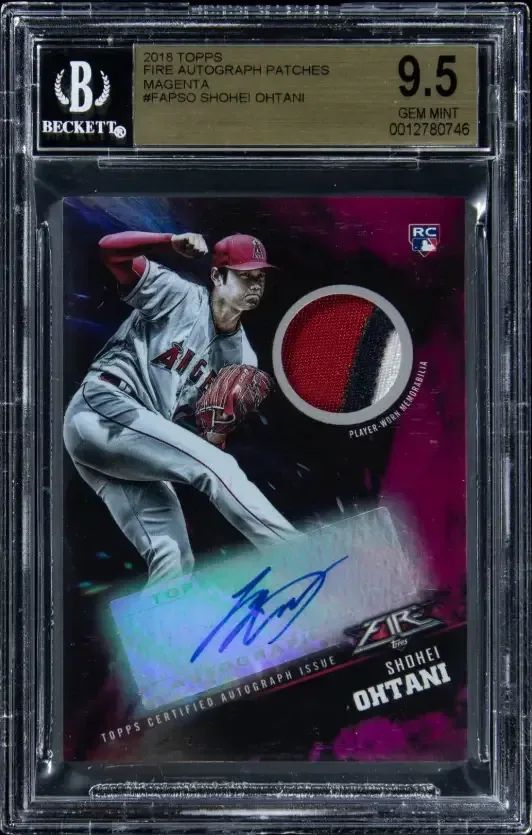
4. 2018 Shohei Ohtani Magenta Autograph Patch /10, BGS 9.5 — $14,642
Ohtani’s 2018 Magenta rookie autograph patch, numbered to 10, moved into fourth place at $14,642 on September 26, 2026. The BGS Gem Mint 9.5 card drew 22 bids in an auction.
This is the pitching-image counterpart to the preceding Ohtani entry, but it adds a player-worn, tri-color memorabilia swatch in red, black, and white. The autograph appears on a sticker placed at an angle that looks intentional within the card’s layout. Card Ladder lists the card at $14,500.
Related coverage includes Top 3 Topps Fire Baseball Card Sales Ever: Shohei Ohtani and Aaron Judge Lead the List.
The difference between an autograph card and an autograph patch card matters. The latter incorporates a clothing swatch alongside the signature, creating multiple collectible components on a single card. Here, the source material identifies the swatch as player-worn. That wording is specific: it signals that the piece was worn by the player, but it does not by itself make a claim that it was used in a particular game.
Its /10 print run is scarcer than the Magenta autograph’s /25 count, but scarcity is only one part of the equation. A high-grade /25 card can compete closely with a /10 patch autograph when buyer preferences, visual presentation, timing, and auction participation differ. The two results—$14,500 and $14,642—are a useful reminder that serial numbering does not create a fixed price ladder on its own.
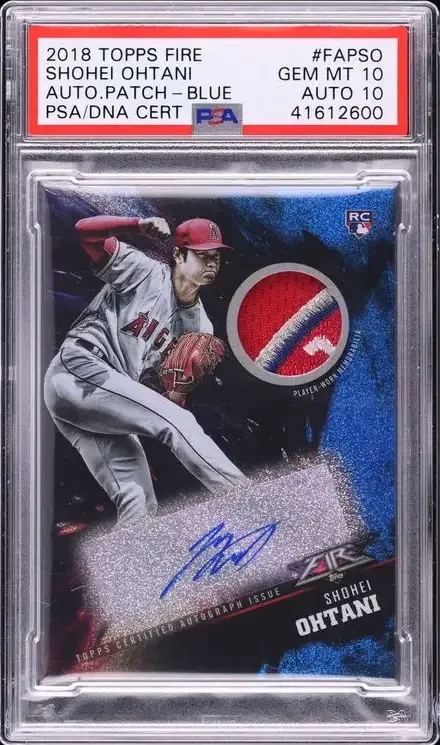
3. 2018 Shohei Ohtani Blue Autograph Patch /15, PSA 10 — $20,400
The third-largest Topps Fire result is another 2018 Ohtani rookie patch autograph, this time the Blue parallel numbered to 15. The PSA Gem Mint 10 example, with a 10 autograph grade, sold for $20,400 on March 15, 2026 after an auction that attracted 57 bids.
The card uses the same general design format as the Magenta patch autograph, but the color treatment is blue and the patch contains red, white, blue, and silver. Card Ladder’s listed value is $35,450, substantially higher than the recorded sale.
That contrast deserves careful reading. A marketplace’s listed value is an estimate or current guide figure; it is not a new completed sale and should not be treated as proof that a buyer has paid that amount. The $20,400 auction result is the documented transaction, while the $35,450 figure indicates the service’s current valuation. The gap may be meaningful to a collector tracking the card, but it is not a guaranteed return or an automatic price for another copy.
Grading is another visible differentiator. PSA 10 denotes a Gem Mint card grade, while the separate autograph grade of 10 addresses the signature itself. In principle, card condition and autograph quality are different assessments: centering, corners, edges, surface, and other physical factors concern the card, while the autograph grade concerns the signature. For a scarce rookie patch autograph, having top grades on both can materially strengthen the card’s presentation to prospective buyers.
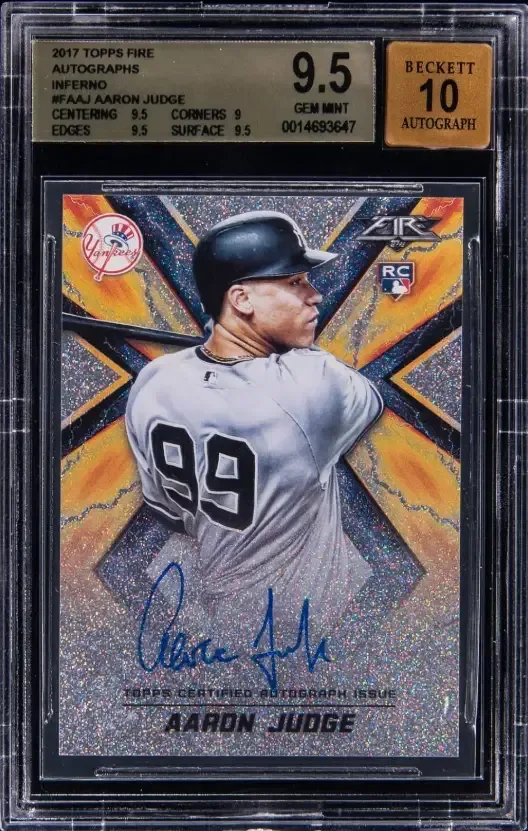
2. 2017 Aaron Judge Inferno 1-of-1 Autograph Rookie, BGS 9.5 — $47,580
Aaron Judge supplies the only non-Ohtani entry—and nearly reaches the top spot. His 2017 Topps Fire Inferno rookie autograph, a one-of-one graded BGS Gem Mint 9.5 with a 10 autograph grade, sold for $47,580 on May 9, 2026. The auction received 22 bids. Card Ladder lists it at $37,960.
Topps Fire used Inferno for its one-of-one treatment. This Judge card has the speckled, mini-diamond-like finish associated with that designation and a blue-ink signature. A one-of-one is exactly what the name suggests: a card with a stated production run of one in that particular version. It is the most direct scarcity designation in the product, although it does not mean that no other Judge autographs, rookie cards, or one-of-one cards exist elsewhere in the broader hobby.
That distinction is practical. Collectors often talk about “the” one-of-one, but the wording is only fully precise when tied to the specific set, year, insert, and parallel. This is the lone 2017 Topps Fire Inferno autograph rookie described here, not necessarily the only singular Judge collectible ever produced. The card’s value proposition is therefore layered: Judge rookie status, on-card presentation of a blue autograph, the Inferno finish, 1/1 scarcity, and a BGS 9.5/10 grade combination.
The sale also illustrates why top-end cards from a product cannot be judged solely by the original box price. A product may be designed for a broad hobby audience, but individual hits can become exceptionally scarce artifacts tied to athletes whose demand grows far beyond the release’s original market tier.
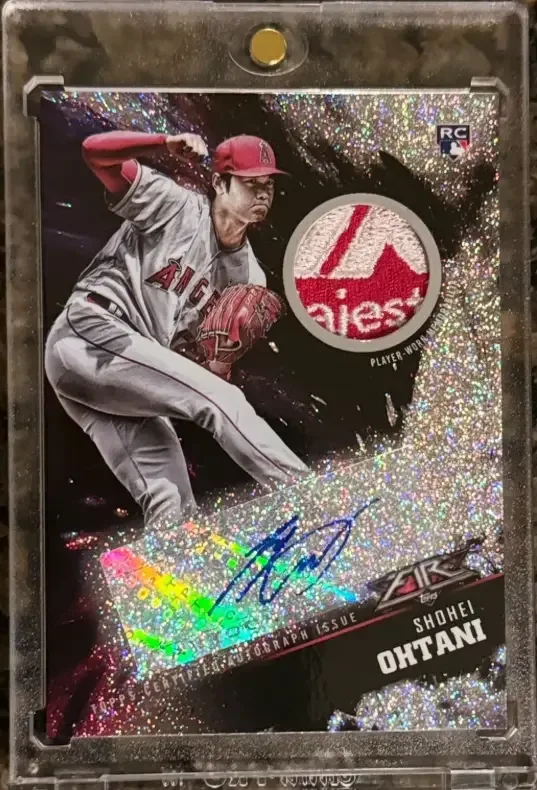
1. 2018 Shohei Ohtani Inferno 1-of-1 Rookie Autograph Patch — $60,000
The record belongs to an ungraded 2018 Shohei Ohtani Inferno rookie autograph patch, a one-of-one that sold for $60,000 on April 27, 2026. Unlike the other high-dollar examples that reached auction, this card changed hands via best offer. Card Ladder lists its ungraded value at more than $80,000.
It is a particularly potent checklist combination: Ohtani rookie-year status, the Inferno 1/1 designation, an autograph, and a patch. It also shows that encapsulation is not an absolute requirement for a major sale. Grading can provide a standardized condition opinion and protection in a holder, but an ungraded card can still command a significant price where rarity and player demand are intense.
Best-offer deals are inherently less transparent than a long public bidding sequence. The completed $60,000 price is still an important market data point, but the format reveals less about how many competing bidders may have been involved or where their maximums sat. That makes it especially important not to assume that every comparable Ohtani card would reproduce the same result.
What the list says about Topps Fire—and what it does not
The leaderboard is dominated by rookie-era Ohtani cards, with the 2017 Judge Inferno as the other major outlier. Every entry contains an autograph; three are patch autographs; and two are 1/1 Infernо cards. In other words, these are not ordinary examples from the set. They are the rarest, most feature-rich cards connected to players with enormous collector interest.
For collectors evaluating Topps Fire, the useful takeaway is specificity. Check the year and player first, then the exact card type, serial number, memorabilia designation, autograph format, grading company, grade, and whether the comparison is a completed sale or a listed estimate. A Blue /15 patch autograph and a Magenta /10 patch autograph may be closely related in design, yet condition and demand can produce different outcomes. A 1/1 may be unique, yet its market still depends on the player and on what the card actually includes.
That attention to detail also applies across collecting categories. Demand signals can be useful, but they are not interchangeable across products; for another example of how reported collector interest is discussed in a different medium, see our coverage of reported comic-shop orders for Absolute Batman #25.
Topps Fire may no longer be in production, but its high-end cards have a sharply defined market identity. The results are led by Ohtani, supported by Judge, and powered by the attributes collectors consistently pursue at the top of a modern sports-card checklist: rookie significance, signatures, memorabilia, condition, and truly limited supply.