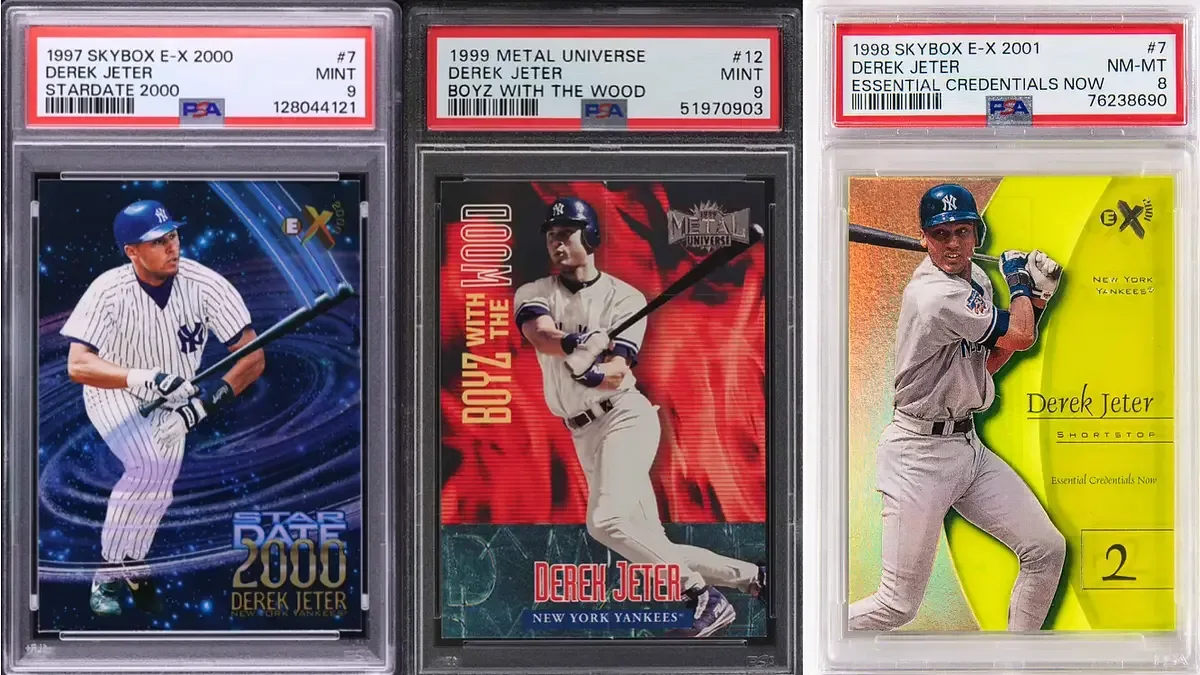
Derek Jeter is hardly an under-the-radar name in baseball cards. He was a Yankee for his entire 20-year major-league career, the club’s captain, a five-time champion and a player whose late-game and postseason moments remain central to his appeal. Yet the available market data presents an intriguing contrast: while several marquee stars of the 1990s have climbed sharply over the past year, Jeter’s player index has moved only modestly.
Ken Griffey Jr.’s index is up 127%, Frank Thomas is up 108%, Mark McGwire is up 60.8%, and Barry Bonds is up 60.3%. Jeter’s index is up 7% over that same period. That gap does not prove that every Jeter card is undervalued, nor does it promise future returns. It does, however, give collectors a useful reason to look beyond the familiar 1993 rookie-card conversation and into later issues, inserts, parallels and image-driven cards.
For broader hobby coverage beyond baseball, readers can also explore recent trading-card news on the site.
Why Jeter’s place in the market is complicated
Jeter’s profile is different from the power-first legends against whom he is often measured. He never won a regular-season MVP award, and he did not produce the towering home-run totals associated with Bonds, Griffey, McGwire or Thomas. That has given skeptics a simple argument: Jeter was an excellent player with a historic team context, but lacked the kind of single-season offensive peak that often fuels card-market mythology.
The other side of that argument is longevity and consistency. For more than a decade, Jeter could be expected to play around 150 games while producing a batting average near .310, an on-base percentage near .380, roughly 30 doubles, 15 to 20 home runs, more than 20 steals and 100 runs. Those are not the stats of a one-dimensional compiler; they describe a remarkably dependable top-of-the-lineup presence.
He also had seasons that were plainly elite. In 1999, Jeter hit .349, reached base at a .438 clip, hit 24 home runs, collected 219 hits and scored 134 runs. In 2006, at age 32, he hit .343 with a .417 on-base percentage and 214 hits, finishing second in American League MVP voting. He was World Series MVP in 2000. That blend of sustained production, New York visibility and October success is difficult to reproduce on a checklist.
Market attention is not a pure ranking of on-field value, of course. Over the past 18 months, hobby interest has notably returned to some of the era’s enormous power hitters, including Bonds and McGwire, whose legacies have been complicated by steroid-era questions and whose Hall of Fame cases remain unresolved. Jeter’s reputation has never depended on that kind of controversy, but the attention paid to the biggest power numbers may have left some of his cards comparatively overlooked.
Collectors should still separate relative attention from a prediction. A 7% index increase does not make Jeter cards cheap, and a fast-rising peer does not create an obligation for Jeter to follow. His top end already demonstrates substantial demand: a 1998 SkyBox E-X2001 Essential Credentials Now #7 numbered to seven copies sold for $500,200 in PSA 10 in February 2026. A one-of-one 2021 Topps Tier One game-used bat barrel card sold for $5,001 in May 2025. The case for the five cards below is not that Jeter has no established market. It is that particular cards may offer a more accessible intersection of story, design, scarcity and condition.
Related coverage includes Five Derek Jeter Cards With Room to Gain Attention.
A quick guide to the card terms that matter here
PSA 9 and PSA 10 refer to grades assigned by Professional Sports Authenticator. A grade is an assessment of a card’s condition, and the difference between a 9 and a 10 can be enormous in a market where high-grade examples are scarce. BGS 9.5 is a Beckett grade and appears in the market history of Jeter’s early cards as well.
A population, often shortened to “pop,” is the number of copies submitted and graded by a particular company at a particular grade or across all grades. It is helpful evidence, but it is not a print run. A low PSA population can indicate a difficult card to preserve, limited grading interest, or both. It does not establish how many copies were printed or survive ungraded.
An insert is a card placed less frequently than the standard base cards in packs. A Refractor is a parallel with a distinctive reflective finish. An SP generally means short print, a version produced in lower quantity than its more common counterpart. These distinctions matter because collectors do not only pay for the player: they also pay for visual identity, brand history, print scarcity and the difficulty of finding clean copies.
1. 1996 Topps Chrome #80 Future Stars, PSA 9
Recent sale: $250 on September 2, 2026.
The 1996 Topps Chrome #80 Future Stars is arguably the clearest entry point on this list because it joins two enduring pieces of the hobby: Jeter’s first major-league season and Topps Chrome’s baseball debut. The 1996 Chrome set adapted cards from the regular 1996 Topps release into a chromium-style format. For collectors who place special value on a brand’s inaugural year, that alone gives the card extra context.
The card is also generally treated as a rookie card because 1996 was Jeter’s first season in the majors, a year in which he won Rookie of the Year and a World Series championship. It is not his only early card—1993 produced numerous Jeter rookie issues, with the SP Foil among the most iconic—but the 1996 Chrome offers a different kind of significance: an early-career Jeter on a foundational modern brand.
The Refractor version already occupies a much more expensive tier, which is the central appeal of the standard PSA 9. It gives collectors the same player image, set and debut-year Chrome association without requiring Refractor money. That does not mean a base Chrome should trade like a Refractor; rarity and parallel status still matter. It does mean the standard card has a coherent collecting story rather than being merely a cheaper substitute.
A recent $5,000 sale for a 1996 Topps Chrome Kobe Bryant PSA 9 demonstrates how iconic base cards from a first-year Chrome release can become major hobby pieces. Jeter and Bryant occupy different collecting markets, so it is not a price target or a direct comparison. The useful takeaway is narrower: landmark base cards can carry significant long-term collector interest when player legacy and brand identity align.
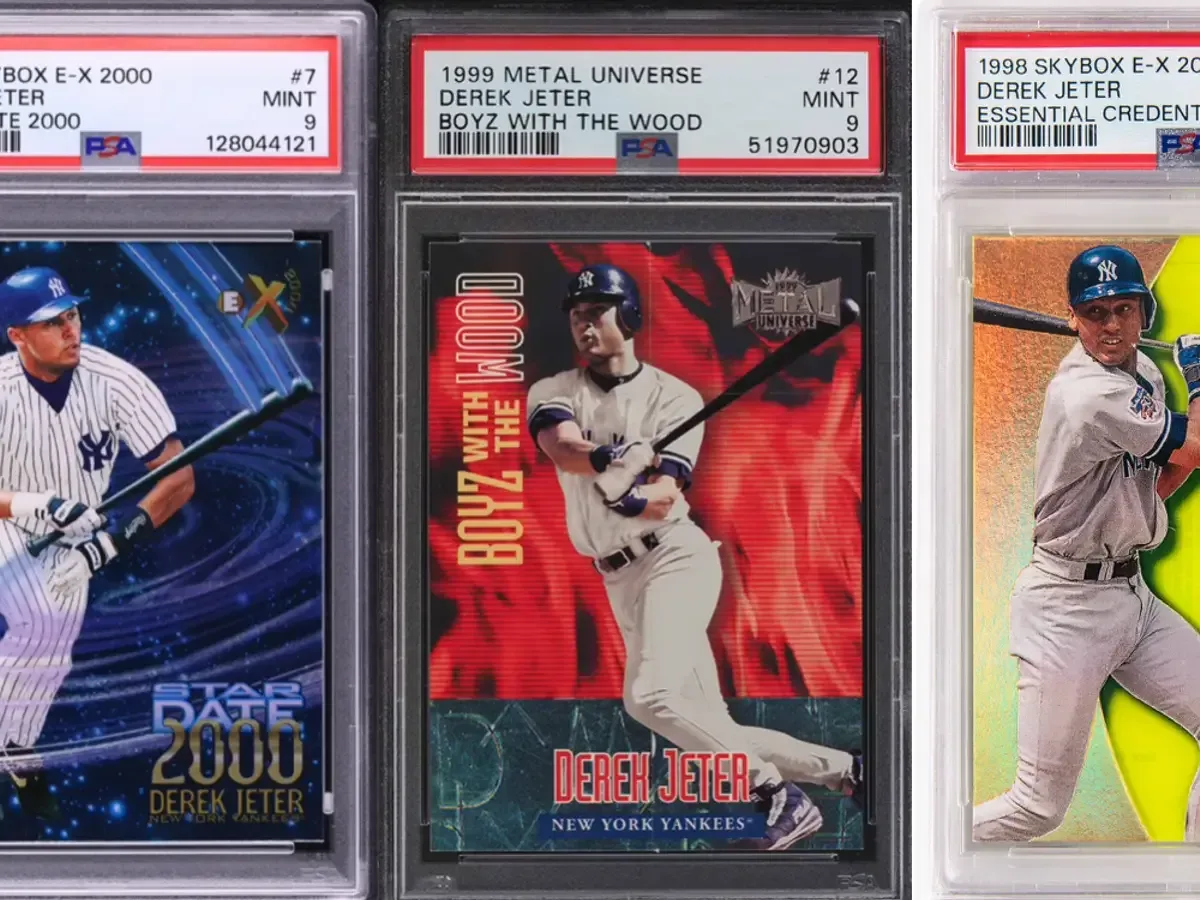
2. 1997 SkyBox E-X2000 #7 Star Date 2000, PSA 9
Recent sales: $200 on August 24, 2026, and $125 on August 14, 2026.
Star Date 2000 is a 15-card insert set built around young stars and inserted at approximately one per nine packs. Its appeal is unmistakably of its period: a futuristic late-1990s presentation that looks unlike a conventional base card. That kind of stylized visual language is increasingly meaningful as collectors revisit the era’s bolder inserts.
Only 40 copies of this Jeter have been submitted to PSA, including six PSA 10s and 19 PSA 9s. Again, those figures should be read carefully. They show a limited PSA submission record, not an exact supply count. Still, a PSA 9 collector is working within a relatively small graded population while buying an early-career Jeter from a recognizable 1990s insert concept.
This is the card for someone who values the design language of the decade as much as conventional rookie-card status. There are scarcer Jeter inserts from the late 1990s, but many already command thousands of dollars. Star Date 2000 presents a more moderate recent price range while retaining an insert ratio, a small set size and an unusually distinctive look.
One market reference is a 1997 SkyBox E-X2000 Ken Griffey Jr. #40 base card in PSA 9 that recently sold for $1,025. That is not a like-for-like comparison: Griffey’s market, card type and demand dynamics differ. But it reinforces that the E-X2000 name and its design remain meaningful to collectors of the period.
3. 1999 Metal Universe #12BW Boyz With the Wood, PSA 9
Recent sale: $69 on August 18, 2026.
The Boyz With the Wood insert has an unusual premise even by 1990s standards. The 15-card set encouraged collectors to fold the card so its appearance changed, making it a tactile novelty rather than simply another shiny parallel. It was inserted at approximately one per 18 packs.
That folding mechanic is important to its appeal and its risk. A card designed to be manipulated can produce condition questions, which makes the grade especially relevant. Only 24 Jeter copies have been graded by PSA, with one PSA 10 and six PSA 9s. For a collector who specifically wants a PSA 9, that is a notably limited number within the PSA population.
The $69 recent sale is especially interesting beside another Jeter Metal Universe insert. A 1998 Metal Universe All-Galactic Team #9-AGT PSA 9, described as having a similar population count, sold for $500 in August. The cards are not interchangeable: design, issue, demand and scarcity perceptions can all create different values. But the difference illustrates why collectors may revisit a lesser-known Metal Universe card that has distinctive aesthetics and limited high-grade availability.
This is likely the most specialized choice in the group. Its upside case depends on collectors continuing to pursue quirky, colorful 1990s inserts—not on broad recognition from casual Jeter buyers. That makes it a card where understanding the design and inspecting the specific graded example are especially important.
4. 2007 Topps #40, PSA 9
Recent sales: $69 on September 5, 2026, and $99 on August 29, 2026.
Some cards become collecting objects because of a spectacular action photo. Others earn their reputation because the background gives collectors a double take. The standard 2007 Topps #40 shows Jeter with Mickey Mantle in the Yankees dugout and President George W. Bush in the stands, both digitally added to the image. An SP version exists without Mantle and Bush, making the digitally altered version the recognizable novelty.
That may sound like a gimmick, but hobby history repeatedly shows that a strange, memorable premise can give an otherwise ordinary issue staying power. The 1990 Hoops Mark Jackson #205 is a prominent example of a card discussed because of the people in the background rather than the featured NBA player. A PSA 9 of that Jackson card recently sold for $65, around the same range as the Jeter, despite the Jackson having more than five times as many PSA-graded copies.
The comparison is not an argument that the Jeter must rise. It identifies the actual appeal: this is a conversation card. It combines a Hall of Fame Yankee icon, a U.S. president, a defining Yankees player and a deliberately altered photo. Collectors interested in oddball Topps concepts may value that combination independently of traditional scarcity metrics.
5. 2015 Topps Chrome #1 Refractor, PSA 9
Recent sales: $51 on September 8, 2026, and $49 on September 4, 2026.
Released after Jeter’s final season, the 2015 Topps Chrome #1 Refractor succeeds on photography rather than rookie-card chronology. Its image captures Jeter celebrating during his final game at Yankee Stadium, after a walk-off single in his last Yankee Stadium at-bat. He is pictured jumping with an arm raised, preserving a moment that has obvious emotional weight for Yankees collectors.
The Refractor finish gives the image a familiar Chrome-style visual hook, while the population offers a measure of graded scarcity: 272 copies have been graded by PSA. That is far larger than the populations for the late-1990s inserts above, but it is not an unlimited supply of PSA-graded examples either. More importantly, it is a card built around a major career moment rather than a generic post-career checklist appearance.
A Barry Bonds 1999 Topps Chrome Refractor #395 PSA 9 recently sold for $1,250. The cards differ sharply in era, player narrative and collector demand, so the sale should not be used as a valuation formula. The Jeter’s appeal is the specific final-Yankee-Stadium image, and that kind of image can make a modern card more enduring than its surface-level rarity would suggest.
How to approach these cards without treating them as guarantees
The common thread across these five cards is not identical scarcity. It is recognizable collecting logic: a first-year Chrome card, a late-1990s futuristic insert, a condition-sensitive novelty, a famous background gimmick and an image from a defining farewell moment. Each gives a collector a reason to care that goes beyond a generic expectation that all Jeter cards should increase.
For buyers, the practical approach is to identify which reason matters most. If brand history is the priority, the 1996 Topps Chrome Future Stars makes the strongest case. If 1990s insert aesthetics are the point, Star Date 2000 and Boyz With the Wood are the more natural fits. If a card needs to work as a story piece in a display, the 2007 Topps #40 and 2015 Topps Chrome Refractor have the clearest narratives.
Recent sales are snapshots, not appraisals. A $125 sale followed by a $200 sale, or a $49 sale alongside a $51 sale, shows where specific examples traded on specific dates; it does not define a permanent floor or ceiling. Grading-company populations also deserve context, as they reflect submitted cards rather than total production. Collectors should compare the exact issue, parallel, grade and card condition before drawing conclusions from a headline number.
Jeter’s market may continue to lag his 1990s peers, catch up, or move in its own direction. What is already clear is that his card catalog contains more than the famous early rookies and ultra-high-end serial-numbered inserts. For collectors willing to prioritize design, narrative and the realities of graded supply, these five issues offer distinct ways to collect one of baseball’s most enduring modern figures.