Baseball-card collectors have spent decades proving that power travels farther than precision. A thunderous home-run hitter can turn cardboard into a bidding war, while an all-time pitcher often gets priced like the responsible adult who showed up to stop the party. Greg Maddux, who won four consecutive Cy Young Awards through command, movement and forensic-level preparation rather than intimidating velocity, has long lived in that peculiar gap.
That gap may be narrowing. The Greg Maddux Card Ladder index has climbed 48% over the past year, and a cluster of key cards has logged notably higher sales in 2026 than in 2025. The movement is most visible in the parts of the hobby collectors already prize: pioneering refractors, scarcer 1990s inserts, gold parallels and the unusual 1991 Topps Desert Shield issue.
Maddux’s on-field case does not require an elaborate tutorial. During his four straight Cy Young seasons, he went 75-29 with a 1.98 ERA. In 1993 alone, he won the Cy Young Award while leading MLB with a 2.36 ERA and 237 innings. His 1998 season brought a 2.22 ERA over 251 innings, at a moment when baseball’s offensive environment made quality pitching look like a survival-horror mode.
Yet the market has usually assigned pitchers a different difficulty setting. Position players with iconic power numbers frequently command the spotlight, while a player nicknamed The Professor is left explaining the math. That has made Maddux an intriguing name for collectors looking at Hall of Fame achievement alongside sales history rather than simply chasing the loudest highlights.
Even the ceiling offers perspective. A 2008 Topps Chrome Greg Maddux Superfractor 1/1 sold for $10,200 in June 2026, the only Maddux card reported to have crossed $10,000. A 1998 Metal Universe Precious Metal Gems Maddux numbered to 50 sold for $7,016 in 2024. Both are serious prices, but they remain modest relative to many landmark cards of star hitters and certain elite athletes in other sports. Vintage-era context matters when comparing players such as Sandy Koufax, whose cards come from a far scarcer collecting landscape, but Maddux’s market still looks restrained relative to his résumé.
That does not mean every Maddux card is suddenly a guaranteed moonshot. Individual sale prices vary with grade, centering, eye appeal, auction timing and the number of determined bidders who happen to be awake. It does mean that five specific cards have supplied clear evidence of renewed attention.
5. 1993 Finest #85 Refractor, PSA 9
The 1993 Finest Refractor is a foundational modern parallel, not merely a shiny card that looks as if it has absorbed a small piece of a laser show. Finest was the first card set to include refractors, giving this Maddux an importance beyond its player checklist position. Refractors have since become one of the hobby’s defining parallel formats.
A PSA 9 copy sold for $2,113 on June 28, 2026, followed by a $1,999 sale on July 14. Those figures compare with $1,408 on February 4, 2025, and $1,220 on June 26, 2025, a 64% increase in the tracked comparison.
Related coverage includes Greg Maddux Card Market Is Heating Up as Five Key Cards Post Big 2026 Gains.
Population details help explain why grade is central here. PSA has graded 257 Maddux copies of the card, including only 30 PSA 10s. For collectors, it is an elegant collision of player, era and hobby history: a peak-season Maddux card from 1993 in the original refractor format. The refractor boom did not begin in a vacuum; it began with cards much like this one.
4. 1998 Finest The Man #TM20, numbered to 500
Serial numbering is routine in 2026, but numbering a card to 500 was a much bigger deal in 1998. The Finest The Man insert gives collectors a finite print run, a Hall of Fame subject and an unmistakably late-1990s premium-card personality. It also presents one of the hobby’s evergreen arguments: whether to leave the card’s protective coating in place.
The coating literally instructed owners to peel it, yet unpeeled examples often command more. Plenty of collectors prefer the visual presentation after peeling. Neither camp has solved the dispute, which is probably for the best; a hobby without mildly absurd arguments over plastic film would be far too orderly.
A copy sold for $175 on August 27, 2026. Earlier reported sales include $84 on June 9, 2025, and $45 on May 7, 2025, equating to a 108% gain in the comparison. Maddux’s 1998 performance offers an appropriate historical backdrop: his 2.22 ERA in 251 innings came amid baseball’s famous home-run explosion. This insert rewards collectors who appreciate that suppressing offense can be every bit as dramatic as creating it.
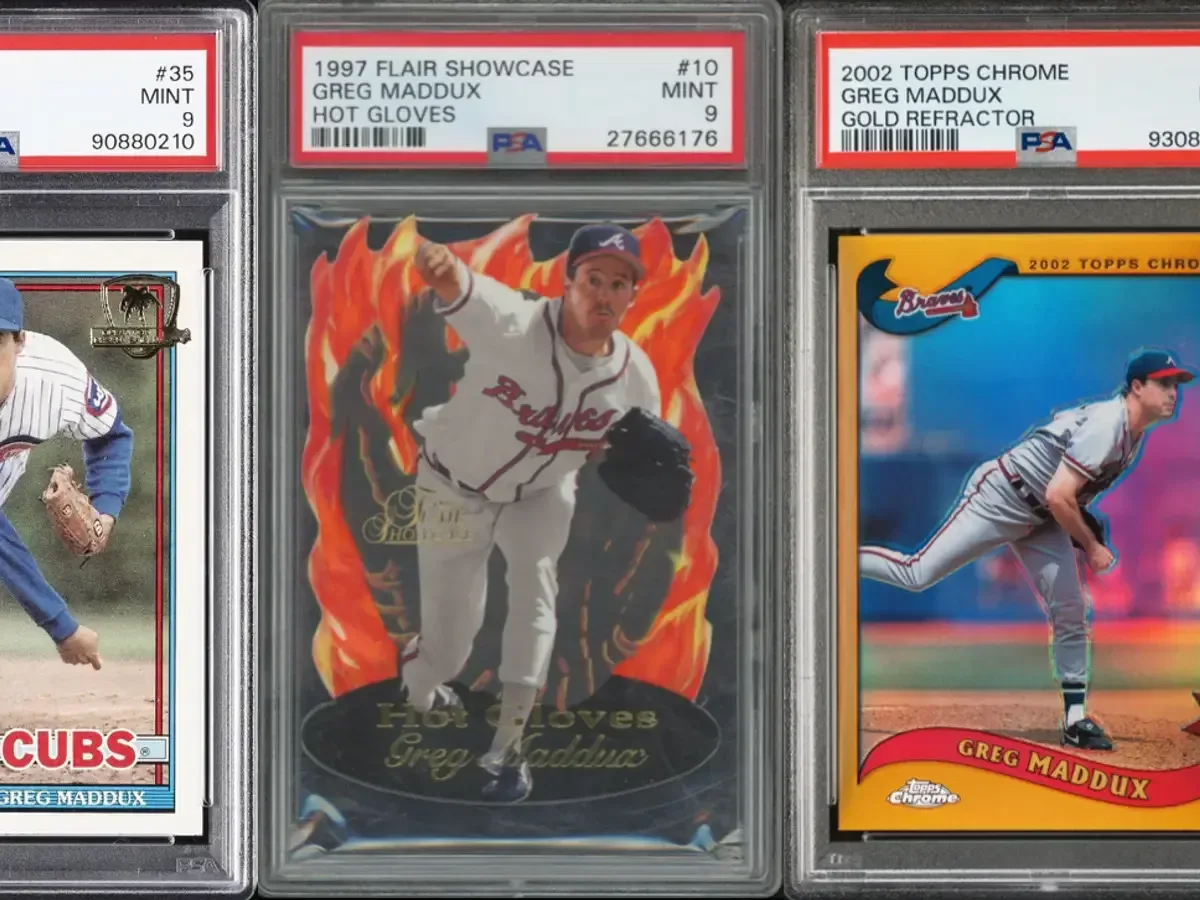
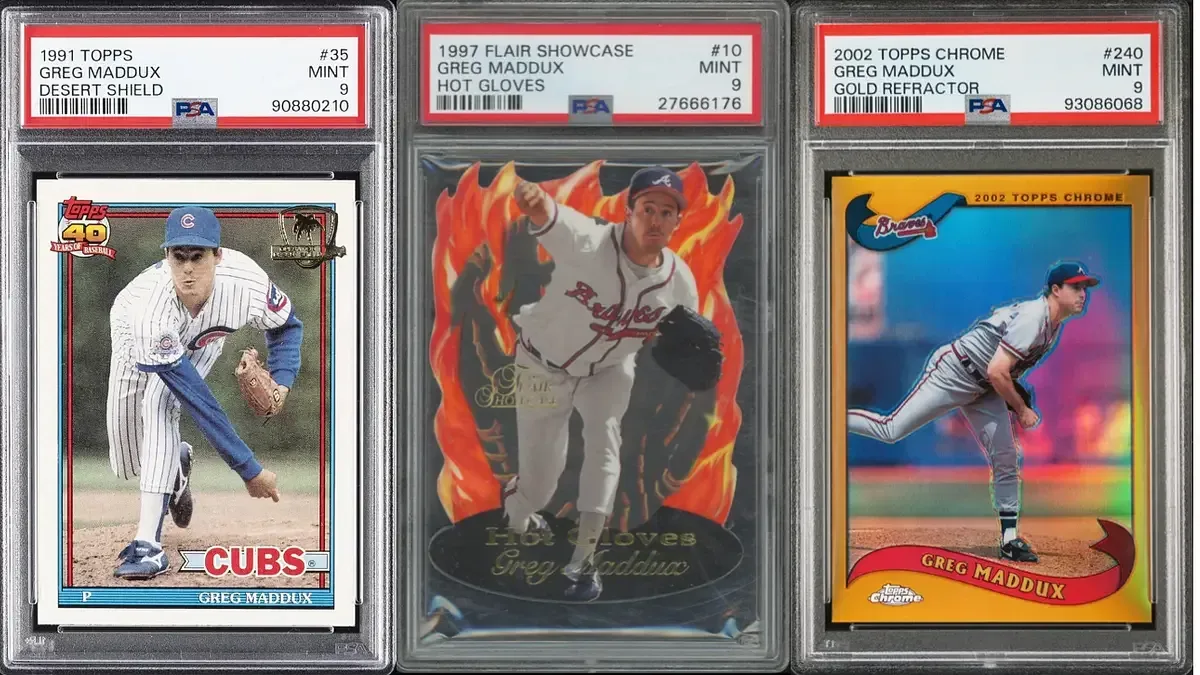
3. 2002 Topps Chrome #240 Gold Refractor, PSA 9
Gold Refractors occupy a special place in parallel collecting. The color has become an instantly recognizable shorthand for a premium version, and Topps Chrome brought the reflective identity of refractors into the early 2000s. Maddux’s 2002 Topps Chrome Gold Refractor may not be a rookie card or a 1990s pack-pulled oddity, but it joins a format and color combination that collectors routinely seek across sports.
The PSA 9 market has moved quickly. Sales reached $200 on May 3, 2026, then $225 on September 2. That follows sales of $81 on April 30, 2025, and $63.56 on November 5, 2024. The cited price increase is 178%.
PSA has graded only 20 examples, with a single PSA 10 recorded. Low graded population does not automatically establish a card’s exact surviving print run, and it should not be treated as a complete census. Still, it adds context to why high-grade copies can attract attention: collectors chasing gold shine have relatively few graded options to pursue.
2. 1991 Topps Desert Shield #35, PSA 9
The standard 1991 Topps issue is a classic product of the Junk Wax Era, an age when printing presses appeared to have been granted unlimited stamina. Desert Shield is the dramatic exception. These cards were distributed to American troops serving in the Middle East and can be identified by the gold Desert Shield emblem on the front.
Production is estimated at roughly 6,500 copies, a radically different proposition from the millions associated with the standard release. The result is one of the era’s most important scarce variations, and it gives Maddux collectors a card that connects to a distinctive chapter of hobby and military-distribution history.
A PSA 9 sold for $412 on June 15, 2026, with another at $400 on July 19. Comparable sales were $145 on May 28, 2025, and $140 on June 1, 2025, for a stated 186% increase. PSA has graded 537 copies, including 29 PSA 10s. Condition is especially consequential because the gold logo, dark borders and familiar early-1990s stock leave little room for a card to hide a rough trip through a childhood shoebox.
Collectors interested in the way an unusual issue can rewrite the value story of a mass-produced era may also want to see how format quirks can drive attention elsewhere in baseball cardboard. Brooks Robinson’s 1961 Topps Dice Game card is another reminder that scarcity and an unexpected place in a set can matter enormously.
1. 1998 Metal Universe All-Galactic Team #12-AGT
The biggest percentage mover in this group is also the most gloriously 1990s object of the bunch. Metal Universe designs leaned hard into the future, with work connected to actual Marvel comic-book artists and visuals that seem determined to make a standard baseball field look insufficiently interstellar. The All-Galactic Team insert turns Maddux into exactly the kind of cosmic figure a 1998 pack-opening session demanded.
It was also exceptionally hard to pull, appearing at a rate of one per 3,456 packs. That is the sort of odds sheet that makes a collector carefully lower the pack, stare into the middle distance and reconsider every prior financial decision.
Recent sales were $70 on August 11, 2026, and $63 on August 20. That is a substantial shift from $15 on August 28, 2025, and $17.25 on November 25, 2025, yielding a 265% increase in the cited tracking. Only three copies have been graded by PSA, another data point that underscores how infrequently the card surfaces in encapsulated form.
For Maddux collectors, the All-Galactic Team is not only the hottest of these five cards by percentage gain. It is an emblem of why the broader market has taken notice: iconic 1990s design, extreme pack odds, a revered player and a visual style with absolutely no interest in behaving normally.
What the movement says about the Maddux market
These five cards span several collecting instincts. The 1993 Finest Refractor appeals to origin-story collectors. The Finest The Man and Metal Universe inserts satisfy the appetite for scarce, unmistakably 1990s pack pulls. Desert Shield brings variation rarity and historical distribution context. Topps Chrome Gold Refractor offers a durable modern-parallel language in a tight graded population.
They also demonstrate why Maddux is not a one-card market. A collector can focus on the most recognizable refractor, the rarest inserts, a military-distributed variation or a low-population gold parallel without abandoning the same player collection. That range is useful when interest rises, because it lets buyers pursue different levels of rarity and different visual eras.
The current numbers are a snapshot, not a promise. Still, a 48% index gain alongside increases ranging from 64% to 265% across these cards makes it difficult to dismiss the shift as a single outlier sale. The Professor’s cardboard is drawing a larger class of students, and this time they appear to have done the reading.