Card collecting can become overwhelmingly numerical. Print runs, serial numbers, pack odds, grading populations and recent sale prices all serve a purpose, but they can also turn a hobby into a constant calculation. A 750-box 2026 Bowman Chrome player break centered on Los Angeles Angels infielder Denzer Guzmán offers a more modest, and arguably more durable, reason to participate: picking a player, enjoying the reveal and having somebody new to follow.
The scale was enormous. Across two player breaks held on the product’s release day, 125 cases and 750 boxes of Bowman Chrome were opened. The buyer spent roughly $144 on Guzmán’s spot. That was not a purchase built around a realistic expectation of landing the one-of-one card. It was a deliberately limited spend on a player who was not among the release’s highest-profile rookies and whose cards were not commanding the cost of the biggest prospect chases.
That distinction matters. A break can be a high-variance purchase: the result is uncertain, the cards are revealed over time and the most desirable outcome may never appear. But uncertainty is not the only thing a collector is buying. In this case, the defined player slot created a connection to every Guzmán card pulled from a truly outsized volume of product. The process offered suspense without pretending that a rare hit was guaranteed or that the return had to be financial.
What the Guzmán chase looked like
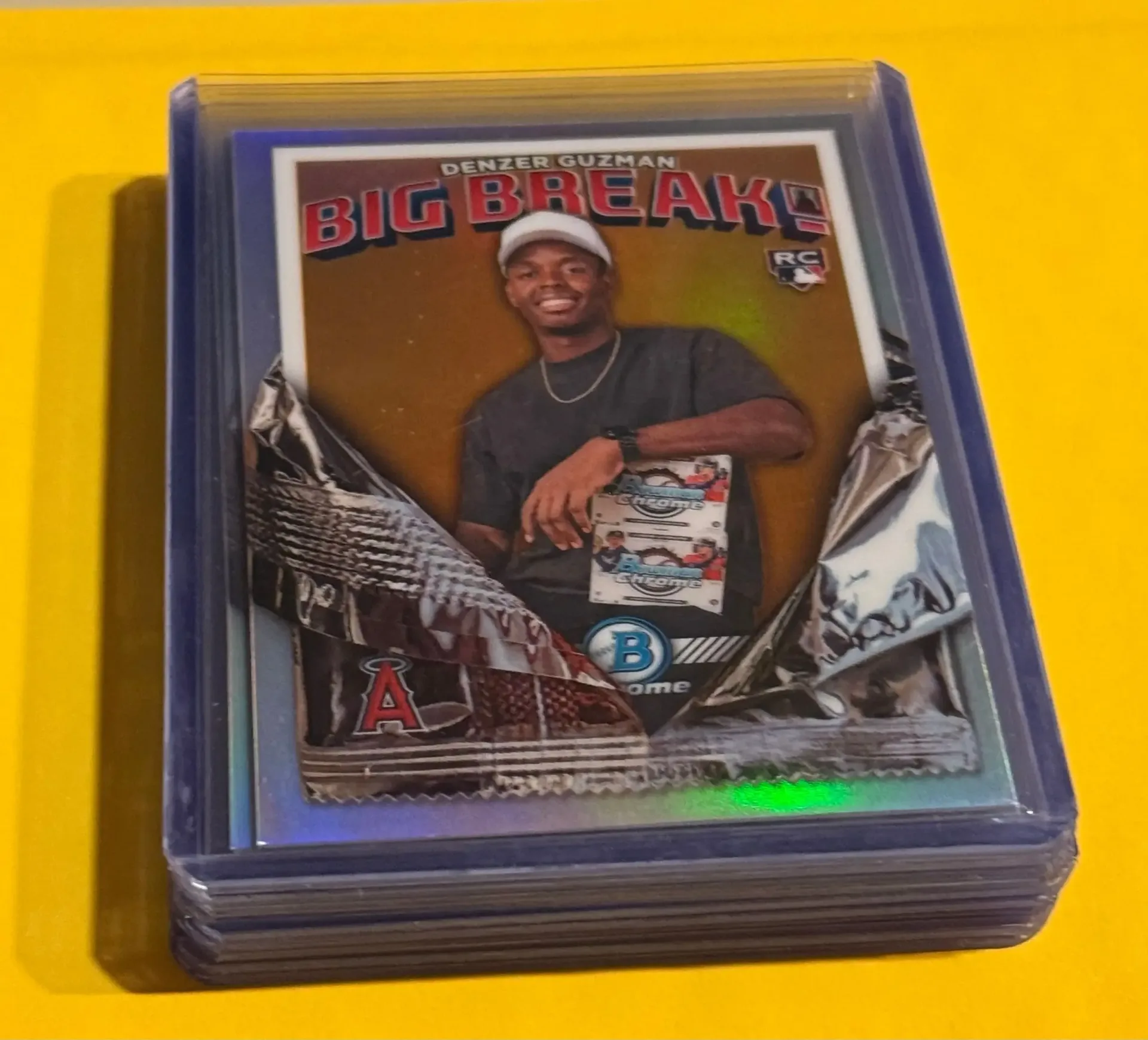
Guzmán’s focus in the product was the Big Break insert, a 25-player set of rookies and prospects depicted opening packs. It is a notably self-aware concept for a product that was being opened by the hundreds of boxes in a live break. Other players in the set include Ethan Holliday, Jac Caglianone, Leo De Vries and Jacob Misiorowski.
An insert is a card set included within a broader release rather than the core base-card checklist. In modern cards, inserts can have their own parallel structure, autograph versions and different scarcity levels. For a collector choosing a player spot, that can make one insert feel like a compact checklist-within-a-checklist: there is a standard card to accumulate, serial-numbered variants to hunt, and an occasional top-end version that is exciting precisely because it is unlikely.
For Guzmán, the Big Break card came with several parallel tiers:
- Mini-Diamonds numbered to 150
- Gold parallels numbered to 50
- Orange parallels numbered to 25
- Red parallels numbered to 5
- A one-of-one SuperFractor
A card marked /150, for example, has a stated run of 150 copies. That tells collectors the designed quantity for that parallel, not whether every copy will surface or what any given copy will sell for. The lower the printed number, the scarcer the parallel within that particular card’s run. It does not automatically make it the best card for every collector, but it makes the chase easier to understand: there are more Mini-Diamonds to find than Golds, more Golds than Oranges, and only one SuperFractor.
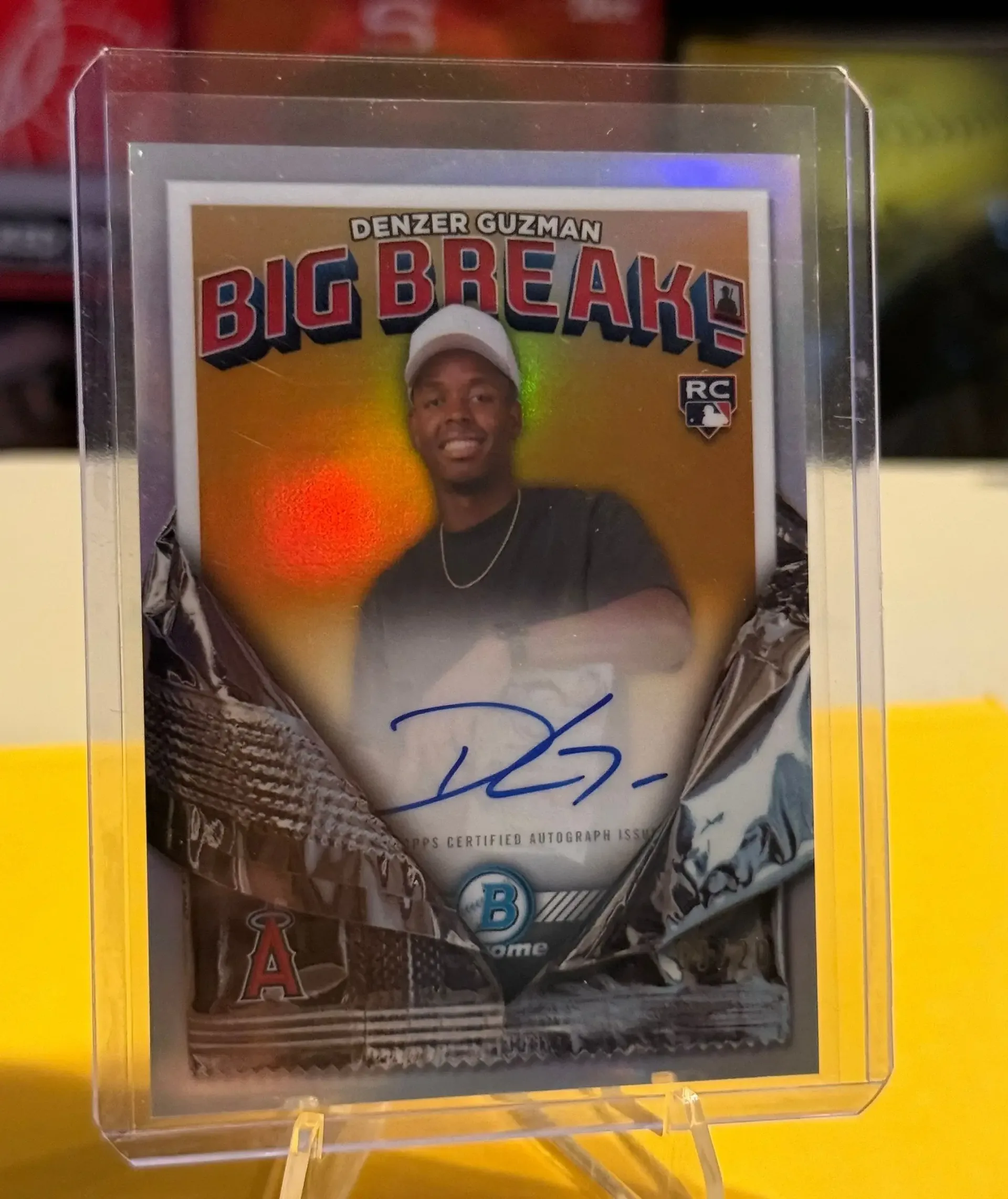
The autograph layer was smaller still. Only 13 of the 25 Big Break subjects have an Autograph Variation numbered to 20, and Guzmán is one of them. The stated odds for any Big Break autograph subject were 1 in 7,007 Hobby packs or 1 in 575 Breaker’s Delight packs. Those figures are for the entire 13-player autograph group, not for one named player. In other words, even locating a Big Break autograph did not mean it would be Guzmán’s.
The SuperFractor odds underline why a one-of-one should be viewed as a possibility rather than a plan. Depending on configuration, the stated chance of pulling a Big Break SuperFractor was roughly one in 42,000 to 68,000 packs, again across all 25 subjects. A 750-box event is a huge opening, but it does not turn a specific player’s one-of-one into an expected result. The large break made the chase compelling; it did not make the long shot ordinary.
The outcome was better than a single card
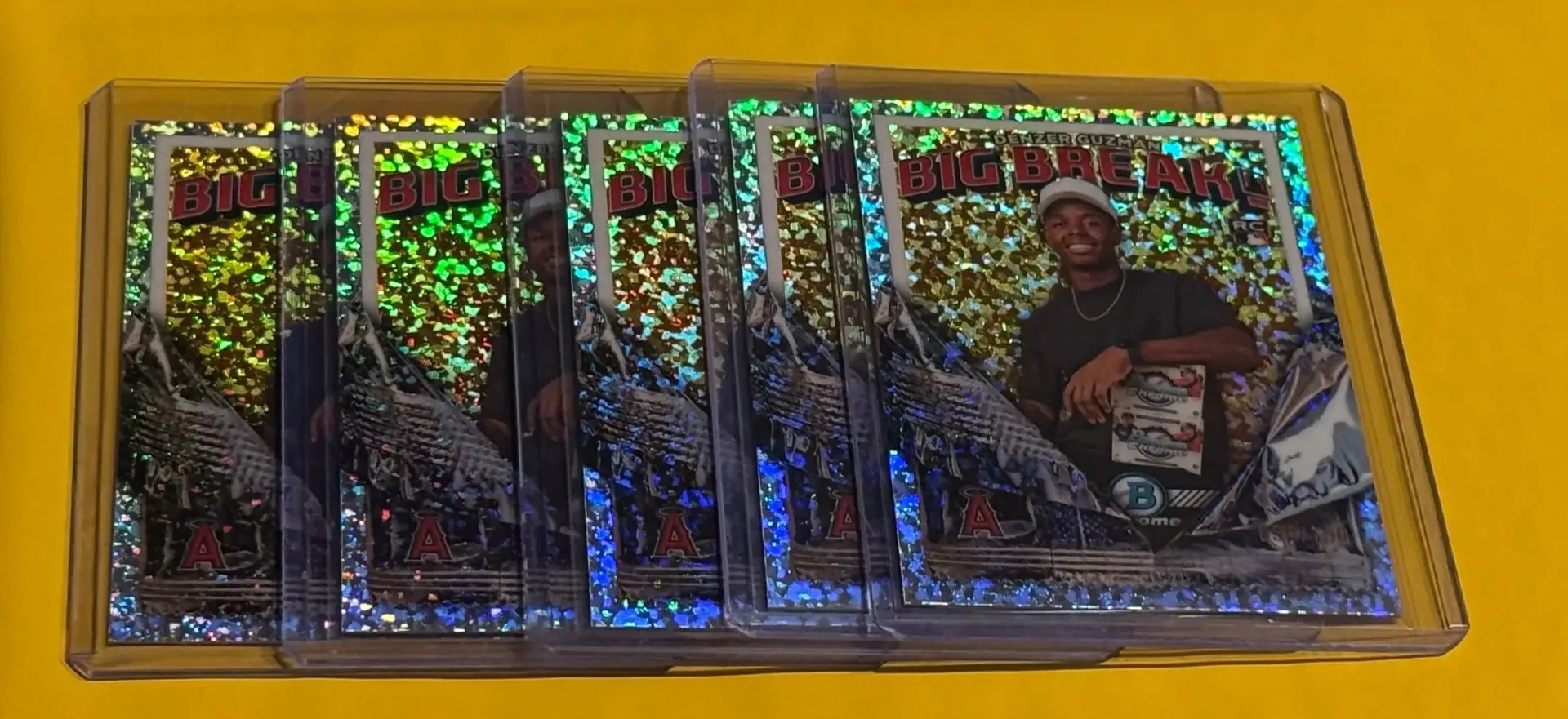
The SuperFractor did not appear. Yet the final haul was far from empty: nine base Big Break cards, five Mini-Diamond parallels numbered to 150, and a Guzmán Big Break Autograph Variation numbered to 20.
Five copies of a /150 Mini-Diamond parallel equal 3.33% of that stated print run. That is an unusually satisfying cluster for one collector, particularly when it emerged from a player break rather than from buying five individual copies after the fact. There is an important difference between acquiring a checklist and participating in its discovery. The first is efficient. The second creates a story around the cards, from every base pull to the signature card that becomes the centerpiece.
The autograph was the clear highlight, not because it automatically transformed the $144 spend into a major profit, but because it gave the chase a genuine payoff. It is a limited card from a subset built around the act of opening cards, pulled in a break large enough to make every player-specific hit feel notable. That is the kind of result that can be personally meaningful even if it is neither a player’s most valuable card nor his earliest Bowman issue.
There is no need to force every card into a hierarchy of “best” or “most investable.” A collection can accommodate a more personal category: the card that came from the night a collector took a chance on an unfamiliar player and enjoyed the ride.
Breaks are not the same thing as buying a card
A player break allocates the cards of one player to the buyer who purchases that spot. The buyer does not receive every card opened; they receive the eligible cards belonging to the player they selected. This format provides a route into a product without buying full boxes or cases, and it concentrates the experience around one athlete.
It also comes with real risk. The buyer pays before knowing exactly which cards, if any, will be pulled. Spending can accelerate when collectors pursue increasingly expensive names or re-enter multiple breaks trying to correct an unlucky result. That is why breaks are often compared with gambling: money changes hands in advance of an uncertain reward, and a small number of premium outcomes can dominate attention.
The responsible distinction is not that breaks are risk-free entertainment. They are not. It is whether a collector is treating the purchase as a bounded hobby expense and understands what they are actually chasing. Here, roughly $144 covered Guzmán across a massive opening, with the expectation that the collector was unlikely to be shut out entirely but had no reason to expect the one-of-one. The target was a player and a set, not an imagined instant windfall.
That framing may be useful for anyone considering a break:
- Set a total amount before buying. A clear limit keeps a long shot from becoming an open-ended chase.
- Know the exact player or team you are purchasing. Player breaks are specific; a familiar product name alone does not tell you what cards are included.
- Read stated odds carefully. Odds for “any” card in a group are not odds for your particular player.
- Decide what counts as success beyond a jackpot. Base cards, a favorite parallel, a new player connection or simply the event itself can all be valid answers.
- Do not use resale assumptions as a budget. A card’s future value is uncertain, while the cost paid for the break is immediate.
For collectors who chiefly want a specific card, purchasing that individual card can be the clearer and more controlled choice. For collectors who value suspense and want a reason to engage with a player over a product’s release day, a carefully budgeted break can offer something the singles market does not: a shared event and a personal pull story.
A card can create a reason to watch
The most lasting part of this chase arrived after the packs were opened. Guzmán finished the season strongly, including home runs in four consecutive games on the Angels’ final road trip. A card slot that began as an affordable decision now had a sporting sequel. Checking an Angels box score became more interesting because a stack of cards had made the player feel familiar.
That is a basic but easily overlooked function of sports cards. They can create or deepen attention. A collector may begin with a favorite team, a superstar or a prospect in their own organization. They may also start with a player outside their usual focus because a card is attainable, a design stands out or a break spot fits a hobby budget. The card becomes a small stake in the player’s progress—not a financial stake, necessarily, but an emotional one.
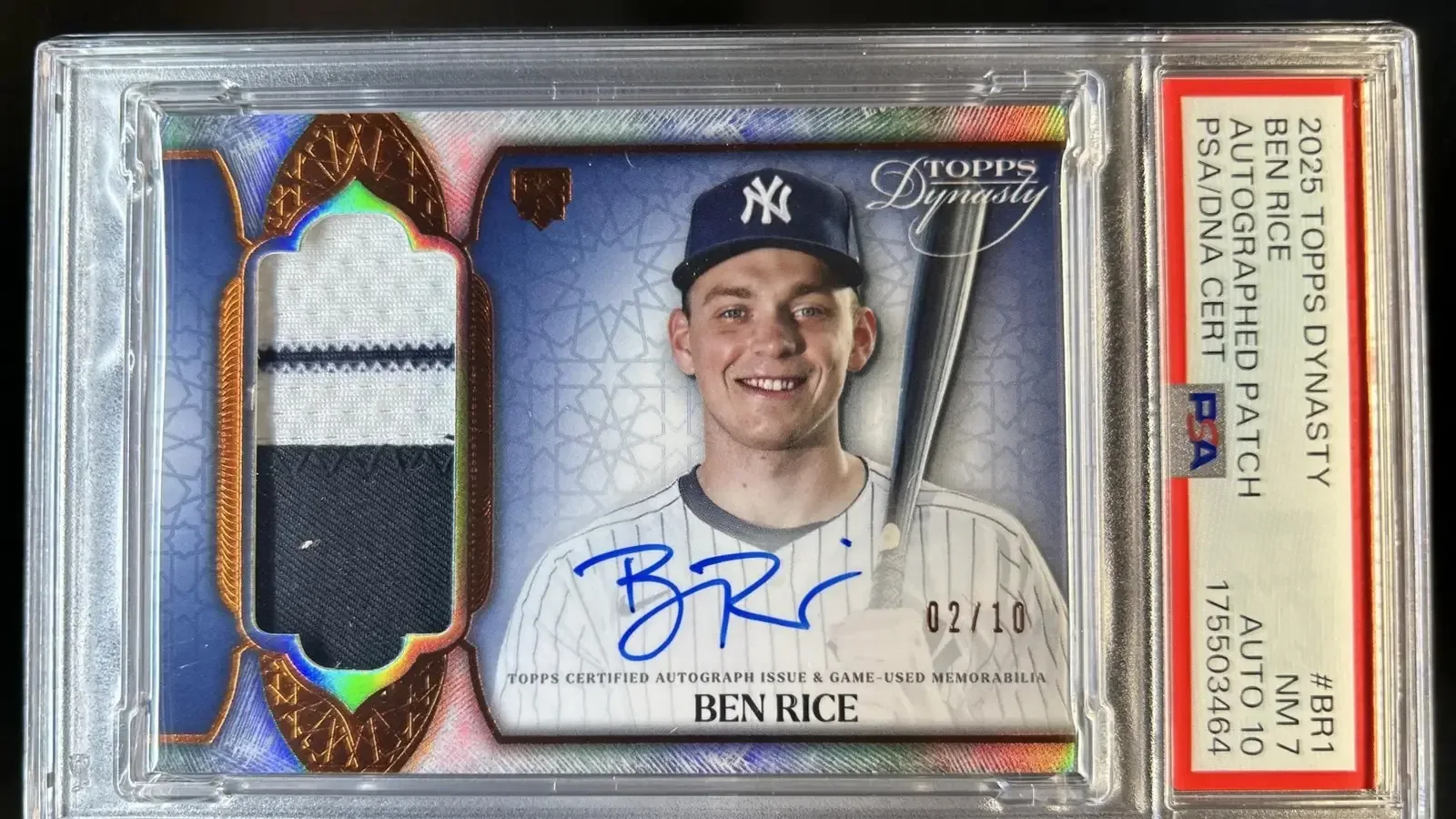
It is worth separating that experience from market coverage. Auctions and sales can be useful signals of demand; for example, a player’s performance can affect attention around signed cards, as seen in recent coverage of Ben Rice signed patch card auctions. But market movement is only one way cards connect fans to sports. Following a player because you pulled a /20 autograph is just as real a collecting experience, even if the card never becomes a headline sale.
The lesson from a missed one-of-one
One-of-one cards receive much of the attention in modern collecting because their scarcity is easy to communicate. There is only one, and its absence is noticeable. But the missed SuperFractor was not a failed break. The nine base cards, five Mini-Diamonds and numbered autograph formed a focused, memorable Guzmán group from one specific event.
That result is also a useful corrective to the idea that every opening needs a “win” in the market sense. The break delivered a scarce autograph and several parallels, but the larger value was narrative: a selected player, an improbable target, an unexpectedly good group of cards and an athlete worth tracking afterward.
Collecting can absolutely include condition, scarcity and value. Those are parts of the hobby, and they help collectors make informed decisions. They do not have to be the only parts. A well-chosen player chase can make a giant 750-box spectacle feel surprisingly personal—and can make the cards worth keeping for reasons that are not on any price chart.