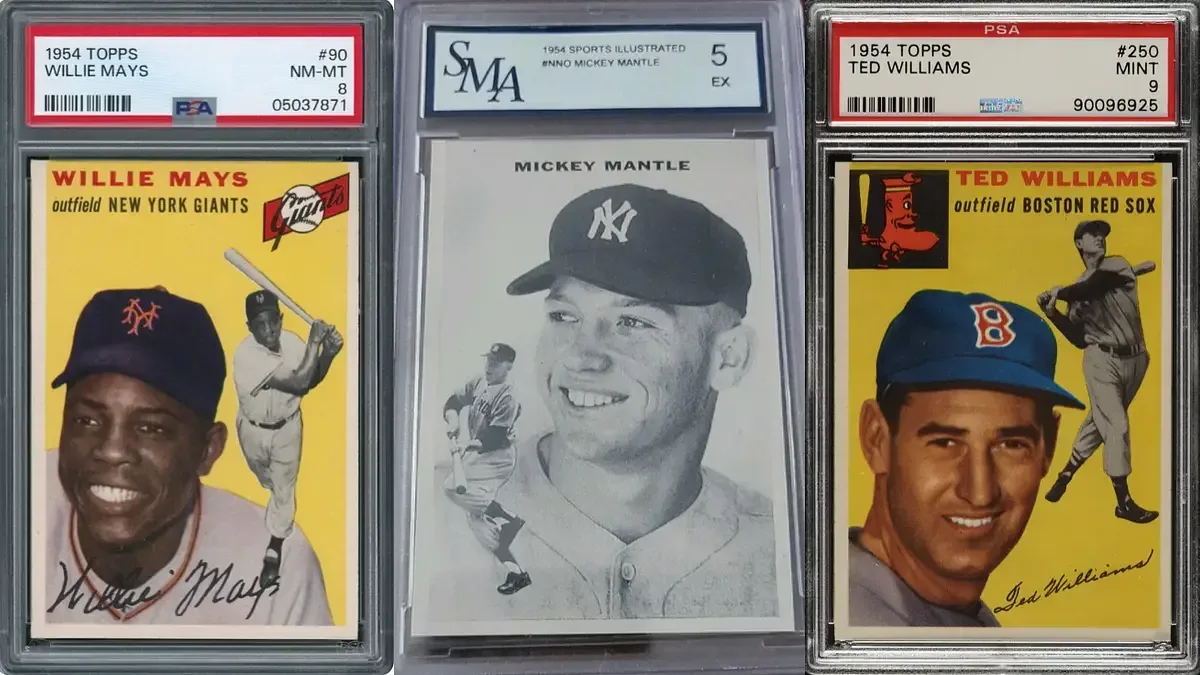
The 1954 Topps Baseball set presents a wonderfully inconvenient truth for vintage-card collectors: one of the hobby’s most celebrated sets was issued without Mickey Mantle. Mantle was tied to an exclusive agreement with Bowman Gum Company, leaving Topps without the Yankees superstar who would become perhaps the single most famous player in card collecting.
That absence has not diminished the set’s standing. Its 250-card checklist includes 20 Hall of Famers and an extraordinary trio of rookie cards: Hank Aaron, Ernie Banks and Al Kaline. Add Jackie Robinson, Willie Mays, Yogi Berra and Ted Williams—who appears at both the beginning and end of the checklist—and 1954 Topps becomes a compact set with unusually concentrated historical weight.
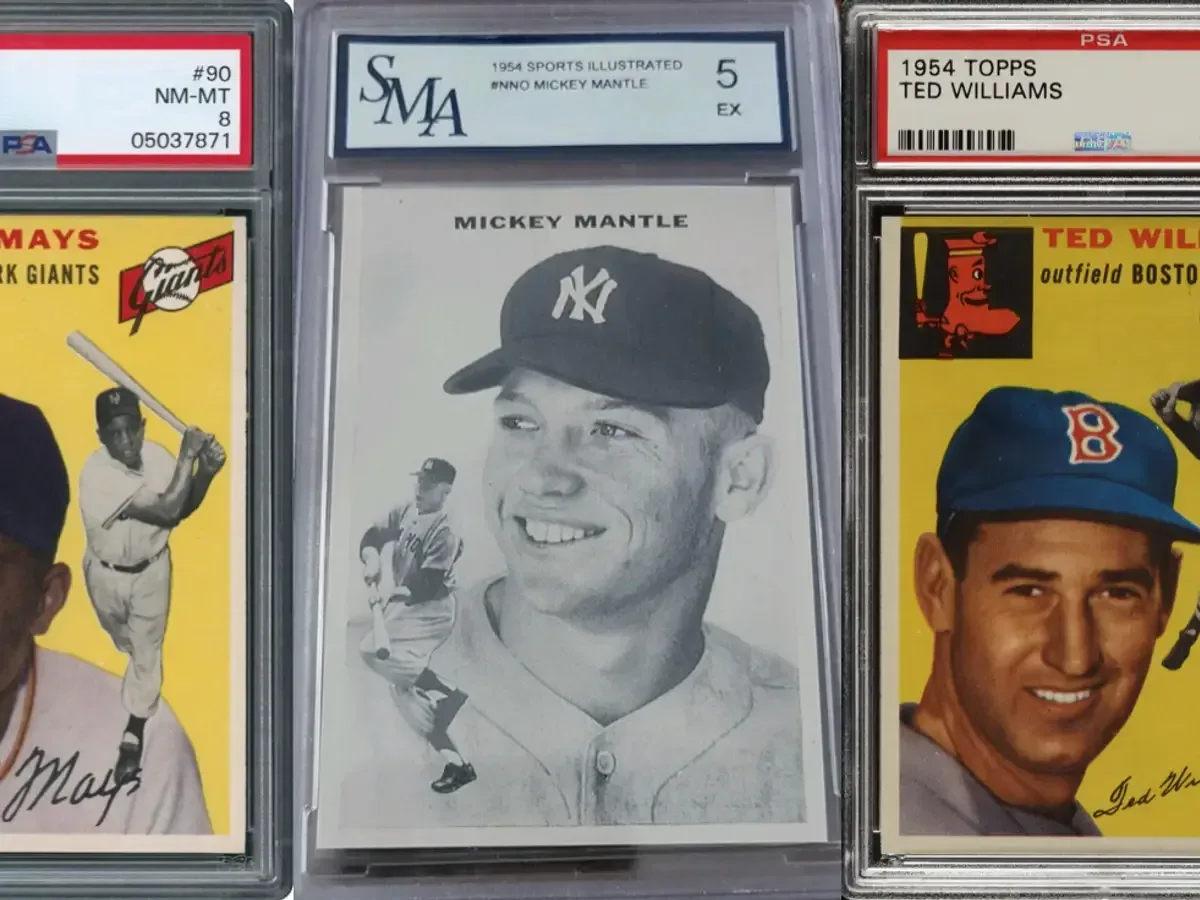
It is also a pivotal design release. The front uses a dual-image approach, combining a larger color portrait with a smaller black-and-white action image. The missing top border was a deliberate production choice that saved space while giving the cards a cleaner, more open appearance. That visual identity matters. In vintage collecting, desirability is not simply a scoreboard of career accomplishments; the image, colors, card number, condition and role within a set can all change how a card is pursued.
The result is a set where the most recognizable names are not necessarily the only meaningful cards. Here is a closer look at eight key 1954 Topps cards, what their reported sales and PSA population figures actually tell collectors, and why a Mantle-shaped hole has become part of the set’s story rather than a fatal flaw.
For more context, explore How to Catalog Four Wii and GameCube Oddities When the Box Hides the Real Collection Story.
Why 1954 Topps remains a vintage cornerstone
A 250-card checklist is modest beside many later flagship releases, but that compact scale is a feature for collectors building a complete vintage set. It creates a defined target while still holding the game’s biggest names and several cards that can anchor a collection on their own. The Aaron, Banks and Kaline rookies provide the major long-term chase, while Robinson, Mays, Williams and Berra deliver star power from players already associated with defining moments and accomplishments.
The set’s appeal is also strengthened by its range. A collector can focus on a single player, chase the Hall of Famers, build the full checklist, or pursue presentation variations within the same basic design language. Kaline’s red-to-orange backdrop, Mays’ yellow card and the visual presence of the Aaron rookie each demonstrate that the set does not look repetitive even when its layout remains consistent.
For anyone new to vintage cards, reported prices should be read with precision. PSA is a grading company whose numeric grades describe a card’s assessed condition, with 10 representing the highest grade in the figures discussed here. A population report, or pop report, is the number of cards that company has graded at each level. It is useful evidence, but it is not a census of every surviving copy. Nor does a large total population mean high-grade copies are easy to find: the counts at PSA 9 and PSA 10 are often tiny compared with the full total.
Related coverage includes The Most Iconic and Valuable 1954 Topps Baseball Cards to Know.
That gap explains why the difference between grades can be enormous. A PSA 9 Hank Aaron rookie has a reported all-time high sale of $720,000, while a PSA 7 copy most recently sold for $25,500. Both are strong-condition examples by ordinary standards, but top-grade vintage cards occupy a much narrower tier of scarcity and demand. Buyers should not treat a headline sale as a universal price guide for every copy.
The Mantle that was not quite a card
There is a curious visual footnote to the 1954 Topps Mantle absence. The August 23, 1954 issue of Sports Illustrated, its second issue, included sheets of uncut Yankees “cards” produced in partnership with Topps. One sheet included Mantle and used the styling of the 1954 Topps set.
That piece should be understood for what it is—and what it is not. It came from a magazine page rather than cardboard stock, and its Mantle image is essentially a black-and-white representation of a card. It is not a standard 1954 Topps baseball card. Its real fascination is speculative and visual: it provides a glimpse of how a genuine Topps Mantle from that year might have appeared.
For collectors, the distinction is important. A cutout from the magazine should never be conflated with a regular-issue card simply because the design is similar. The unusual item enriches the history of the set, but its format, material and origin make it a separate collectible category.
8. Tommy Lasorda rookie card, No. 132
Tommy Lasorda’s No. 132 is an outlier on this list because his Hall of Fame legacy was made as a manager, not during his brief major-league pitching career. He appeared in 26 Major League games and was replaced on the Dodgers roster by Sandy Koufax in 1955. That gives his 1954 Topps card a distinctive appeal: it is his only mainstream playing-days baseball card, attached to a figure chiefly remembered for leading the Dodgers to World Series titles in 1981 and 1988.
A PSA 9 reportedly sold for $13,000 on September 2, 2026, and a PSA 7 sold for $750 six days later. PSA has graded 4,117 copies, including 20 PSA 9s and one PSA 10. The card is a reminder that collecting can preserve a different chapter of a famous baseball life than the one that established the person’s reputation.
7. Yogi Berra, No. 50
The Yogi Berra card represents a player at the center of an extraordinary Yankees career. Berra won his second American League MVP award in 1954, added another the following year, and ultimately finished with three MVPs and 10 World Series rings as a player. His No. 50 is not a rookie card, but it connects a bright, memorable Topps design to a player whose résumé can be difficult to match.
The reported high sale is $28,030 for a PSA 9 on June 6, 2026, while a PSA 7 sold for $738 on September 10. Of 5,566 PSA-graded copies, 14 have received PSA 9 and none PSA 10. There is another practical entry point here: a PSA 3 was available for less than $200. That contrast demonstrates why collectors should decide whether they are chasing technical condition, eye appeal, player significance or simply a representative copy before they begin shopping.
6. Al Kaline rookie card, No. 201
Al Kaline is sometimes described as the least expensive member of 1954 Topps’ three elite rookie cards. That label needs context. He is being measured against Aaron and Banks, not against an ordinary rookie-card market. Kaline spent all 22 seasons of his Hall of Fame career with the Detroit Tigers, became the youngest batting champion in Major League history at 20 and earned 18 All-Star selections.
His card has some of the set’s most striking color work: a vivid candy-apple red background that can appear orange-tinted, paired with a yellow Tigers logo. It is a case where design can help distinguish a card even within a class of historic rookies. A PSA 10 sold for a reported $192,000 on February 26, 2021; a PSA 7 sold for $3,675 on June 28, 2026. The PSA population is 7,872 copies, including 20 PSA 9s and one PSA 10.
5. Ted Williams, No. 1 and No. 250
Ted Williams does something no other player in the set does: he bookends it. Topps assigned Williams card No. 1 and card No. 250, highlighting the importance of acquiring him during its competition with Bowman for player contracts. For a checklist builder, the pairing creates an obvious mini-goal; for a Williams collector, it turns one set into a two-card project with a built-in narrative.
The cards are separate issues and their market records differ. No. 1 reached a reported PSA 9 high of $53,378 on July 10, 2021, with a PSA 7 sale of $4,500 on April 14, 2026. No. 250 reached $96,000 in PSA 9 on August 18, 2025, and a PSA 7 sold for $4,340 on August 2, 2026. PSA’s total counts are 9,661 for No. 1 and 7,586 for No. 250. No. 1 has six PSA 9s and no PSA 10s; No. 250 has 10 PSA 9s and one PSA 10.
Williams’ on-card prominence is appropriate to his stature as one of baseball’s greatest hitters, despite losing nearly five full prime seasons to service in World War II and the Korean War.
4. Willie Mays, No. 90
Few cards bind so closely to one celebrated season as Willie Mays’ 1954 Topps No. 90. After missing most of the two prior seasons during military service, Mays returned to win the National League MVP award, hit .345 and help the Giants win the World Series. That season also contained “The Catch,” widely regarded as one of baseball’s greatest defensive plays.
The yellow background and Mays’ smile give the card immediate visual recognition, but the season behind it is the larger reason for its pull. A PSA 9 sold for a reported $140,300 on August 21, 2026, while a PSA 7 sold for $4,360 three days earlier. PSA has graded 8,506 copies; just 13 sit at PSA 9 and none at PSA 10. It is a fourth-year card, proof that the strongest card in a player’s vintage run is not always the first.
3. Jackie Robinson, No. 10
Jackie Robinson’s No. 10 carries historical significance beyond its place in the checklist. Only eight mainstream playing-era Robinson cards exist, making each an important piece for collectors focused on his career. This 1954 issue depicts him still performing at a high level, during the year he made his sixth straight All-Star team.
Market movement has been notable at lower grades as well as elite ones. A PSA 3 that sold for less than $150 in 2019 now sells for more than $1,000, while a PSA 7 brought $5,005 on September 2, 2026. The reported PSA 9 high is $152,500, achieved February 23, 2025. There are 12,874 graded copies in total, but only 23 PSA 9s and no PSA 10s. The card’s importance should not be reduced to its price, yet the figures show why condition and authenticated grade remain consequential in this segment of the hobby.
2. Ernie Banks rookie card, No. 94
Ernie Banks’ only mainstream rookie card ranks among the pillars of the 1954 Topps release. Banks debuted in 1953 as the first Black player in Chicago Cubs history, then became synonymous with the franchise as “Mr. Cub.” His consecutive National League MVP awards in 1958 and 1959 cemented that status.
The card combines the rookie-card premium with a subject whose joy and personality are central to his lasting appeal. A PSA 9 reached a reported $215,250 on August 16, 2026. A PSA 7 sold for $10,500 on July 11, 2026. PSA’s population total is 10,514, including 14 PSA 9s and two PSA 10s. Those two top-grade examples illustrate a key vintage principle: surviving quantity and gem-condition quantity are very different things.
1. Hank Aaron rookie card, No. 128
Hank Aaron’s No. 128 is the centerpiece of 1954 Topps. It is his only rookie card and combines a famous design with a career that ended at 755 home runs, including the breaking of Babe Ruth’s iconic home-run record. Aaron was 20 in 1954 when Bobby Thomson’s spring-training ankle injury opened an outfield spot with the Braves.
His route to the Braves had been far from inevitable. Aaron played three months for the Indianapolis Clowns of the Negro American League, playing shortstop and earning $200 per month. Offers arrived from both the Boston Braves and New York Giants; the Braves’ offer was $50 per month higher. A small difference in salary helped direct a career that could otherwise have placed Aaron alongside Willie Mays in New York.
The market tiers are dramatic. A PSA 9 Aaron rookie sold for a reported $720,000 on August 18, 2022. A PSA 7 sold for $25,500 on June 7, 2026. PSA has graded 12,211 copies, including 25 PSA 9s and two PSA 10s. For collectors, that does not mean every Aaron rookie should be evaluated through six-figure headlines. It means that centering, corners, surface, color and the assigned grade can materially change the card’s position in the market.
That is ultimately why 1954 Topps endures. Mantle’s absence makes for a compelling what-if, but Aaron, Banks and Kaline give the set an unmatched rookie core, while Robinson, Mays, Williams, Berra and others make the broader checklist feel like a concentrated record of baseball history. The best approach is to identify which part of that record matters most—rookie status, a single player, top condition, visual design or completion of the full 250-card run—and compare like-for-like copies rather than assuming every sale tells the same story.