A shelf label usually answers only two questions: what the game is called and which Nintendo system uses the disc. That is enough for a familiar first-party release, but it breaks down with licensed games, renamed regional editions, motion-control software and titles related to earlier releases. A box can make two games look interchangeable when their play requirements, identity or catalog history are different.
Scene It? Bright Lights! Big Screen!, The Scorpion King: Rise of the Akkadian, Pitfall: The Big Adventure and Swingerz Golf make a useful four-game catalog exercise. They are not a ranking or a hidden-gems list. Each exposes a different record-keeping problem: content assumptions, film licensing, a Wii retitling, and regional aliases combined with a save requirement.
The goal is to create a release record that answers three practical questions: What exactly is this item? What does it need to work? What other release might someone confuse it with? Once those questions are built into the catalog, unusual games become easier to shelve, lend, replace and search.
Start with the collection problem, not the shelf genre
The first useful catalog record is not a verdict about whether a game is good. It is an identification record that tells you what the item is, what it needs and what it should not be confused with. For these four games, platform, region, release title, publisher, developer, player count, save method and related releases are more valuable than a loose label such as party game or movie tie-in.
This approach also prevents a common physical-media mistake: treating the visible box as the whole collection story. A complete-looking case can still lack a manual, a required memory card, a bundled accessory or the regional name needed to find matching documentation. Record confirmed facts separately from observations about the copy in front of you. If you have not inspected the disc or manual, mark that field unverified rather than filling it from a marketplace photograph.
Use one main record for the exact edition in your possession. Add linked records for materially different platform or regional versions. That keeps a North American GameCube disc from being merged with a PlayStation 2 release, while still allowing a search for the shared game title, franchise or film connection.
- Exact title as printed on the cover and disc
- Platform, region and rating information
- Developer and publisher when verified
- Player count and local or online limitations
- Save hardware or storage requirement
- Related titles, alternate names and confusingly similar releases
- Condition and contents observed on your own copy
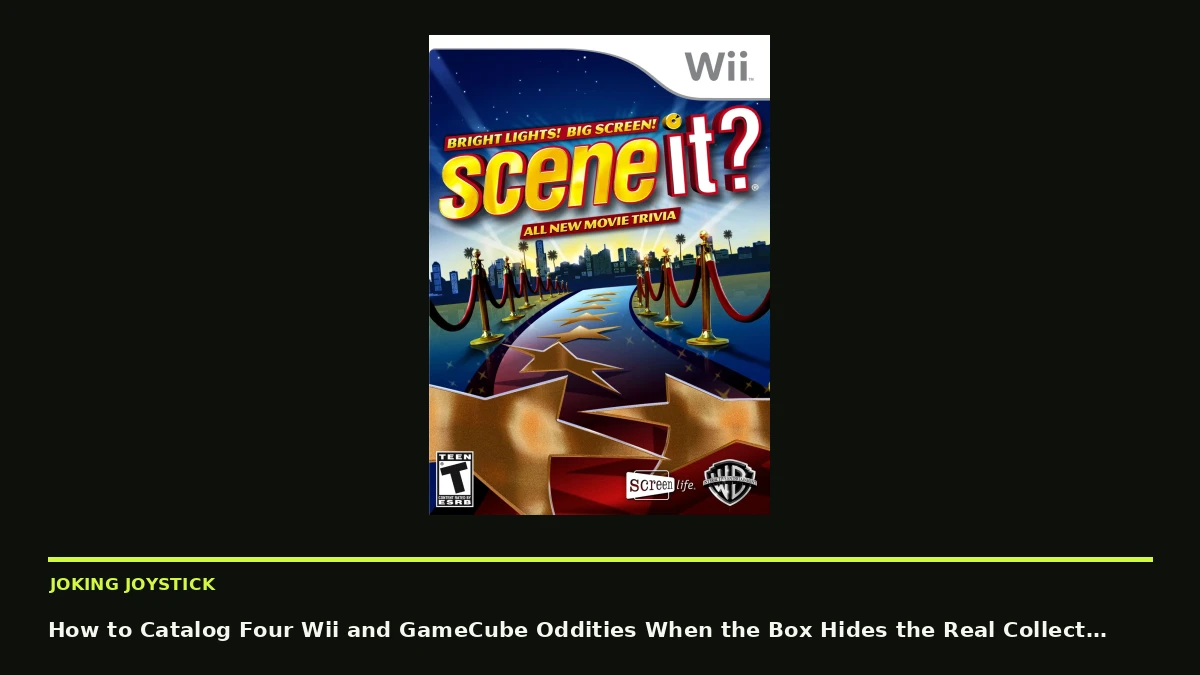
Scene It? Bright Lights! Big Screen!: do not file trivia as automatically child-focused
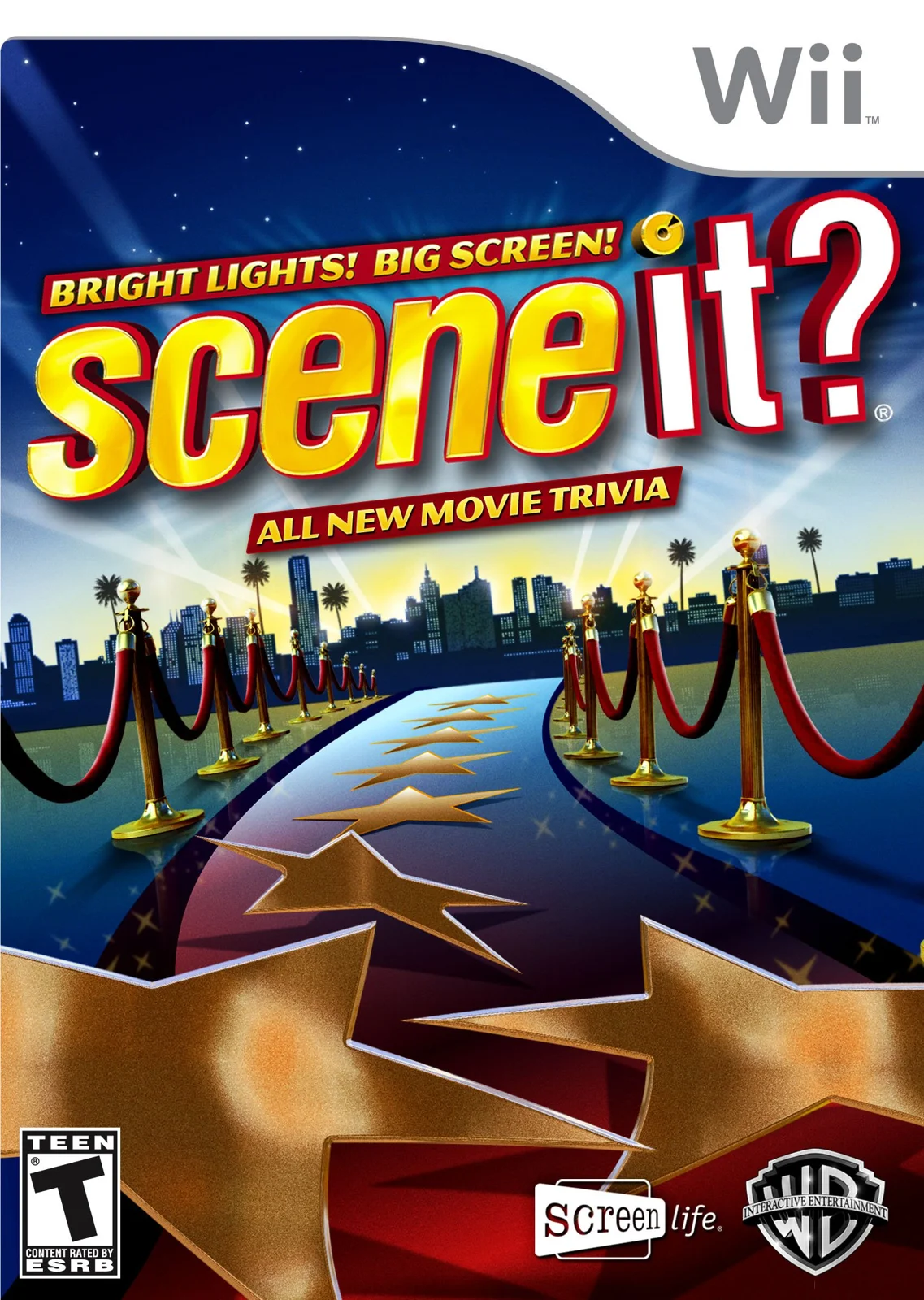
Scene It? Bright Lights! Big Screen! is a Wii movie-trivia game built around questions and clips from Hollywood films. Its game-show presentation makes it easy to place in a broad family-party category, but the North American ESRB entry rates the Wii edition Teen and lists Drug Reference, Mild Blood, Mild Language, Mild Violence and Sexual Themes. Those descriptors belong in the catalog record because they change how another person may choose to use or lend the game.
The more useful classification is a Wii movie-trivia and local group-play title with adult-oriented content descriptors, not simply a children’s quiz disc. The release also appeared on PlayStation 3 and Xbox 360, so the platform field matters even when the subtitle is the same. A Wii copy should remain its own edition record rather than being merged with the other console versions.
Record the number of players and the controller or accessory assumptions only after checking the manual or edition-specific documentation. Do not assume that a generic Wii Remote description proves a special bundled controller was present in every retail package. If your copy contains only the disc and case, say that. If a game-specific accessory is present, record it as an observed component rather than as a universal feature of the release.
This is a good example of why catalog tags should describe use without replacing metadata. A tag such as local group play helps you find the game for a gathering. The rating and content descriptors help you decide whether that gathering includes younger players. Both pieces of information are needed, and neither should be inferred from the cheerful box design.
- Platform: Nintendo Wii
- Format: movie trivia and game-show-style play
- Player count recorded from edition-specific documentation
- ESRB note: Teen with Drug Reference, Mild Blood, Mild Language, Mild Violence and Sexual Themes
- Linked editions: PlayStation 3 and Xbox 360 releases
- Catalog caution: do not infer child suitability from the trivia format
- Bundled accessories listed only when physically confirmed
The Scorpion King: separate the film license from the game identity
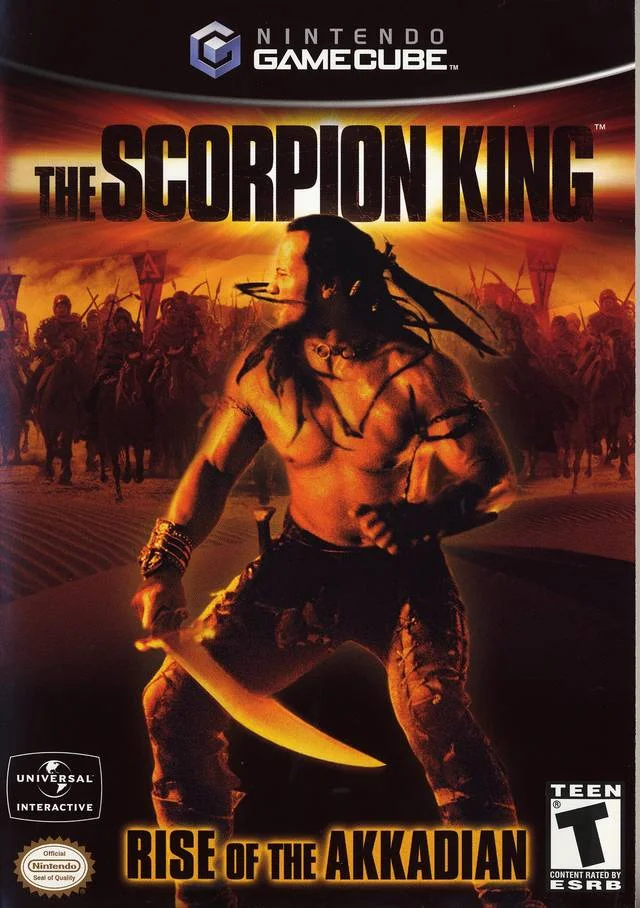
The Scorpion King: Rise of the Akkadian is a 2002 action title released for both GameCube and PlayStation 2. Its connection to the film is important, but it should not become the primary identity of the record. A catalog entry should identify the game as a film-related action release and preserve the exact platform edition, rather than treating the movie license as proof that every version is interchangeable.
The GameCube record should stand apart from the PlayStation 2 record. The physical discs use different formats, the cases and manuals belong to different platform ecosystems, and a replacement search needs to know which edition is missing. A shared parent entry can connect the two releases, but ownership, condition, region, cover art and product identifiers should stay attached to the specific copy.
The game is a single-player action release in the North American GameCube data, with an ESRB Teen rating and a Violence descriptor. That makes its collection role different from Scene It? even though both are licensed around screen entertainment. One is designed around group trivia; the other is a solo action game. A broad movie tie-in shelf tag hides that distinction.
Product codes can help when a case is damaged or has replacement artwork, but they should be transcribed from the disc, case spine, manual or a trusted edition record. Do not copy a code from a seller’s photograph without checking whether the image belongs to the stated region. If the code cannot be verified, leave the field blank or mark it uncertain rather than creating false precision.
The film relationship also deserves a controlled note. Use wording such as film license or film-inspired release, then add any verified story relationship separately. Avoid describing the game as a scene-for-scene adaptation unless the documentation supports that claim. The license, platform and play format are certain catalog facts; assumptions about how closely the story follows the movie are a separate research question.
- Platform: Nintendo GameCube
- Related platform: PlayStation 2, cataloged separately
- Release year: 2002
- Developer: Point of View
- Publisher: Universal Interactive
- Play format: single-player action
- North American rating note: Teen with Violence
- Relationship note: film-related release
- Product code: record only after verifying the exact physical edition
Pitfall: The Big Adventure: preserve the Wii-specific identity
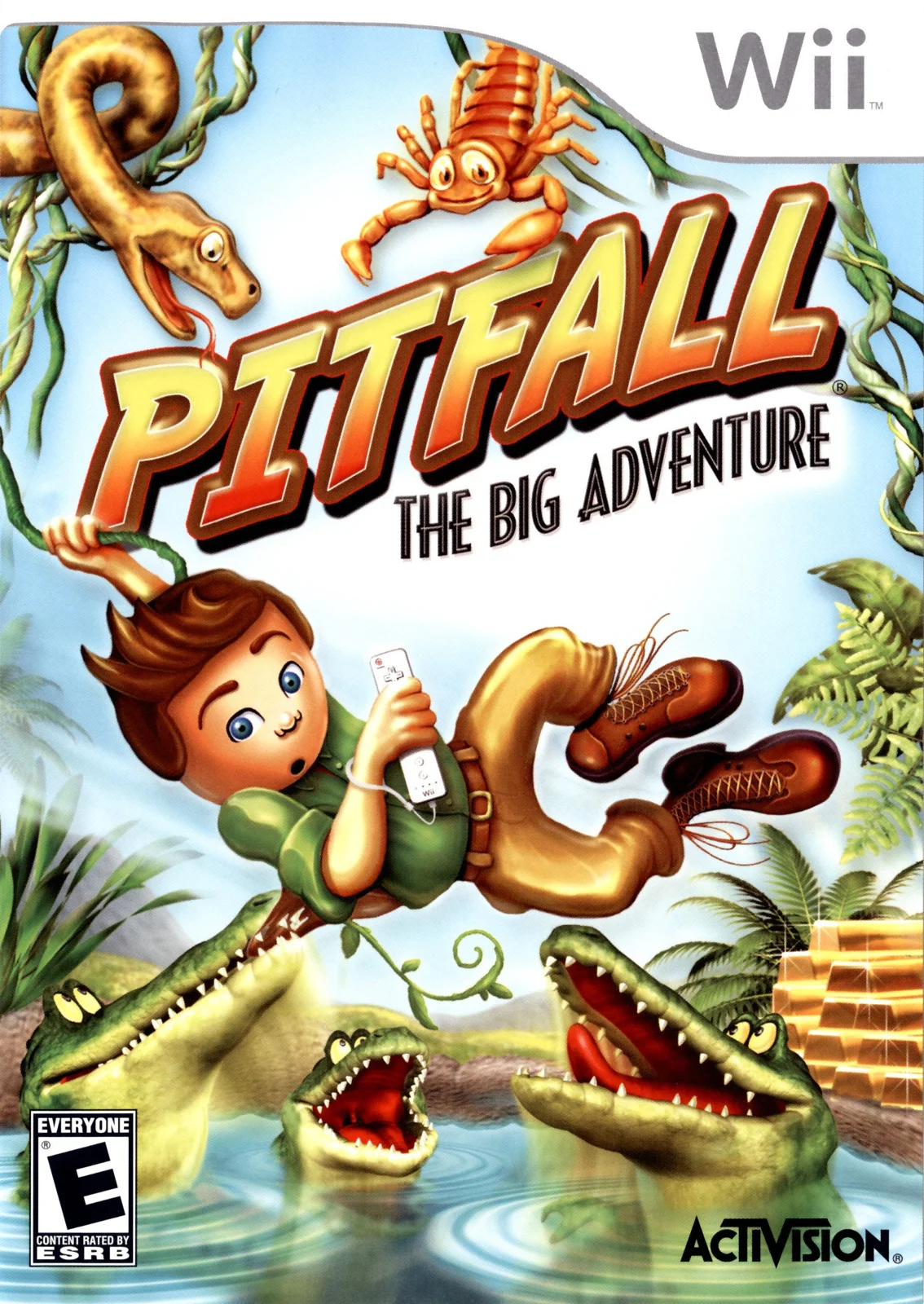
Pitfall: The Big Adventure creates a different catalog trap because its name invites comparison with Pitfall: The Lost Expedition. Activision announced The Big Adventure as a Wii-exclusive release developed around Wii motion controls, with more than 60 levels across rainforests, caves and glacial mountains. The earlier subtitle appeared on GameCube and other sixth-generation platforms. That relationship should be recorded, but the two release records should not be collapsed into one.
The safest catalog wording is that The Big Adventure is the Wii edition or Wii-specific reworking associated with The Lost Expedition, while noting the subtitle change and control differences. This is more useful than calling it a completely unrelated game or treating the two boxes as identical. A collector searching for the GameCube release may need The Lost Expedition, while someone looking specifically for Wii motion-control software needs The Big Adventure.
A GameCube-compatible Wii can run GameCube software, but that does not make a Wii copy of The Big Adventure interchangeable with a GameCube copy of The Lost Expedition. Nintendo identifies the original RVL-001 Wii as compatible with GameCube accessories, while later Wii models and the Wii mini have different limitations. GameCube software on a compatible Wii also needs GameCube-compatible controllers and memory cards. The console’s ability to run older discs is therefore a hardware note, not a reason to merge two different software releases.
Record the complete subtitle exactly as printed. This matters when you replace a missing case, search a database or build a lending list. A catalog entry that says only Pitfall risks pulling in the earlier GameCube, PlayStation 2, Xbox or other franchise releases. The subtitle is not decorative packaging text; it is the field that prevents a false match.
The Wii box’s level count and motion-control emphasis are useful edition notes, but they should not be expanded into claims about the game’s quality or every version’s exact content unless those differences have been verified. For collection purposes, the practical distinction is already clear: the Wii item has its own title presentation, platform identity and control context.
- Platform: Nintendo Wii
- Complete title: Pitfall: The Big Adventure
- Control note: designed around Wii Remote motion controls
- Announced scope: more than 60 levels
- Setting note: rainforests, caves and glacial mountains
- Related release: Pitfall: The Lost Expedition
- Catalog caution: do not merge the Wii and GameCube subtitle records
- Hardware note: GameCube backward compatibility depends on the Wii model
Swingerz Golf: alternate titles are part of the object’s identity
Swingerz Golf is a 2002 GameCube release from Eidos Interactive, developed by Telenet Japan. Its most important catalog issue is geographic naming. The game is also known as Ace Golf in Europe and Wai Wai Golf in Japan. A North American-only shelf label can therefore make a regional search appear to fail, even when the related release is present under another title.
Add the alternate names as search terms, not as replacement titles for every copy. A North American Swingerz Golf disc should remain labeled Swingerz Golf in the ownership record. A European Ace Golf copy should have Ace Golf as its exact regional title, with the other names stored as aliases or linked releases. This preserves what is printed on each object while still allowing a database search across regions.
The manual adds a practical detail that a title database may not show: the game needs a Nintendo GameCube Memory Card with at least 10 free blocks to save progress, scores and settings. That is a software requirement, not proof that a Memory Card was included with a retail copy. Keep those facts separate. Record the storage need in the release metadata and inspect the package independently for bundled hardware.
The manual also identifies one-to-four-player support and several play modes, including Tour, Stroke Play, Match Play and mini-games. Reference data describes six courses and 14 playable golfers. These details explain why a one-to-four-player field alone is not enough: the game can serve a group, but its regional names and save dependency affect whether it is easy to find and use.
This is the kind of entry that benefits from a requirements tag. Use terms such as GameCube Memory Card required for saving, then add a separate copy note that states whether a card is present in the collection. A buyer, lender or family member can then tell the difference between software compatibility and package completeness.
- Platform: Nintendo GameCube
- North American title: Swingerz Golf
- European alias: Ace Golf
- Japanese alias: Wai Wai Golf
- Publisher: Eidos Interactive
- Developer: Telenet Japan
- Players: one to four golfers
- Save requirement: at least 10 free Memory Card blocks
- Do not assume a Memory Card was bundled
- Record the actual regional title printed on the copy

Record the physical copy separately from the software facts
A database entry should describe the release, while a collection condition record should describe the particular copy. Mixing the two creates misleading listings. For each item, note whether you have the original case, cover art, disc, manual and inserts. Then record visible condition such as cracks, label wear, water damage, writing or a replacement case. Use neutral observations rather than conclusions about authenticity when you cannot verify the source.
The four examples show why this separation matters. A missing Scene It? case may erase the platform clue even though the disc remains identifiable. A damaged Scorpion King spine may make the disc label or product code more useful. A Pitfall replacement cover may omit the subtitle that separates The Big Adventure from The Lost Expedition. A Swingerz Golf copy may be playable but still need a Memory Card with enough free blocks.
Do not treat a seller’s claim of complete in box as confirmation. Check the components yourself and preserve photographs or notes if the item is being loaned, sold or moved. A simple contents field can say disc, case and manual present; original insert unverified. That wording protects the catalog from gradually turning assumptions into facts.
Use separate fields for release metadata and ownership metadata. Release metadata remains stable across copies: platform, title, publisher, developer, player count and save requirement. Ownership metadata changes from copy to copy: condition, missing manual, replacement case, personal labels and whether the required controller or Memory Card is available in your collection.
- Disc present and title or product code inspected
- Original case present or replacement case noted
- Cover art matches platform and region
- Manual present, absent or unverified
- Inserts and promotional materials listed separately
- Required accessories or storage documented without claiming inclusion
- Condition observations kept separate from release metadata
Build a catalog template that survives unusual releases
A useful template should be short enough to complete consistently but detailed enough to catch edition differences. Start with identity fields: exact title, alternate titles, platform, region, publisher, developer, release year and product code. Add usage fields: player count, multiplayer type, control method, save method and any required storage or accessory. Finish with relationship fields for film licenses, earlier subtitles, other platforms and regional equivalents.
Use controlled values where possible. For example, write local multiplayer instead of alternating between couch play, party mode and multiplayer. Keep a free-text note for facts that do not fit a fixed field, such as the relationship between The Big Adventure and The Lost Expedition. This makes searches more reliable without flattening the unusual details that make these items worth documenting.
A confidence field is useful when sources disagree or when the package is incomplete. Mark information as verified from the disc or manual, verified from a rating or publisher record, observed from the case, or awaiting inspection. Never use a blank catalog field as evidence that a feature does not exist.
A compact record for these four games might contain the following fields: exact regional title; platform; region; release year; developer; publisher; rating; player count; multiplayer type; control method; save method; free-block requirement; alternate titles; related releases; product code; package contents; condition; and confidence level. That is enough structure to handle a movie-trivia disc, a film-license action game, a retitled Wii adventure and a renamed golf game without creating a separate system for each one.
- Identity: title, aliases, platform, region and year
- Credits: developer and publisher
- Identification: product code and disc label
- Use: players, multiplayer type and controls
- Requirements: save method, free blocks and accessories
- Relationships: film, franchise, predecessor and other-platform links
- Confidence: source-confirmed, physically observed or unverified
Choose shelf organization by the question you ask most often
Platform order is the safest primary arrangement for a Wii and GameCube collection because it matches hardware and disc format. Within each platform, alphabetical order by the exact regional title keeps retrieval predictable. Under that system, The Scorpion King belongs with GameCube action games, Swingerz Golf with GameCube sports titles, and the two Wii releases remain distinct even when their boxes occupy similar space.
A second label layer can capture the collection story. Use tags such as movie license, local group play, motion control, alternate regional title and external save requirement. This lets you answer practical questions without physically reorganizing the shelf: Which games need a Memory Card? Which discs support four people? Which releases are connected to films?
Franchise or theme-first shelving can be attractive, but it creates risks. Putting every Pitfall item together may hide the platform difference; combining all film tie-ins may put a Teen-rated single-player action game beside a trivia title with different group-use expectations. Use franchise or genre as a secondary view in your digital catalog rather than sacrificing platform clarity on the shelf.
If the collection includes multiple regions, add a region divider or a visible catalog tag. Do not rely on cover color alone. Alternate titles can make a European or Japanese copy look unrelated to its North American counterpart, while a similar cover can make two platform editions appear interchangeable. Platform and region should remain the primary physical identifiers.
- Primary shelf order: platform, then exact regional title
- Secondary tags: player setup, control method, license and storage need
- Linked records used for related releases
- Regional aliases added as search terms
- Physical shelf kept consistent with the hardware needed to use the item
When one entry is enough—and when to create linked records
Create one release entry when the item is the same platform and region, with the same product identity, and your differences are limited to condition. A complete and incomplete copy of the same Wii edition of Pitfall: The Big Adventure should not become two software records. Give them separate copy or condition notes instead.
Create linked edition records when the platform changes, the regional title changes, the subtitle changes or the hardware assumptions change. The GameCube and PlayStation 2 versions of The Scorpion King meet that test. Swingerz Golf and Ace Golf need linked regional names because a search must find the related release through different titles. Pitfall: The Big Adventure and The Lost Expedition need a relationship note because the shared franchise and underlying release history can otherwise produce a false duplicate or an incorrect substitution.
The decision is practical: would merging the records cause someone to buy, shelve, lend or operate the wrong item? If yes, separate them. Would splitting them merely duplicate condition information for identical editions? If yes, keep one release record and add multiple ownership or condition notes. This rule prevents both overcounting and dangerous oversimplification.
For these four examples, the clean structure is four primary records matching the staged items, plus linked records or aliases for the related PlayStation 2, GameCube, European and Japanese releases. That arrangement preserves the exact objects in the collection while still showing how their names and histories connect.
- Same edition, different condition: one release record with copy notes
- Different platform: separate linked edition records
- Different regional title: aliases plus a linked regional record when needed
- Different subtitle or control model: separate records
- Shared license or franchise: relationship link, not automatic merging
- Split records only when the distinction changes identification or use
These four discs demonstrate why cataloging is more than copying a title from a box. Scene It? needs a content and player-context note; The Scorpion King needs platform and film-license separation; Pitfall needs a Wii-specific relationship note; and Swingerz Golf needs regional aliases plus its Memory Card requirement.
A durable collection record tells the next person what the item is, what it needs and what it is not. It also distinguishes confirmed release facts from the condition and contents of one particular copy. Once those fields are captured, unusual releases stop being confusing shelf exceptions and become some of the most informative entries in the library.