The Purge is heading to comic shops. Blumhouse and IDW Dark have revealed a new comic-book series set in the dystopian horror franchise, scheduled to arrive in late 2027. The series will be written by Eisner Award winner Dan Watters, with art by Juan José Ryp.
The announcement establishes The Purge as the first disclosed project in a broader effort to bring Blumhouse horror properties into IDW Dark, IDW’s horror-focused imprint. Specific plot details, issue count, format and a more precise release date have not yet been provided. What is clear is that the creative team is being positioned to tell a fresh chapter rather than simply retell one of the films.
A new medium for Purge Night
Created by James DeMonaco and produced by Blumhouse, The Purge imagines a near-future United States governed by the New Founding Fathers of America. Its central premise is brutally simple: for one annual 12-hour period, every crime—including murder—is legal.
That sanctioned night is known as the Purge, but the franchise has never treated it as a mere excuse for masked intruders and survival horror. Across its stories, the premise has been used to examine wealth, class divides, political extremism and institutionalized violence. The original film placed a wealthy family inside a highly secured home whose defenses fail. Later installments moved outward into Los Angeles streets, a presidential campaign, the early experimental phase on Staten Island, and a scenario in which the violence continues after the designated period should have ended.
Comics are a natural format for a setting constructed around perspectives. A monthly series can follow a single person trying to survive the night, but it can also cut between households, neighborhoods, institutions and the people benefiting from the system. The important distinction is that this is not yet a confirmed description of Watters and Ryp’s story; it is the flexibility available to a premise that has repeatedly expanded its point of view.
For readers who know the films chiefly as high-pressure thrillers, the move to comics could offer room to linger on the world around the annual event. The franchise’s political framework is part of the horror: the violence is not random in the conventional sense, but permitted and encouraged by a society built to rationalize it. Sequential art can make that contrast especially immediate, shifting from ordinary civic imagery to a city transformed by a single legal exception.
The creative team
Watters comes to the project as an Eisner Award-winning writer whose credits include Batman: Dark Patterns and TMNT: Shredder. Those references do not disclose the tone or plot of The Purge, but they place the series with a writer who has worked in established genre universes and character-driven comics.
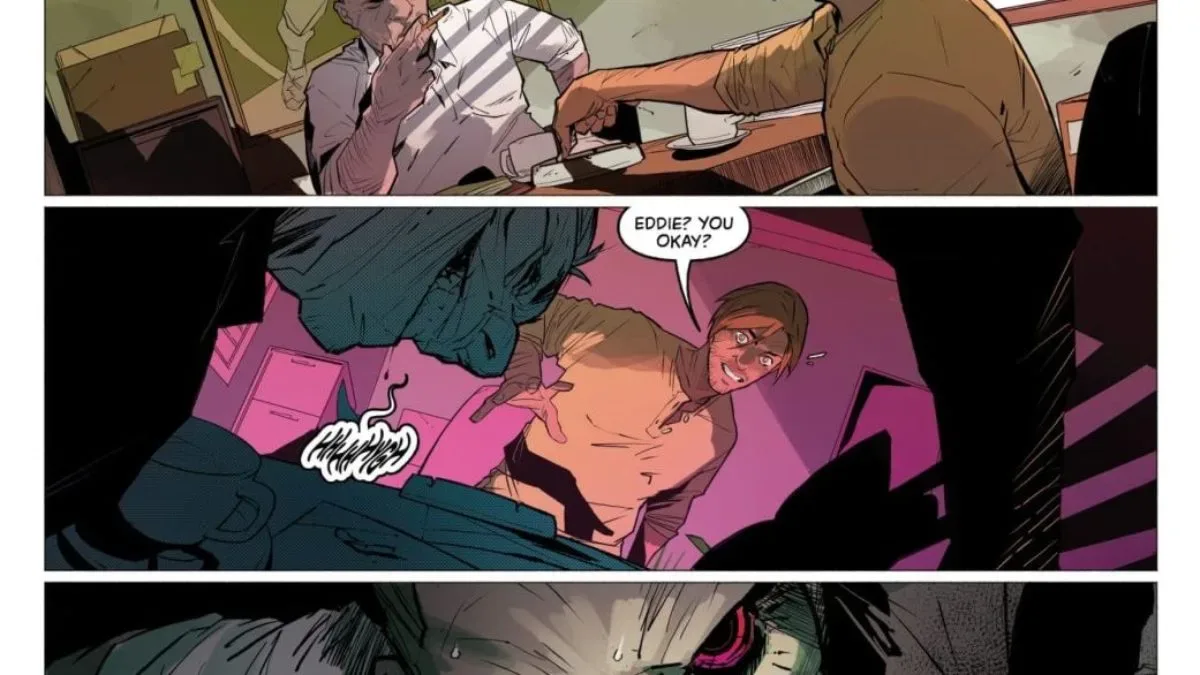
Ryp’s listed credits include Wolverine: Blood Hunt and Ghost Rider: Vengeance Forever, alongside earlier work for Avatar Press. His involvement gives the book an artist accustomed to violent, heightened material—a potentially significant fit for a franchise in which physical danger and social spectacle are inseparable.
In comics, the artist’s role reaches beyond illustrating moments already described in a script. Page composition controls what the reader sees first, what is withheld until a page turn, and how long an encounter feels. A tightly packed sequence can emphasize chaos; a nearly silent page can make a supposedly safe room feel vulnerable. Those tools are particularly relevant to The Purge, where anticipation before a threat is often as central as the threat itself.
That does not mean a comic must imitate the pacing of a film. The medium has different strengths. Readers set the pace, can revisit background details, and absorb a whole page as an arrangement before moving through its individual panels. If the new series leans into the social systems surrounding Purge Night, it could use those visual possibilities to show how propaganda, security, privilege and fear operate alongside the immediate violence.
What “dystopian horror” means here
Dystopian fiction generally depicts a society whose political or social order has become oppressive, dehumanizing or deeply unjust. In The Purge, the dystopia is not only the legal status of violence for one night. It is the state-backed argument that such a night is acceptable and useful.
Horror, meanwhile, supplies the personal consequence. The policy is experienced by people sheltering inside homes, crossing dangerous streets, losing protection, or confronting others who have been given permission to act without normal legal restraint. Combining the two modes gives the franchise its identity: it asks viewers and readers to think about a system while making them feel the immediate terror it produces.
The franchise has maintained that balance across five films: The Purge (2013), The Purge: Anarchy (2014), The Purge: Election Year (2016), The First Purge (2018), and The Forever Purge (2021). It also received a television adaptation that ran for two seasons between 2018 and 2019. The five films have grossed more than $500 million worldwide despite relatively modest budgets, underlining the durability of the concept across screen formats.
The comic arrives after the screen franchise has already explored both a confined home-invasion setup and larger social landscapes. That history gives the new book an established foundation without defining its exact route. At this stage, readers should be careful not to assume which characters, time period or type of Purge Night will be used. The confirmed promise is a new chapter set in the franchise’s world.
IDW Dark’s Blumhouse expansion
IDW’s chief executive, Davidi Jonas, described the Blumhouse partnership as an expansion of the publisher’s horror imprint and emphasized the opportunity to explore the company’s modern genre properties in comics. The Purge is the first announced title from that relationship.
That framing matters because an imprint is more than a label on a cover. In publishing, an imprint gives books a shared editorial identity and helps readers understand what kind of material to expect. IDW Dark’s focus is horror, while the Blumhouse partnership points toward adaptations or expansions involving recognizable film properties. Whether further franchises will be announced, and which creative teams might handle them, remains unknown.
For comics readers, the practical takeaway is simple: this is a licensed horror series planned for late 2027, not an immediate release. There is no announced solicitation information, issue count or creative lineup beyond Watters and Ryp. Fans interested in the publisher’s work with major entertainment properties can also see IDW’s separate plans for a new James Bond comic beginning with the six-part “Sunbreaker”.
Why the premise still has room to grow
A one-night premise can sound restrictive, yet The Purge has sustained multiple stories because the consequences are much larger than one evening. Who is protected? Who can afford security? Who gains political power from panic? What happens when official rules are used to make cruelty appear legitimate? These are recurring questions built into the setting itself.
The films have approached them from distinct angles, from a family whose home security is compromised to groups navigating Los Angeles, a candidate targeted during Purge Night, the Staten Island experiment that helped establish the event, and a version of the concept that refuses to stop. The comic’s opportunity is not simply to repeat that escalation. It is to find a character, setting or moral pressure point that makes the familiar rules feel dangerous again.
Watters and Ryp have more than a year before the planned late-2027 launch, and there is substantial information still to come. Until IDW Dark and Blumhouse share a premise, covers, issue details or a firm on-sale date, the most reasonable expectation is a new creator-led visit to a world where a state-sanctioned night of lawlessness remains the engine for horror and social critique alike.