Smile: Any Given Smile #1 takes the unnerving grin at the center of the Smile film franchise into a very different pressure cooker: a championship football game. The 32-page mature comic from IDW Dark is scheduled to go on sale September 23, 2026, with Stephanie Williams writing, Pablo M. Collar providing the art, and Ashley Witter on the cover.
The premise is set in January 1995 in St. Augustine, Florida, as the Sharks prepare for the American Arena League championship. Maximillian Dupree, a backup quarterback suddenly thrust into the spotlight, is dealing with far more than the demands of an enormous game. His personal debts to the local gambling underworld add a second, much more dangerous kind of stakes to every decision around him.
That setup is already built on uncertainty: sports outcomes are unpredictable, backup players are often placed under immense scrutiny, and gambling debts can make even ordinary setbacks feel catastrophic. Any Given Smile adds a supernatural menace to that instability. A series of suicides in the community draws a sports journalist toward the championship and the apparent connection between the deaths, the game and a mind-bending entity. The result is a horror story where nobody can be entirely sure that what they see is real.
A sports setting designed for psychological horror
Putting Smile in an arena-football setting is more than a visual switch from the franchise’s previous screen stories. The game provides a confined social world with clear rituals: teammates, fans, reporters, gambling interests and a clock pushing everyone toward kickoff. The championship also creates a fixed deadline. Whatever is haunting St. Augustine is not simply lurking in the background; it arrives as the city’s biggest sporting moment approaches.
Dupree is a useful focal point for that environment. He is described as a sudden-star backup quarterback rather than an established face of the team. That means public attention, team expectations and financial vulnerability converge at once. A player in that position has little room to fail, especially when people beyond the locker room may be invested in a particular outcome.
The supplied material also identifies gambling as a central force, not merely local color. Dupree owes money to the city’s gambling underworld, while the entity’s visions threaten payouts alongside sanity and survival. The language deliberately joins football’s ordinary vocabulary of odds and payoffs with horror’s fear of coercion and loss of control.
What “line shaving” means here
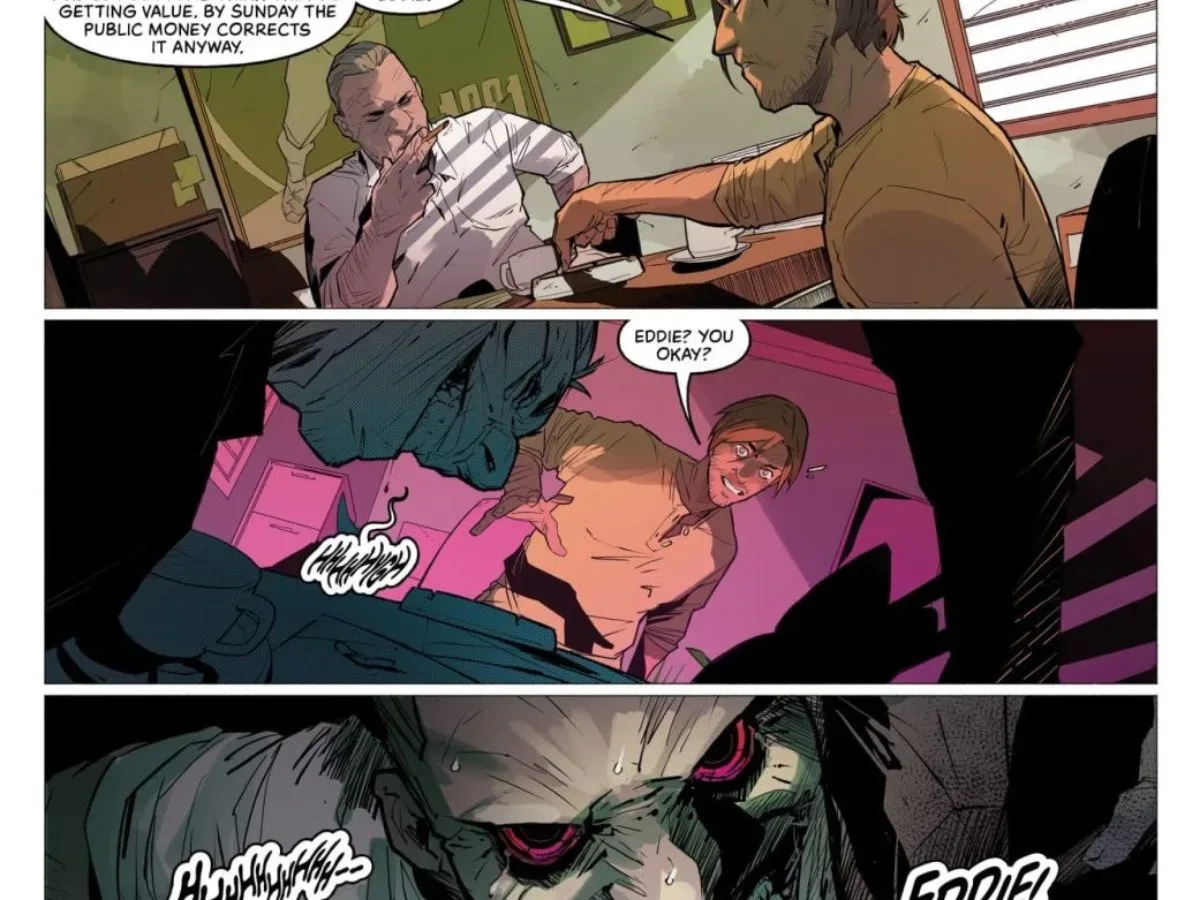
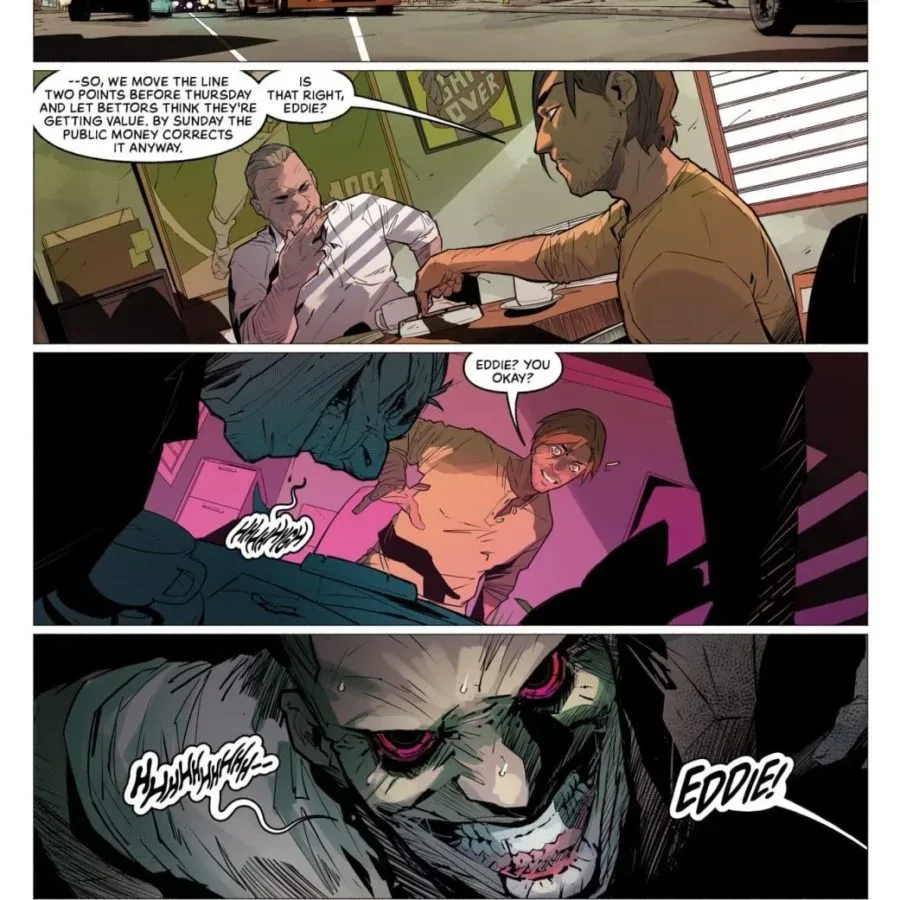
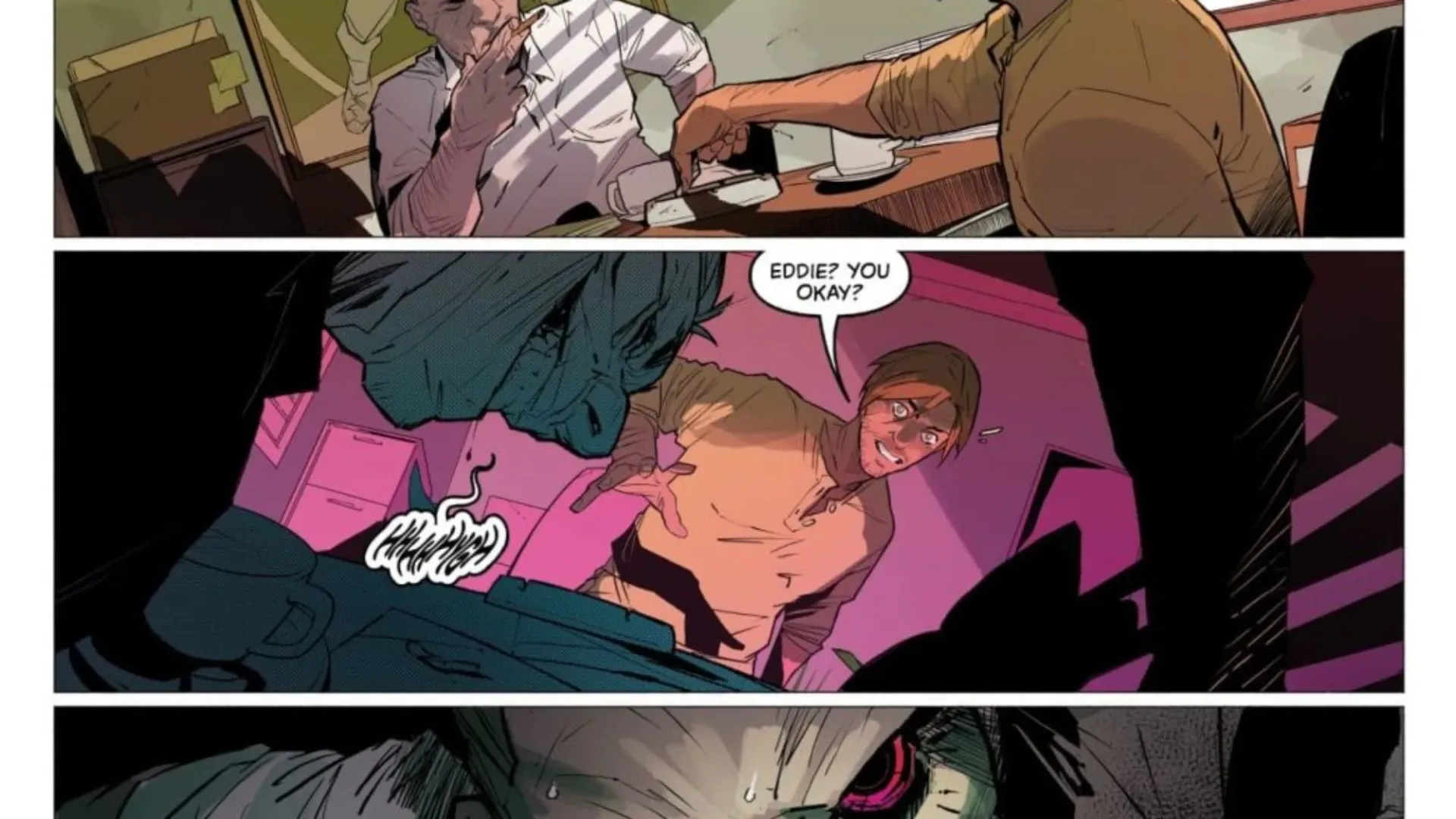
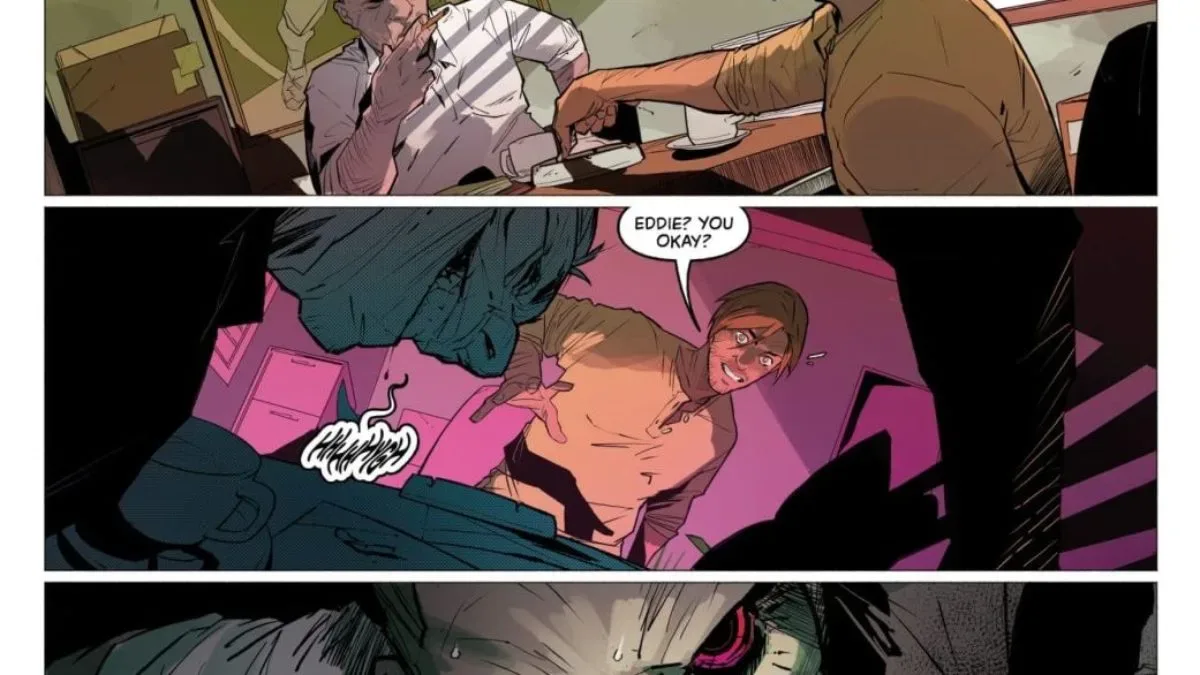
Preview material shows a bookmaker discussing line shaving with a character named Eddie before the horror breaks through. In sports-betting terms, a betting line is the margin or expected difference used to frame wagers. “Line shaving” refers to manipulating elements of a game or its result to influence that betting line. It does not necessarily mean changing who wins; the critical detail can be the final margin.
That distinction makes the concept especially fitting for a horror comic. It turns a game into something people may attempt to control from the sidelines while players and fans believe they are watching a fair contest. In this story, the supernatural threat introduces a still worse possibility: manipulation may not be limited to the score at all. Perception itself is unstable.
The preview’s image of Eddie undergoing the franchise’s familiar, frightening transformation gives the book an immediate bridge to the established Smile iconography. It also signals that the comic is not treating the championship solely as a crime or gambling thriller. The sport-and-debt plot is the route into an explicitly supernatural story.
Williams and Collar enter the Smile universe
Williams is credited as the writer of Nubia and Roots of Madness, while Collar is credited for art on Avengers Academy. Their work here has a defined challenge: deliver the recognizable dread associated with Smile while making football culture, a 1995 setting and St. Augustine matter to the story rather than operating as interchangeable scenery.
The solicitation suggests the mystery will be shared between two perspectives. Dupree is trapped in the immediate pressure of the championship and his debt, while the unnamed sports journalist follows the pattern of deaths that has struck the community. That structure could let the book contrast the public narrative around the Sharks’ title game with the danger building away from the field.
It also gives the comic an opportunity to use sports reporting as a narrative engine. A journalist investigates connections, gathers accounts and tries to separate evidence from rumor. In a story explicitly about frightful visions and an entity that distorts the mind, that task becomes considerably harder. The reporter is not only trying to solve a mystery but also confronting the possibility that witnesses, victims and investigators cannot trust their own senses.
Importantly, the available description does not establish the entity’s full rules, origin or method. That uncertainty is part of the hook. Readers know there are suicides, visions and a threat to lives, but the opening issue appears positioned to reveal how the curse intersects with the game and gambling machinery over time rather than laying out every answer before kickoff.
Why the 1995 date matters to the mood
The January 1995 setting is specifically named, and it suits a story centered on local pressure. The material presents the championship as the American Arena League’s most significant event in its 20-year history, concentrating the city’s attention on one game and one team. St. Augustine becomes a place where sports, money, personal debts and community grief are all colliding in public.
For the reader, the period setting can also sharpen the isolation at the core of the premise. The plot is driven by face-to-face scenes involving athletes, bookmaking and a reporter’s investigation, rather than being described as an online-age betting scandal. That is not to say the book abandons spectacle; a championship is inherently a spectacle. But its suspense appears rooted in people trying to make sense of danger in their own city as the event they cannot escape draws near.
The title, of course, turns a well-known football phrase into a warning. “Any given” becomes less about the possibility that an underdog can win and more about the lurking possibility that someone might be marked by the horrifying smile at any moment. It is a playful piece of wordplay carrying a grim implication: in this town, game day may not end when the final whistle sounds.
Issue details and cover options
Smile: Any Given Smile #1 is listed at $4.99 in the US and $6.99 in Canada. Alongside the standard issue, the solicitation lists a Variant B by Jock, a Collar Trading Card Variant, a 1:15 Simmonds variant and a 1:25 Jones Full Art variant. The “1:15” and “1:25” labels denote retailer-incentive cover ratios: retailers generally qualify to order one such incentive copy based on orders of a stated number of the regular issue. They are separate cover editions, not indications of additional story pages or different plot content.
- On sale: September 23, 2026
- Publisher/imprint: IDW Publishing / IDW Dark
- Format: 32 pages, mature
- Writer: Stephanie Williams
- Artist: Pablo M. Collar
- Cover artist: Ashley Witter
- Price: $4.99 US / $6.99 CAN
For comic readers looking for more genre-adjacent coverage, The Rocketeer: Infiltrator! #3 is another recent comic-book story built around a protagonist navigating escalating danger.
With its quarterback under pressure, a journalist chasing a pattern of deaths, and betting interests that may be every bit as threatening as the monster, Smile: Any Given Smile #1 is positioned as a supernatural sports thriller rather than a conventional football comic. The central question is not simply whether the Sharks can win a championship. It is whether anyone in St. Augustine can reach game day with their judgment, safety and identity intact.