The Rocketeer: Infiltrator! #3 is set to arrive from IDW Publishing on September 23, 2026, placing Cliff Secord in a mission where flying skill and raw nerve may not be enough. The 32-page, Rated T issue is written by Gabriel Hardman, drawn by Dean Kotz, colored by K.J. Díaz and lettered by Shawn Lee. Kotz also provides the main cover.
The central complication is deliberately uncomfortable and high-stakes: Cliff’s MI6 handler has been taken prisoner by Nazis, while Betty has been invited to a dinner attended by Nazi officers. Cliff has to protect her and navigate the situation without the training normally expected of a covert operative. That tension is the issue’s clearest hook. Cliff is a stunt pilot, not a polished intelligence professional, so the story’s suspense turns on whether improvisation can hold up in a setting built around scrutiny, deception and immediate danger.
A Rocketeer story built around espionage rather than expertise
The premise uses a familiar but effective contrast. Cliff has exceptional practical abilities: he can pilot, react under pressure and use the Rocketeer equipment in a crisis. None of that automatically translates into subterfuge, meaning the careful use of secrecy, false identities and misdirection to avoid suspicion. The problem is not simply reaching an enemy location. It is acting convincingly once he gets there, especially when Betty’s safety is part of the equation.
That difference matters because a dinner of enemy officers is not an environment that rewards the usual kind of pulp heroics. A rocket pack can provide an escape route, a dramatic entrance or a way to alter the balance during open combat. At a formal gathering, however, it could be a liability. A hero has to understand what information to reveal, what questions to evade and when an attempt at rescue risks exposing everyone involved.
The supplied setup does not establish precisely how Cliff intends to enter or move through the dinner, so readers should not assume a particular disguise, operation or outcome. What is known is more interesting on its own: he needs to shield Betty while his handler is unavailable, captured and unable to provide the direction that a mission like this would ordinarily require.
Action scenes raise the pressure before the social trap
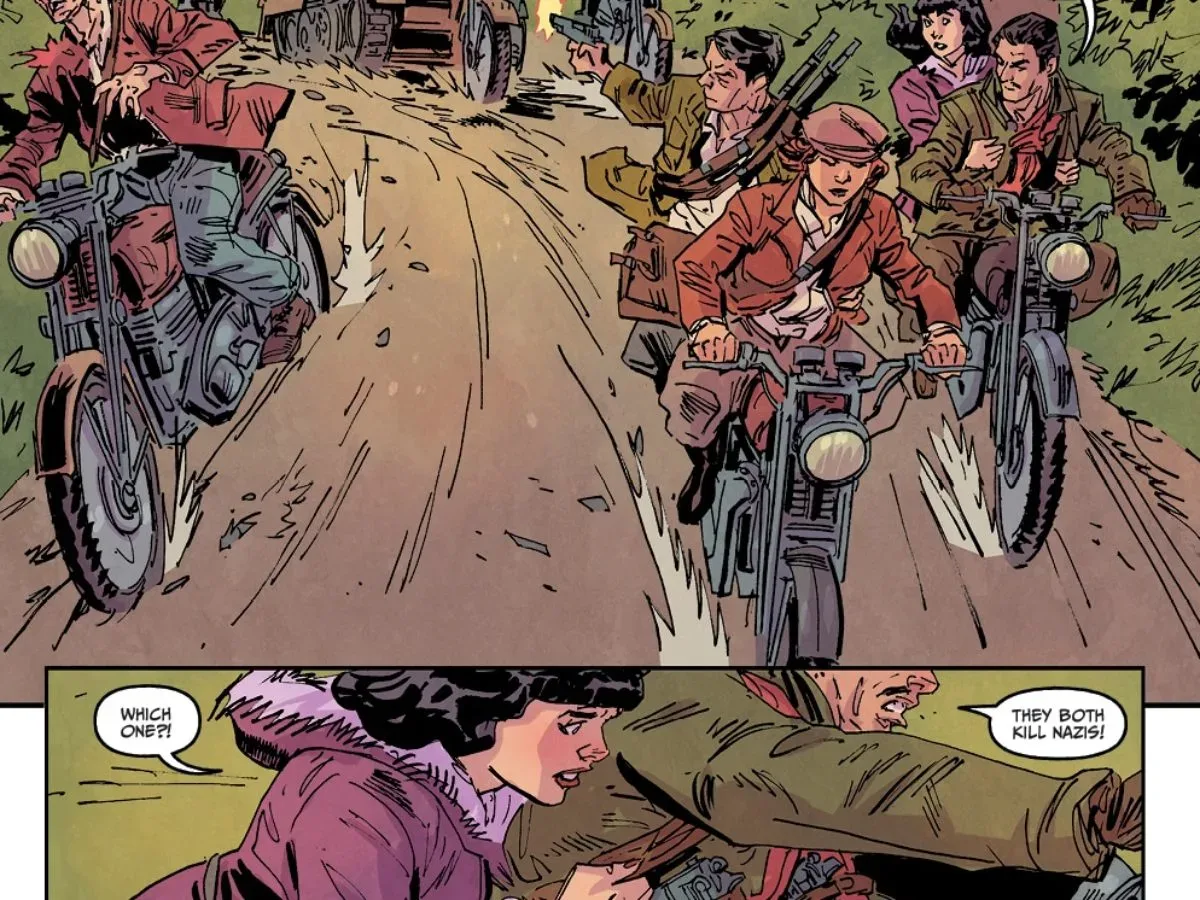
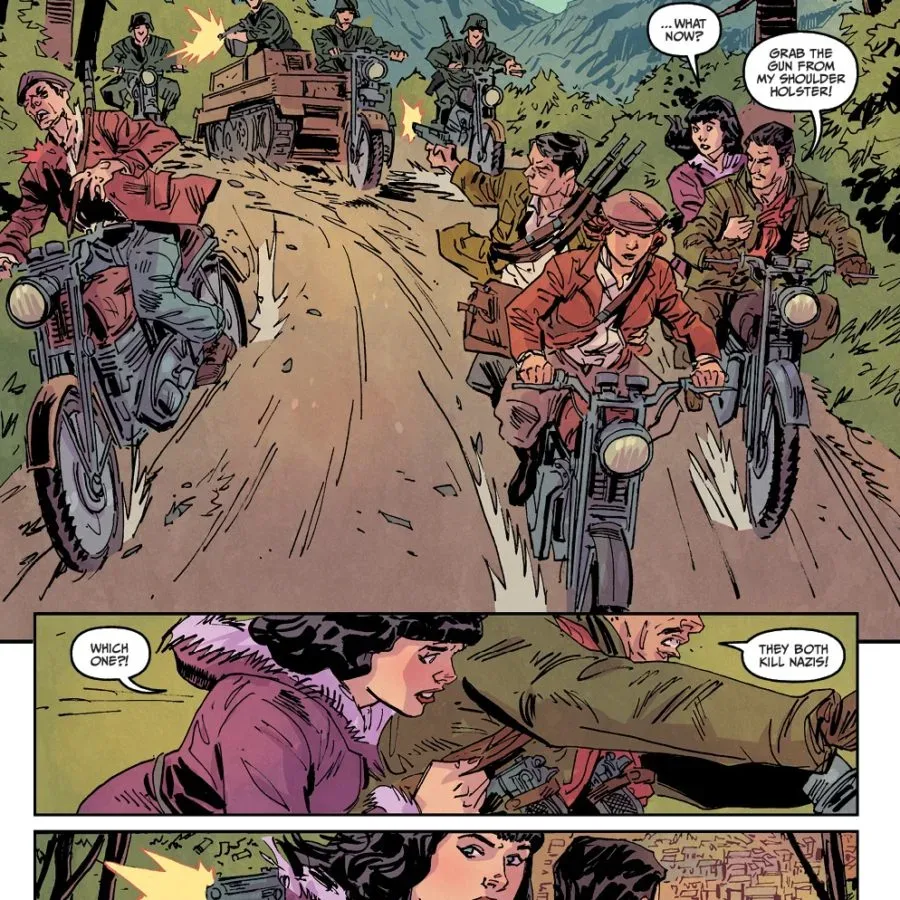
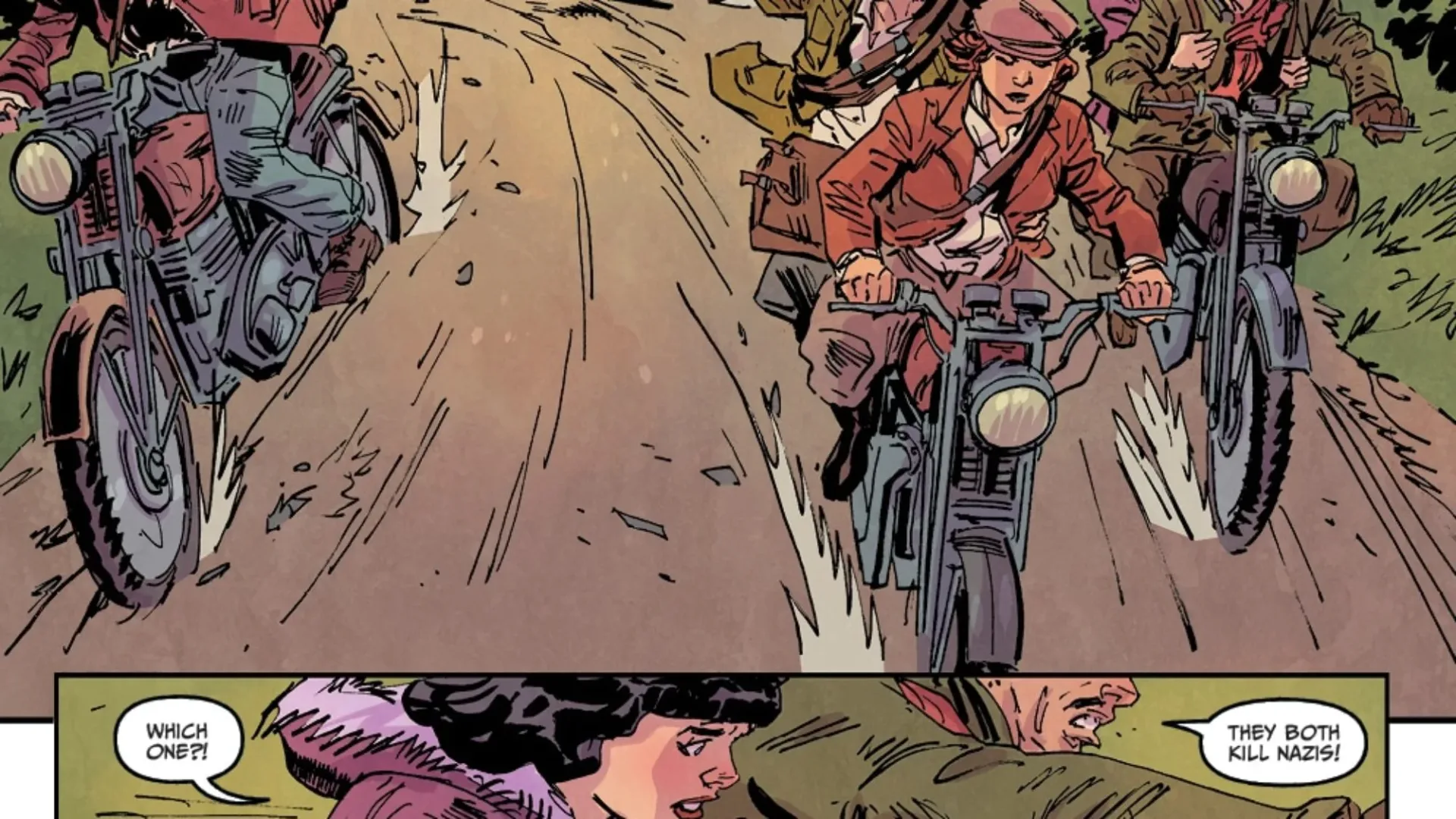
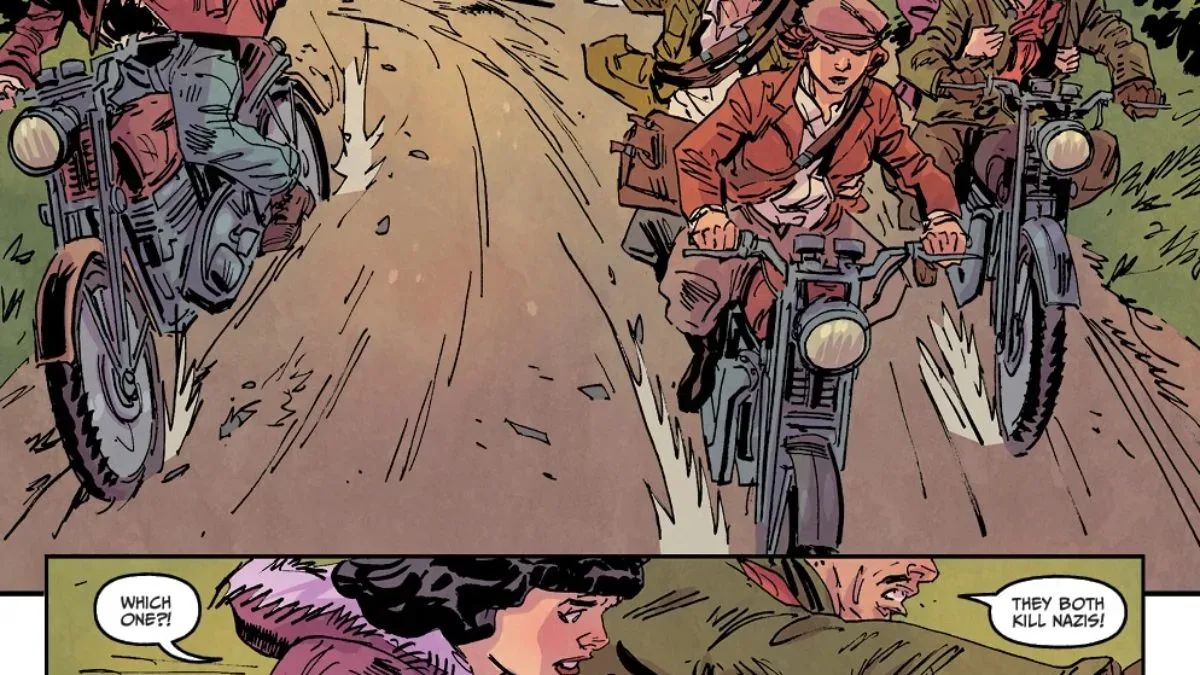
The issue is not confined to a room full of hostile officers. Its previewed events include a motorcycle pursuit, a confrontation involving a half-track and aerial combat. A half-track is a vehicle that combines wheels at the front with tracks at the rear, a configuration associated with moving people or equipment across rougher terrain. In comic-book action terms, it offers both the speed of a vehicle chase and the instability of a large moving platform.
The aerial material also gives Cliff a natural arena: flying. Yet even there, the danger is not abstract. A Messerschmitt pilot shoots at Cliff, and the exchange reportedly includes the opponent damaging his own wing. That detail lends the sequence a dose of dark slapstick amid the conflict, while keeping the broad direction clear: Cliff and Betty are being actively pursued, not merely working around a distant threat.
Motorcycles, armored transport and aircraft make for escalating kinds of jeopardy. On a motorcycle, survival depends on speed, balance and split-second maneuvering. A fight around a half-track means a hard, moving target and little margin for error. Aerial combat compounds the stakes because altitude itself becomes a hazard. These situations can highlight why Cliff is useful despite his lack of formal spy credentials: he has skills that remain valuable once secrecy gives way to a chase.
But the set pieces also make the dinner scenario more precarious. If an operation has already produced gunfire, a pursuit or an aerial clash, anyone connected to Cliff may face greater attention. The comic’s question is therefore not merely whether he can fight his way free. It is whether he can transition from visible mayhem back to controlled concealment long enough to protect Betty.
Why the captured handler changes the mission
An MI6 handler, in the context presented here, is the intelligence contact responsible for directing or supporting Cliff. With that person a prisoner, Cliff loses a key source of operational guidance. This is an important narrative distinction: a captured ally is not only someone to rescue but also a missing part of the plan.
A handler’s absence can leave a field agent without vetted intelligence, contingency instructions or a trusted point of contact. The solicitation does not specify which of those resources Cliff had been using, and it would be wrong to add details that have not been provided. Still, it clearly frames his task as one shaped by inexperience. He is being asked to handle an espionage problem without the person who could have helped translate broad objectives into workable choices.
That setup keeps Cliff’s status as a stunt pilot meaningful rather than incidental. A stunt pilot is trained to execute dangerous aerial feats safely and precisely; a secret agent is trained for covert work. There can be overlap in courage, observation and composure, but the disciplines are not interchangeable. Infiltrator! #3 appears to draw drama from that gap rather than pretending it does not exist.
Betty is central to the stakes
Betty’s dinner invitation is not background flavor. It is the reason Cliff has to operate around people who represent an immediate threat. The available description positions her within the setting where the enemy officers are gathered, while Cliff must find a way to keep her safe. That makes the personal stakes inseparable from the espionage plot.
The issue’s solicitation does not explain why Betty is invited, what she knows, or whether she is acting under an assumed identity. Those are story details best left to the comic. What the setup does establish is the intense asymmetry of the moment: Cliff has to assess a hostile social environment while someone he cares about is already inside it. The prospect of danger does not rest in a far-off fortress or a theoretical battle; it is waiting across a dinner table.
That kind of scenario asks for a different brand of heroism than an airborne rescue. Cliff may have to delay action, read a room and choose the least dangerous moment to intervene. The suspense comes from the possibility that the most obvious move could be the worst one.
Creative team and edition details
Hardman writes the issue, with interiors by Kotz. Díaz handles colors and Lee handles lettering. A comic’s colorist and letterer can be especially important in an action-and-espionage story: color helps distinguish location, time and danger, while lettering has to keep rapid exchanges, radio-like communication and action beats readable. No assessment of the finished execution can be made from the supplied details alone, but the credits identify the creative roles behind the issue.
The standard edition is listed at $4.99 in the United States. Two additional editions are listed at the same U.S. price: Variant B by Ito and a retailer-incentive Variant RI (10) by Alpi. The designation “RI (10)” identifies the variant as a retailer-incentive edition, while the provided material does not specify distribution terms beyond that label. Canadian pricing is listed as $6.99 for both variants.
- Title: The Rocketeer: Infiltrator! #3
- Publisher: IDW Publishing
- On sale: September 23, 2026
- Format: 32 pages, Rated T
- Writer: Gabriel Hardman
- Artist and main cover: Dean Kotz
- Colors: K.J. Díaz
- Letters: Shawn Lee
- U.S. price: $4.99
What readers should expect from issue #3
The information available promises a collision of pulp action and covert tension: an imprisoned MI6 contact, Betty surrounded by Nazi officers, and Cliff forced to make up for missing spycraft with instincts developed far from intelligence work. The chases and aerial confrontation suggest the story will not keep the pressure contained to the dinner, while the dinner itself provides the more delicate threat.
For readers following comic publishing more broadly, the contrast between a traditional single-issue release and the shifting digital ecosystem remains notable; our look at the difficult audience migration confronting webcomic creators examines a very different part of that ecosystem. Here, though, the immediate appeal is straightforward: a hero accustomed to surviving impossible aerial situations has to face an enemy setting where simply looking out of place could be disastrous.
The Rocketeer: Infiltrator! #3 has a clean central challenge. Cliff Secord can fly, fight and improvise under fire. The issue asks whether those talents can protect Betty when the essential skill is not getting noticed at all.