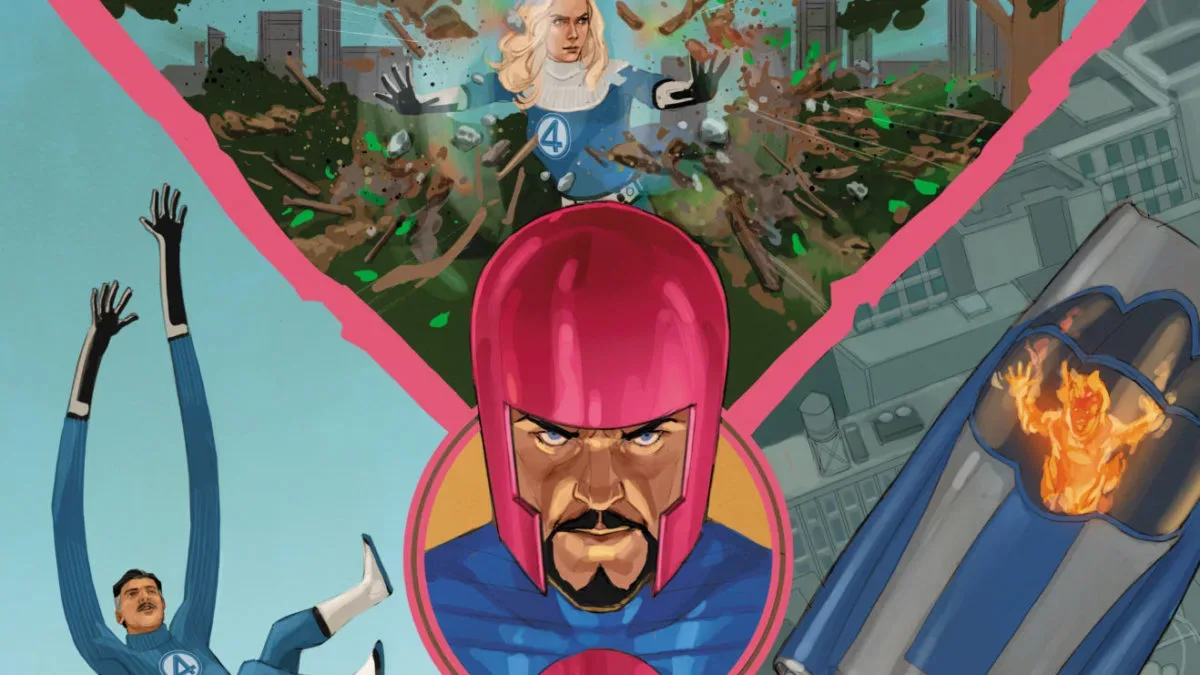
Spoilers for Queen In Black #4 and Queen In Black: Defenders Of Light And Dark #3 follow.
Marvel’s latest symbiote catastrophe has reached London, but Queen In Black #4 uses the invasion to reveal a more distinctly British problem in its fictional continuity: Hydra’s New Hydra Party has made substantial gains in recent local elections. The result, as presented in the issue, is a sharp reduction in support for Britain’s superheroes and a conspicuous absence of the nation’s usual superhuman defenders during an attack that plainly needs them.
The issue is written by Al Ewing, with art by Iban Coello and Paco Medina. It arrives as part of a larger conflict in which Hela, operating as the Queen in Black and commanding Venom symbiotes, is turning Earth into a staging area for her war with Knull, the former King in Black. That cosmic premise has massive stakes by design. The London material makes those stakes local: amid a symbiote assault around Tottenham Court Road station, the question is not only how the city will survive, but why its own heroic infrastructure is so thin on the ground.
A London emergency without Britain’s usual backup
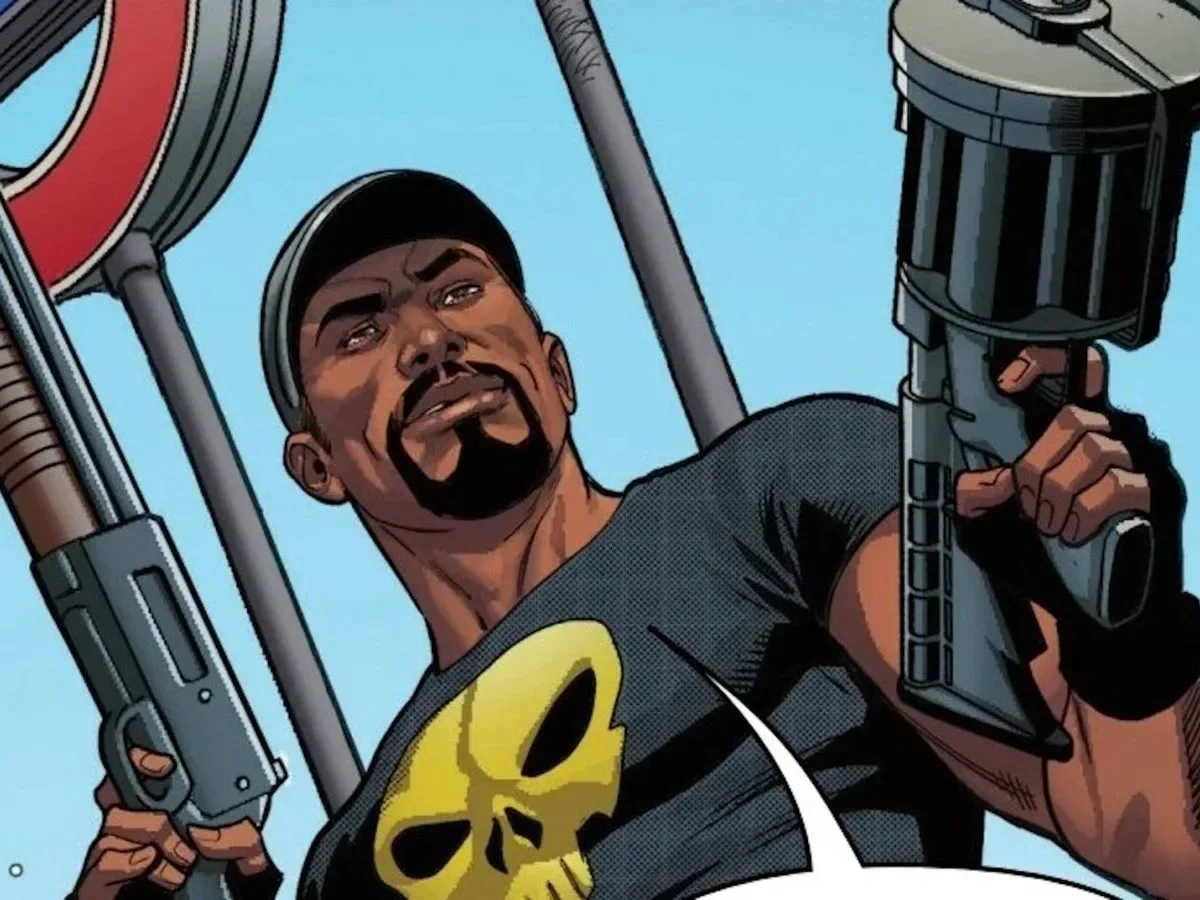
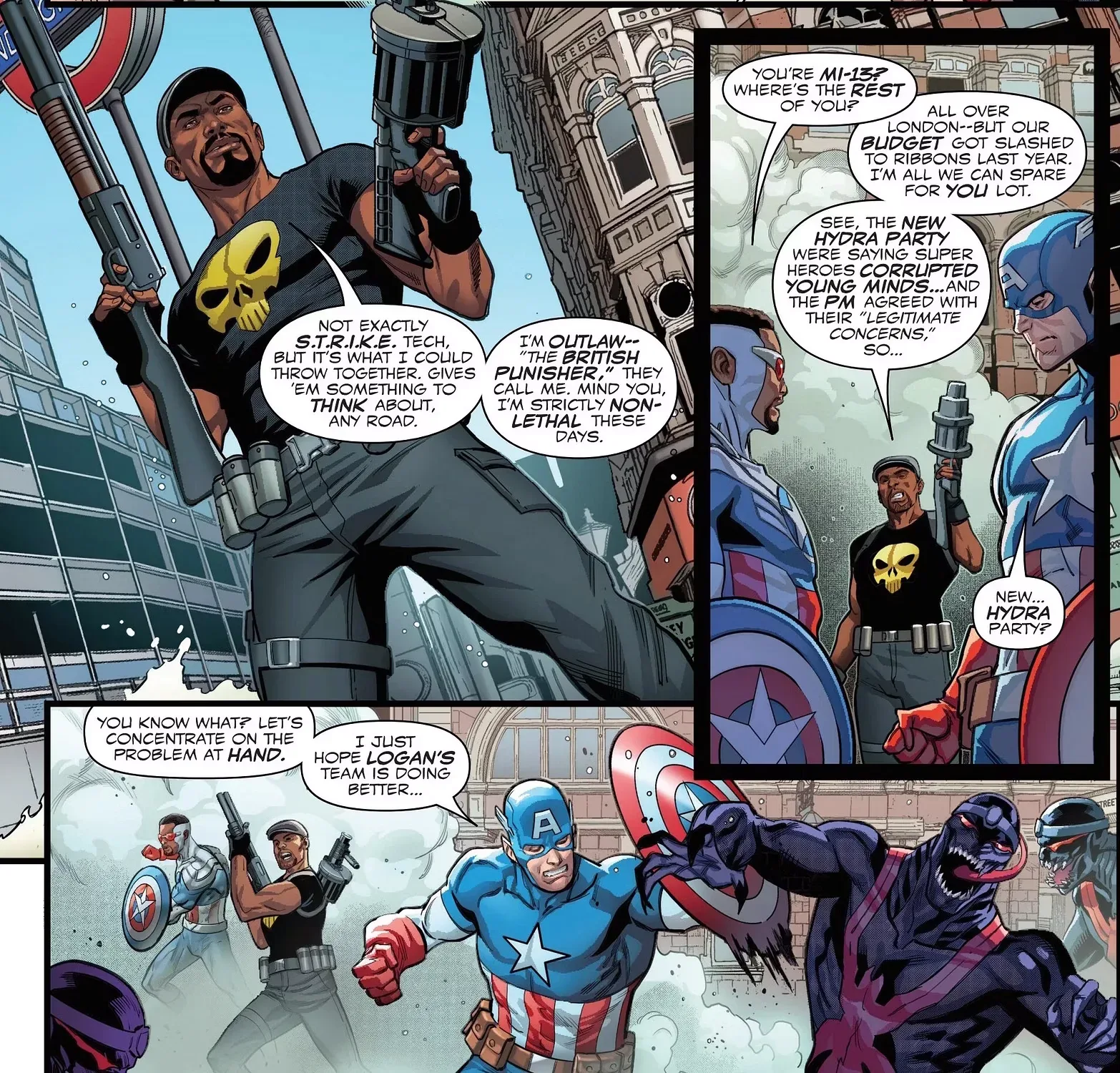
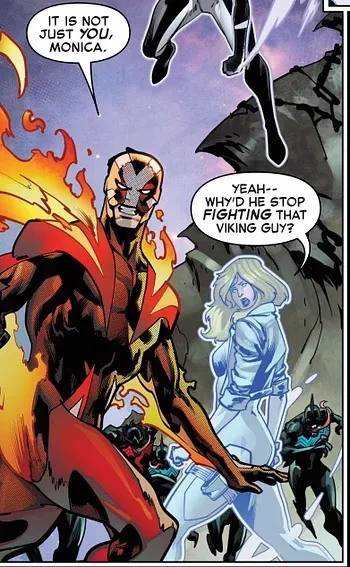
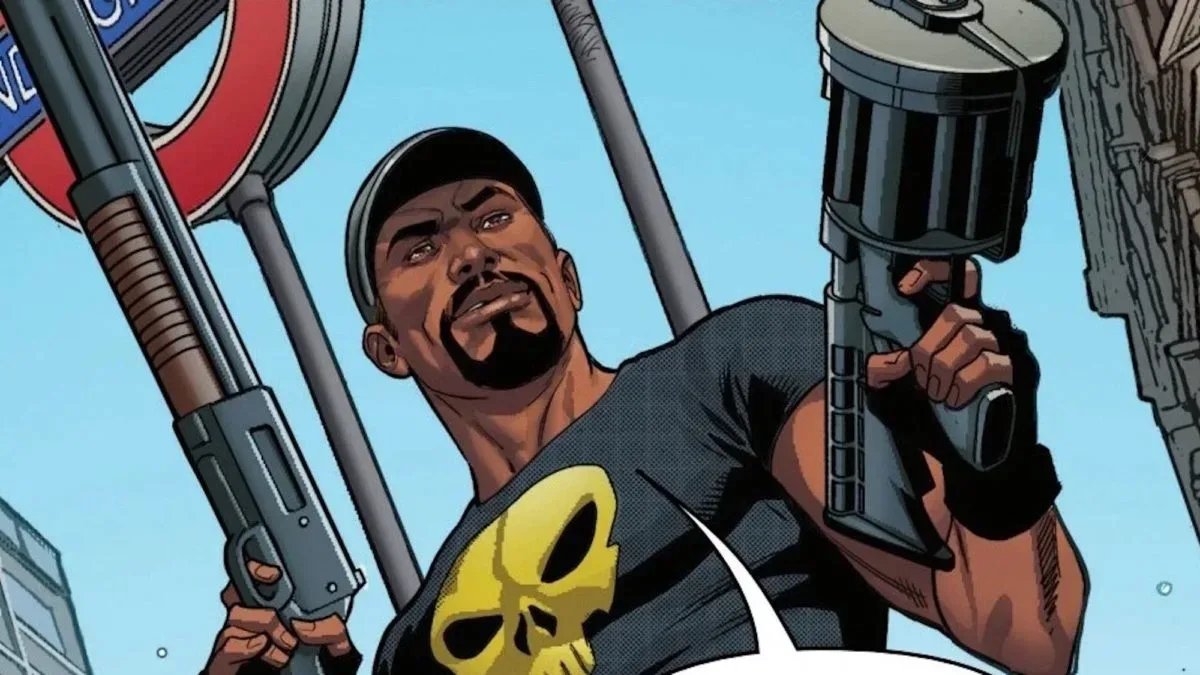
The specific setting matters. Two Captain Americas and a Greek god are at the corner of Oxford Street and Charing Cross Road, close to Tottenham Court Road tube station, looking for British heroes as well as S.T.R.I.K.E. and MI-13. Neither organization appears to answer the call. Instead, the responding local figure is Nigel Higgins, better known as Outlaw or the British Punisher.
Outlaw is not a newly invented emergency substitute. He was created by Dan Abnett, Andy Lanning and Douglas Braithwaite in Punisher #64 in 1992. His return gives the sequence a deliberately rough-edged answer to the missing-heroes problem: London has someone willing to show up, but not the broad official response that readers might expect from a capital city in Marvel’s superhero world.
That absence also makes the issue’s political revelation practical rather than merely decorative. The New Hydra Party’s position is framed around opposition to heavy spending on superheroes. In a world where symbiotes can overrun a major transport and shopping district, cuts to superhuman support are not treated as an abstract budget debate. They become part of the immediate tactical disadvantage. Outside heroes have to help hold the line because domestic resources are unavailable.
What the New Hydra Party changes
Hydra is a familiar Marvel villain name, historically associated with clandestine power and authoritarian ambition. A group using that name as a political party changes its function in the story. Rather than being only an enemy cell to punch through, it becomes a force that can influence institutions, funding and public trust.
Queen In Black #4 does not need to stop its symbiote plot to present an exhaustive account of an election. The core information is simpler and more consequential: Hydra’s aligned party has performed well enough to help shrink institutional backing for costumed protectors. That is why the comic’s London set piece has an unusual composition. The people confronting the disaster include American heroes and a god, while British agencies and marquee defenders are missing.
The party’s rhetoric also turns a classic superhero-comics tension into a pointed plot device. Secret identities, masks and extraordinary public expense have long been sources of distrust in fictional universes. Here, the argument against heroes asks what masked people might be concealing, while presenting their existence as an unacceptable cost. The issue places that suspicion beside a visible monster invasion, allowing the reader to see the immediate risk of treating superhero protection as expendable.
The story follows earlier tension surrounding Britain and mutants during the Age of Krakoa, when the United Kingdom in Marvel continuity did not recognize Krakoa. Otherworld mages gained influence, mutants were treated as outsiders, and fear supported more restrictive policies. Against that backdrop, the New Hydra Party is not presented as an isolated twist. It fits a Britain already depicted as vulnerable to anti-mutant hostility and a retreat from superhuman cooperation.
The Captain Britain-sized gap
The natural question after the London scenes is where Captain Britain is. The role has long been Marvel’s most obvious shorthand for a British superheroic response, so its absence is especially noticeable when London is under siege. Queen In Black: Defenders Of Light And Dark #3, released the same day, appears at first to offer an answer.
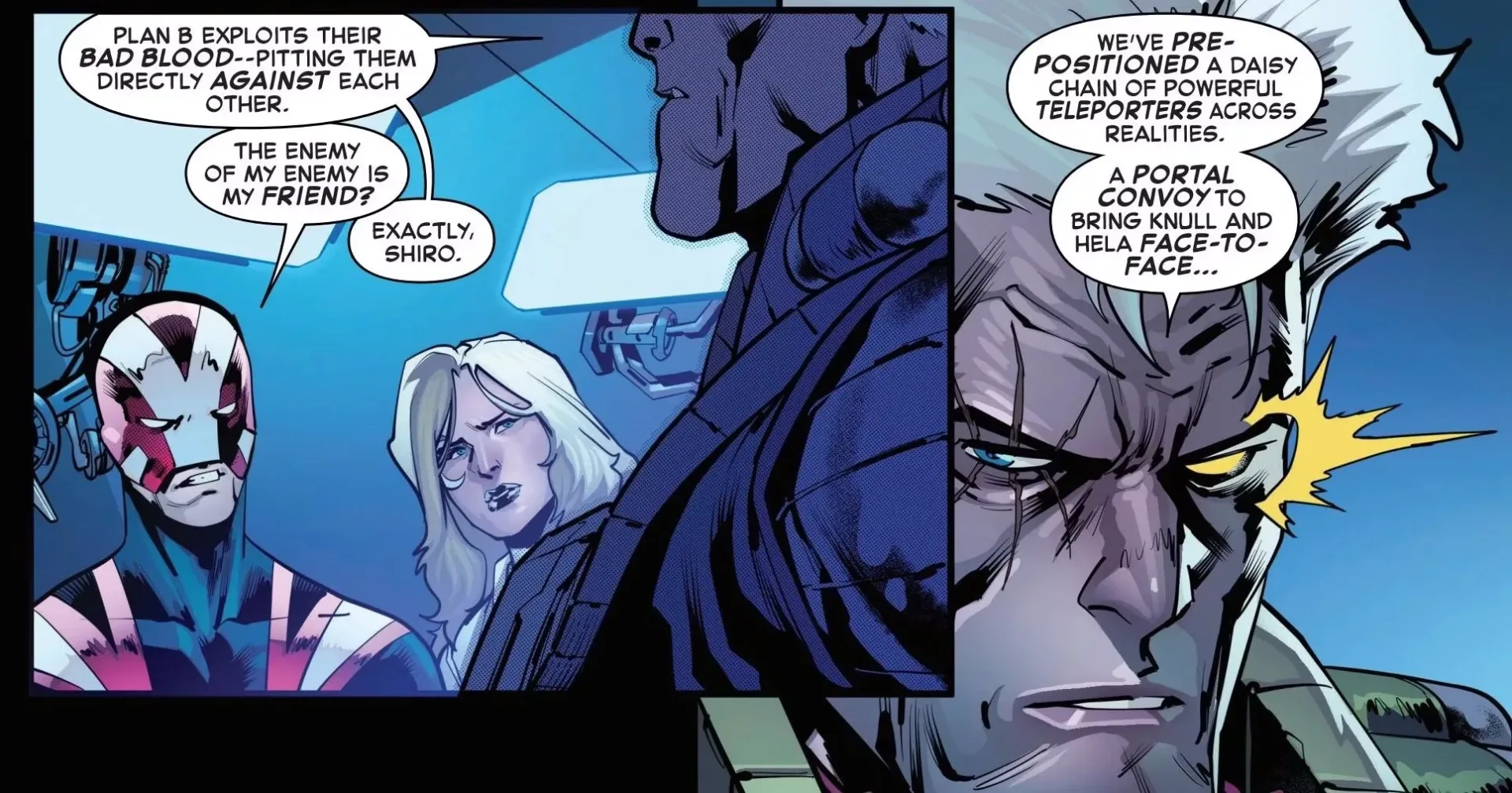
In the companion issue by Tom Waltz and Ze Carlos, the Avengers are fighting on a much larger stage, moving from America into a conflict that reaches across the galaxy. A figure wearing Union Jack-style colors seems, on first glance, to be Captain Britain heading into space.
But the character is identified as Shiro Yoshida, better known as Sunfire. Sunfire is the Japanese superhero who was a founding member of the team introduced in Giant-Size X-Men. His appearance in colors strongly associated with Captain Britain is therefore striking, especially because earlier issues gave him a different visual presentation.
There is not enough information in these issues alone to establish why Sunfire is dressed this way. It may be an intentional story detail with a later explanation; it may be a coloring or production inconsistency. The important point for now is that the image does not confirm Captain Britain’s return. It makes the character’s absence from London more conspicuous while adding a visual mystery to the cosmic side of the event.
Sunfire’s placement is also a useful reminder that team-book imagery can carry narrative ambiguity. A costume’s colors can signal allegiance, a temporary role, an alternate identity, or simply create confusion when a long-established visual association is invoked. Until the comics explain the choice, readers should treat the Union Jack palette as a question, not as proof that Shiro has become Captain Britain.
How the two issues connect
The two comics operate at very different scales. Queen In Black #4 includes Tyr unleashing a final weapon against the battered Avengers, while Reed Richards investigates Codex’s half-symbiote power in the Baxter Building. The issue’s solicitation asks whether Venom’s golden era and Earth itself may be nearing their end. Those threads put personal rivalries, scientific investigation and planetary danger into one event chapter.
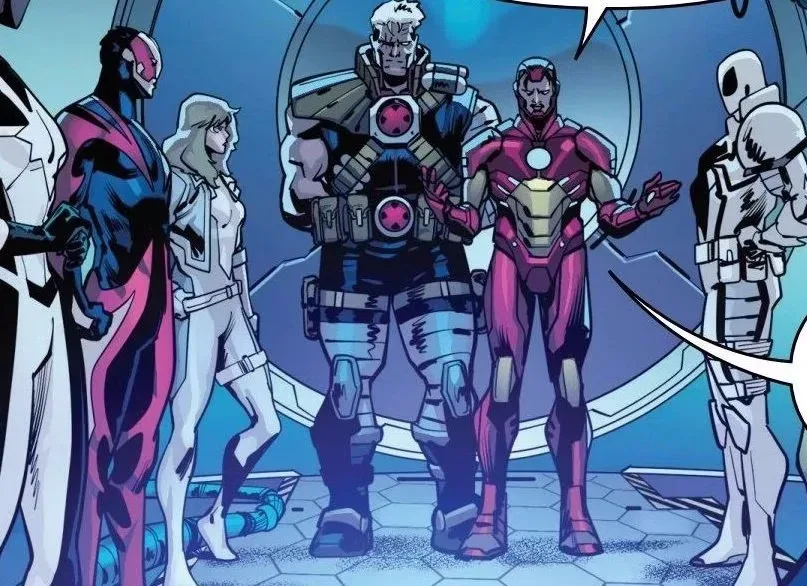
Defenders Of Light And Dark #3 is positioned as a grand finale built around two damaged strike teams. Knull and Hela have been emboldened by the Defenders’ setbacks, forcing Team Light and Team Dark toward a desperate Plan B. Its purpose is to bring those opposing forces together against the threat of Earth becoming another battlefield in the conflict between the Queen in Black and the God of Light.
Read together, the books show why an event can sustain both cosmic spectacle and national consequences. Hela and Knull’s war is enormous, but its repercussions do not land evenly. London’s predicament in Queen In Black #4 is shaped by who has been funded, who has been marginalized and which agencies have failed to appear. The galaxy-spanning action in Defenders Of Light And Dark #3 may explain why prominent heroes are elsewhere, but it does not erase the critique built into the London scenes.
That combination is the strongest idea in the material. Marvel’s Britain is not simply helpless because a crossover needs guest heroes to save the day. The comic links the shortage of local defenders to a political movement whose rise has affected the public support around superheroes. Whether future issues expand on the New Hydra Party or leave this as a sharply targeted piece of world-building, the immediate effect is clear: Britain’s superhero safety net has been weakened at the worst possible moment.
Why it matters for Marvel’s wider continuity
For readers tracking Marvel’s mutant side, the British material adds to a continuing picture of a country where supernatural and superhuman anxieties can be mobilized into policy. The prior Krakoa-era hostility mentioned in the issue provides context for the New Hydra Party’s anti-superhero posture. Both stories hinge on a familiar political mechanism within genre fiction: portray an already-visible minority or protected class as an unaffordable danger, then use the resulting fear to justify exclusion or withdrawal of support.
For readers following the broader event, Outlaw’s appearance anchors an otherwise universe-sized story in a specific location and a lesser-seen British character. The Captain Britain question, meanwhile, remains deliberately unresolved. And the Sunfire colors in Defenders Of Light And Dark #3 ensure that the event’s visual continuity has its own unresolved hook.
There is also a broader connection to Marvel’s current use of history and identity as active pressure points rather than background trivia. That approach is visible elsewhere in the X-line, including the recent story placing X-Men history on the front line against 3K. Here, Britain’s earlier treatment of Krakoa-era mutants informs the social terrain on which Hydra’s party can gain traction.
Queen In Black #4 and Queen In Black: Defenders Of Light And Dark #3 are published by Marvel Comics. Each issue is listed at $4.99 and dated September 16, 2026.
Shop the products
Check current price, model and availability at the retailer.