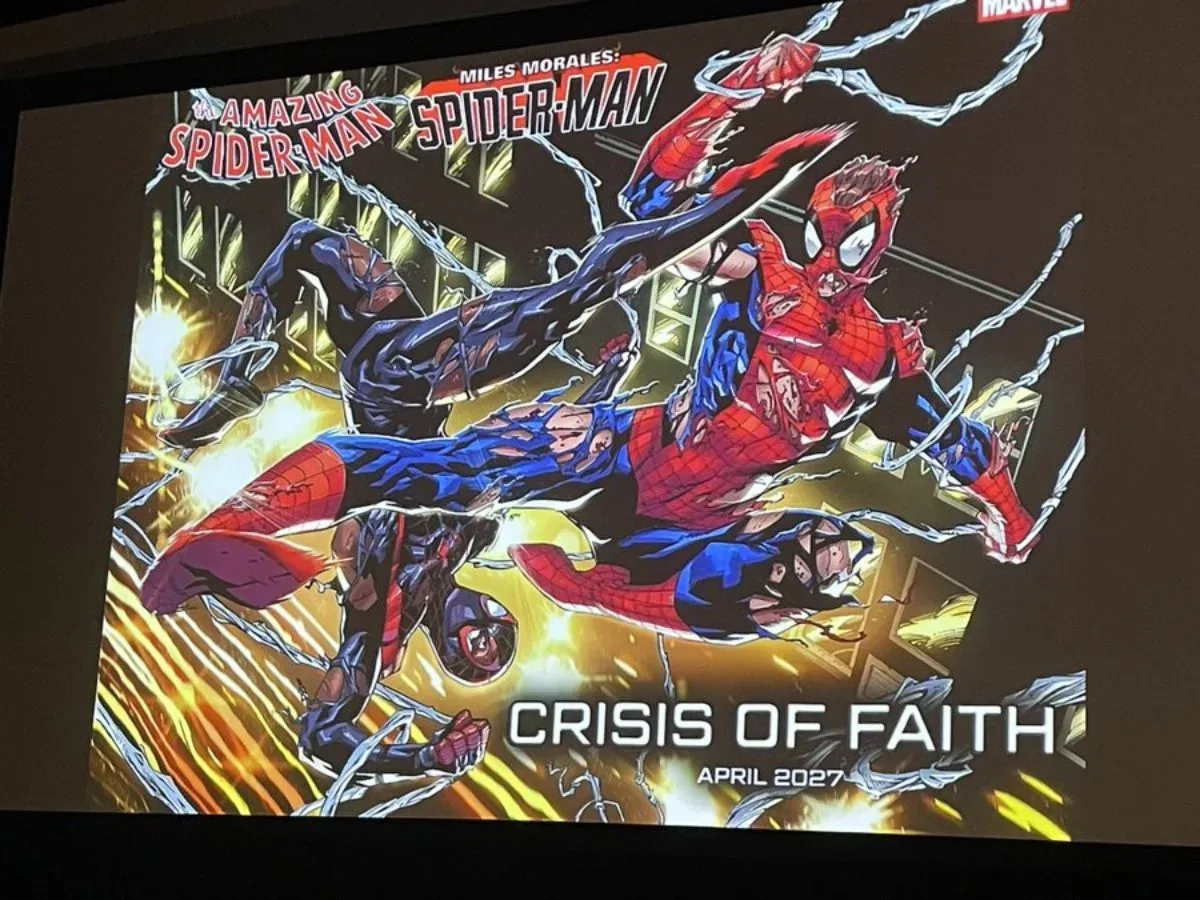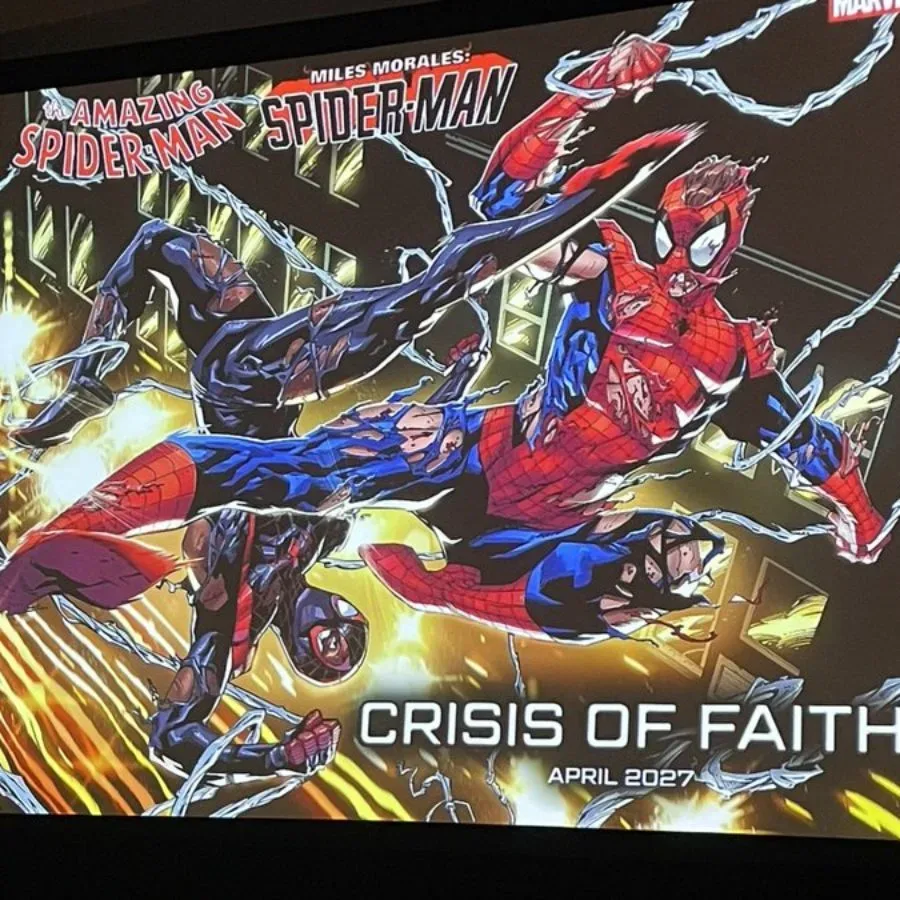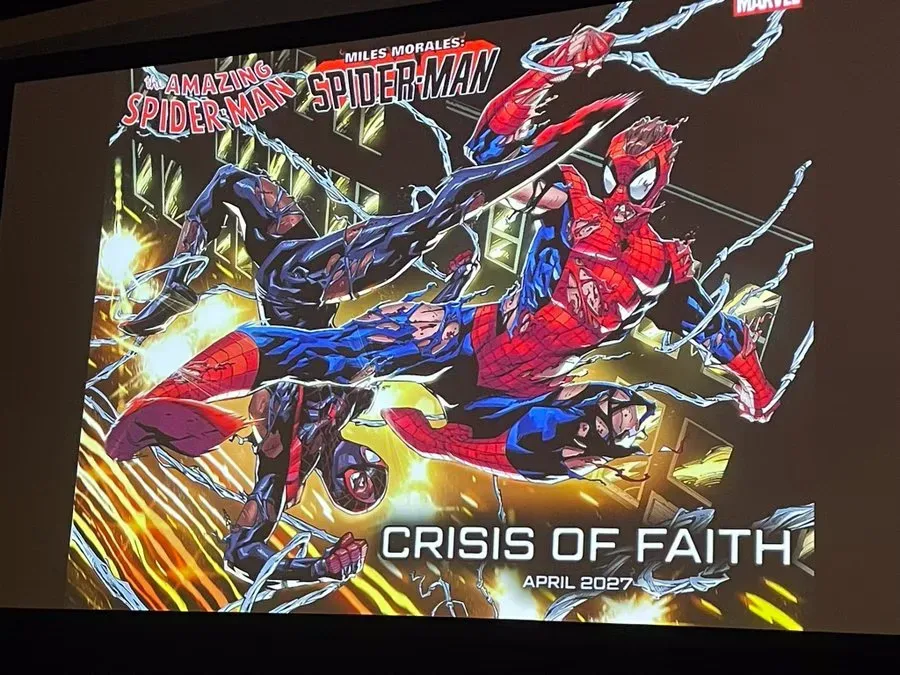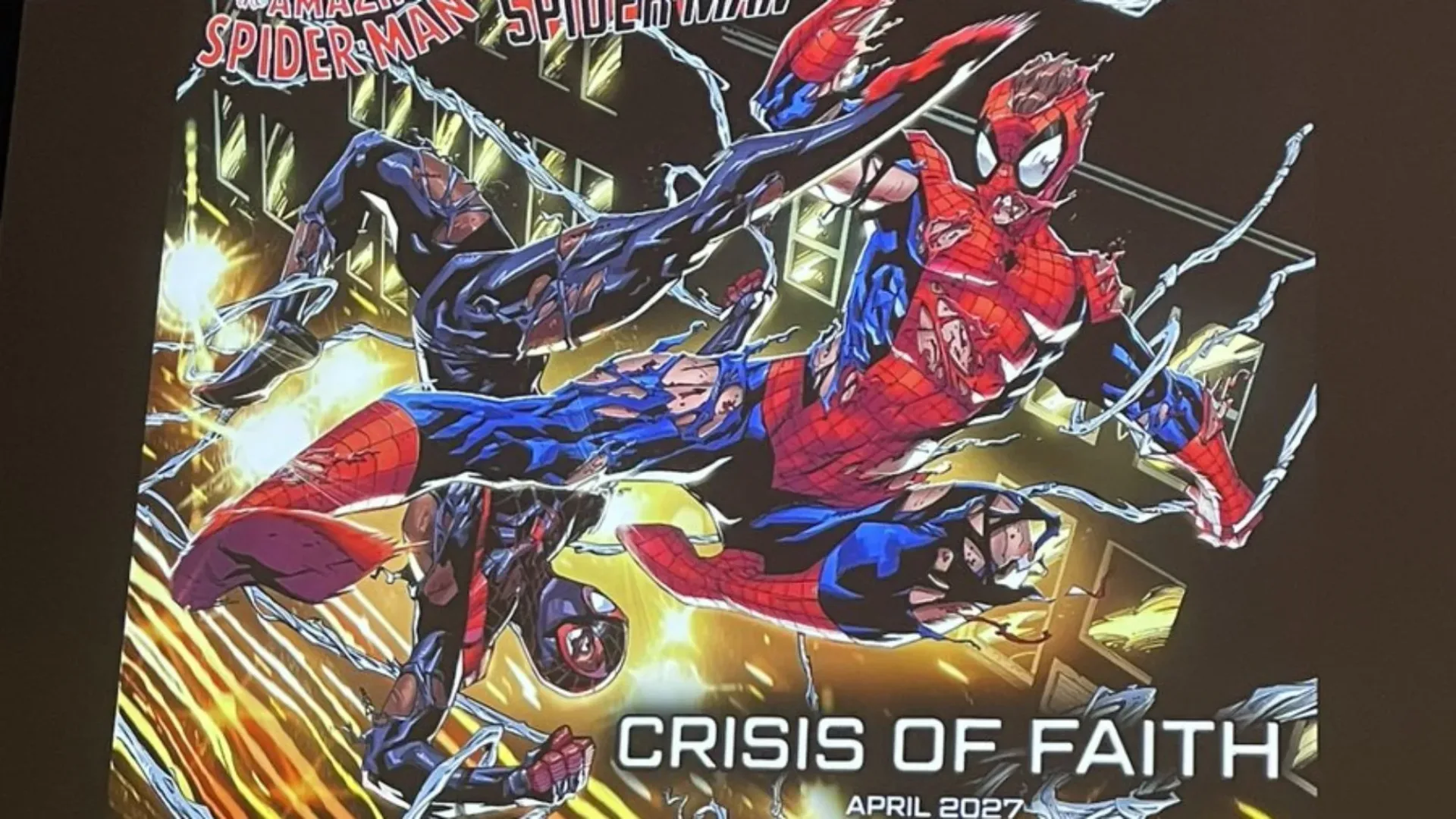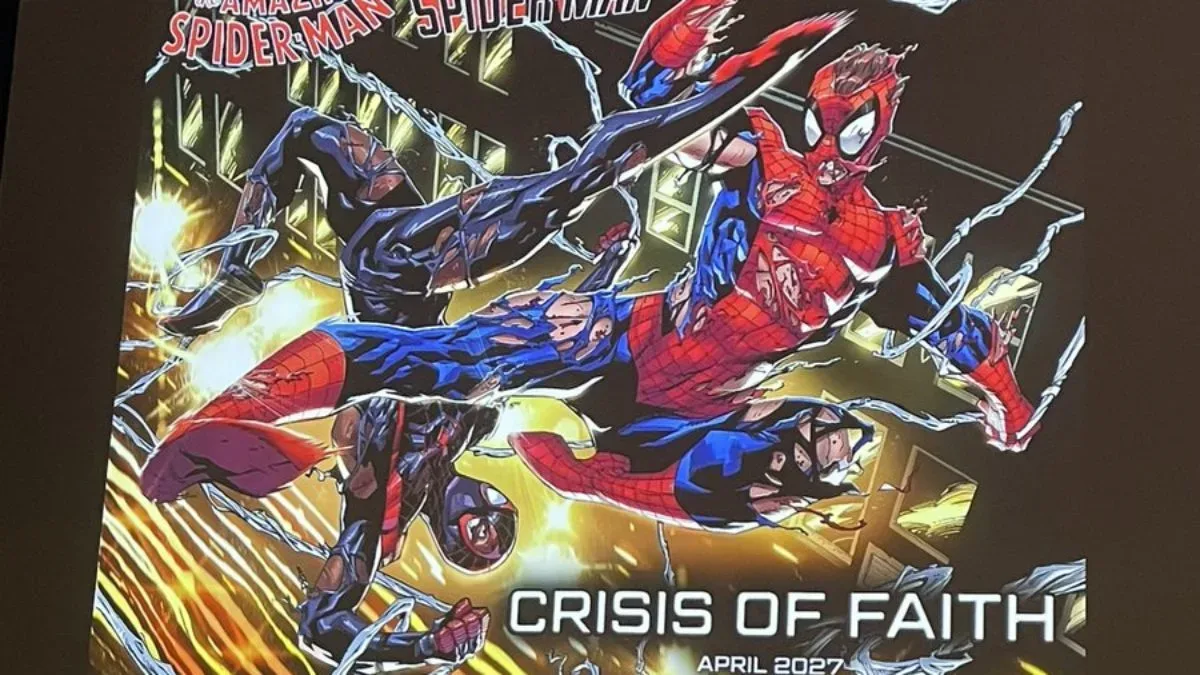
Marvel has revealed Miles Morales/Peter Parker Spider-Man: Crisis of Faith, a crossover planned for April 2027. The story will unite Peter Parker and Miles Morales in what has been positioned as a direct, high-stakes clash between the two Spider-Men.
Joe Kelly and Bryan Edward Hill will co-write the event. Their involvement gives the crossover an immediate practical significance: each writer is already associated with one of the characters’ regular series, so Crisis of Faith is set up to bring two ongoing character perspectives into the same central conflict rather than feeling like a detached interruption.
The core tension is not simply another team-up against a shared villain. Peter is dealing with a crisis of confidence in the aftermath of Hellgate’s arrival, while Miles is unhappy with the decisions Peter has been making. That premise makes the title especially pointed. A “crisis of faith” can mean doubt in one’s own ability, doubt in a mentor or partner, or doubt that a hero’s methods remain sound. In this case, all three possibilities are present in the announced setup.
What Marvel has confirmed
- Title: Miles Morales/Peter Parker Spider-Man: Crisis of Faith.
- Release window: April 2027.
- Writers: Joe Kelly and Bryan Edward Hill.
- Lead characters: Peter Parker and Miles Morales.
- Premise: Peter’s shaken self-belief following Hellgate becomes a point of friction with Miles, who objects to choices Peter has made.
The crossover was revealed during a Spider-Man-focused presentation at New York Comic Con 2026. The panel was framed as a look ahead for Marvel’s web-slinging corner, including Peter, Miles and Gwen Stacy, though the announced details specifically establish Peter and Miles as the focal pair for Crisis of Faith.
Important details remain unannounced. There is no confirmed issue count, artist, format, exact release schedule or full supporting cast in the information available so far. There is also no indication that Gwen Stacy will have a role in the crossover itself simply because she was included in the broader panel’s preview of upcoming Spider-Man material. Readers should treat those questions as open rather than fill them in from the event’s broader Spider-Man framing.
Hellgate is the key piece of Peter’s current predicament
The announced story builds on Peter’s recent encounters with Hellgate, an alien warrior introduced in Amazing Spider-Man in 2025. Hellgate’s first major confrontation with Spider-Man was not a narrow defeat. He overpowered Peter, sent him across the cosmos and argued that Spider-Man needed to become stronger. Hellgate also threatened Earth and the people Peter values, establishing the villain as a personal challenge to Peter’s responsibility as well as his physical capability.
Peter later faced Hellgate again with new allies and an enhanced suit. The conflict ended when allies crashed a starship onto Hellgate. But the resolution was deliberately unstable: Hellgate maintained that the result was neither fair nor a genuine defeat, and that his confrontation with Spider-Man would continue.
That history matters because it explains why Peter’s confidence problem is more substantial than ordinary post-battle frustration. Hellgate did not merely beat him; he made Peter’s perceived inadequacy the subject of the conflict. Peter is still looking for ways to get stronger, and that ongoing drive is now positioned as the emotional pressure point that brings Miles into opposition with him.
Why “getting stronger” may not be a simple solution
In superhero comics, an upgraded suit or a new ally can be a literal answer to a threat. Peter’s situation appears more complicated. Hellgate’s challenge has made strength into a measure of Peter’s worth and fitness to protect others. That can push a hero toward escalation: taking greater risks, pursuing power at any cost, working alone, or treating caution from friends as an obstacle instead of valuable accountability.
None of those specific actions has been confirmed for Crisis of Faith. They are, however, the stakes suggested by the setup. Miles being angry about Peter’s choices makes this a disagreement over judgment, not just a debate about whether Hellgate is dangerous. The event’s conflict may therefore be strongest when it asks whether Peter’s response to failure is making him more effective—or simply less able to recognize the cost of his actions.
A collision between two Spider-Men
Peter and Miles have a built-in connection that gives this premise weight. Both carry the Spider-Man identity, and Miles’ concern can be read as an intervention from someone who understands the demands of that responsibility from the inside. He is not an outside observer telling Peter how a superhero should behave. He is another Spider-Man assessing choices that could affect the people, neighborhoods and allies both heroes are expected to protect.
The “no holds barred” description attached to the event signals a more confrontational crossover than a routine shared mission. It does not confirm precisely how far their dispute will go, whether it will become a physical battle, or how long the rift will last. But it does establish that Marvel intends the difference between Peter and Miles to be the dramatic engine, rather than a minor obstacle before a familiar team-up.
That distinction is useful for readers considering where the event fits. A crossover is a story that crosses the boundary between separate ongoing titles or character lines. It can use the relationship between those books to create a conflict neither series could fully stage alone. With Kelly and Hill writing together, the stated structure suggests an attempt to preserve both characters’ points of view: Peter’s fear that he is not strong enough after Hellgate, and Miles’ conviction that Peter’s response has gone too far.
Whether the story ultimately proves one Spider-Man right, finds fault on both sides, or redirects their conflict toward Hellgate has not been revealed. The unresolved Hellgate rivalry makes a future return plausible within the broader setup, but his participation in Crisis of Faith itself has not been confirmed.
What the creative pairing could mean
Kelly and Hill coming together is one of the clearest concrete details beyond the title and date. A dual-writer crossover can serve several functions. It can keep the voice and concerns of each lead character close to their respective ongoing stories, and it can make the event feel less like one hero has wandered into the other’s book. Here, it also matches the concept: Peter and Miles are not simply sharing panel time, but approaching the same crisis from conflicting moral and emotional positions.
The arrangement does not tell readers how the scripts will be divided, and no issue-by-issue creative breakdown has been provided. Still, it underscores that the crossover is rooted in the present direction of both Spider-Man series. Peter’s post-Hellgate struggle and Miles’ reaction are the stated foundations, rather than a newly introduced threat with no connection to either hero’s current circumstances.
What readers should watch for before April 2027
The announcement leaves several story questions worth tracking in the lead-up to release:
- Peter’s next steps after Hellgate: The crossover’s premise rests on Peter continuing to seek greater strength. The manner in which that search develops will shape why Miles believes intervention is necessary.
- Miles’ specific objections: Marvel has established that he is unhappy with Peter’s choices, but has not identified those choices. The distinction will determine whether the dispute is tactical, personal or ideological.
- Hellgate’s status: The villain’s refusal to accept his defeat leaves his conflict with Peter unresolved. That does not confirm an appearance in the event, but it remains the key background pressure behind Peter’s crisis.
- The crossover’s structure: Readers still do not know its number of issues, participating titles or full art team, all of which will matter for following the story.
For the moment, Crisis of Faith looks less like a celebration of two Spider-Men joining forces and more like a test of what happens when shared responsibility turns into an argument about how responsibility should be carried. Peter’s inability to put Hellgate’s challenge behind him has created the fault line. Miles is the person prepared to call out what Peter does next.
The April 2027 event arrives amid a busy comic-book slate already looking toward that year, including the newly announced reunion of Brian K. Vaughan and Cliff Chiang for Roam. For Spider-Man readers, though, the immediate question is narrower and more personal: after being told he was not strong enough, can Peter Parker regain his footing without losing the trust of Miles Morales?