Aladdin #3 shifts the focus to Abu, giving the familiar companion a conflict that is small in scale only in the most literal sense. The issue, published by Dynamite Entertainment, is scheduled for comic shops on Wednesday, September 16, 2026, with a $4.99 suggested retail price.
The setup places Abu between two versions of himself: the palace primate with a new home and new responsibilities, and the nimble street survivor who once treated a dangling bracelet, an unattended pocket or an accessible clothesline as an invitation. He runs away and moves through Agrabah while struggling not to fall back into those old instincts.
That premise is a useful choice for a character often defined by motion, reaction and comic mischief. Rather than treating Abu’s sticky fingers as a one-note gag, the solicitation frames them as a genuine point of pressure. He is not merely encountering valuables; he is confronting what it means to have changed when the old life remains close enough to reclaim.
Agrabah becomes Abu’s test
The streets of Agrabah are central to the issue’s conflict. Abu is repeatedly tempted to pick pockets, take laundry and steal jewelry. Those specifics matter because they make the dilemma immediate. A grand villainous scheme would put Abu in danger, but a reachable trinket tests something more personal: whether he can make a different choice when nobody is necessarily forcing him to do so.
In narrative terms, this is an internal conflict: a struggle driven by a character’s competing desires or values rather than solely by an outside obstacle. Abu’s old habits promise familiarity and instant gratification. His palace life represents loyalty and a future built with people who trust him. The tension comes from the distance between knowing what he should do and resisting what he has learned to do.
The premise also keeps the stakes suited to the character. Abu need not become a different kind of hero to carry an issue. His agility, curiosity and attraction to shiny objects are the very traits creating the problem. The story can therefore explore growth without discarding the personality that makes him recognizable.
The bottle-sized complication
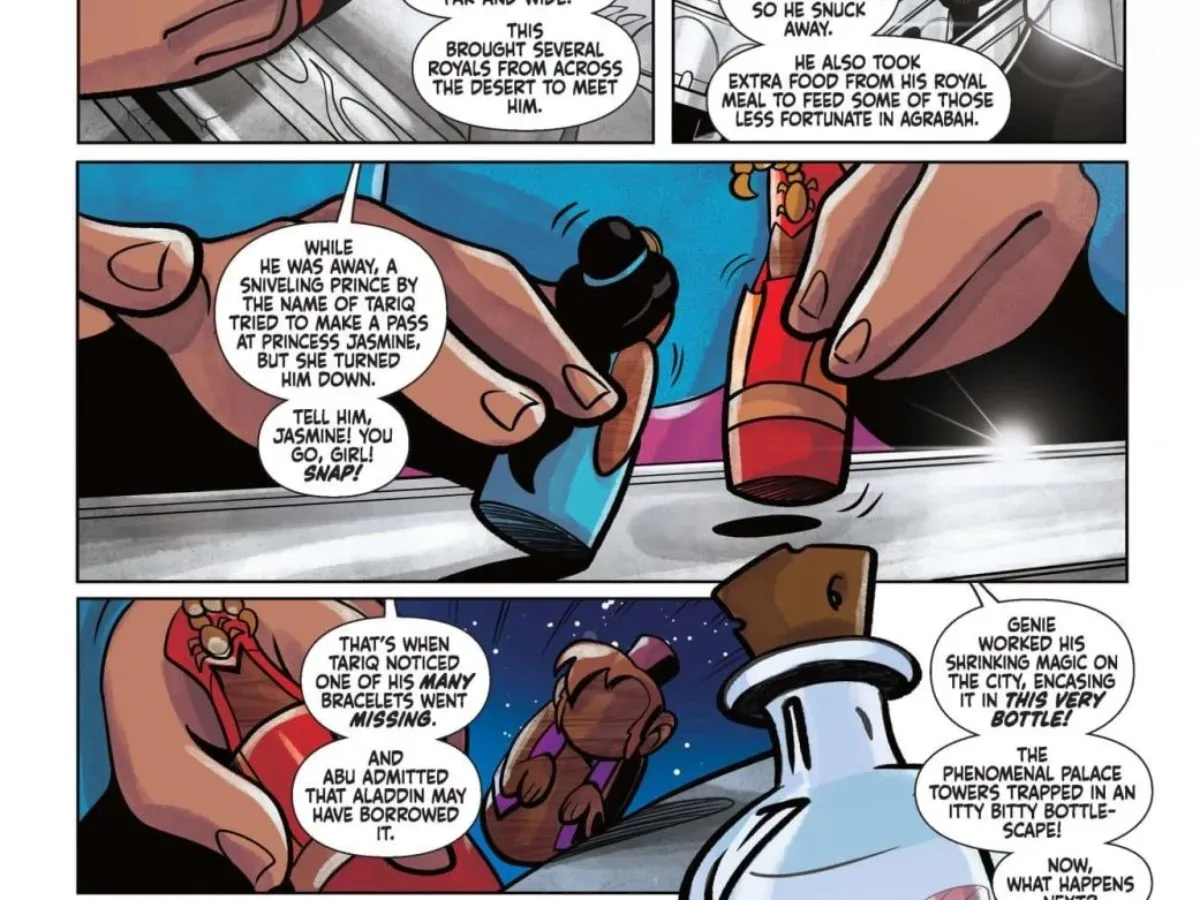
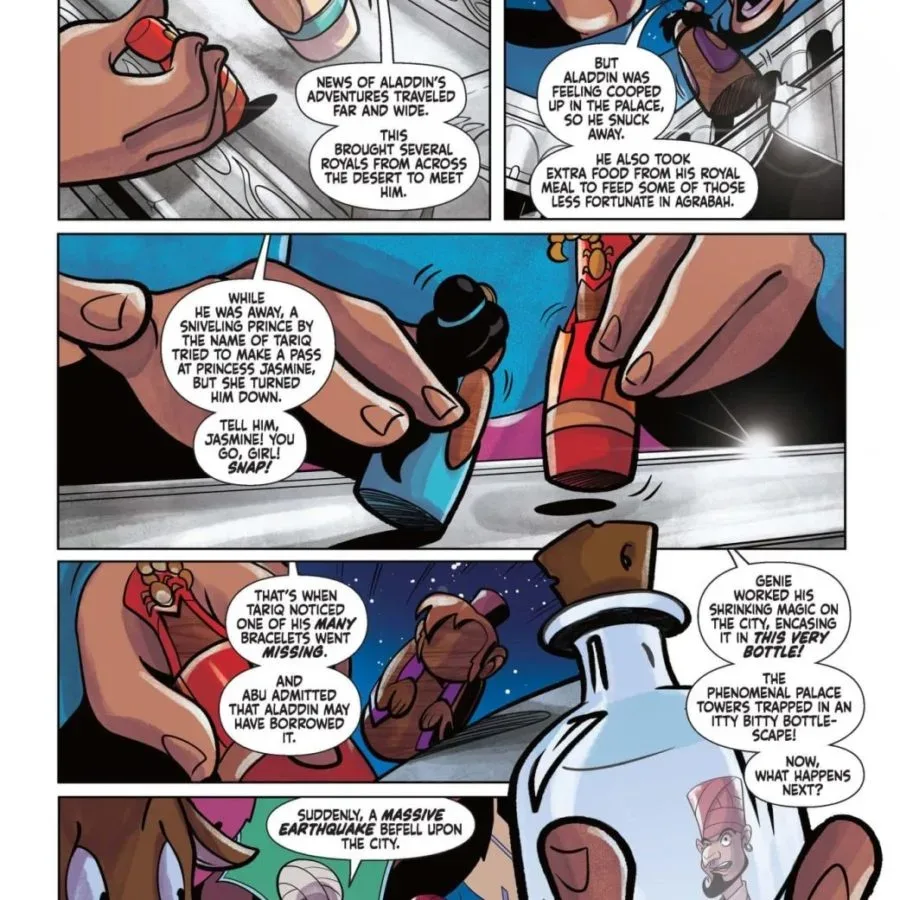
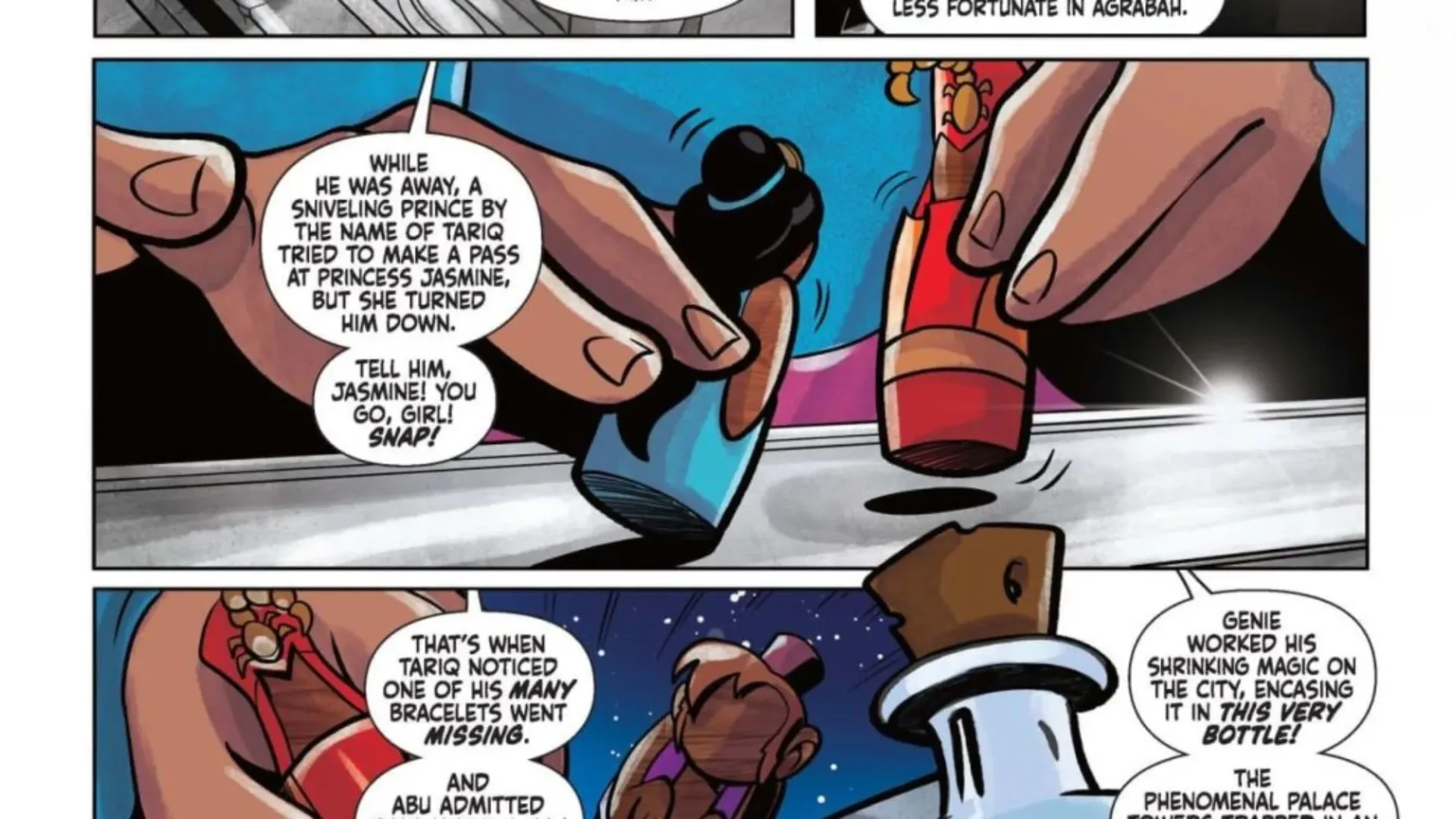
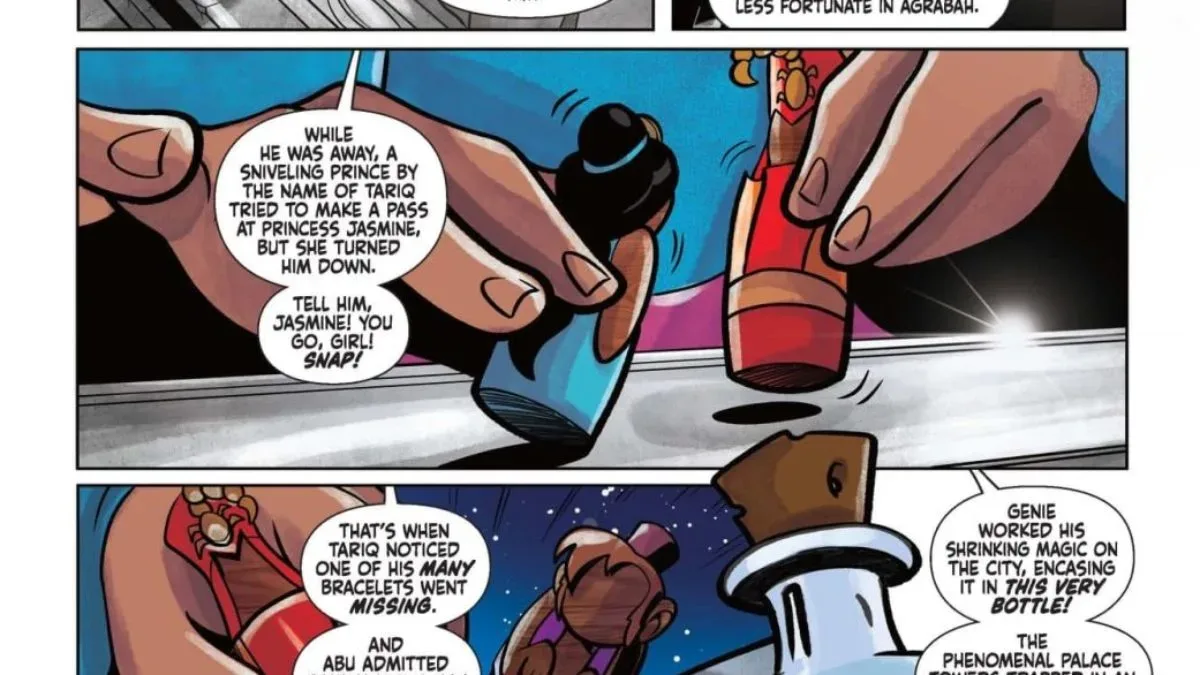
Preview material indicates that Genie’s magic has shrunk the palace into a bottle, reducing Abu and the others to insect-like size. That provides a visual and practical complication beyond the moral one. A palace ordinarily signals shelter, stability and royal protection. Once miniaturized and bottled, it becomes an image of confinement and vulnerability.
The altered scale also changes familiar dangers. A tiger described as housecat-sized is still immense from Abu’s perspective, turning a compact animal into an imposing threat. Abu’s frightened “SOWWY” in the preview material points toward a broad, animated sense of comedy, but the premise can still create meaningful peril. When characters are made tiny, ordinary spaces and creatures become unpredictable terrain.
That is the appeal of a scale shift in an adventure comic. It does not simply make everything smaller. It revises the characters’ relationship to their world. Places that should be safe may now be difficult to navigate; animals that would normally be manageable can become overwhelming; a bottle stops being a container on a shelf and becomes a boundary around an entire community.
For Abu in particular, the bottle-sized palace creates an interesting contrast. He is trying to move beyond theft while his world has been reduced to something that can itself be carried away, contained or lost. The preview details do not establish how the shrinking crisis began or how it will be resolved, but they make clear that Abu’s personal crossroads unfolds amid a much bigger magical disruption.
Why Abu’s story can carry an issue
Sidekick characters can be easy to keep at the margins of an adventure. They assist, react and punctuate dramatic scenes, but their wants are often assumed rather than explored. Making Abu the center of Aladdin #3 creates room to examine the cost of belonging somewhere new.
His former life is not described as an abstract flaw. The story identifies concrete actions—lifting pockets, swiping clothes and taking jewelry—that made survival and mischief possible. The palace, meanwhile, gives him a different identity, but that does not automatically erase reflexes built before he arrived there. The conflict is therefore less about whether Abu is “good” or “bad” than whether a new environment is enough to overcome an old pattern.
That approach can work especially well in an all-ages-friendly adventure framework. The lesson, if the issue chooses to emphasize one, does not need to be delivered as a speech. A character faced with one tempting opportunity after another can show the difficulty of change through decisions, slips and consequences.
It also gives the supporting cast a chance to matter through Abu’s absence. When a companion runs away during a magical emergency, the choice affects more than the runaway. The solicitation does not reveal how Aladdin, Genie or the palace’s other residents respond, so readers should not assume the scope of the fallout. Still, Abu leaving at such a vulnerable moment naturally raises the importance of trust within the group.
Creative team, covers and buying details
James III writes Aladdin #3, with interior art by Agnese Eterno. Nicoletta Baldari is credited for the main cover. The issue carries the Diamond-style listing number 0526DE0658.
Several additional cover listings are identified: a Natacha Bustos cover (0526DE0659), an Animation Art cover (0526DE0660), a Cartoon Head cover (0526DE0661), plus four further cover entries numbered 0526DE0662 through 0526DE0665. Each listed edition has a $4.99 SRP. The supplied listing does not provide artist credits or distinguishing descriptions for those latter four covers, so collectors should check final retailer listings before assuming which image corresponds to each code.
For readers following comics beyond Agrabah, Joking Joystick has also covered the expanding League of Assassins roster in Absolute Cassandra Cain #1.
What to expect from Aladdin #3
The confirmed premise promises an Abu-led chapter built around temptation, loyalty and disorienting magical scale. The issue’s strongest hook is that those ideas overlap: Abu’s most ordinary weaknesses are playing out while the palace itself has become extraordinarily fragile.
Readers looking for a straight showcase of palace adventure will still find Agrabah, Genie magic and a dangerous size-changing predicament in the setup. Readers more interested in character stories have a clearer reason to look in as well. Abu’s attempt to choose between his past and his place in the palace is not presented as a solved problem. It is the story Aladdin #3 sets out to test.