The original racing topic does not fit this assignment’s fresh-angle requirement, so this list takes the Wii in a different direction: shooters. The system’s infrared pointer could make a Wii Remote feel like a light gun, while the Nunchuk supported movement, strafing and gesture-based actions. That combination produced a catalog broader than the platform’s reputation suggests.
The ranking favors games released for Wii, including first-person shooters, rail shooters, light-gun compilations and action games built around ranged combat. Selection criteria include aiming responsiveness, enemy and level variety, replay structure, multiplayer value, control identity and how well each game remains distinct from the others. The order is an editorial judgment rather than an objective score. Original online features are noted as historical context where relevant, but Nintendo Wi-Fi Connection services for Wii software ended on May 20, 2014.
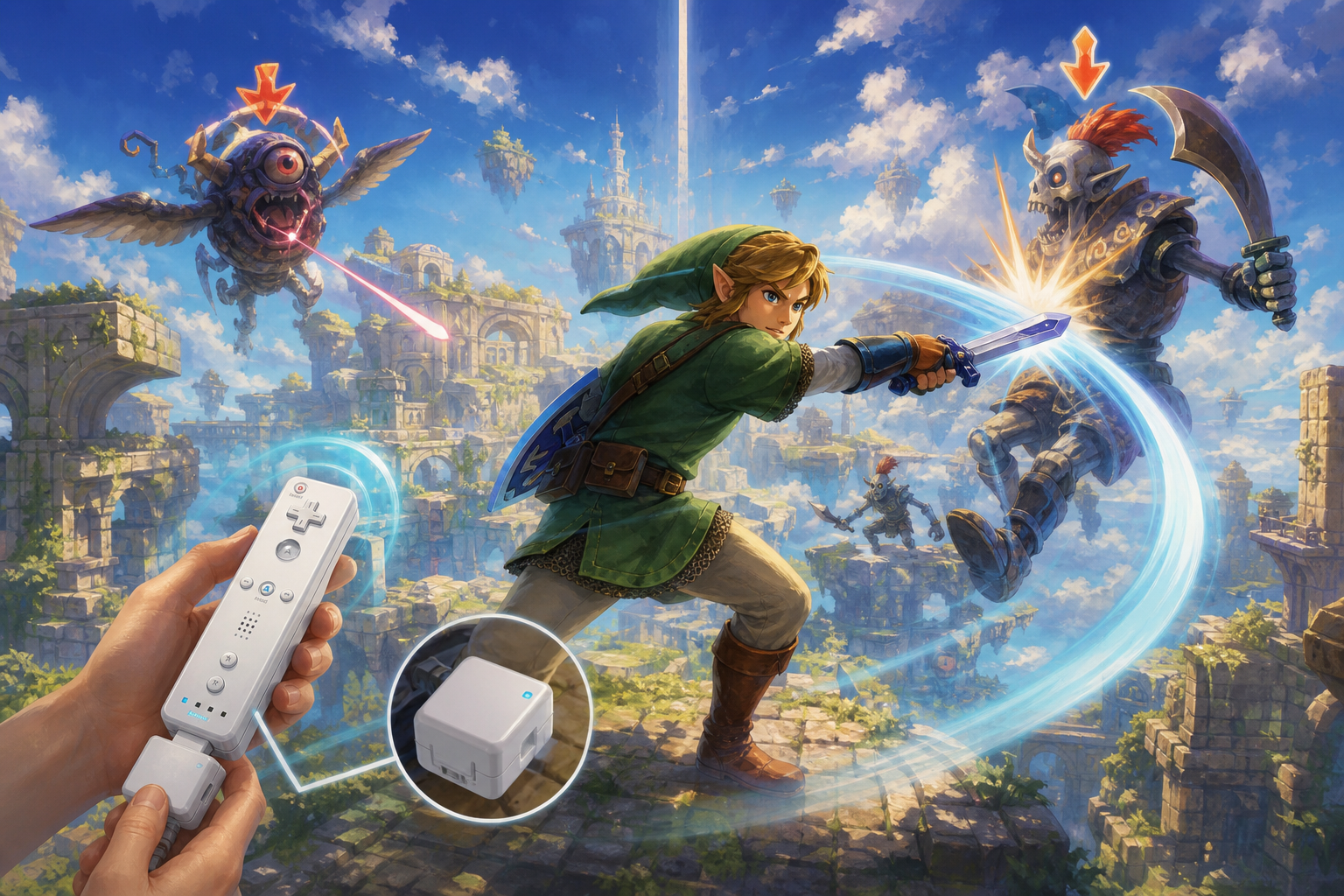
10. Link’s Crossbow Training
Link’s Crossbow Training is a compact shooter built around The Legend of Zelda: Twilight Princess’ visual world, but it is not a conventional adventure. Its stages divide into target shooting, moving-target challenges and more active combat sections, giving the Wii Remote pointer a clear purpose from the opening seconds. The game includes nine levels, with several stage types asking players to hit targets quickly or fight through free-movement combat areas.
The limited campaign keeps it below the longer games here, yet that limitation is also its appeal. Sessions are easy to start, the rules are quickly understood and score chasing gives familiar stages a reason to revisit. It suits players who want short arcade challenges rather than exploration, inventory systems or a lengthy story. The bundled Wii Zapper association also makes it an important example of Nintendo presenting pointer aiming as a physical console activity, although the accessory is not required to play.
- Best for: short score attacks and Zelda fans.
- Tradeoff: much less campaign depth than the other first-person choices.
9. Red Steel
Red Steel is uneven, but it belongs in a Wii shooter history because it attempted to make pointer aiming, weapon handling and close-range swordplay part of one console identity. Its first-person shooting sections use the Wii Remote for aiming, while the Nunchuk handles movement and additional actions. That arrangement was more ambitious than simply converting an existing gamepad layout.
Its strongest appeal is experimentation. Firearms, environmental encounters and sword duels create a changing rhythm, even when the campaign’s pacing and presentation are less consistent than the best games here. Players interested in the Wii’s early efforts to establish motion-controlled action will find more historical value than polish. It is a better fit for curiosity about launch-era design than for someone seeking the cleanest-feeling shooter. The original game’s rougher control implementation also helps explain why later Wii shooters refined sensitivity, pointer movement and motion input so carefully.
- Best for: studying early Wii pointer-shooter design.
- Tradeoff: control and presentation are less refined than later Wii shooters.
8. Battalion Wars 2
Battalion Wars 2 turns ranged combat into a brisk tactical action game. The player directly controls a soldier or vehicle while issuing broad commands to allied units, so success depends on more than pointing at enemies and firing. Infantry, tanks, aircraft and naval forces create different battlefield problems across the campaign.
The Wii Remote gives the game an accessible aiming interface, but its real distinction is the combination of personal action and unit management. Missions encourage movement, target selection and awareness of the wider fight rather than slow menu-based planning. It is less precise than a dedicated first-person shooter and less theatrical than an on-rails game, yet that middle ground gives it a useful identity. Players who want military action without a fully simulation-heavy structure should start here.
Battalion Wars 2 also demonstrates how the Wii’s controls could support battlefield commands without turning the game into a traditional strategy interface. Its original online mode is no longer available through Nintendo’s official Wii service, so the enduring value is in the campaign’s mixture of direct combat and tactical decisions.
- Best for: players who want direct combat with light tactical command.
- Tradeoff: mission objectives can feel more rigid than the shooting itself.
7. Medal of Honor: Heroes 2
Medal of Honor: Heroes 2 offers a traditional wartime first-person campaign adapted to Wii controls. Pointer aiming makes target acquisition more immediate than an analog-stick-only setup, while movement remains familiar to players coming from console shooters. Its historical setting supplies a recognizable structure of firefights, objectives and large military set pieces.
The game’s importance is not that it reinvents the genre. Instead, it demonstrates how a mainstream first-person shooter could be translated to Wii without abandoning the expected campaign format. The Wii Remote and Nunchuk handle the standard action, while the Wii Zapper offers an alternative physical grip. The game also included an Arcade Mode that guides players through levels while leaving aiming and firing as the main tasks.
Its original 32-player online mode was a notable feature for Wii, but it should be treated as part of the game’s historical design rather than a currently usable service. Heroes 2 ranks in the middle because its shooting foundation is approachable, but its campaign has less unusual level design than the strongest games on this list.
- Best for: conventional military shooting on Wii.
- Tradeoff: less distinctive than the platform’s rail shooters and motion-focused experiments.
6. Ghost Squad
Ghost Squad is a concentrated arcade light-gun experience. Stages move the player through hostage rescues, armed confrontations and timed action sequences while the Wii Remote acts as the weapon. The game’s appeal comes from immediacy: targets appear, decisions must be made quickly and a replay can improve accuracy, route choices and score.
Its compact missions work particularly well for local sessions. Rather than asking one player to spend hours learning a complex campaign, Ghost Squad makes repetition part of the design. Different difficulty levels and branching decisions help the short scenarios remain active after the first clear. The game supports the Wii Remote and Wii Remote with Nunchuk, as well as the Wii Zapper, giving it a straightforward range of control options.
It is not the best choice for someone seeking free exploration or character progression, but it is one of the clearest Wii examples of a home console reproducing the direct rhythm of an arcade shooter. Its four-player support also makes it more flexible for group play than its compact campaign might suggest.
- Best for: arcade-style sessions and local score competition.
- Tradeoff: short, repeatable missions replace a long narrative campaign.
5. The House of the Dead: Overkill
The House of the Dead: Overkill combines rail-shooter structure with deliberately exaggerated grindhouse presentation. The player aims with the Wii Remote while the game controls forward movement, allowing attention to stay on enemy placement, target priority and incoming attacks. Its levels are built around repeated runs, accuracy and the pleasure of clearing crowded scenes efficiently.
The campaign’s tone is unusually committed, but the shooting remains the reason to return. A weapon shop lets players improve their arsenal, while special abilities such as grenades and temporary slow-motion effects add more decision-making than simply pulling the trigger. The game also includes a competitive mode for up to four players, giving its arcade structure a social dimension.
Overkill is a poor match for anyone wanting freedom of movement, yet that restriction is also its strength: the game focuses each encounter like an arcade cabinet. It earns this position through personality as well as reliable pointer action. Its mature presentation and extreme gore are also meaningful audience limitations, not minor details.
- Best for: players who want a loud, stylized rail shooter.
- Tradeoff: fixed movement, mature content and limited exploration will not suit every audience.
4. Sin and Punishment: Star Successor
Sin and Punishment: Star Successor is a fast, demanding shooter that treats movement, aiming and boss patterns as one continuous test. Players guide the character through hazardous stages, target enemies with pointer controls and avoid incoming attacks while the screen fills with threats. The result feels closer to an arcade action challenge than a conventional first-person campaign.
Its replay value comes from mastery. Memorizing attack patterns, improving movement and learning when to prioritize targets matters more than collecting equipment or wandering through a large map. That focus makes the game exhilarating for players who enjoy pressure, but intimidating for anyone seeking a relaxed shooter.
The control scheme is central to the design rather than a novelty layered over it. Nintendo’s development interview specifically describes the Wii Remote pointer as the means of aiming while the Nunchuk handles movement. The game also supports two-player play, making its demanding action more approachable when shared, although the difficulty remains a major part of its identity.
- Best for: high-speed arcade shooting and boss practice.
- Tradeoff: demanding encounters can overwhelm players expecting a casual rail shooter.
3. Resident Evil: The Darkside Chronicles
Resident Evil: The Darkside Chronicles uses rail-shooter movement to revisit stories and characters from the Resident Evil universe. The fixed route allows the game to stage cinematic encounters while the player concentrates on aiming, reloading and reacting to threats. Zombie groups, larger enemies and environmental targets keep the pointer busy rather than reducing every scene to identical headshots.
Its structure makes it accessible to players who do not enjoy traditional survival-horror navigation, but it still preserves tension through limited resources, sudden attacks and pressured encounters. Weapon upgrades and collectible documents give the campaign additional reasons to revisit chapters, while dynamic difficulty adjusts the challenge according to performance.
The presentation is more story-driven than Ghost Squad or Overkill, giving it stronger appeal for fans of the series. The game also supports two-player cooperative play. The tradeoff is that the campaign’s guided movement leaves little room for improvisation. It works best as an action-focused companion to Resident Evil lore, not as a replacement for exploration-heavy entries.
- Best for: Resident Evil fans who prefer direct action to maze navigation.
- Tradeoff: fixed paths reduce exploration and make some scenes feel less interactive.
2. Dead Space: Extraction
Dead Space: Extraction is one of the Wii’s most substantial rail shooters. Its guided movement supports horror pacing, but the player still has meaningful work: identifying weak points, switching weapons, managing threats and responding to hazards before they overwhelm the screen. The pointer makes limb targeting feel deliberate, which suits the series’ emphasis on dismemberment rather than ordinary headshots.
The campaign also benefits from a stronger narrative framework than many arcade shooters. Audio logs, environmental details and escalating encounters give each chapter forward momentum, while repeated runs invite players to improve accuracy and discover more of the game’s presentation. EA designed the game specifically for Wii and included cooperative play, giving it a stronger campaign-and-companion balance than many single-player rail shooters.
It is a demanding choice for players who dislike horror imagery, but for everyone else it shows that a fixed route can support tension, tactical aiming and story rather than merely simplifying movement. The guided structure is a deliberate tradeoff: players lose free navigation but gain tightly staged encounters and a consistently directed horror experience.
- Best for: horror fans and players who want a story-led rail shooter.
- Tradeoff: disturbing imagery and fixed movement will not suit every audience.
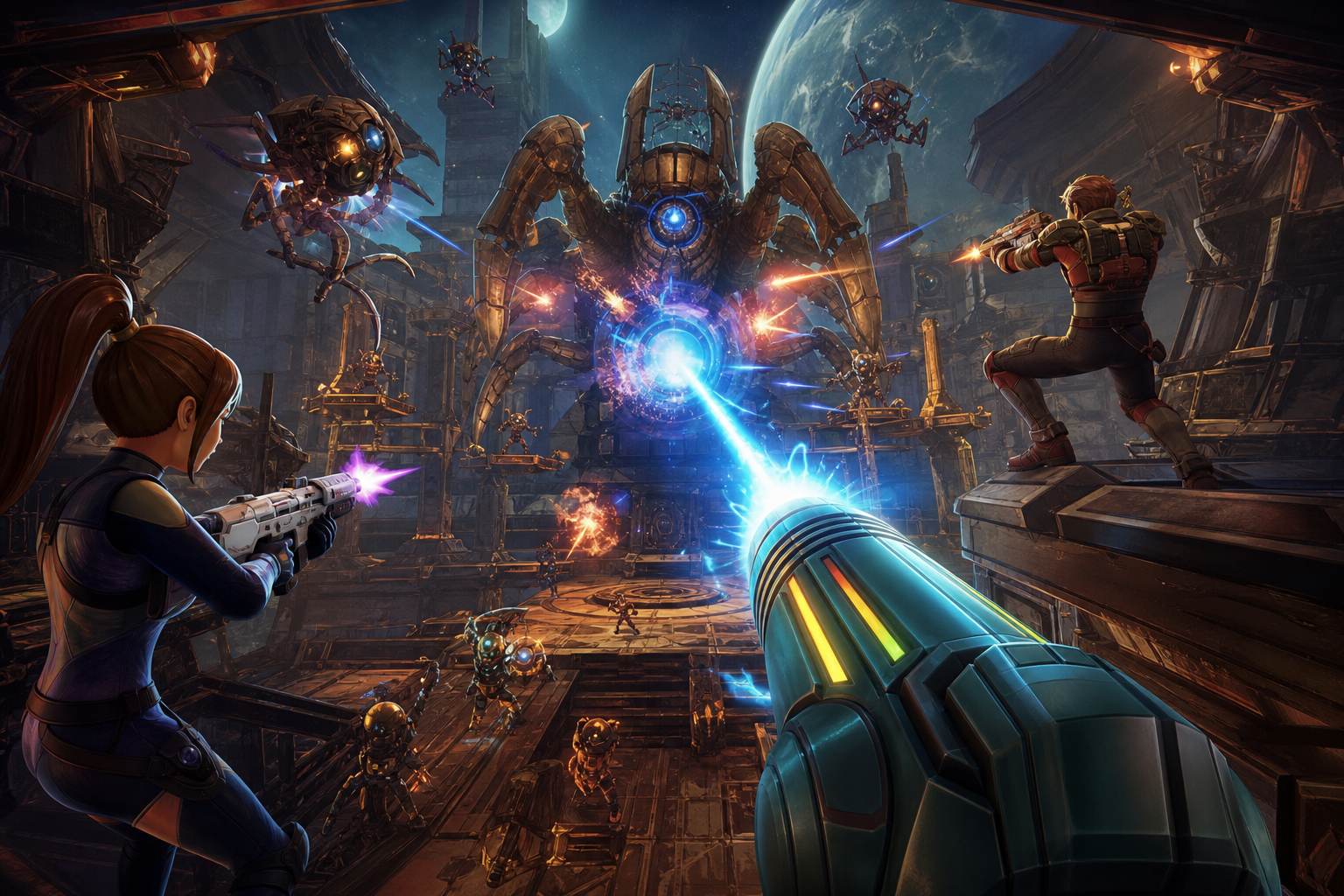
1. Metroid Prime 3: Corruption
Metroid Prime 3: Corruption is the broadest and most complete shooter on this list. It combines first-person aiming with exploration, environmental puzzles, scanning, upgrades and large areas that reward returning to earlier locations with new abilities. The Wii Remote pointer gives Samus more direct control over aiming, while the Nunchuk supports movement and other interactions. Motion actions are used for devices and weapons, making the interface part of the world rather than a separate minigame.
Its campaign has the variety needed to sustain a long adventure: close combat, ranged enemies, vehicle sequences, upgrades and boss encounters all fit into a connected progression. The game also supports multiple sensitivity settings, helping it accommodate both newcomers and experienced first-person players. Nintendo’s documentation identifies the Wii Remote pointer as the aiming and view-control method, while the Nunchuk handles movement and several core actions.
Players who want a pure arcade shooter may find it slower than the rail entries, but that slower pace creates room for discovery and atmosphere. It ranks first because it offers the strongest combination of pointer shooting, exploration and world design in the Wii catalog. Its appeal is not endless score-chasing; it is the way combat, scanning and return visits make the campaign feel like one connected first-person adventure.
- Best for: players who want a full first-person adventure with exploration.
- Tradeoff: its longer, more deliberate structure is less immediately social than an arcade shooter.
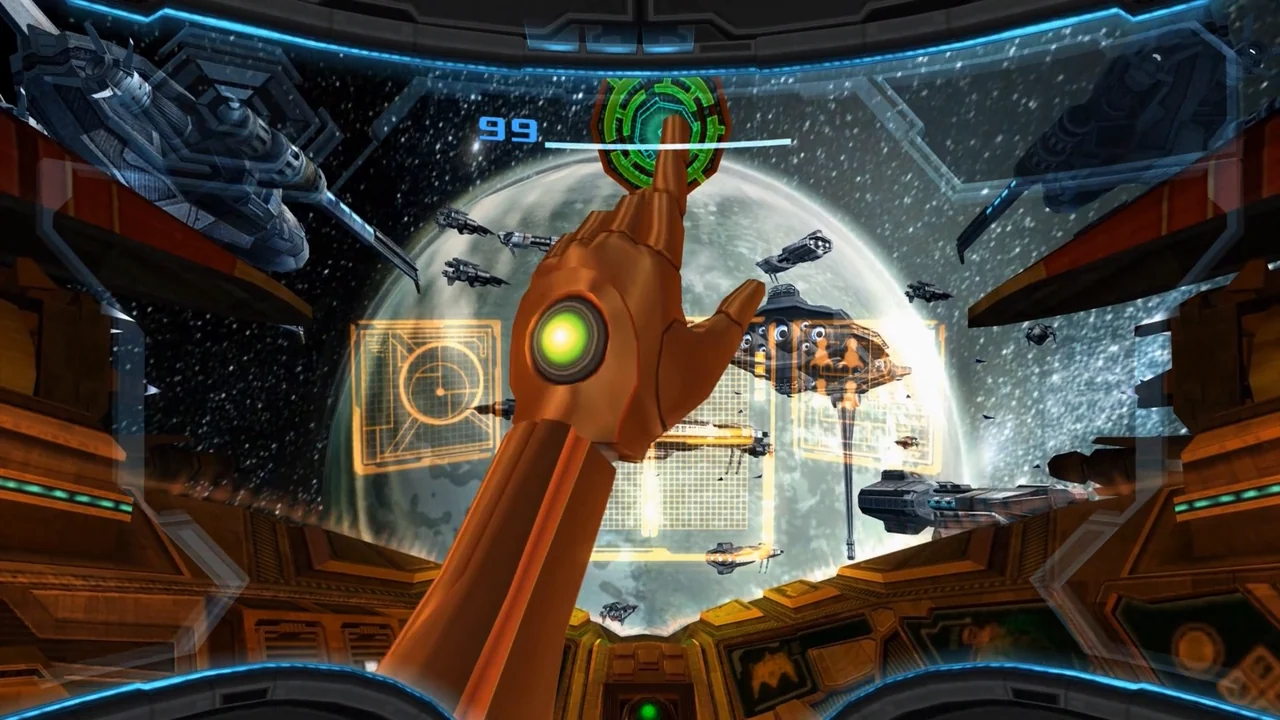
The right Wii shooter depends on the kind of replay value you want. Link’s Crossbow Training and Ghost Squad suit short sessions, while The House of the Dead: Overkill and the Resident Evil: The Darkside Chronicles deliver guided arcade action. Sin and Punishment: Star Successor is the precision challenge, Battalion Wars 2 supplies a tactical angle, and Dead Space: Extraction offers the strongest horror-focused rail experience.
Metroid Prime 3: Corruption is the best all-around starting point because it treats shooting as one part of a larger adventure. It also demonstrates why the Wii’s pointer deserved more than novelty status: in the right game, aiming, movement, exploration and interaction can reinforce one another instead of competing for attention.