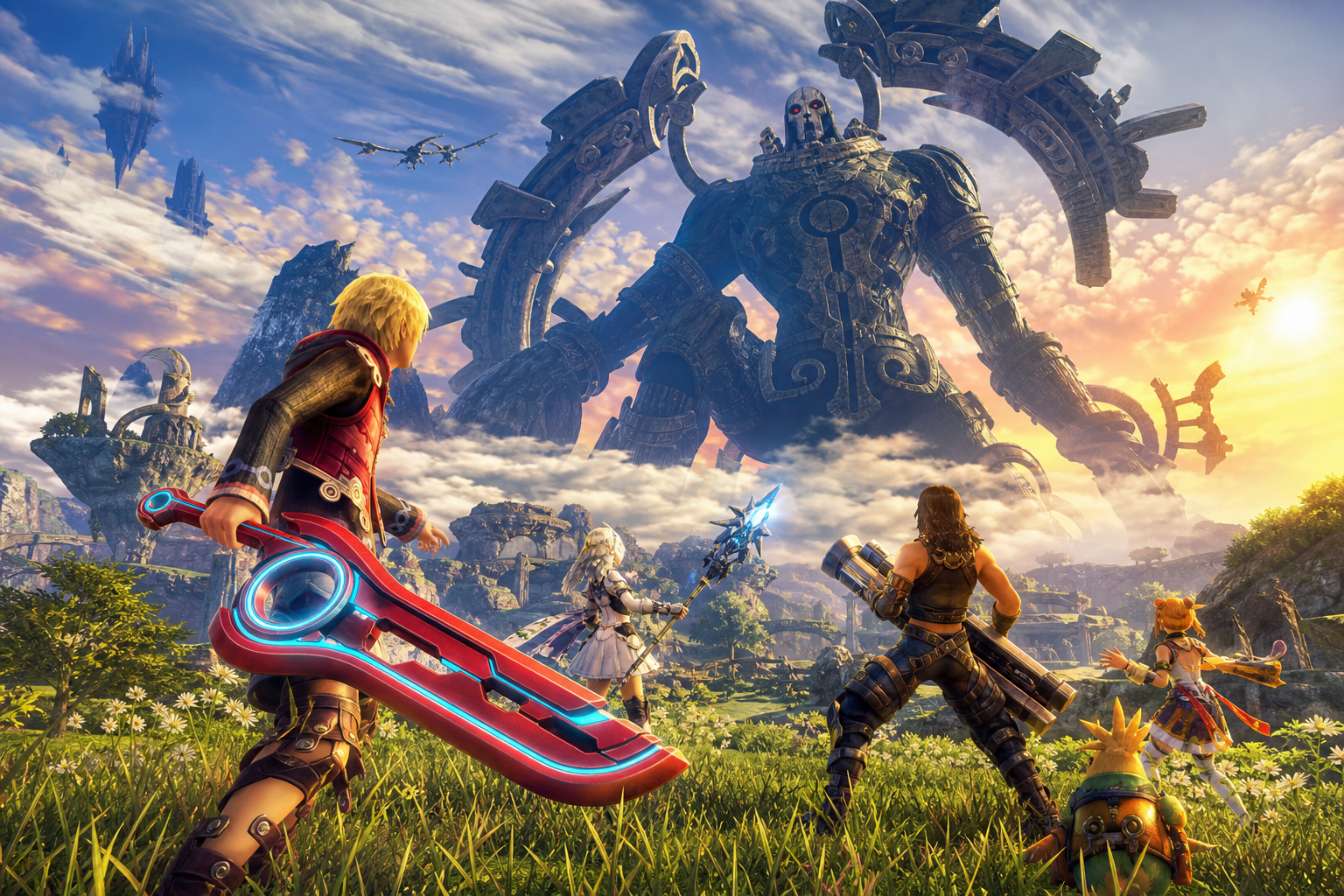
The original Wii Remote made motion controls approachable because it did not ask players to think about sensors, axes or tracking systems. Point at the screen, swing the controller, tilt it or shake it, and the game translated that action into something understandable. Yet beneath that simplicity was a technical limitation: the controller could detect acceleration and use its infrared camera for pointing, but it could not always maintain a dependable account of how the remote was rotating in space.
Nintendo’s answer was Wii MotionPlus, an attachment that added gyroscopic sensing to the Wii Remote. It supplemented the controller’s existing accelerometer, buttons and pointer system rather than replacing them. That distinction matters. MotionPlus did not make every Wii game more precise, and it did not turn every gesture into a literal one-to-one performance. Its benefits appeared in software designed to use the additional rotational information.
The accessory’s history is best understood through the games that gave that information a purpose. Wii Sports Resort made the technology easy to understand. Sports titles tested whether racket and club orientation could improve familiar formats. Red Steel 2 applied the idea to sword combat, while The Legend of Zelda: Skyward Sword made MotionPlus a requirement for a major adventure. The result was not a universal Wii upgrade, but a targeted attempt to make the controller understand more of what a player’s wrist was doing.
The problem beneath the Wii Remote’s magic
The Wii Remote was already more sophisticated than a conventional button controller. Its accelerometer detected changes in movement, allowing software to recognize swings, shakes, tilts and other changes in motion. Its infrared camera worked with the Sensor Bar to support pointing and screen-relative aiming. Those systems gave the Wii its signature control language without requiring players to hold a traditional analog stick in both hands.
What they did not provide was a continuously reliable description of the remote’s orientation. A quick movement could produce acceleration data, but acceleration alone did not always tell the game whether the player had rotated the controller, moved it through space or simply flicked it. The difference mattered when the angle of a golf club, racket, disc or sword was supposed to affect the result.
Nintendo therefore treated MotionPlus as an addition to the original system. Its announcement described the accessory working with the Wii Remote’s accelerometer and the Sensor Bar to track arm position and orientation in three-dimensional space with greater detail. The important change was not that the Wii Remote stopped being a simple controller. It gained another kind of information for software that needed to distinguish direction, angle and rotation more carefully.
A 2008 reveal with an ambitious promise
Nintendo announced Wii MotionPlus on July 14, 2008, ahead of its E3 presentation. The announcement framed the accessory as a major advance for Wii control, promising faster and more accurate reproduction of movement in three-dimensional space. Nintendo also used near 1:1 language, presenting the device as capable of reflecting even small wrist and arm movements on screen.
That wording was powerful because it addressed a common criticism of early Wii games. The console had made physical gestures visible, but many games simplified those gestures into broad commands. A swing might be treated as a button-like event. A shake might perform the same action regardless of the exact path of the remote. MotionPlus promised to give developers more information from which to build richer rules.
The qualification became obvious once the first software appeared. Accurate sensing was not the same thing as accurate-feeling gameplay. Developers still had to decide which movements mattered, how much assistance to provide and how to communicate the result. A golf game could use rotation to influence a shot, while a tennis game might use it mainly to determine racket angle. Nintendo’s 1:1 language described the hardware’s ambition, not a guarantee that every compatible game would reproduce every movement literally.
A small attachment that made the controller larger
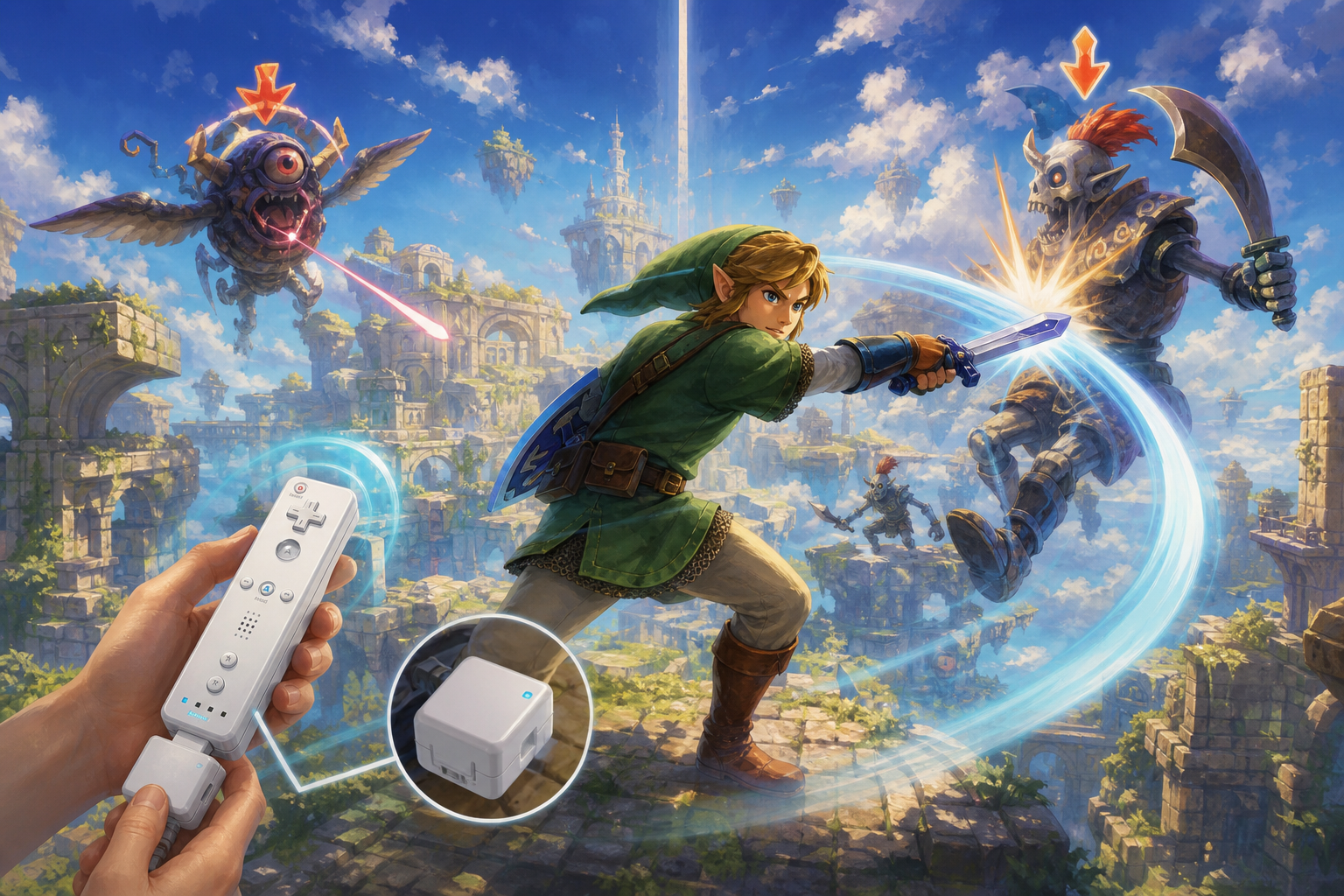
The retail accessory, identified by Nintendo Japan as RVL-026, connected to the Wii Remote’s bottom expansion port. Nintendo’s Japanese accessories archive describes it as a device that made finer movement detection possible and notes that the sensor unit and protective jacket were integrated into one attachment. The jacket was not just cosmetic packaging; it became part of the physical form in which the add-on was used.
That design solved an obvious engineering problem while creating a visible compromise. MotionPlus had to fit an existing controller rather than replace the Wii Remote altogether. The result was a longer, bulkier remote with another component extending from its base. The expansion connection still allowed compatible accessories such as the Nunchuk and Classic Controller to be used, but the familiar Wii Remote now had an additional step in its hardware chain.
The arrangement also established a distinction that later confused casual descriptions of the technology. An original Wii Remote with MotionPlus attached was not the same product as a Wii Remote Plus. Both could provide the enhanced motion capability to supported software, but one required an external module while the other integrated the sensor into the controller. That difference shaped the accessory’s short life as a separate product.
The 2009 rollout and Wii Sports Resort
Nintendo’s European rollout placed the standalone Wii MotionPlus accessory in stores on June 12, 2009. Nintendo Japan lists the white version’s release date as June 25, 2009, with a black version following in September. These regional dates show why the accessory’s launch should not be reduced to one worldwide event. Nintendo’s hardware and software schedules varied by territory.
The main software vehicle was Wii Sports Resort. Nintendo announced a European release date of July 24, 2009, and bundled one MotionPlus accessory with each copy. The packaging gave players an immediate explanation for the extra hardware: this was not merely a revised controller hidden behind technical language, but a device that enabled the game’s central activities.
The original Wii Sports and Wii Sports Resort therefore have different roles in Wii history. Wii Sports introduced broad, accessible gestures through activities such as tennis, bowling and baseball. Wii Sports Resort used a collection of more focused events to demonstrate how orientation and rotation could affect swordplay, golf, disc throwing, table tennis and other activities. Nintendo’s own later interviews describe Wii Sports Resort as the first game for MotionPlus and explain that its separate activities helped the Zelda team understand the technology.
That structure made the sensor easier to teach. A minigame could isolate one question, such as how the angle of a disc or sword changed the result, and provide immediate feedback. The player did not need to learn a whole adventure system before understanding what the new hardware contributed.
Sports games tested whether rotation mattered
The first third-party wave included EA’s Tiger Woods PGA Tour 10 and Grand Slam Tennis, along with Sega’s Virtua Tennis 2009. Sports games were natural candidates because they already represented actions such as swings, strokes and throws. MotionPlus could add information about the orientation of the imagined club or racket rather than merely detecting that the player had moved the remote.
Virtua Tennis 2009 is a useful example because racket orientation matters differently from the speed of a gesture. A player might want to influence the angle, spin or placement of a shot, and the controller’s rotation could become part of that decision. Nintendo promoted the game as MotionPlus-compatible alongside the EA sports titles, presenting the accessory as relevant to more than Nintendo’s own software.
Early reception showed that the results were uneven. Contemporary coverage found Tiger Woods PGA Tour 10 more convincing in its use of swing detail, while Grand Slam Tennis made a more modest use of MotionPlus and did not always translate the extra data into a convincing one-to-one tennis experience. Later impressions of Wii Sports Resort also found that some activities demonstrated the hardware more clearly than others.
That variation is central to the accessory’s history. MotionPlus expanded what the controller could report, but each game still had to turn that data into readable rules, feedback and timing. A better sensor could deepen a sports game, but it could not automatically supply the physics, animation or design needed to make the result feel natural.
Red Steel 2 took MotionPlus beyond the fairway
Red Steel 2 became one of the clearest attempts to make MotionPlus matter outside sports. Nintendo described the game as using the accessory to make sword movements correspond more directly with the blade on screen. That gave the technology a dramatic role: the remote was not standing in for a club or racket, but for a weapon whose direction and angle were central to combat.
The game still depended on conventional controls. The Nunchuk handled movement, while buttons and other inputs remained important for the wider action system. MotionPlus did not turn the Wii into a controller that reproduced every movement of the player’s body. Instead, Red Steel 2 combined a more expressive sword layer with traditional aiming, locomotion and action-game structure.
That combination highlighted the design challenge. A sword game must decide when a movement counts as an intentional attack, how closely the blade should follow the remote and what happens when the player’s physical gesture is imprecise. More sensing can make combat feel more direct, but it can also make unclear rules more noticeable. The game has to communicate why a particular swing succeeded, failed or produced a different attack.
Red Steel 2’s lasting importance is therefore not that it solved motion control for action games. It showed that rotational sensing could support a more demanding combat idea while remaining part of a conventional game system. MotionPlus added expressive control, but buttons, camera rules and carefully bounded interactions still did much of the work.
Why Skyward Sword made the hardware mandatory
The Legend of Zelda: Skyward Sword turned MotionPlus from an optional enhancement into a structural requirement. Nintendo’s support documentation states that the Wii release requires a Nunchuk and either a Wii Remote with MotionPlus attached or a Wii Remote Plus. Without that motion-sensing hardware, the game cannot progress beyond its controller setup requirements.
Sword fighting was the obvious reason. Enemies could defend from particular directions, and Link’s attack depended on the angle selected by the player rather than on a generic shake event. MotionPlus allowed the game to preserve a stronger relationship between the controller’s orientation and the direction of Link’s blade.
Nintendo’s developer discussions show that the challenge extended far beyond sword strikes. The team had to make precise sword control coexist with bombs, arrows, the Clawshot and other items in a continuous adventure. A sports minigame can isolate one control idea. Zelda has to shift between combat, exploration and tools without making the controller feel like a sequence of unrelated demonstrations.
The developers also explained that Wii Sports Resort helped them understand what MotionPlus could do. Its individual sports separated the control problems into manageable experiments, while Skyward Sword had to make them work across a much larger system. The team even considered abandoning MotionPlus during development before returning to it and redesigning the game around the technology.
Skyward Sword therefore marks the point at which the accessory became more than a demonstration. It became part of the game’s basic grammar, influencing enemy defenses, sword direction and the relationship between physical orientation and on-screen action.

Calibration and compatibility were part of the bargain
Nintendo’s MotionPlus documentation treated calibration as a normal part of using the accessory. The manuals describe placing the controller on a flat surface when its orientation becomes misaligned so the system can establish a reference. That requirement reflects a basic limitation of inertial sensing: the controller can measure changes in movement, but its estimate of orientation may need to be re-established against a known position.
Compatibility was another important boundary. Nintendo’s accessories documentation states that MotionPlus provided additional accuracy in games specially designed for it. An ordinary Wii game could still operate with the attachment connected, but it would not automatically gain more precise controls. The extra data mattered only when software had been programmed to read it and use it.
This is why MotionPlus should not be described as a universal upgrade for the Wii library. The original Wii Remote’s broad motion commands remained valid, and many games had no reason to use rotational information. The presence of the attachment on a controller did not prove that a particular game supported its enhanced functions.
The distinction became more visible as Nintendo released software built around the newer capability. Wii Play: Motion, released in Europe on June 24, 2011, was a collection of twelve minigames designed to show off the Wii Remote Plus. Nintendo’s product description presented the integrated controller as the intended device, while the broader Wii ecosystem still allowed the original add-on to serve compatible software.
Calibration, software support and controller type were therefore part of the historical bargain. MotionPlus increased the available information, but it also introduced new expectations about how software and hardware had to cooperate.
The Wii Remote Plus replaced the awkward middle step
Nintendo announced Wii Remote Plus in October 2010 and launched it across Europe on November 5, 2010. The revised controller integrated MotionPlus hardware into the standard Wii Remote form. Nintendo emphasized that the new controller preserved the same physical dimensions as the ordinary remote and continued to support peripherals such as the Nunchuk and Classic Controller.
The integrated design removed the most obvious inconvenience of the original accessory. Players no longer needed a separate module and extended jacket to access the enhanced motion features. The capability became part of the controller’s identity rather than an attachment that changed its length and appearance.
This transition did not instantly make the original MotionPlus accessory irrelevant. Existing compatible games could use either arrangement, and owners of earlier Wii Remotes could continue using the add-on. The Wii Remote Plus mainly simplified the path for new controllers and made it easier for Nintendo to present MotionPlus as a normal part of the Wii control experience.
The change also reveals Nintendo’s broader lesson from the first generation of motion software. The issue was not that players refused more precise sensing. Wii Sports Resort had made the idea understandable to a mass audience. The issue was that an optional module introduced friction whenever a game required the improved capability. Integrating the hardware made the technology less conspicuous and easier to treat as a standard feature.
By 2010, MotionPlus had moved from a technical experiment to a platform feature. It still did not apply to every game, but the Wii Remote Plus made the new control vocabulary feel less like an accessory and more like the next version of Nintendo’s controller.
Reception and the lasting legacy
Early reception was mixed because MotionPlus’s potential was easier to describe than to reproduce consistently. Contemporary coverage recognized clearer benefits in golf and disc throwing, while questioning whether some launch-period tennis software delivered convincing one-to-one control. The criticism was not that the accessory supplied no useful information. It was that games varied widely in how successfully they translated that information into moment-to-moment play.
The accessory also arrived after the original Wii Remote had established an expectation that motion controls should be immediate, simple and forgiving. More precise sensing could make an action richer, but it could also expose calibration issues, add physical bulk and require players to understand why orientation mattered. A broad swing is easy to recognize. A deliberate change in angle is more demanding for both the player and the game.
MotionPlus’s legacy is consequently narrower and more interesting than the claim that it transformed the entire Wii library. Wii Sports Resort established the accessible showcase. Virtua Tennis 2009 and the EA sports titles tested whether rotational information could deepen familiar actions. Red Steel 2 applied the idea to sword combat. Skyward Sword made it central to a major Nintendo adventure. Wii Play: Motion then treated the capability as the premise for a new set of minigames.
Nintendo ultimately did not make every Wii title a MotionPlus game. Instead, it created a second control vocabulary for software that needed orientation as well as movement. The original Wii Remote remained useful, while MotionPlus enabled a smaller group of distinctive experiences. Its most important achievement was not making the whole system more accurate. It gave developers a way to build games around the difference between moving a controller and knowing how that controller was turned.
Wii MotionPlus was a targeted correction to the original Wii Remote, not a replacement for it. The accelerometer, infrared pointer, buttons and familiar accessories remained essential; the added rotational sensing supplied information those systems could not reliably preserve on their own.
The accessory’s history is therefore a story of translation. Nintendo translated technical sensing into approachable sports demonstrations, third-party developers translated it into racket play and sword combat, and Skyward Sword translated it into the rules of a full adventure. The Wii Remote Plus eventually hid the extra hardware inside a cleaner controller, but the underlying design lesson remained: motion control mattered most when a game gave precision a clear purpose.