Action is a broad category on Wii. This list includes platformers, action-adventures, first-person shooters, survival horror, rail-shooter-style games and character-action games, provided that real-time movement, combat or physical challenge drives the experience. Sports games such as Wii Sports are excluded, as are Xenoblade Chronicles, The Last Story and similar role-playing games whose dominant structure is party development, menus and long-form progression.
The ranking considers mechanical quality, the value of each game’s Wii controls, stage and encounter design, replay value, accessibility and the severity of its drawbacks. The selections judge the original Wii releases rather than later remasters or ports. Regional naming and hardware differences also matter: Sin & Punishment is called Star Successor in North America and Successor of the Skies in Europe, while Skyward Sword requires Wii MotionPlus or a Wii Remote Plus.
10. Sonic Colors
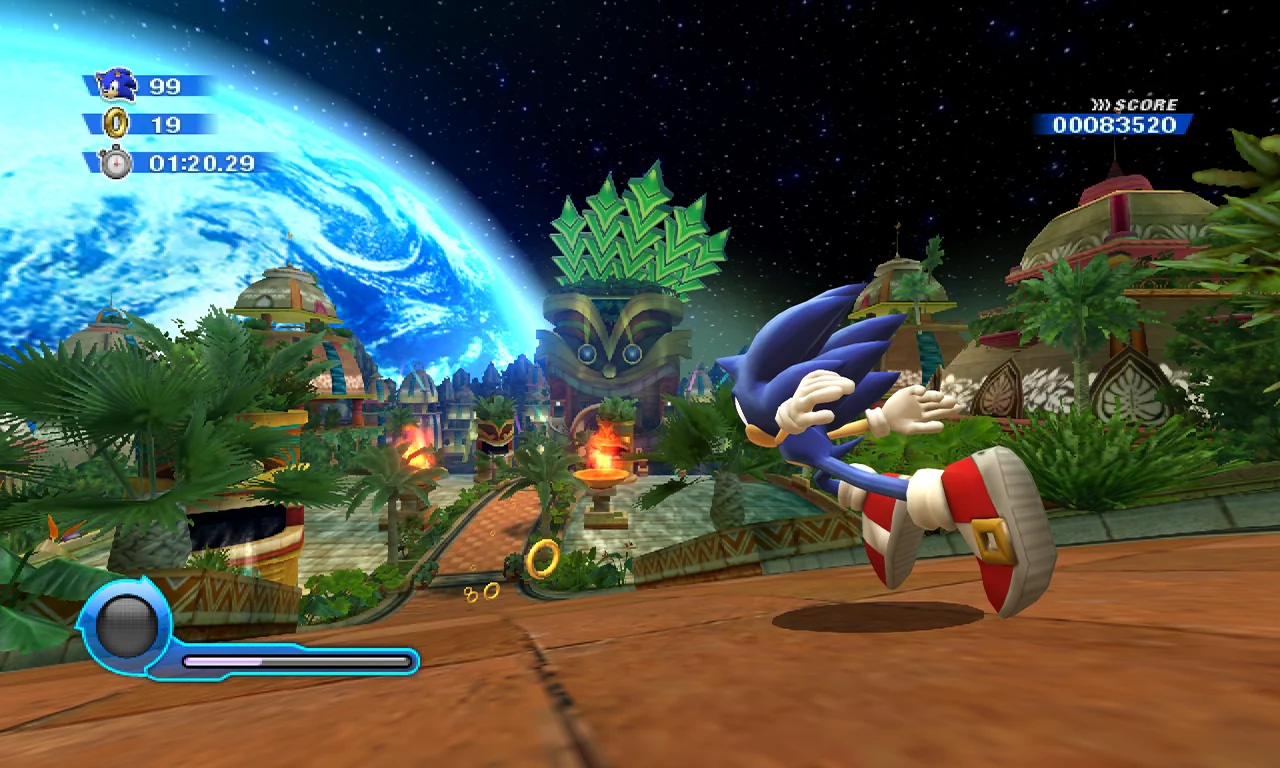
Sonic Colors gives the Wii a bright, compact speed-platformer built around momentum, branching routes and alien color powers. Drill, Rocket, Laser and other Wisps change how Sonic moves through stages, turning familiar running sections into short puzzles about timing, direction and route choice. The strongest levels reward replay because a first clear often reveals only one of several possible paths or shortcuts.
The Wii release is substantially different from the Nintendo DS version, so the two should not be treated as interchangeable editions. Sonic’s speed can expose the game’s weakness: hazards arrive quickly, and mistakes may feel like trial and error rather than a failure of deliberate planning. The Wii version also includes cooperative play in which two players control virtual hedgehogs rather than sharing a second full Sonic campaign. That mode is a pleasant extra, but the single-player stages are the main attraction.
Sonic Colors is a strong choice for players who enjoy colorful platforming, route hunting and learning levels through repetition. It ranks tenth because its best ideas are spread across an uneven difficulty curve, and because its Wii identity comes more from the game’s platform and multiplayer options than from an essential motion-control system.
- Who should play it: Sonic fans who enjoy replaying stages for better routes and players wanting a lighter action adventure.
- Meaningful limitation: speed can make hazards difficult to read, especially when a first attempt is being used to discover the stage.
9. Rayman Origins
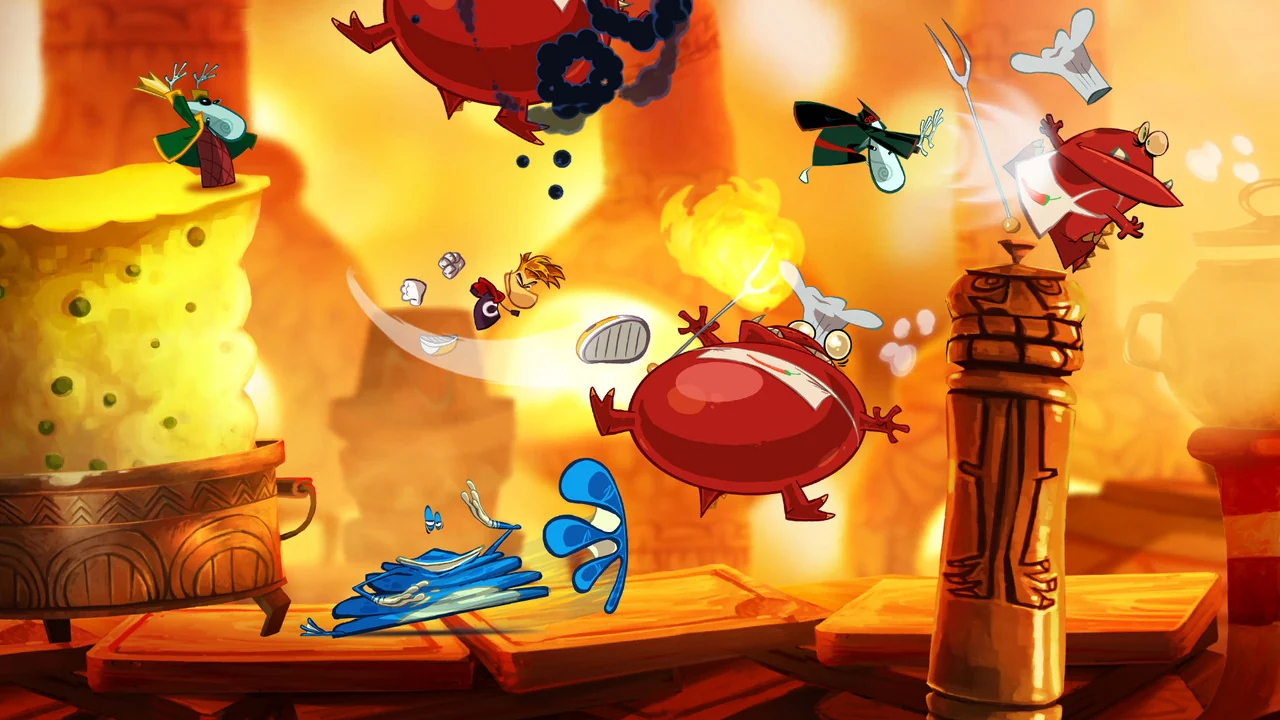
Rayman Origins is a fluid 2D action-platformer with expressive animation, lively environments and movement built around flowing from one obstacle to the next. Its stages mix running, jumping, attacking and quick reactions, while collectible creatures and hidden objects give experienced players reasons to revisit familiar routes. The presentation is energetic without requiring a complicated control scheme.
Local cooperation is a major part of its appeal. Several players can share the screen, helping one another through difficult sections or creating new problems when characters collide in a tight space. That makes Rayman Origins a useful group choice for players who want lively platforming without the more unpredictable physics of New Super Mario Bros. Wii.
Its limitation is strategic rather than technical. Rayman Origins does not make especially distinctive use of the Wii Remote, so the Wii version is best understood as a very good 2D action game on Nintendo’s system rather than a showcase for the hardware. It ranks above some more ambitious games because its movement is consistently readable and its cooperative structure remains welcoming.
Who should play it: players who value animation, cooperative platforming and collectible-driven replay. It is less suitable for someone specifically seeking pointer controls, swordplay or motion-sensitive interaction.
8. New Super Mario Bros. Wii
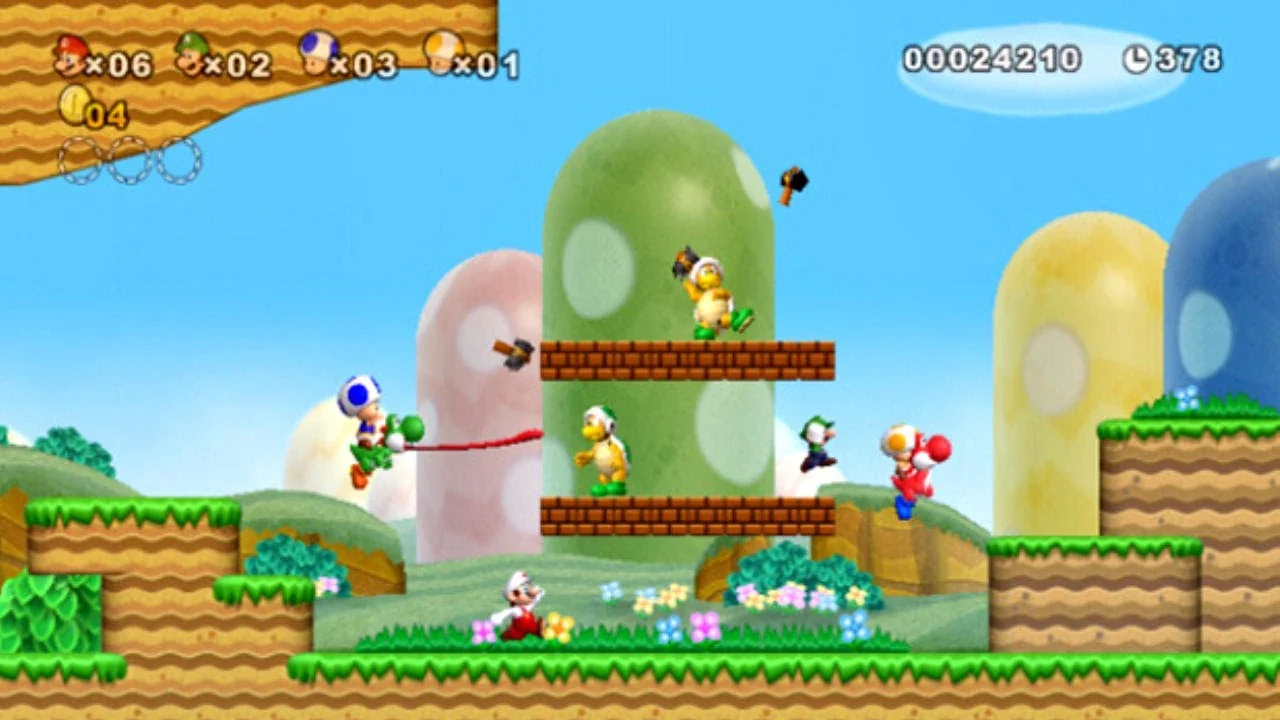
New Super Mario Bros. Wii translates traditional Mario platforming into a four-player shared-screen contest of cooperation, rescue attempts and accidental sabotage. Players can bounce off one another, carry companions, use familiar power-ups and negotiate hazards that are manageable alone but unpredictable when the whole group is moving at once.
That multiplayer design gives the game a personality beyond its individual stages. A careful player can build a route for a newcomer or rescue someone from a difficult jump, while an impatient player can throw the entire group into a pit. Players who are in trouble can also use the bubble system to stay with the group without taking part in every dangerous section. Solo play remains worthwhile, particularly for players who enjoy searching for secrets, but the basic structure is deliberately more conventional than Super Mario Galaxy or Donkey Kong Country Returns.
Motion is used sparingly. Tilt and shake actions appear in parts of the game, but the core platforming remains based on running, jumping and timing. That is both a strength and a limitation: the controls are easy to understand, but the game does not offer the same sense of hardware-specific experimentation as the top-ranked entries.
Who should play it: families and groups that want immediate cooperative action, plus solo platform fans who prefer classic side-scrolling rules. Players seeking a radically new Mario movement system should start elsewhere.
7. No More Heroes 2: Desperate Struggle
No More Heroes 2 turns Wii Remote and Nunchuk input into exaggerated beam-katana combat, wrestling maneuvers and deliberately theatrical finishing actions. Travis Touchdown can use more than one beam katana, and the game’s bosses lean into distinctive gimmicks, personalities and arenas rather than serving as interchangeable targets. The result is a character-action game with an attitude that is difficult to mistake for Nintendo’s family-friendly platformers.
The game’s abrasiveness is both its hook and its barrier. Its presentation, humor and story assume that players can tolerate crude material, stylized violence and a heightened comic-book tone. Combat can also become repetitive between its best encounters, while newcomers may find the story less welcoming without context from the earlier game. The motion controls are more meaningful than a token shake because finishing moves and wrestling actions use the Wii Remote, but they do not eliminate the need to learn enemy patterns and spacing.
No More Heroes 2 also trims and reshapes the open-world structure compared with its predecessor, placing more emphasis on the sequence of assassin battles. That makes its strongest moments more focused, although players expecting a large, densely interactive city may find the surrounding activities less compelling than the boss fights.
Who should play it: adults who want flamboyant boss battles, pulpy presentation and direct Wii swordplay. It is a poor fit for players wanting a calm adventure, a clean narrative entry point or consistently deep combat.
6. The Legend of Zelda: Skyward Sword
Skyward Sword makes directional swordplay the foundation of its combat. Enemies guard particular angles, so the player must read an opening and match the cut rather than simply repeat a general attack. Shield actions, item use and environmental puzzles extend that relationship between motion and interaction, giving the Wii hardware a clear purpose.
The design is ambitious but not frictionless. Wii MotionPlus or a Wii Remote Plus is required for the central control system; a standard Wii Remote alone is not an equivalent setup. Motion can also need recalibration, and repeated travel through familiar areas can make the adventure feel more constrained than its strongest dungeons. These are not minor edition details: the game’s defining sword system depends on the additional motion hardware.
Even with those limitations, the best combat and puzzles are inseparable from the control idea. Different enemies demand different responses, and items such as bombs and the beetle use motion in ways that connect exploration with combat. Skyward Sword belongs in the upper half because it does more than add gestures to a conventional adventure. It builds encounters around reading direction, timing and physical response.
Who should play it: Zelda fans who enjoy deliberate sword encounters and dungeon puzzles. Players who dislike motion requirements or repeated traversal should know those limitations before choosing it.

5. Donkey Kong Country Returns
Donkey Kong Country Returns is a demanding side-scrolling action game built around momentum, timing and environmental spectacle. Mine carts, rocket barrels, collapsing structures and moving platforms turn many stages into sequences that must be learned through repetition. The level design frequently asks for a confident commitment rather than cautious inching, especially when collectibles, puzzle pieces and hidden exits are involved.
The game supports Wii Remote-only play held sideways as well as Wii Remote and Nunchuk control. Shake inputs perform rolls and other actions, a choice that some players find less precise than a dedicated button. Two-player support makes the adventure more approachable for groups, though an extra character does not remove the sharpness of the later challenges.
Returns ranks above the earlier platformers because its stages have a stronger rhythmic identity and a more satisfying escalation from basic movement to elaborate set pieces. It is also unusually good at making failure informative: a missed jump or mistimed barrel often reveals exactly which part of the sequence needs more attention. The difficulty can become severe near the end, but the challenge generally serves the level design rather than existing only to slow progress.
Who should play it: experienced platform players and groups that enjoy learning difficult sequences together. It is less friendly to anyone looking for relaxed, low-pressure platforming.
4. Resident Evil 4 Wii edition
Resident Evil 4 Wii edition is a port of the earlier GameCube release, but its pointer aiming changes the feel of nearly every encounter. The Wii Remote makes target selection quick and direct, while the Nunchuk handles movement. Motion-based actions and the included Separate Ways scenario add to an edition that feels carefully adapted rather than casually converted.
Its strength is the relationship between aiming and encounter design. Enemies pressure the player from several directions, ammunition and healing items require decisions, and set pieces alternate with quieter inventory and exploration moments. The pointer does not remove the need to manage positioning, because Leon can still be overwhelmed while aiming at one threat and ignoring another.
The game is not a Wii original, so it should not be mistaken for a demonstration of Wii-exclusive level design. Its place here comes from the quality of the Wii control implementation. Compared with the earlier GameCube version, aiming feels more immediate, while the campaign’s survival-horror structure remains intact. Separate Ways also gives the package additional story and combat content rather than merely repeating the main campaign.
Who should play it: players wanting survival horror with action-forward pacing and responsive pointer aiming. Those seeking a wholly original Wii adventure should choose one of the Nintendo or Treasure releases instead.
3. Sin & Punishment: Star Successor
Known in Europe as Sin & Punishment: Successor of the Skies, this Treasure shooter combines constant aiming with character movement, evasive positioning and rapid target switching. Ground battles become screen-filling tests of prioritization, while aerial sequences change the rhythm and force players to read threats from a different perspective. The Wii Remote pointer is central, not decorative, and the Nunchuk handles movement so aiming and evasion can happen at the same time.
The game is structured around intensity and score chasing rather than a leisurely campaign. Players who enjoy mastering routes, improving accuracy and learning enemy patterns will find more depth than a first run suggests. Treasure designed the sequel around the Wii Remote’s pointer and Nunchuk combination, making the control scheme part of the game’s identity rather than an optional alternative.
That same focus creates its main limitation: the difficulty can be severe, and the visual pressure may overwhelm anyone looking for a slower shooter. Its regional subtitle difference also matters when searching for manuals, guides or physical editions. Sin & Punishment ranks third because it is one of the Wii’s clearest examples of pointer controls and arcade design working together.
Who should play it: arcade-shooter fans who welcome demanding repetition and score improvement. Casual players should expect a focused challenge rather than a forgiving action adventure.
2. Metroid Prime 3: Corruption
Metroid Prime 3: Corruption uses the Wii Remote pointer for aiming and the Nunchuk for movement, making first-person exploration more immediate than a traditional dual-stick setup. Samus scans environments, switches beams, manipulates devices and fights enemies across several worlds, so the controls support both combat speed and investigative play.
The campaign’s strongest moments come from combining those systems. A player may scan a machine, identify a vulnerability, use a beam or visor function, and then reposition while incoming attacks change the problem. Bosses ask for observation as much as reflexes, while exploration rewards attention to environmental clues. The pointer also makes turning and aiming feel more direct than the controls used by the original GameCube releases.
The game is not designed around a standard GameCube controller as its primary control method. Its Wii Remote and Nunchuk operation is fundamental, and the official manual specifically excludes GameCube controller operation. Some players may prefer the more enclosed exploration rhythm of the earlier Prime games, while others may find Corruption’s planetary structure less mysterious. Even so, it remains one of the Wii’s most consequential action experiments because its controls improve the central first-person loop instead of merely decorating it.
Who should play it: players who want first-person combat joined to scanning, exploration and environmental problem-solving. It is the best choice here for a longer solo campaign built around pointer aiming.
1. Super Mario Galaxy
Super Mario Galaxy combines accessible movement with some of the Wii’s most imaginative level design. Gravity changes the meaning of a jump, a small planet can become a complete route, and the spin move gives Mario an extra way to attack, recover and interact with the environment. The pointer gathers Star Bits and supports cooperative assistance through Co-Star Mode, while power-ups regularly change the rules without burying the player in menus.
Its camera and spherical spaces can occasionally make orientation less intuitive, and the game’s later challenges ask for much more precision than its inviting opening suggests. Those limitations do not outweigh the variety of its stages. Galaxy keeps introducing new spatial problems, movement ideas and visual setups, then teaches each one through play rather than explanation.
The Wii controls complement the platforming instead of competing with it. The pointer is useful without becoming a mandatory aiming reticle, the spin move adds options without replacing jumping, and a second player can assist without taking over the adventure. That balance gives Galaxy the broadest welcome on this list while preserving enough depth for players who want to improve their movement and tackle harder challenges.
It ranks first because it offers the widest range of action, the clearest use of Wii hardware and the strongest combination of accessibility and invention. It is not the hardest game here, nor the most focused, but it is the most complete expression of what a Wii action game can be.
Who should play it: almost anyone seeking a single-player Wii action game, especially players who enjoy inventive movement and compact challenges. It is the strongest all-round choice on this list.
The best choice depends on the kind of action you want. Super Mario Galaxy is the broadest recommendation, Metroid Prime 3 and Resident Evil 4 Wii edition are the pointer-aiming standouts, Sin & Punishment is the precision challenge, and Skyward Sword is the clearest swordplay experiment. For platforming, Donkey Kong Country Returns favors demanding movement, while New Super Mario Bros. Wii and Rayman Origins are stronger group choices.
Together, these games show why the Wii action library cannot be reduced to simple motion gimmicks. Some use pointing, directional input or movement sensing as structural ideas; others use conventional controls brilliantly on a system known for experimentation. The important distinction is not whether a game moves the Remote, but whether its controls make the action clearer, deeper or more memorable.