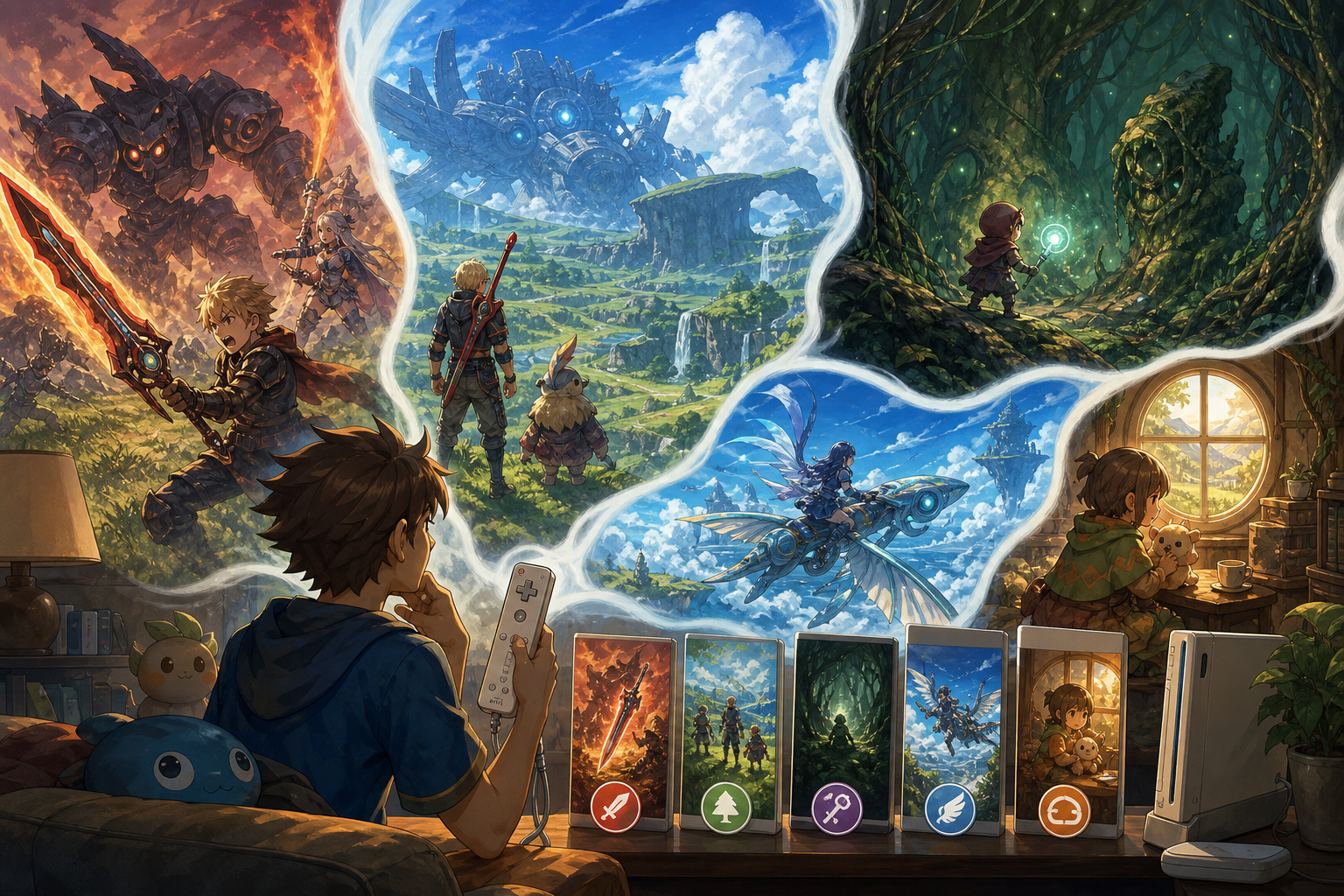
A Wii library can offer very different kinds of solo adventure without relying on the same genre formula. One evening might call for a huge world, layered party management and a long-term character-building commitment. Another might suit a compact story, a first-person expedition, motion-sensitive swordplay or a platforming quest that makes progress easy to remember.
This guide compares exactly five original Wii releases: Xenoblade Chronicles, The Last Story, The Legend of Zelda: Skyward Sword, Metroid Prime 3: Corruption and Super Paper Mario. The comparison focuses on combat style, exploration, controls, story emphasis and how much relearning each game demands after a long break.
The result is not a universal quality ranking. These games solve different problems. Some are best when you want systems to occupy your attention for a long stretch. Others are better when you want a clear objective, distinctive controls or a structure that makes it easy to remember where you left off.
How to choose between five very different adventures
The genre labels matter. Xenoblade Chronicles is the clearest long-form role-playing adventure here, combining real-time battles, party decisions, quests and broad areas to explore. The Last Story is an action RPG built around a more concentrated cast and tactical encounters. Skyward Sword is an action-adventure game whose sword controls and dungeon puzzles depend on Wii MotionPlus functionality. Metroid Prime 3: Corruption is a first-person adventure about aiming, scanning, tools and environmental progression. Super Paper Mario mixes platform action, puzzles, story and light role-playing systems rather than behaving like a conventional party RPG.
Returnability is useful when a Wii game shares time with other projects. A game is easier to resume when its next objective, control scheme and progression systems are easy to reconstruct. That does not necessarily mean it is short. Xenoblade Chronicles can be easy to understand in a single session but difficult to resume after a long absence because several systems overlap. Super Paper Mario can still be substantial while offering clearer landmarks through chapters, stages and character abilities.
The most practical first question is therefore not “Which game is best?” It is “What kind of mental space do I want this adventure to occupy?”
- Choose by the kind of thinking you want to do, not only by the label on the box.
- Check the required controller hardware before choosing a motion-focused game.
- Treat the original Wii editions as their own releases rather than silently substituting later remasters or collections.
1. Xenoblade Chronicles: choose the largest world and deepest commitment
Xenoblade Chronicles is the choice for a solo mood built around scale. Nintendo describes it as both an adventure and an RPG, and that combination explains its appeal. The game gives the player broad areas to cross, enemies that occupy the same spaces as exploration, party development, quests and a long-form story that continually pulls the group through a substantial journey.
Its world is built to support both directed progress and detours. You can follow the main route, investigate surrounding spaces, take on optional tasks or simply spend time learning how an area connects to the larger journey. That makes it a strong fit for players who enjoy the sense that the next interesting discovery might be somewhere beyond the immediate objective.
Combat happens in real time without switching to a separate battle screen. The player manages positioning, commands and character abilities while the party acts in the field. Vision Mode adds a forecasting element: the protagonist can receive warnings about future dangers and respond by changing the party’s actions, using an ability or trying to prevent a predicted attack. It gives encounters a recognizable identity beyond simply choosing the strongest available move.
The cost is re-entry friction. Returning players may need to recall party roles, equipped abilities, quest directions, current objectives and the logic of the area they were exploring. The game is not difficult to understand in isolation, but its many overlapping systems can make a long absence feel like a reset period.
The original Wii manual supports either a Wii Remote and Nunchuk combination or a Classic Controller. That gives this release more control flexibility than the motion-dependent choices below. Those are original Wii options; later versions should not be used to describe this edition.
Choose Xenoblade Chronicles when exploration, party management and long-term progression are the point of the evening. Avoid it when you want a tightly bounded session with little menu work or system recall.
- Best fit: players who want the broadest world and the deepest party-focused progression.
- Combat mood: real-time battles with positioning, commands and predictive information from Vision Mode.
- Exploration mood: large connected areas with room for detours and optional activity.
- Return cost: highest in this group because quests, party setup and interconnected systems can fade from memory.
- Controller note: the original Wii release supports Wii Remote and Nunchuk or Classic Controller configurations according to its manual.

2. The Last Story: choose focused drama and tactical teamwork
The Last Story offers a more concentrated alternative to Xenoblade Chronicles. Nintendo classifies it as an action RPG, but its identity is less about surveying a giant landscape and more about moving through a directed adventure with a team. The story keeps attention on a defined group of companions, making it a good choice when you want dramatic momentum without the same breadth of optional wandering.
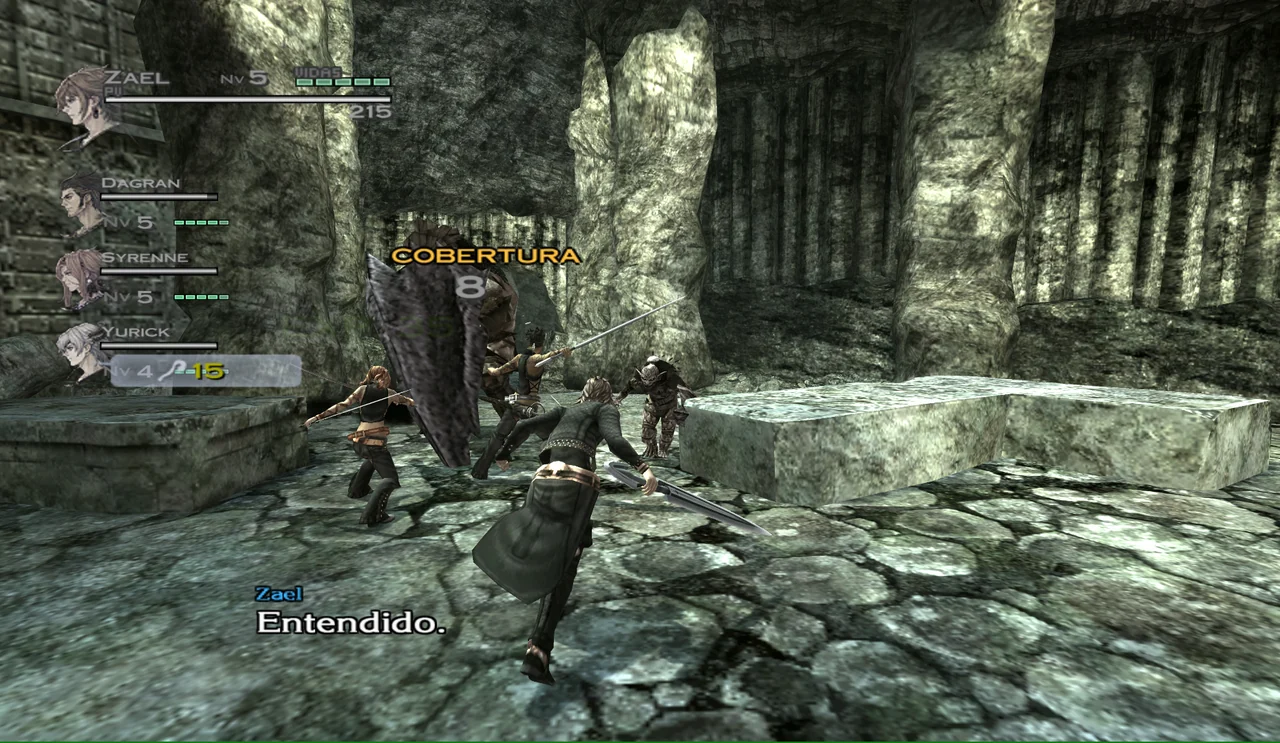
Its combat centers on real-time teamwork. Zael’s Gathering ability draws enemy attention, allowing him to influence the flow of a battle while allies perform their own roles. The result is not simply a matter of selecting attacks from a menu. Positioning, enemy focus, cover and the arrangement of the battlefield can all affect what happens next.
The game also lets players choose between automatic and manual attacking. Automatic attacks reduce the need to press an attack button for every ordinary strike, while manual attacks place more direct control in the player’s hands. That option gives the combat a useful range: a player can concentrate on movement and tactical commands in one situation, then take more active control when an encounter deserves closer attention.
Terrain adds another layer. The official description highlights actions such as attacking from cover and destroying obstacles, while the development material explains how the team designed dungeons around features such as climbing. Those systems make the battlefield part of the problem rather than a decorative backdrop.
This focus makes The Last Story comparatively easy to understand after a break. You still need to remember party roles and encounter habits, but the directed structure provides fewer competing destinations than Xenoblade Chronicles. Its former online modes should not be treated as a current reason to choose it, since the original Wii Connection service ended in 2014. The solo campaign is the relevant feature for a modern original-Wii session.
Choose The Last Story when character relationships and tactical group action matter more than a huge map. It is less suitable for players seeking free-form wandering, extensive route discovery or a largely solitary adventure.
- Best fit: players who want a focused story with party-based action.
- Combat mood: draw enemy attention, create openings and coordinate allies in real time.
- Exploration mood: directed areas where terrain and battle positioning matter more than open-ended wandering.
- Return cost: moderate, since party roles matter but the structure limits aimless reorientation.
- Hardware note: controller support should be checked against the particular regional package or manual before purchasing accessories.
3. The Legend of Zelda: Skyward Sword: choose motion-driven combat and dungeon logic
Skyward Sword is the clearest choice for someone who wants the controller to be part of the adventure. It is an action-adventure game rather than a conventional RPG, and sword direction is central to both combat and some puzzles. Wii MotionPlus tracks the intended angle of a swing, so encounters ask the player to read an opening and make the appropriate directional attack instead of relying only on a button-combination routine.
The adventure alternates between sky travel and ground-based regions, with dungeons, environmental puzzles, item upgrades and revisits to earlier locations. That structure creates a useful memory loop. A route that was previously confusing may become understandable once a new item or ability changes what the player can do. Returning after a break is therefore less about remembering a character build and more about recalling the current tool, dungeon objective and unfinished path.
The same structure can also create friction. Some players will enjoy revisiting familiar areas with new capabilities, while others may find the repeated transitions and motion-sensitive encounters less relaxing than a conventional button-controlled adventure. The controls are not a cosmetic extra; they affect how the player approaches swordplay, defense and certain interactions.
The major practical tradeoff is hardware dependence. The original Wii release requires a Nunchuk and either a Wii Remote Plus or a standard Wii Remote fitted with Wii MotionPlus. An ordinary Wii Remote alone is not enough. This should be checked before selecting the game, especially when a collection contains mixed controller generations or third-party accessories.
Skyward Sword is a good choice when physical sword direction and puzzle-solving sound inviting. If you prefer a conventional button-focused control scheme, its accessory requirement and motion emphasis may become friction rather than charm.
This comparison concerns the original Wii game, not Skyward Sword HD. The later release should not be used to describe the original edition’s hardware requirements or control context.
- Best fit: players who want dungeons, item-based puzzles and motion-sensitive swordplay.
- Combat mood: read attack angles and respond with directional strikes.
- Exploration mood: revisit areas after gaining items that change what paths are possible.
- Return cost: moderate; tool knowledge and dungeon context matter more than extensive RPG bookkeeping.
- Required hardware: Wii MotionPlus functionality, a Wii Remote or Wii Remote Plus, and a Nunchuk.

4. Metroid Prime 3: Corruption: choose direct aiming and environmental discovery
Metroid Prime 3: Corruption is the strongest choice for a player who wants exploration without party builds, equipment spreadsheets or character-level RPG progression. It is a first-person adventure in which scanning, combat and environmental observation work together. The player advances by learning what a space contains, recognizing how abilities interact with obstacles and remembering routes that connect earlier areas to new possibilities.
The Wii controls make aiming part of ordinary play. The Wii Remote handles pointing and view control, while the Nunchuk supports movement, lock-on and additional interactions. The control design separates movement from looking and aiming in a way that suits the first-person format, while sensitivity options help establish a preferred response level.
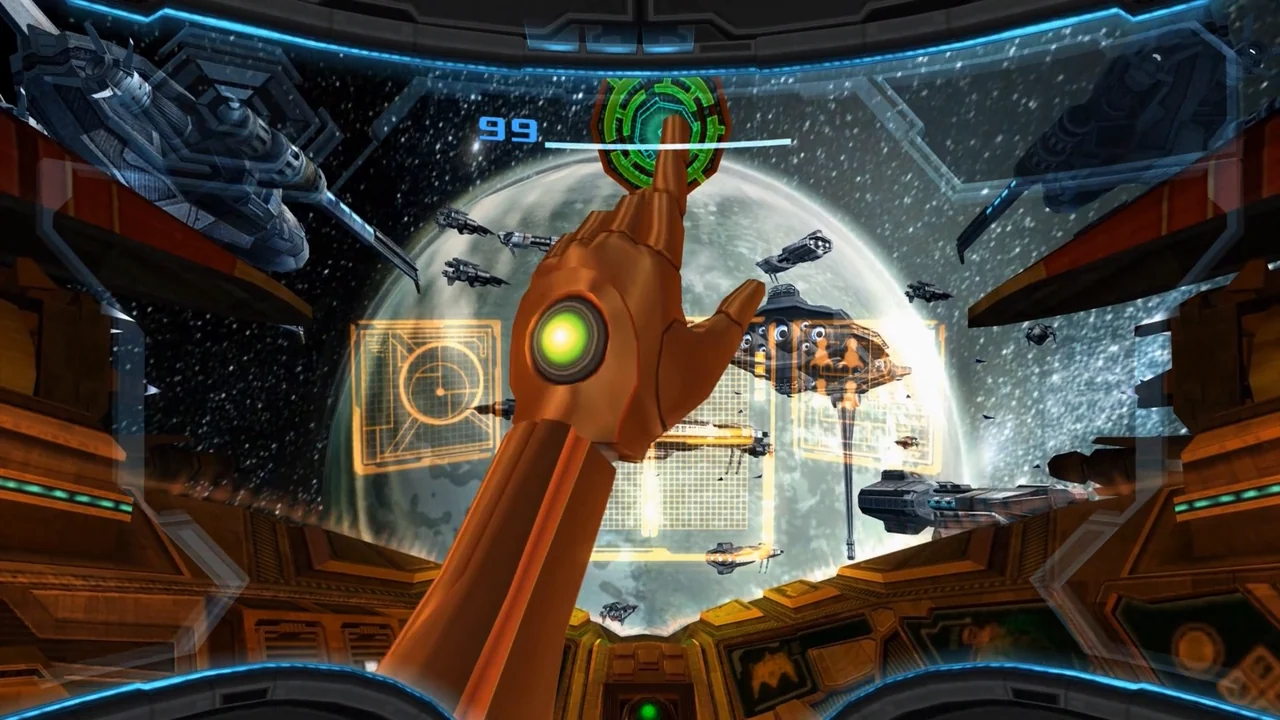
The game also builds exploration around tools and interfaces such as the Command Visor, Grapple Beam actions and Morph Ball abilities. Those additions make progression feel like an expanding vocabulary. A blocked route may become meaningful later when the right tool is available, and an apparently ordinary room may deserve another look once a new visor or movement ability changes what can be investigated.
Re-entry depends on spatial memory. After a long break, the main challenge may be remembering which planet, room or corridor contains the next useful lead rather than rebuilding a party. Scanning and the game’s visor systems reinforce the investigative character, but players who dislike backtracking or first-person aiming should understand the tradeoff before choosing it.
The original Metroid Prime 3 controls require a Wii Remote and Nunchuk, and Nintendo’s manual states that a GameCube controller cannot operate the game. Do not substitute the separate Metroid Prime Trilogy package when discussing the assigned original release; that is a different edition with different collection context.
Choose Metroid Prime 3 when you want to investigate a world directly and solve environmental problems through observation. Choose another game if you primarily want dialogue-driven party relationships, conventional RPG advancement or a chapter-based platforming structure.
- Best fit: players who want first-person exploration, scanning and environmental puzzles.
- Combat mood: direct pointing, aiming, lock-on and tool-based encounters.
- Exploration mood: route discovery driven by abilities, visors and environmental clues.
- Return cost: moderate; remembering routes and acquired abilities is more important than recalling character statistics.
- Required hardware: Wii Remote and Nunchuk. A GameCube controller does not operate the game.
5. Super Paper Mario: choose the easiest chapter-by-chapter return
Super Paper Mario is the most approachable option for a player who wants an adventure with clear chapters, platforming and story without the full commitment of a large RPG. Nintendo categorizes it across action, adventure and RPG, but its moment-to-moment identity is closer to platform action with light progression systems. Defeated enemies provide points, leveling raises health and attack, and the adventure is organized into chapters rather than a sprawling web of party builds and side objectives.
Its defining idea is the ability to flip between two-dimensional and three-dimensional perspectives. A route that looks blocked from one view may reveal a passage, hidden object or useful relationship from another. The mechanic gives exploration a puzzle flavor without requiring the player to memorize a huge map. It also makes the game feel different from a standard side-scrolling platformer because the camera perspective is part of the solution.
Mario, Peach, Bowser and Luigi each offer different ways to approach situations, while Pixl companions add distinct traversal and puzzle abilities. The result is a light role-playing structure that supports experimentation without asking the player to manage a traditional party. Character choice and Pixl selection are more about solving the immediate obstacle than maintaining a complex combat formation.
The control scheme is comparatively simple, but not entirely conventional. The original manual describes holding the Wii Remote sideways for much of play, with pointing used for selected actions, examinations, hints and minigames. The game also uses the remote’s motion functions for some actions. That makes it less accessory-dependent than Skyward Sword while still giving the Wii version a clear control identity.
Super Paper Mario is the easiest game here to resume after a break because chapters provide strong mental landmarks and the core objective is usually legible. A player can still forget a particular Pixl ability or the solution to a perspective puzzle, but the overall structure is easier to reconstruct than Xenoblade Chronicles’ larger network of quests and systems.
It is not the best choice for someone seeking deep party tactics or expansive free-form exploration. It is an excellent fit for shorter, clearly segmented solo sessions where platforming, humor, puzzles and character switching can share the spotlight.
- Best fit: players who want platforming, humor, puzzles and light role-playing systems.
- Combat mood: switch characters and use Pixl abilities rather than manage a traditional party.
- Exploration mood: flip between 2D and 3D perspectives to reveal routes and hidden objects.
- Return cost: lowest in this group because chapter structure and character abilities create clear landmarks.
- Controller note: the Wii Remote is generally held sideways, with pointing reserved for selected functions.
Match the game to the solo evening you want
For the largest sense of place, choose Xenoblade Chronicles. It asks the most patience but gives exploration, real-time combat and party development the most room to grow. It is the best match for a player who wants the game’s systems to become a long-term hobby rather than a short detour.
For the most focused tactical drama, choose The Last Story. Its battles are still active and demanding, yet the adventure keeps attention on a defined cast, tactical roles and directed progression. It is the clearest alternative to Xenoblade Chronicles for a player who wants party combat without the same scale of world management.
For the most distinctive controls, choose Skyward Sword, provided the required MotionPlus-capable Wii Remote and Nunchuk are already available. Its hardware requirement is not a minor detail; the controls shape both combat and puzzle design.
For exploration built around aiming, scanning and route discovery, choose Metroid Prime 3: Corruption. It delivers an expedition mindset without asking you to maintain RPG statistics or a conventional party.
For the easiest return after a long gap, choose Super Paper Mario. Its chapters, character roster and perspective mechanic give the player strong reminders of how the game is organized.
These are editorial matches rather than a universal quality ranking. A player can reasonably prefer the game with the most demanding controls, the largest memory burden or the least conventional genre blend, depending on the desired mood.
- Largest world and deepest systems: Xenoblade Chronicles.
- Most focused tactical party adventure: The Last Story.
- Most control-specific action-adventure: Skyward Sword.
- Strongest first-person exploration: Metroid Prime 3: Corruption.
- Easiest chapter-based re-entry: Super Paper Mario.
Original Wii edition and accessory checks
Edition accuracy matters because later releases changed the context of some of these games. This comparison concerns the original Wii versions of Xenoblade Chronicles, The Last Story, Skyward Sword, Metroid Prime 3: Corruption and Super Paper Mario. Do not import interface changes, additional story material or control options from Xenoblade Chronicles: Definitive Edition or Skyward Sword HD. Metroid Prime Trilogy is also a separate package from the original Metroid Prime 3 release.
The hardware requirements divide the list neatly. Skyward Sword is the most demanding: Wii MotionPlus functionality and a Nunchuk are required. Metroid Prime 3 requires a Wii Remote and Nunchuk and does not accept a GameCube controller. Xenoblade Chronicles offers the clearest documented alternative between Wii Remote and Nunchuk and Classic Controller play. Super Paper Mario centers on sideways Wii Remote use with pointing for selected tasks.
The Last Story requires more care when discussing accessories because regional packaging and manuals present controller information differently. A collector should confirm the specific edition before making a firm accessory purchase rather than assuming every listed configuration applies identically to every region.
These details are practical selection criteria, not collector trivia. A game can be a poor fit simply because the required controller is missing, uncomfortable or difficult to identify in a mixed accessory drawer. Confirm the original manual and regional packaging before buying a replacement or assuming a later controller configuration applies.
- Original Wii Skyward Sword requires Wii MotionPlus functionality and a Nunchuk.
- Original Wii Metroid Prime 3 requires Wii Remote and Nunchuk, not a GameCube controller.
- Xenoblade Chronicles supports Wii Remote and Nunchuk or Classic Controller play according to its original manual.
- Do not use later remaster features to describe the assigned Wii editions.
- Verify regional controller information for The Last Story before making a firm accessory purchase.
The best choice depends on what you want the adventure to remember for you. Xenoblade Chronicles asks you to remember a large world and many systems. The Last Story keeps the focus on tactical companionship. Skyward Sword makes physical input part of the puzzle. Metroid Prime 3 turns route memory into investigation. Super Paper Mario packages its ideas into chapters that are easy to pick up again.
Start with the controller and the mood, then consider scale. If the evening calls for a long world, choose Xenoblade Chronicles. If it calls for a concentrated drama, choose The Last Story. For motion swordplay, first-person discovery or an approachable chaptered quest, the other three each provide a distinctly different Wii adventure rather than a lesser version of the same formula.