A platformer can feel completely different when several people share the screen. A solo player may welcome precise jumps and repeated practice, while a family group may care more about whether a beginner can recover from mistakes without stopping everyone else. Player count matters too, but four character slots do not automatically make a game a good four-person choice.
This comparison covers the original Nintendo Wii releases of five platformers: Kirby’s Epic Yarn, Kirby’s Return to Dream Land, New Super Mario Bros. Wii, Donkey Kong Country Returns and Rayman Origins. The useful questions are practical. How much responsibility does each player carry? Can a stronger player help without taking over? What happens after a mistake? Does the game reward calm experimentation, coordinated movement, chaotic interaction or rapid retries?
The result is not a universal difficulty ranking. A game that is comfortable for one group can be frustrating for another because of controller familiarity, screen clutter, player confidence or tolerance for repeating a difficult section. The best choice is the one whose cooperative structure matches the people in the room.
How to choose between the five Wii platformers
There are several kinds of difficulty in local multiplayer. Mechanical difficulty is the obvious one: how demanding the jumps, hazards and enemy encounters are. Social difficulty can matter just as much. A game becomes harder to enjoy when one player controls the route, another repeatedly causes collisions, or the group must replay a long stretch after one person makes a mistake.
Retry friction describes everything that happens between a mistake and another attempt. Checkpoints, bubbles, revival systems and short restarts reduce that friction. A game can contain demanding levels while remaining pleasant for repeated attempts. Conversely, an apparently accessible game can become tiring if everyone must repeatedly revisit the same section.
Player count should be treated as a starting point, not a verdict. Kirby’s Epic Yarn and Donkey Kong Country Returns are two-player games, but their partnerships work very differently. Kirby’s Return to Dream Land, New Super Mario Bros. Wii and Rayman Origins support up to four players, yet one emphasizes ability variety, one emphasizes physical interaction and one emphasizes quick recovery.
Controller availability also matters. The original Wii editions do not all use the same control arrangement, and later ports or remakes should not be used as evidence for the Wii versions. Before starting, check whether the group has enough Wii Remotes and whether the game calls for a Nunchuk or Classic Controller.
- Choose Kirby’s Epic Yarn for calm two-player discovery.
- Choose Kirby’s Return to Dream Land for flexible mixed-skill family play.
- Choose New Super Mario Bros. Wii for loud, physical four-player interaction.
- Choose Donkey Kong Country Returns for a focused two-player challenge.
- Choose Rayman Origins for fast four-player retries and collectible-focused movement.
1. Kirby’s Epic Yarn: Best for forgiving experimentation
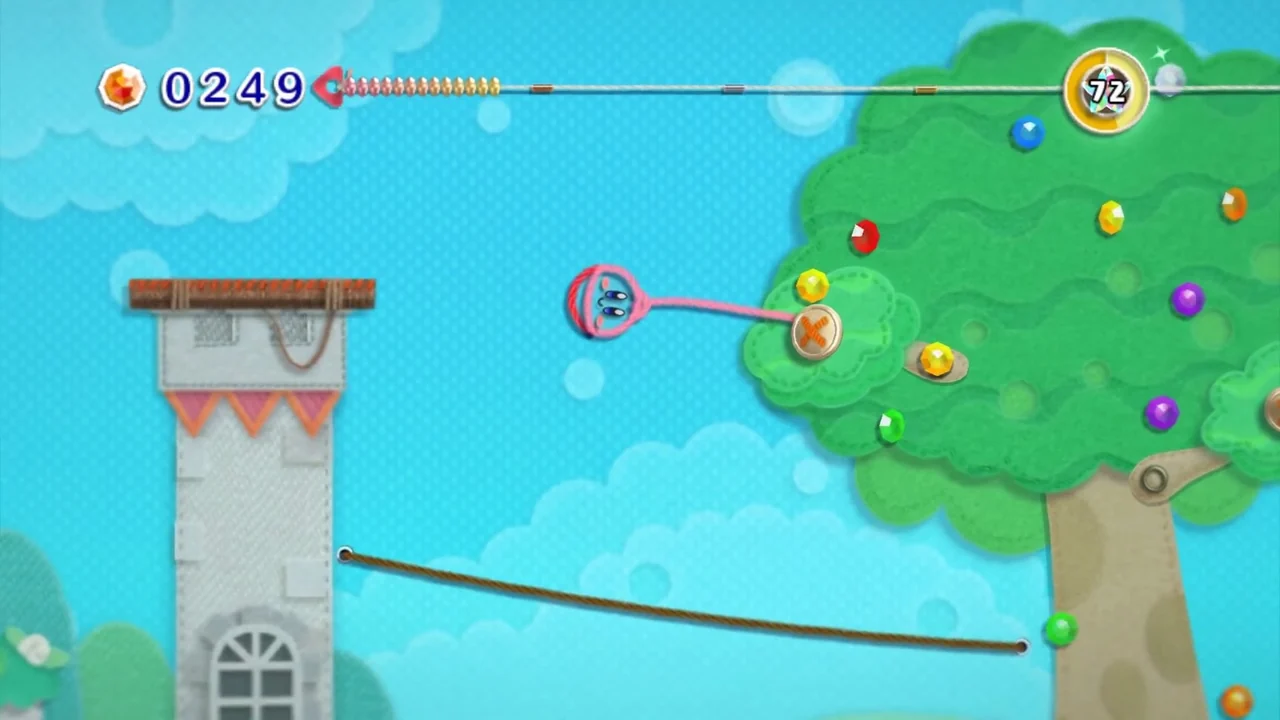
Kirby’s Epic Yarn is the strongest fit here for two players who want to explore platforming ideas without making every error feel like a verdict. Its fabric-and-yarn presentation is more than decoration. Transformations, zips, buttons and other environmental interactions make movement feel inventive and tactile. Instead of treating every obstacle as a demand for perfect timing, the game often encourages players to inspect the scene and ask what can be pulled, opened, transformed or revealed.
Its cooperative mode supports two players on one screen, so it is not the answer for a four-person gathering. That limitation is useful when choosing for a smaller group. Two people can discuss what they see, share responsibility for collecting items and experiment without the visual congestion that can come from several characters occupying the same platform.
That structure makes Epic Yarn particularly welcoming for a parent and child, a new player paired with a patient friend, or two people who enjoy creative discovery more than strict execution. A less experienced player has room to observe how platforming spaces work and can contribute without needing to match an expert’s speed immediately.
The tradeoff is that Epic Yarn is not designed to deliver the most demanding precision test in this group. Players who want strict timing, difficult recovery or a long sequence of high-stakes jumps may find its gentler approach less satisfying. Its appeal is the low-pressure loop: try an interaction, make a mistake, understand the result and continue.
Do not mistake forgiving design for a lack of substance. The transformations and environmental tricks give experienced players reasons to engage with each stage beyond simply reaching the exit. The right audience is a pair that wants platforming to feel like a playful conversation. The wrong audience is a group of three or four people waiting for a turn at the same time.
- Best audience: two players, including at least one newcomer.
- Co-op shape: shared-screen partnership rather than a four-person crowd.
- Main strength: experimentation with fabric-themed transformations and objects.
- Main tradeoff: less suitable for groups seeking severe precision or four-player play.
2. Kirby’s Return to Dream Land: Best for mixed-skill family co-op
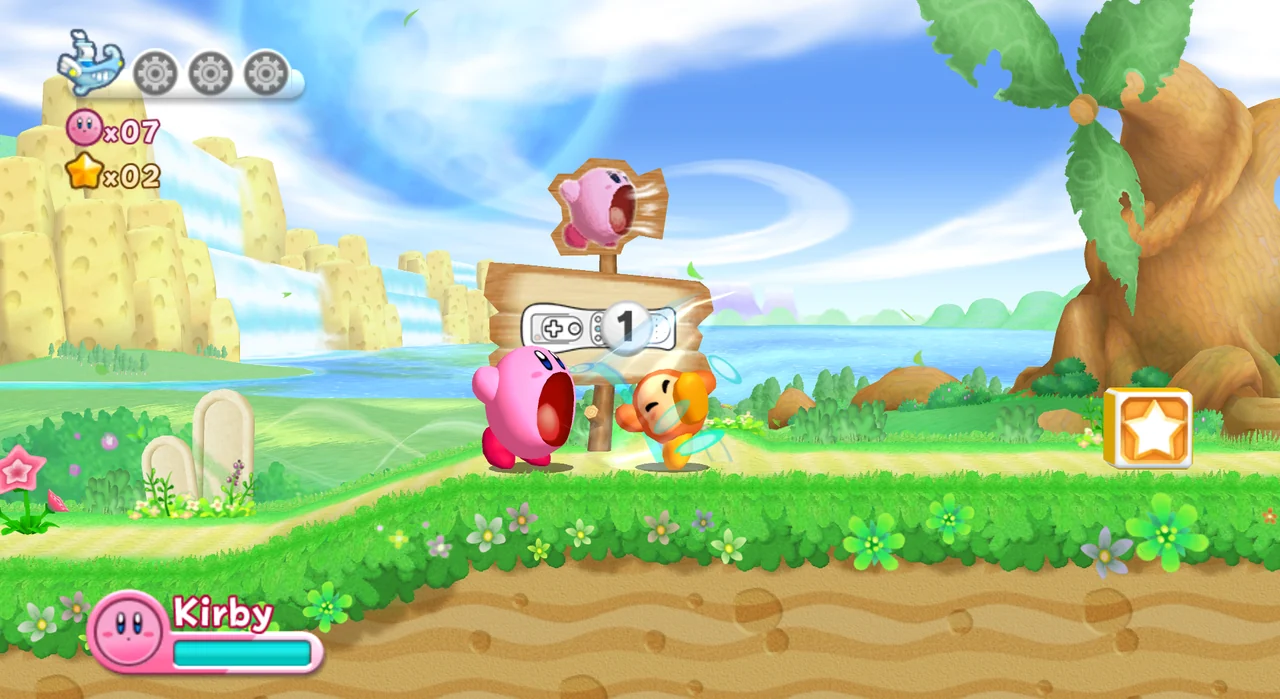
Kirby’s Return to Dream Land is the most adaptable choice for a group whose experience levels do not match. The original Wii release supports simultaneous play for up to four players, with additional Wii Remotes required. Players can also join or leave during play, which is valuable during a family session where someone may need to step away or a younger player may want to participate for only a few stages.
Its cooperative design is built around assistance as well as shared progress. Different characters and abilities give players more ways to approach encounters, and a stronger participant can help a less experienced player through difficult scenes. That does not remove all responsibility from the beginner, but it can make the skill gap less disruptive. A player who misses a jump remains part of the group rather than simply watching an expert finish the level.
The game’s designers specifically built the Wii version around four-person simultaneous play and the ability for players to join or leave. That makes it more flexible for an irregular game-night group than a title that requires everyone to commit to the same session from beginning to end.
The larger roster creates a meaningful tradeoff. Four active characters can make busy sections harder to read, particularly when everyone moves at once or several abilities fill the screen. The same variety that helps players find a comfortable role can also make coordination less tidy. Groups should agree on whether they are trying to move efficiently or simply enjoying the spectacle.
Return to Dream Land suits families and mixed groups better than a rigid skill ranking suggests because it lets the party adjust its membership and use cooperation as a safety net. It is a better four-player recommendation than Epic Yarn, while remaining less collision-driven and less deliberately chaotic than New Super Mario Bros. Wii. Pick it when the goal is to keep everyone involved, not to determine who is the best jumper.
- Best audience: families or groups with uneven platforming experience.
- Player count: up to four simultaneous players on the Wii version.
- Main strength: join-and-leave flexibility and ability variety.
- Main tradeoff: four characters can make crowded scenes visually busy.
3. New Super Mario Bros. Wii: Best for a chaotic four-player night
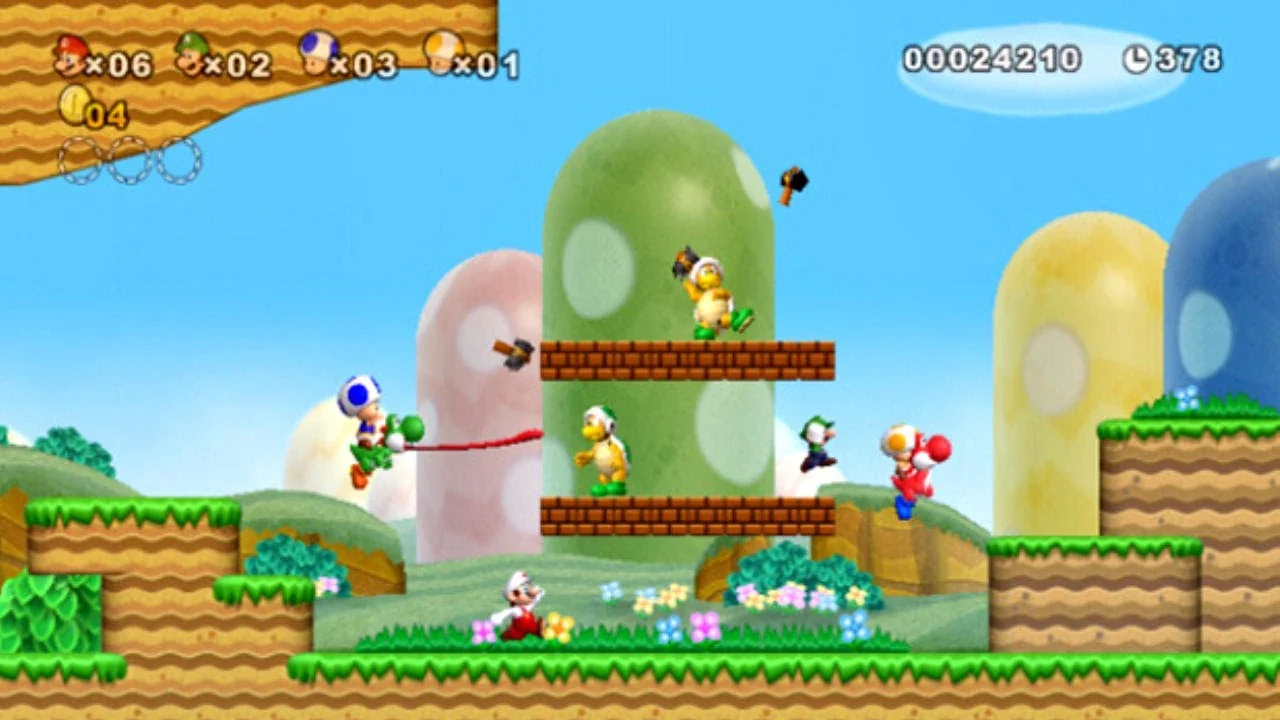
New Super Mario Bros. Wii is the clearest choice when four people want to control conventional platforming characters at the same time. Its multiplayer mode supports two to four players, with one Wii Remote per participant. The original control arrangement is based on holding the Wii Remote horizontally, although the game also supports Wii Remote and Nunchuk play.
The important difference is how directly players affect one another. Characters can lift and throw teammates, bounce off one another, perform cooperative jumps and use simultaneous ground pounds. These actions can produce genuine cooperation, such as helping someone reach a platform, but they can also turn a careful section into a pileup. The game is therefore excellent for groups that enjoy laughter, improvisation and accidental betrayal. It is less comfortable for players who need a quiet screen and predictable personal space.
Failure recovery helps keep the room moving. A player who loses a life can return in a bubble and float toward another character for revival. Entering a bubble does not itself cost a life. The bubble can be popped when it touches another player, allowing the struggling player to resume control.
The recovery system has limits. If every player ends up in a bubble, or if the remaining active player loses a life while the others are in bubbles, the group returns to the map screen. That gives the team a reason to communicate without making every individual mistake a full stop.
The game’s greatest strength is shared physicality. Everyone has a visible role, and the group can solve a section by coordinating jumps or deliberately using another character as a platform. Its weakness is the same thing. Experienced players who rush ahead can strand others, while beginners may feel responsible for repeated collisions. Establish a relaxed rule before starting: reaching the goal together matters more than proving who caused the last mistake.
- Best audience: three or four players who enjoy energetic interaction.
- Controls: horizontal Wii Remote play, with one Remote needed per multiplayer participant.
- Main strength: lifting, throwing, cooperative jumps and bubble-based recovery.
- Main tradeoff: cooperation and interference are inseparable.
4. Donkey Kong Country Returns: Best for a focused two-player challenge
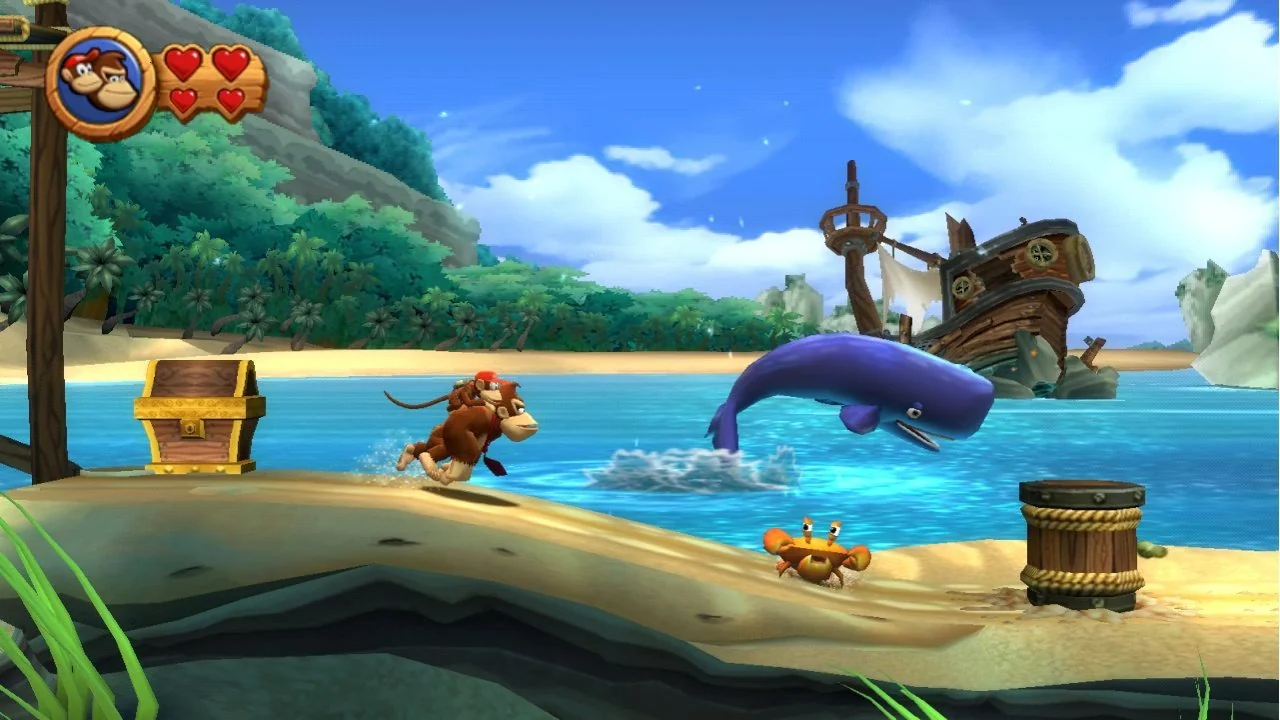
Donkey Kong Country Returns is the choice for two players who want more pressure on movement and timing. Its cooperative structure is not an equal partnership in the same sense as two independent platforming characters. Player One controls Donkey Kong, while Player Two controls Diddy Kong. Diddy can ride on Donkey Kong’s back, giving the less experienced player a support role during demanding movement sections rather than requiring both players to perform every jump independently.
That arrangement can be especially helpful when a skilled player and a beginner want to play together without splitting the session into spectator and expert. The Donkey Kong player carries more of the movement responsibility, while Diddy’s contribution can make difficult passages more manageable. The pair still needs to communicate, because separating at the wrong moment or mistiming an action can turn a support system into another source of trouble.
Returns creates more retry pressure than either Kirby game. Timing-heavy hazards, mine-cart sections, rocket-barrel stages and boss encounters demand concentration. The Wii version also uses motion-based actions, which is an important controller consideration for players who prefer conventional buttons and sticks.
The game does provide checkpoints and item-based assistance, but those tools do not make every failure inexpensive. A difficult section may still require repeated attempts, and both players need to be willing to learn the timing rather than expecting the support role to remove the challenge.
This is not the best recommendation for a relaxed four-person gathering or for a first platformer chosen solely because the box offers co-op. It is a strong match for two players who enjoy learning a difficult movement sequence, discussing who should take which risk and retrying until the timing becomes reliable. The support relationship between Donkey and Diddy gives the game a distinct cooperative identity, but it also means both players should understand that their responsibilities are deliberately uneven.
- Best audience: two players who want challenge and a defined support role.
- Co-op shape: Donkey Kong leads movement while Diddy Kong provides assistance.
- Main strength: a skilled player can help a less experienced partner stay involved.
- Main tradeoff: motion-based actions and timing-heavy hazards increase retry pressure.
5. Rayman Origins: Best for fast retries and high-energy four-player play
Rayman Origins is the best fit for a group that wants fast movement, collectible hunting and frequent attempts without a heavy punishment loop. The Wii version supports local multiplayer for up to four players, allowing the room to explore levels and collect Lums together. Its pace gives each participant plenty to do, but the game still rewards players who pause long enough to notice routes, secrets and timing opportunities.
A defeated player can return as a bubble that another player activates. This makes individual mistakes less disruptive than a conventional lives-and-game-over structure. The group can keep moving, revive a partner and attempt the next obstacle without turning every failure into a long administrative break. That recovery system is particularly useful when players have different levels of confidence or when the group wants to learn by repeating a short section rather than carefully protecting a limited supply of lives.
The forgiving retry structure should not be confused with beginner-only design. Rayman Origins contains demanding platforming and collectible challenges, and later attempts can become more about precision than simple forward progress. A group that ignores optional collection may find the route manageable, while a completion-minded group faces a much sterner test.
This makes Rayman unusually flexible. Casual players can focus on momentum and helping one another recover, while experienced players can turn the same stages into a technical exercise. Its cooperative systems reduce the cost of an individual mistake without removing the need to control movement accurately.
Controller choice is another advantage on Wii. Contemporary coverage of the Wii release identifies Wii Remote-only play, Wii Remote with Nunchuk and Classic Controller support. The group should agree on controls before beginning so that no player is learning a different control scheme in the middle of a difficult stage.
Choose Rayman when the room wants the energy of a shared run, the satisfaction of collecting together and the ability to try again quickly. Choose Mario instead when the main attraction is direct physical interaction between characters.
- Best audience: up to four players who enjoy speed and repeated attempts.
- Co-op shape: shared exploration, collection and bubble-based revival.
- Main strength: low retry friction without removing demanding platforming.
- Main tradeoff: collectible and precision challenges can still challenge beginners.
The practical choice for five common groups
For a first platformer or a quiet two-person session, start with Kirby’s Epic Yarn. Its low-pressure experimentation gives a new player time to understand the language of platforming without making every error a public event.
If the group has three or four people and includes children or players with very different abilities, Kirby’s Return to Dream Land is the safer social choice. Participants can join or leave, and the game gives the group several ways to support a struggling player. Its four-character presentation can become busy, but that is usually easier to manage than asking a mixed-skill family to share the more collision-heavy Mario experience.
For a loud four-person game night, New Super Mario Bros. Wii offers the most direct shared interaction. Expect collisions and treat them as part of the entertainment. For a skilled player paired with a beginner, the decision is between Return to Dream Land and Donkey Kong Country Returns. Kirby offers broader, more flexible cooperation, while Donkey and Diddy create a clearer expert-helper relationship with more demanding movement.
Choose Rayman Origins when the group dislikes replaying long stretches after one person makes a mistake. Its bubble revival and quick recovery rhythm keep the session active, but players who want a calm introduction may find its speed and later precision challenges demanding.
If the group enjoys mastering timing rather than merely reaching the end, Donkey Kong Country Returns is the focused two-player option, provided everyone is comfortable with its Wii motion actions. Its uneven character roles are a feature for some pairs and a drawback for others.
These recommendations also depend on the hardware in front of you. The comparison concerns the original Wii releases, not later versions with altered features, controls or content. Confirm that the available Wii Remotes and, where relevant, Nunchuks or Classic Controllers match the game’s original multiplayer requirements before promising a particular setup.
- First platformer: Kirby’s Epic Yarn.
- Mixed-skill family: Kirby’s Return to Dream Land.
- Four-player chaos: New Super Mario Bros. Wii.
- Focused two-player mastery: Donkey Kong Country Returns.
- Fast cooperative retries: Rayman Origins.
The right Wii platformer depends less on an abstract difficulty scale than on how your group handles responsibility. Kirby’s Epic Yarn gives two players room to experiment, Kirby’s Return to Dream Land accommodates a changing family group, Mario turns cooperation into controlled chaos, Donkey Kong asks two players to manage an uneven support partnership, and Rayman keeps a larger group moving through repeated attempts.
Before choosing, count the players, check the available controllers and decide whether mistakes should create laughter, discussion or another serious practice run. That small conversation will usually identify the best match faster than a ranking ever could.