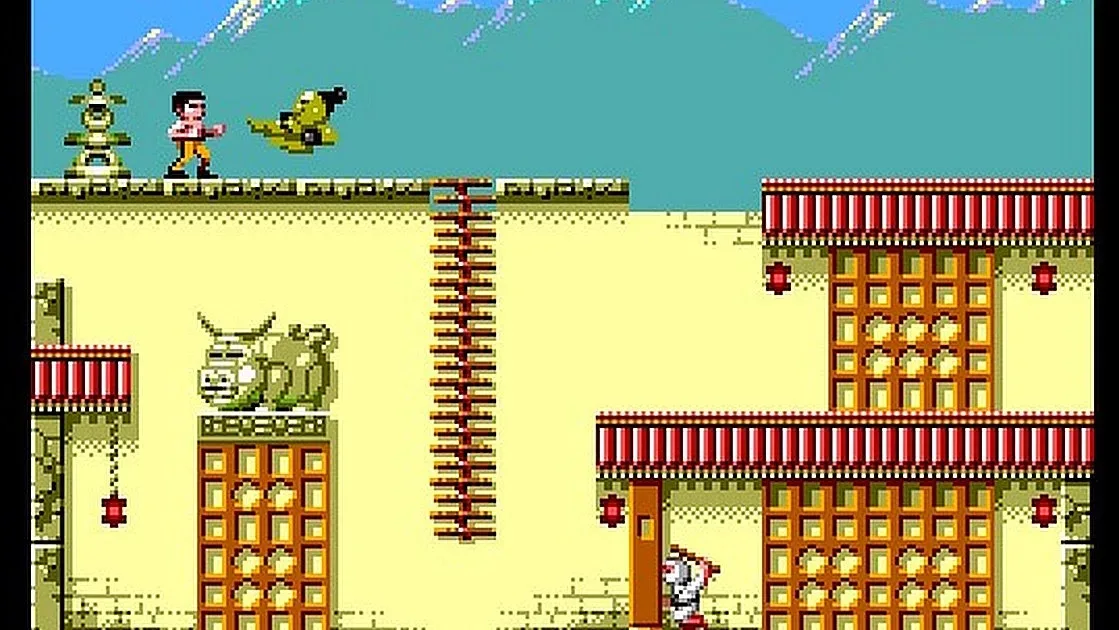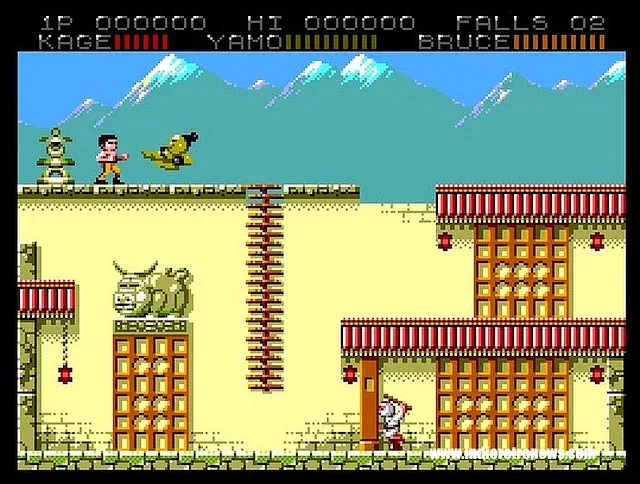
Bruce Lee has arrived on the Commodore Amiga in a conversion aimed squarely at the original Sega Master System version. Credited to Tim Kovack, the new release targets classic Amiga OCS hardware with only 512K of RAM, while supporting both NTSC and PAL systems.
The most interesting part is not simply that an 8-bit action game now runs on an Amiga. It is the approach behind the conversion: rather than treating the Master System release as a loose template and rebuilding it from the ground up, the game logic was translated from Z80 assembly language into 68000 machine language. That choice is intended to retain the original edition’s mechanics, timing and overall feel.
For retro players, that is a meaningful distinction. Ports routinely involve trade-offs, whether in movement, collision timing, scrolling, visuals, performance, controls or even the speed at which the game itself runs. This project’s stated goal is much narrower and more preservation-minded: bring the Master System game to Amiga OCS while keeping its original behavior central to the conversion.
A port that follows the Master System’s timing
The Amiga release behaves differently depending on the video standard of the machine running it. On an NTSC Amiga, Bruce Lee operates at 60 Hz, matching the pace of the original Master System version. On PAL Amigas, it runs at 50 Hz, which makes the game roughly 17% slower.
That slowdown is not presented as an accidental performance shortfall. It mirrors the difference experienced by players using European PAL Master System hardware. In practical terms, the distinction matters because Hz, short for hertz, refers here to how often the display refreshes each second. A game updating in step with a 60 Hz display can move and animate more frequently than one running in step with a 50 Hz display, if the game is designed around those refresh rates.
In action games, a change in update rate can affect more than a stopwatch. Character movement, enemy motion, animation cadence and the window for player reactions can all feel different when the pace shifts. The NTSC configuration is therefore the one that matches the original console velocity, while the PAL configuration preserves the slower regional experience familiar from PAL Master System play.
This is a useful reminder that “the same game” did not always mean an identical experience across territories and hardware standards. The Amiga conversion does not erase that historical difference; it carries it forward. Players using an NTSC machine receive 60 Hz operation, and players on PAL hardware get the corresponding 50 Hz behavior.
From Z80 to 68000: what the conversion method means
The key technical claim is that the original Master System logic was translated directly from Z80 assembly to Motorola 68000 machine language. Both are low-level forms of programming closely tied to their respective processors. The Sega Master System uses a Z80 processor, while the Amiga’s 68000-family CPU uses a different instruction set.
Related coverage includes Bruce Lee Brings Its Master System Action to Amiga OCS.
Assembly language is not a universal game format that can simply be loaded on a different processor. Instructions written for a Z80 must be re-expressed for the 68000 so that the destination machine performs equivalent work. That makes a direct logic translation a particularly focused form of conversion work: the programmers are preserving how the original program makes decisions, manages timing and runs game behavior, but expressing those operations in the language understood by Amiga hardware.
It does not mean the hardware is identical, because it clearly is not. It means the game’s underlying rules have been carried across as directly as possible. For a project based on an existing Master System game, that is a sensible route to maintaining the character of the source version rather than producing an interpretation that merely resembles it.
The result also shows why the Amiga’s greater visual reputation does not automatically make this a simple “upgrade.” The stated target is an accurate Master System conversion on an OCS system with 512K, not a redesign that adds features or changes the game’s identity. The limitations and the chosen target matter as much as the destination machine’s potential.
Using Amiga sprites without losing the Master System look
Visually, the port uses Amiga hardware sprites in attached pairs to render 16-color characters that match the Master System palette. A hardware sprite is a graphics element the system can draw and position independently from the main background. Using hardware support can reduce some of the work otherwise required to draw moving characters frame by frame as part of the playfield.
Attached sprite pairs are used here to achieve the required color depth for characters. The stated aim is fidelity to the Master System presentation rather than an Amiga-specific reinterpretation of the art. That helps explain another design choice: stationary scenery, including stage lanterns, is incorporated directly into the background.
Putting static objects in the background keeps the available moving-sprite resources focused on elements that actually need to move. On older systems, that sort of division is fundamental. A lantern that never changes position does not need to consume the same drawing resources as a player character or a moving opponent.
The port also has a safeguard for busy horizontal sections of the screen. When more than four moving sprites would share the same horizontal lines, additional objects are drawn into the background rather than remaining hardware sprites. The purpose is to avoid flicker.
Sprite flicker is a familiar artifact of limited graphics resources. When a system cannot display every moving object it has been asked to show in a given area, a game may alternate which objects are drawn from one frame to the next. That can preserve visibility overall, but it creates a distracting flashing effect. This Bruce Lee conversion instead shifts excess moving objects into background rendering under those conditions, prioritizing a steadier image.
That solution is a clear example of adaptation rather than brute-force imitation. The conversion preserves the original palette and intended gameplay behavior, while making practical use of Amiga OCS techniques to operate within the machine’s display constraints.
Room changes and the cost of a complete redraw
Players will encounter a brief interruption when moving from one room to another. The transition triggers a full redraw of the screen, costing a couple of frames.
A full redraw means the game reconstructs the new screen rather than smoothly carrying an already-rendered view into the next room. It is a small but visible consequence of the conversion’s technical choices and hardware budget. Importantly, the reported delay is only a brief handful of frames, not a prolonged loading sequence, but it is part of the port’s behavior to know about.
For enthusiasts of original hardware, such quirks can be as informative as the headline feature list. They show where the conversion is making its compromises: retain Master System logic and color presentation, support 512K OCS hardware, manage sprite pressure, and accept a momentary redraw on room changes.
One practical limitation before playing
There is one operational detail owners should not miss: Bruce Lee does not include a route back to the Amiga Workbench graphical interface. When finished playing, users will need to reset the machine physically.
Workbench is the Amiga’s GUI environment, and software commonly needs a proper exit path to hand control back to it. Without that option, resetting is required to leave the game. It is a straightforward limitation, but one that matters more on original hardware than it might in a modern desktop environment, where closing an application is generally assumed.
A deliberately specific kind of retro release
This is not positioned as a sweeping remake or a technically maximalist showcase for the Amiga. Its appeal is more precise: a Master System Bruce Lee conversion made for classic Amiga OCS machines, retaining the original game logic through a Z80-to-68000 translation and respecting the NTSC/PAL pace difference.
That precision gives the release its identity. The 60 Hz NTSC version aligns with the Master System’s original velocity; PAL hardware recreates the 50 Hz behavior associated with European console play. Its 16-color characters retain the source palette, while background drawing and sprite-management decisions address the realities of the Amiga display hardware.
For readers interested in how old platforms solved different technical problems, the Amiga’s history has plenty more to explore beyond games themselves. Our look at the PlayStation 2 Network Adapter and the console’s online era examines another case where hardware capabilities and practical limitations shaped the way people used a system.
Bruce Lee on Amiga OCS stands as a focused piece of conversion work: one that treats timing, processor behavior, palette matching and sprite limits as core parts of the game, rather than invisible details to be smoothed away.