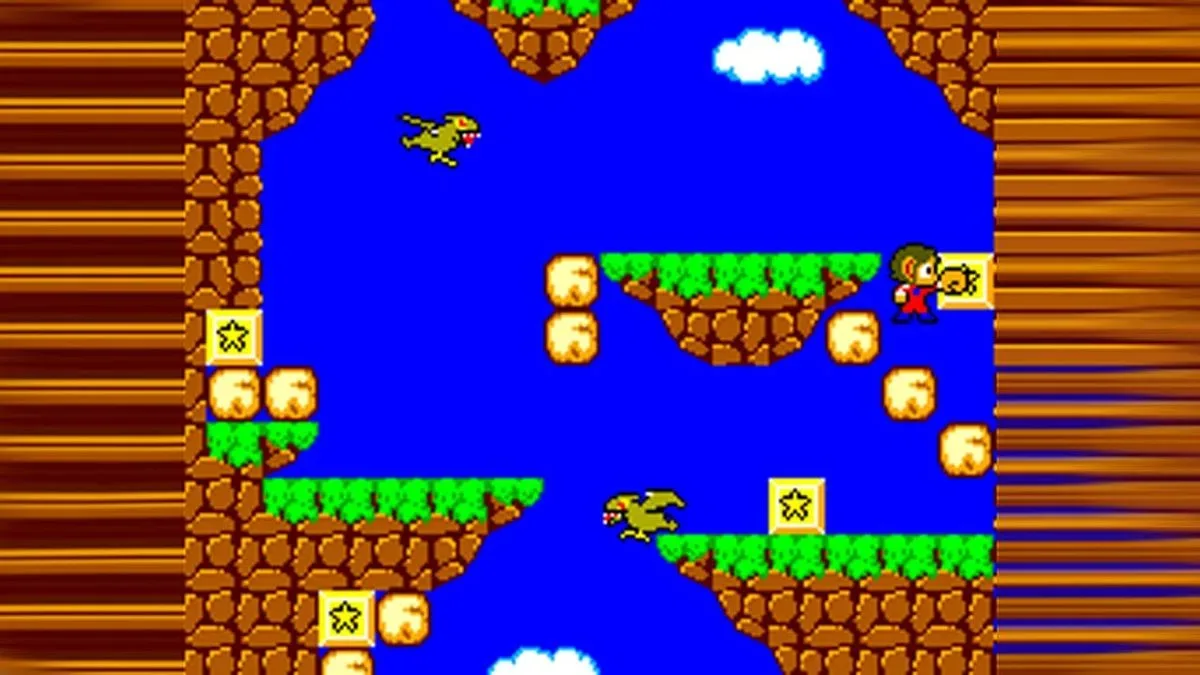
Alex Kidd in Miracle World has gained a remarkably small repair for one of its most familiar frustrations. A new ROM hack by Psicopompo addresses the Master System platformer’s troublesome punch-to-block collision behavior, making breakable blocks respond when Alex’s extended fist actually reaches them rather than relying on an exceedingly narrow, momentary test.
For a game from 1986, Alex Kidd remains an especially recognizable part of Sega’s early console history. Its colorful stages, motorcycles, rock-paper-scissors boss encounters and relentlessly breakable scenery gave it a personality that many players still associate with the Master System. Yet the game’s punch has also been a source of decades-long irritation. A fist can look as though it has connected with the edge or corner of a block, only for the block to remain perfectly intact. The result is the kind of tiny disagreement between player and game that can turn a simple platforming move into an argument with a cartridge.
This patch is not presented as a way to make the game easier through invincibility, altered level layouts or extra lives. It instead changes the way the original game determines whether a punch should break a block. That distinction matters: the goal is to make the on-screen action and the game’s underlying collision logic agree more consistently.
Why Alex Kidd’s punches could miss a block they seemed to hit
The original behavior comes down to the severe limits of the existing block-collision check. In the unpatched game, the test happens on only one frame: the frame in which the player presses the button. It also examines just a single 8-by-8-pixel point.
That is a very tight window for an action that visually continues as Alex’s fist moves outward. If the character is jumping, if the fist reaches a block a fraction after the input frame, or if a punch lands around a block’s corner, the one-time test may not register contact at all. The animation can sell a hit even while the collision code has already decided otherwise.
Old games often have rules that feel mysterious until the technical details are exposed. This is one of those cases. The erratic result was not necessarily a matter of player timing alone; the game was checking a small area at a very specific instant. Players who habitually punch while moving or jumping were particularly likely to encounter the problem, because the fist’s meaningful on-screen contact did not always line up with that single collision check.
The new hack changes the logic from a one-frame event into a sustained check. Whenever Alex’s fist is extended, the game checks for contact every frame. That approach better matches what players see: a punch is treated as active throughout the time the fist is visibly out, not merely when the input began.
A wider check built from the game’s own enemy-hit logic
Rather than inventing a wholly different attack shape, the patch uses the fist hitbox that the game already employs for striking enemies. That existing hitbox measures 8 by 5 pixels. The hack adds a one-pixel margin on every side, resulting in a 10-by-7-pixel area for checking breakable blocks.
Related coverage includes Alex Kidd in Miracle World ROM Hack Fixes Its Longstanding Punch Collision Problem.
The enlarged area is sampled at six points, organized as three columns by two rows. This is important because simply widening a collision space can still leave untested gaps if the checking pattern is too sparse. The six-point arrangement is intended to cover the expanded attack area so that a valid collision with a breakable block is not lost between sample positions.
The revised approach continuously tests the fist while it is extended, using the enemy-strike hitbox with a small margin and six sample points across the 10-by-7-pixel area.
In practical terms, a block should break if any of those sampled points touches it. Corners and edges—the spots most likely to provoke a visible-but-unsuccessful punch in the original—are therefore part of the fix’s central purpose. It is a compact example of how collision behavior can shape a game’s feel as much as a character’s controls or physics.
There is an appealing preservation-minded quality to the change. Alex is not given a radically oversized fist, and the hack does not replace the game’s combat concept with something new. It takes a hitbox the game already trusts for enemies, then applies it more reliably to destructible blocks. The revised behavior is aimed at consistency, not spectacle.
The patch also changes the button arrangement
Psicopompo’s modification includes one other notable quality-of-life adjustment: the default control mapping is switched so that Button 1 punches and Button 2 jumps. For many players, that ordering may feel more intuitive, particularly given how commonly the first face button is associated with an attack in action games.
Control preferences are personal, especially for people who have played a particular game for years with its original layout committed to muscle memory. Still, the swapped mapping fits the patch’s overall philosophy. Both changes concern the immediate relationship between a player’s intention and Alex’s response. Press punch, get a punch. Put the fist into a breakable block, get a broken block.
It is also worth noting what the patch does not change. Its scope is extremely narrow. There is no stated alteration to the cartridge header or checksum, and the work is limited to collision behavior and button assignment. That restraint makes the project more interesting than a broad fan revision: it is a focused maintenance job for a specific design flaw that survived into the game’s long afterlife.
Only 121 bytes for a decades-old problem
The entire hack is just 121 bytes. It fits into unused space at the end of the cartridge’s fixed bank, avoiding the need to displace other game data. For a correction that affects a core action in a celebrated platform game, that size is strikingly modest.
Small patches can be among the most satisfying forms of retro-game work because their scale draws attention to the original engineering. The answer is not always a full remake, a new engine or a sweeping rewrite. Sometimes it is a handful of carefully placed bytes that revises when a collision is tested and where it is allowed to count.
That is especially true in a title such as Alex Kidd in Miracle World, where punching is not a rare secondary tool. Breaking blocks is woven into movement, exploration and the rhythm of navigating stages. Any uncertainty around that action can make the game feel harsher than intended. A repair that removes the false misses without changing the basic challenge has the potential to preserve the game’s demands while reducing one very particular kind of annoyance.
The patch also serves as a reminder that “authentic” does not have to mean preserving every accident of old software. There is value in playing a game exactly as it originally shipped, bugs and all. There is also value in an optional, clearly defined correction that lets players experience the original design with one technical snag removed. Those approaches can coexist, and ROM-hacking communities have spent years demonstrating how much careful archival and technical study goes into even seemingly simple changes.
A repair that respects the Master System original
Alex Kidd’s legacy has outlasted the era in which it appeared. The game has been revisited in later releases and remade in modern form, but the original Master System version remains the one tied to this exact collision quirk. A patch focused on that version gives returning players a reason to revisit the old adventure without asking them to trade its original look, structure or personality for a modern reinterpretation.
For anyone following how classic games continue to be maintained and discussed, this kind of project sits alongside the wider conversation around game history and preservation. Modern releases may dominate news cycles—such as the ongoing discussion around Final Fantasy VII Revelation’s expanding world—but modest technical work on older software can be just as revealing. It shows where a game’s systems succeeded, where they were constrained, and how later enthusiasts can identify an issue with precision rather than simply calling an old title clunky.
There is no claim here that Alex Kidd in Miracle World has been transformed into a different game. The rocks, platforms, enemies and hazards remain part of the same demanding Master System adventure. What has changed is the reliability of a punch against breakable scenery: an action that now receives continuous collision checks across the period when Alex’s fist is actually extended.
After nearly four decades, the famous little hero’s punches have gained the consistency they always appeared to have. For a 121-byte adjustment, that is a substantial victory over one of retro gaming’s most stubbornly small problems.