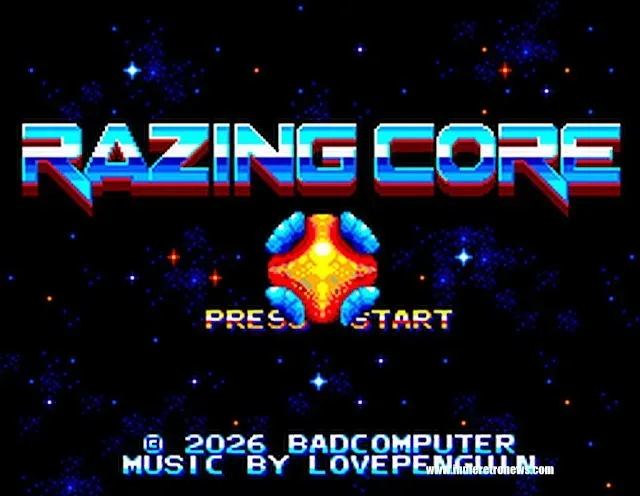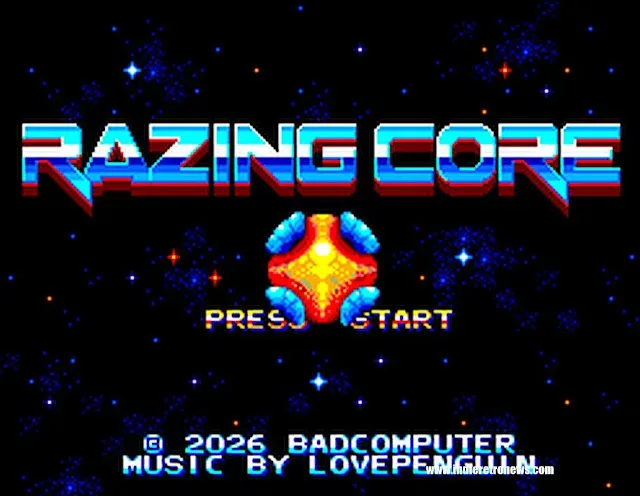
The Sega Master System has a new reason to make room beside the CRT: Razing Core, a vertical shoot ’em up from Badcomputer with music by Lovepenguin, has been released for Sega’s 8-bit Sega Master System and Mark III hardware. It is a new game built around one of the most durable arcade premises imaginable—pilot a small ship into overwhelming danger, make lots of explosions happen, and try not to become one yourself—but its stated feature set suggests a notably ambitious mission for the platform.
Razing Core sends players through seven stages across the solar system, where enemy formations, mid-boss encounters and screen-filling bosses stand between the pilot and any hope of restoring interplanetary peace. The basic idea may be gloriously old-school, but the release is aiming for more than a short novelty excursion. There is a progression of weapon upgrades, a five-level Burst Charge attack, multiple weapon categories to manage, and a full run of distinct locations rather than a single demo-sized orbit around the block.
For Master System owners, that combination is a welcome reminder that the machine’s library is not frozen in time. New retro releases are often interesting because they make old hardware feel active again, not because they pretend technical constraints never existed. A sharp-scrolling shooter designed specifically for the system can turn those constraints into part of the appeal: readable enemy patterns, concise visual language, immediate controls and the kind of music that makes a player swear the next credit will definitely be the one.
A seven-stage trip through hostile space
Razing Core’s campaign is described as spanning seven expansive stages set around the solar system. That scope matters in a genre where a game’s stages are not simply backdrops. They are the framework for pacing, enemy behavior, power-up decisions and escalating pressure. One section may invite careful positioning around incoming formations; another can demand quick responses to a mid-boss with its own attack pattern. A final boss, meanwhile, is where the game gets to ask whether players were genuinely learning—or merely surviving on stubbornness and a rapidly dwindling stock of lives.
The game includes both large bosses that occupy much of the screen and uniquely challenging mid-bosses. The latter are particularly important in a vertical shooter. Mid-bosses can punctuate a stage without ending it, forcing the player to demonstrate control before the level resumes its regular barrage. They are the space-shooter equivalent of a surprise exam, except the grade is usually determined by lasers.
Seven stages also gives Razing Core room to build a sense of a journey. The supplied details do not outline every location, boss or story beat, so prospective players should not assume a particular planet order or narrative setup. Still, the solar-system framing promises a broader interplanetary route than a single environment repeated with tougher waves. For a game defined by forward momentum, the thought of moving from one celestial danger zone to another is exactly the proper kind of excess.
Three weapon paths and a Burst Charge safety valve
Badcomputer has equipped the player ship with upgradeable primary, secondary and Core weapons. That split is a major part of what separates a shooter with a power-up system from one that merely throws a bigger bullet at the player every few minutes. Different weapon lanes can create choices in how an offensive toolkit develops over the course of a run, even if the essentials remain blessedly direct: destroy incoming enemies before their plans become your problems.
Razing Core also features a five-tier Burst Charge weapon. A charge mechanic introduces an additional rhythm to standard firing. Rather than relying only on constant shots, players can weigh the temptation to release a more destructive attack against whatever danger is gathering on screen. The description calls the Burst Charge devastating, but it does not specify its exact behavior, whether it acts as a piercing blast, a wide-area strike or another form of emergency persuasion. That is a discovery best left to the game and the pilots brave enough to press the button at precisely the right—or hilariously wrong—moment.
Related coverage includes Razing Core Brings a New Vertical Shooter to Sega Master System and Mark III.
This layered arsenal should help give the campaign a little more texture than a one-button shooting gallery. Vertical shooters are at their best when their apparent simplicity conceals a growing set of decisions: where to fly, which threat to prioritize, how aggressively to chase upgrades, and when to spend a powerful resource. A Master System game does not need a galaxy-sized control scheme to create that tension. It needs clear action and stakes high enough to make every near miss feel like the universe has personally agreed to grant one more chance.
Built for Sega’s 8-bit hardware
The launch details point to smooth 60fps scrolling and high sprite counts, two claims that speak directly to the visual demands of the genre. Scrolling is not a decorative feature in a vertical shooter. It establishes the game’s tempo, keeps the player advancing and creates the necessary sense that a larger battlefield is arriving from just beyond the top of the screen. Keeping that movement fluid is especially valuable when enemies and projectiles begin to pile up.
Early player feedback has been positive, with players characterizing the experience as intense and arcade-like. As always, early impressions are not a substitute for a broad long-term consensus, and no review score is attached to the release information. But the response matches the game’s stated design priorities: brisk action, plentiful enemies, major boss encounters and a bright Master System soundtrack accompanying the blaster fire.
Lovepenguin handles the music, and an upbeat soundtrack is a natural partner for this kind of game. Great shooter music does more than fill the silence between explosions. It gives repeated attempts personality. When a stage sends a player back to its opening moments after a game over, a memorable track can make the return feel like an invitation rather than a punishment. Or, at minimum, it can make losing sound terrific.
Modern work around older systems continues to cover a wide spectrum, from commercial-style cartridge releases to experiments and emulator-focused projects. Readers interested in the wider homebrew and preservation-adjacent side of older platforms may also want to see the recent ARMSX3 update, another example of ongoing attention being paid to aging game technology.
A demo and printable manual for curious pilots
Anyone who wants to inspect the first section before committing to the full voyage can try a free Stage 1 demo. That is especially useful for a shooter, where feel is inseparable from the pitch. Screenshots can show art direction and footage can convey motion, but the player’s own reaction to movement, firing, scrolling and enemy pressure is what determines whether a game earns a permanent place in the rotation.
The release also includes a printable manual with an illustrated cover. It is a small but fitting addition for a game made with classic console sensibilities in mind. Manuals were once an everyday part of opening a new game, offering controls, art and often a tiny dose of dramatic fiction before the cartridge even reached the console. A printable version does not require players to preserve an original paper booklet, while still giving collectors and retro enthusiasts an option to add a tactile layer to the experience.
Why Razing Core fits the Master System moment
Razing Core arrives at an appealing intersection of old hardware and enduring design. The Sega Master System and Mark III are platforms with a long history, yet a fresh game can still find an identity by respecting what makes their games distinctive rather than treating the system as a museum exhibit. Here, that means an immediately recognizable vertical-shooter structure supported by a substantial stage count, several upgrade systems, forceful boss encounters and music tailored to the platform’s sound.
It is also encouraging to see a new project aimed at both Master System and Mark III players. Those machines remain beloved by collectors and active retro players, and releases designed around them help keep attention on a corner of Sega history that can sometimes be overshadowed by the Genesis/Mega Drive. Razing Core is not trying to disguise its heritage: it wants spaceships, waves of invaders, dramatic weapons and a soundtrack with enough momentum to keep the cockpit lively.
For fans of 8-bit shooters, the essential proposition is clear. Razing Core offers a new solar-system campaign on Sega Master System and Mark III, with seven stages, big bosses, specialized mid-boss encounters, upgradeable primary, secondary and Core weapons, plus a five-level Burst Charge. Those who are simply curious can start with Stage 1 at no cost. Those who already hear the call of the high-score chase may want to keep the controller close—and perhaps keep a little extra faith in their reflexes.