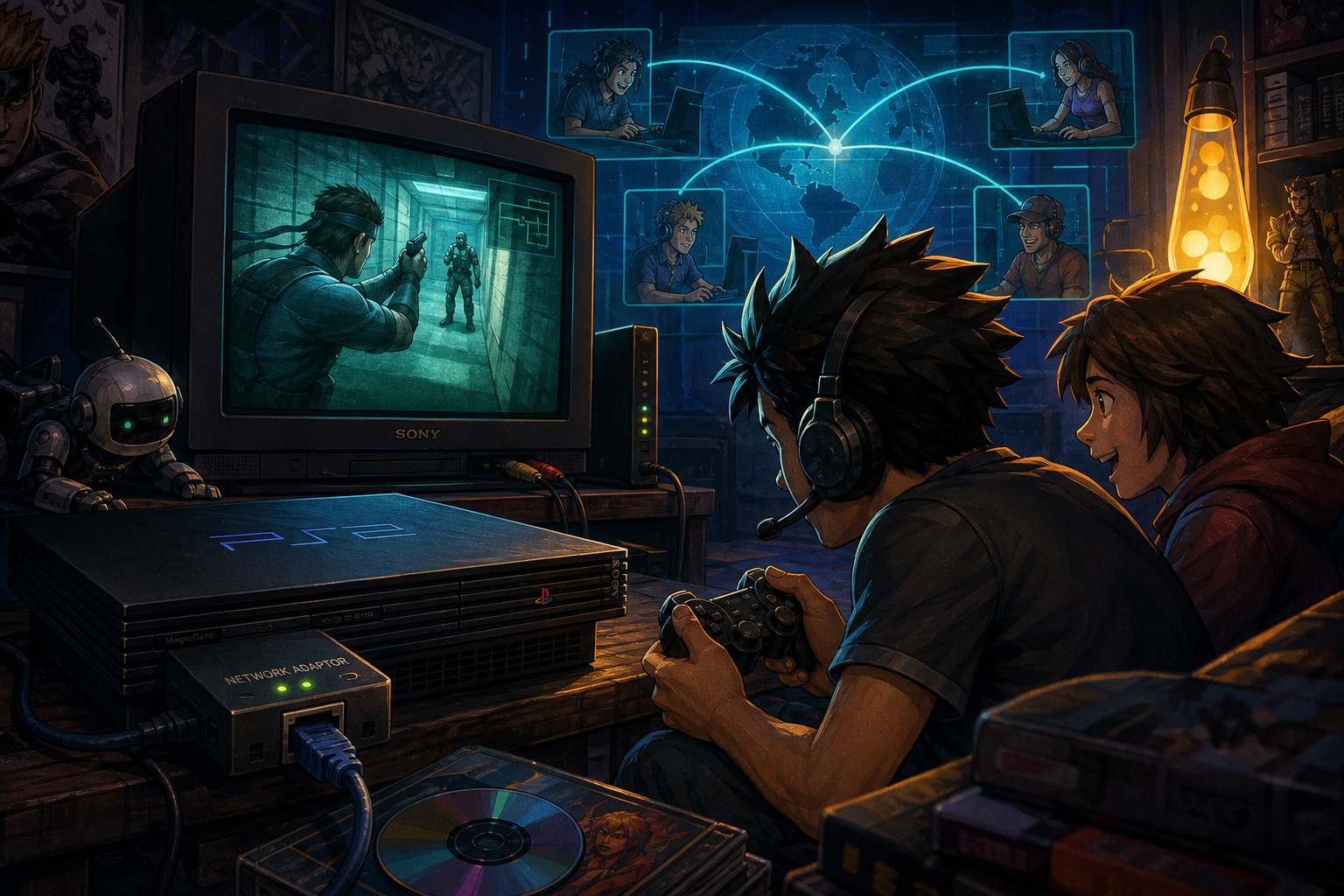
The PlayStation 2 is remembered chiefly for its enormous single-player library, but its online history began a second life for the console. Sony’s Network Adaptor connected the machine to broadband and, in North America, some dial-up services. More importantly, it gave publishers a foundation for experiments that would shape console gaming for years: voice chat, clans, persistent records and subscription-based online worlds.
This was not a universal online switch comparable to a single platform-wide service. Games had to be designed for network play, publishers often supplied their own servers, and regional hardware and software differences mattered. The adapter’s story is therefore less about one accessory than about a transitional moment when console makers were still deciding what online gaming should be.
Before the Ethernet port: an expandable console with online ambitions
The original PlayStation 2 launched into a market where online console gaming was promising but far from settled. Sega’s Dreamcast had already demonstrated the appeal of a built-in modem, while PC gaming had established online communities, dedicated servers and persistent characters. Sony’s answer was more modular. Rather than putting a network connection in every launch console, it treated connectivity as one part of the PlayStation 2’s expansion strategy.
That choice matched the machine’s broader design. The fat PlayStation 2 had an Expansion Bay at the rear, intended for accessories that could add capabilities over the console’s life. Networking could therefore arrive alongside other expansions instead of raising the cost of every system from day one. Sony’s own corporate history later identified online gaming as a PlayStation 2 hardware milestone introduced with the Network Adapter, but the hardware and commercial rollout were gradual rather than global and simultaneous.
The early Japanese machines show how unsettled the design still was. Original models such as SCPH-10000, SCPH-15000 and SCPH-18000 used a PC Card-style Ethernet adapter rather than the later Expansion Bay adapter. Sony’s own documentation identifies the PC Card model as an Ethernet-only device with no modem function. That makes the phrase “the PS2 Network Adapter” slightly misleading: Sony’s online hardware evolved with the console’s regional model families.
Regional beginnings were not one launch
North America received its consumer Network Adaptor on August 27, 2002. Sony Computer Entertainment America announced a $39.99 suggested retail price and positioned the release as the beginning of a broad online push rather than a niche experiment. The package included a Start-Up Disc with connectivity setup tools, help documentation, interactive game demonstrations, promotional videos and a mail-in coupon for Twisted Metal: Black Online.
Sony’s launch was presented with a public online tournament linking players in New York and San Francisco. The event was more than publicity theater: it demonstrated that the company wanted online play to be understood as a social feature of the living-room console. The same launch material emphasized SOCOM matches, team communication and the use of a USB headset.
Sony Japan’s later Expansion Bay release followed a different timetable. The SCPH-10350 Ethernet adapter was announced on May 14, 2003, and went on sale June 12, 2003, at 3,980 yen before tax. Its documented design included a network connector, a PlayStation 2 connection, an interface for the hard disk and a power connection for that drive.
That difference matters when reconstructing the period. North American launch messaging focused on bringing a familiar home console online quickly, while Japanese hardware and software planning included more substantial online services, including Final Fantasy XI and other games built around the optional hard disk. Regional dates, model numbers and package contents should not be collapsed into one worldwide release story.
What the North American adapter actually added
The central job was network access through the PlayStation 2’s Expansion Bay. North American launch material described a combination of 10/100 Ethernet and a 56K V.90 analog modem, giving the early accessory a broader connection range than a broadband-only device. That modem capability was not universal. Japan’s early PC Card adapter was Ethernet-only, and later regional products included Ethernet-only designs. The North American Ethernet/modem model should not be treated as the specification for every PlayStation 2 network device.
The adapter also provided an important physical link to the fat console’s internal hard-drive expansion. Most ordinary online matches did not need the hard disk, but the existence of the shared interface revealed Sony’s larger plan: the PlayStation 2 could become a platform for games that stored more substantial persistent data and connected regularly to online services.
None of this made every PlayStation 2 game online. Network functionality lived in the software. A game could use the adapter for competitive matches, cooperative play, rankings, voice communication or a persistent world, but a conventional offline release remained offline. The accessory was infrastructure, not a magic enhancement applied retroactively to the entire library.
Sony’s launch strategy relied on publishers
Sony’s North American approach was deliberately different from the unified-service model that would later become familiar. Players generally used their existing Internet service, while publishers operated or contracted the servers for individual games. Account systems, lobbies, fees, records and support could therefore vary from one disc to the next.
That arrangement lowered the barrier for Sony to begin an online program, but it also made the experience fragmented. There was no single PlayStation 2 online identity that automatically connected players across every title. A player moving from a combat game to a sports game could encounter entirely different menus, registration demands and service policies.
Sony did not initially intend to charge for a single mandatory PlayStation 2 online subscription. Contemporary reporting described a hands-off approach in which publishers determined server arrangements and whether their games would involve additional charges. This gave software companies flexibility, but it also left the platform without one consistent standard for accounts, matchmaking or long-term support.
Sony’s promotional material tried to make this complex ecosystem feel concrete. The Start-Up Disc offered configuration assistance and demonstrations, while public events and game showcases emphasized that online play could be social rather than merely competitive. The adapter’s significance grew from those demonstrations: it made networked console gaming visible in living rooms, stores and press coverage before the platform had settled on a permanent service model.
The first wave: matches, sports and publisher experiments
The launch-era software lineup showed how many different ideas were being placed under the word “online.” Twisted Metal: Black Online extended a vehicle-combat series into network matches, while Sony’s materials described support for up to eight players over broadband and only two over an analog connection. That distinction made connection type part of the game’s design rather than an invisible technical detail.
Madden NFL 2003 was another important marker because it became the first console version of Madden to offer online play. EA supplied the online infrastructure, including lobbies and player-record features. Its importance was not simply that football could be played against another person; it demonstrated how a major annual franchise could treat network competition as a standard feature instead of a separate curiosity.
Tony Hawk’s Pro Skater 4, ATV Offroad Fury 2 and sports games from Sega and EA broadened the audience further. These games used online features in different ways, from competitive sessions to records and lobbies. Sony’s launch announcement listed thirteen expected online titles for 2002, including SOCOM: U.S. Navy SEALs, Twisted Metal: Black Online, Madden NFL 2003, NBA Live 2003, Tribes: Aerial Assault, Tony Hawk’s Pro Skater 4 and several Sega Sports releases.
The lesson was clear: the adapter did not define one genre. It gave publishers a platform on which racing, action, sports and tactical games could each invent their own version of connected play.
SOCOM made the adapter feel social
SOCOM: U.S. Navy SEALs became one of the clearest North American demonstrations of what the Network Adaptor could mean beyond a simple versus mode. Its tactical matches supported two-to-sixteen players across ten maps, with demolition, suppression and extraction modes. Team structure mattered, so communication and coordination became part of the experience rather than optional decoration.
The game also built a social layer around its matches. Clans, clan message boards and persistent online records gave players reasons to return between individual rounds. Those features helped distinguish SOCOM from a traditional split-screen console contest. The game was not only asking who won tonight; it was helping players form groups and build an identity around continued participation.
Voice communication made the hardware story even more visible. Sony used a USB headset in SOCOM demonstrations and launch events, showing how one network adapter could encourage a wider accessory ecosystem. The headset was not built into the console, but the combination of network connection, dedicated software and voice support offered a recognizable preview of later online-console culture.
Contemporary coverage also captures the period’s uncertainty. Reviews discussed connection quality, the novelty of online console play and the practical differences between modes. SOCOM’s achievement was not that it solved every problem, but that it made the social promise of console networking easy to understand.
Final Fantasy XI required a much larger commitment
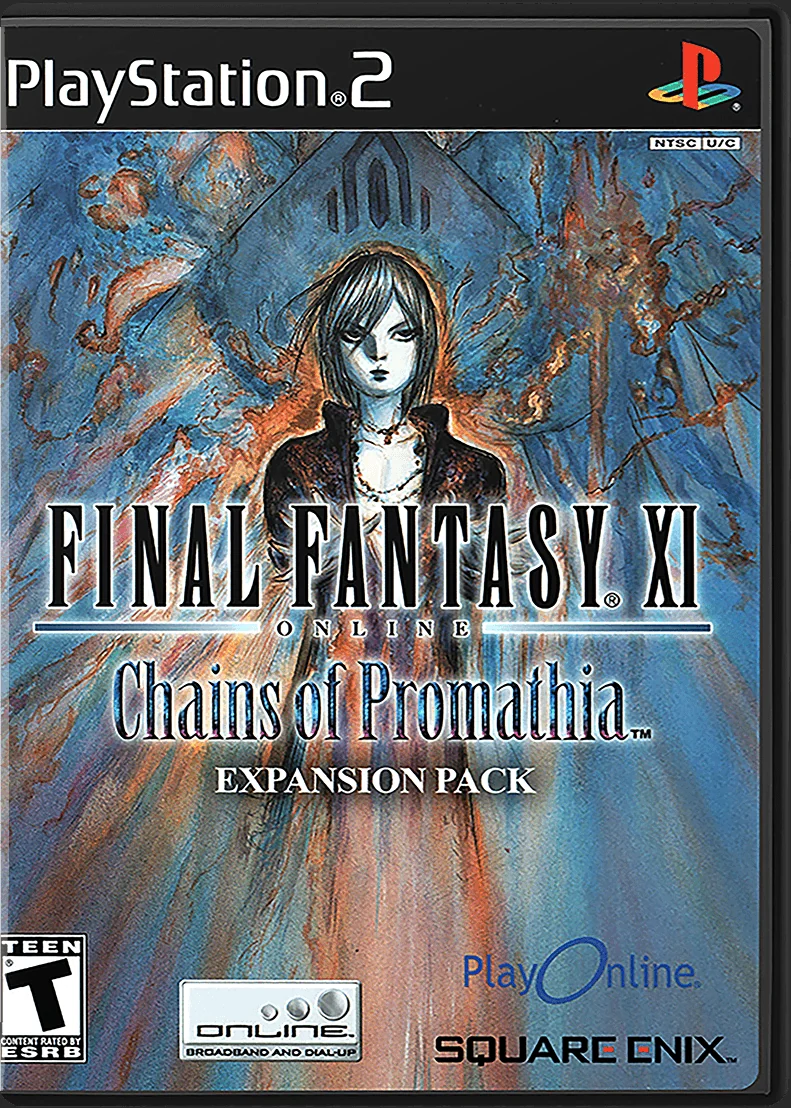
Final Fantasy XI represented a different category of online game. It was not a collection of short matches that began and ended in a lobby. Square Enix built a persistent role-playing world around PlayOnline, and the PlayStation 2 version required a 40GB internal hard disk, Internet access, an ISP account and the appropriate software. The Network Adapter was necessary, but it was only one part of the system.
The hard-drive requirement explains why the Japanese SCPH-10350’s shared networking and drive interface was historically significant. Sony’s hardware planning anticipated software that needed more than a connection to a match server. Final Fantasy XI needed room for a large installation and an environment capable of supporting continuing content and a persistent online community.
Sony Japan’s 2003 documentation listed Final Fantasy XI and PlayOnline among the country’s dedicated online titles. The same document separated games that merely supported the adapter from games that required the online platform, underlining how different the MMO’s demands were from those of a conventional network match.
The title also exposed the importance of regional compatibility. Square Enix warned that Japanese or European PlayStation 2 consoles were not compatible with the North American PlayOnline Final Fantasy XI package. This was not a minor packaging distinction. Console region, game package, PlayOnline software and service access were connected parts of the product.
Final Fantasy XI ultimately outlasted nearly every other official PlayStation 2 online service. Square Enix ended service for the PlayStation 2 version on March 31, 2016. That unusually long lifespan made it the strongest argument that the PS2’s online experiment could sustain a genuine virtual world, not merely a short-lived launch feature.
The adapter’s limitations were part of its identity
The first limitation was software support. A Network Adaptor could not add online play to Shadow of the Colossus, God of War or Final Fantasy X simply because those games ran on the same console. The library contained many celebrated offline games, but the online catalog was a separate branch of PlayStation 2 software with its own requirements and service histories.
The second limitation was uneven connection capability. Broadband and analog connections did not always offer the same player counts or modes. Twisted Metal: Black Online’s documented difference between eight broadband players and two over analog illustrates why modem support was useful but not equivalent to Ethernet.
The third limitation was infrastructure fragmentation. Publishers controlled many servers and determined whether an online service required a fee. Account systems and records were not standardized across the platform. When a publisher ended support, the adapter itself could not preserve the original service.
Regional restrictions added another layer. Japanese hardware could differ physically from North American hardware, and software packages could depend on matching regional services. Even apparently similar accessories could have different combinations of modem, Ethernet and hard-drive functionality.
The hardware also had a time-sensitive limitation: its role depended on the fat PlayStation 2’s Expansion Bay. Later console revisions changed the baseline. The PlayStation 2 Slim, introduced in November 2004, moved Ethernet into the console itself, so a separate Expansion Bay adapter was no longer necessary for ordinary network access on that model.
These limits do not make the adapter a failure. They show that Sony was connecting a console during an era when platform networking had not yet become a tightly integrated operating-system feature. The hardware worked, but the player’s experience depended on a chain of decisions made by Sony, the publisher, the ISP and sometimes a separate service operator.
The Slim changed the accessory’s role
The late-2004 PlayStation 2 Slim moved Ethernet into the console itself. Sony’s timeline records the redesigned system’s launch in November 2004 across North America, Europe, Japan, Hong Kong and Taiwan. Official documentation for later Slim models describes a built-in NETWORK connector and broadband Ethernet connection.
That change removed the need for the separate Expansion Bay adapter for ordinary network access and made online play a more obvious part of the system’s identity. The Slim did not erase the earlier adapter’s historical importance; it showed that Sony had decided networking was now common enough to belong in the base hardware.
The shift also clarified the adapter’s position in the product timeline. At first, it was the visible gateway to a new category of software. Later, it became an accessory associated with fat-model systems and particular hard-drive arrangements, while newer consoles made the network connection less conspicuous.
This was a familiar pattern in console history: an experimental or optional capability becomes normal, then disappears into the machine. The Network Adaptor helped Sony learn what players and publishers actually wanted before Ethernet became part of the standard PlayStation 2 experience.
Reception, shutdown and the legacy of a transitional platform
Contemporary reception reflected both enthusiasm and caution. The appeal was immediate: console players could meet opponents outside the room, speak to teammates and keep records that extended beyond one session. But reviewers and players also encountered the realities of early online gaming, including connection differences, service fragmentation and the need for each publisher to support its own infrastructure.
The adapter’s most lasting contribution was cultural. SOCOM helped normalize clans and voice communication. Sports games demonstrated that online competition belonged in mainstream console franchises. Final Fantasy XI showed that a PlayStation 2 could host a persistent online world when paired with a hard disk and a dedicated service ecosystem. These were not identical achievements, but together they expanded the definition of what a living-room console could be.
Later PlayStation systems would offer more integrated network identities and storefronts, making the PS2 model appear improvised by comparison. Yet that improvised structure was historically useful. Sony and its publishing partners were testing account systems, server relationships, communication tools and business models in public, one game at a time.
The final chapter is also a reminder that online history has an endpoint. Most PS2 online games lost official support at different times, depending on their publishers. Final Fantasy XI’s March 31, 2016 cutoff became the clearest closing date for Sony’s original online era. The adapter remained a piece of hardware, but its meaning had shifted from gateway to artifact: evidence of when console networking became important before it became invisible.
The PlayStation 2 Network Adapter was never a universal answer to online gaming. It came in regional forms, depended on software designed for network play and connected players to services that publishers managed separately. Its limits were inseparable from the period’s experimentation.
Its legacy is stronger than its simplicity suggests. The adapter helped make clans, voice chat, competitive records, publisher-run servers and console MMOs part of the PlayStation conversation. When Ethernet moved into the Slim, Sony had absorbed the lesson: online gaming was no longer an exotic expansion, but a defining part of the console’s future.