The Nintendo DS had two cartridge slots, two screens and a touch interface, so a small vibration cartridge seems like a natural part of its experimental design. In practice, the DS Rumble Pak remained a curious optional extra: officially supported, occasionally bundled with games, but absent from most of the system’s library.
Its limited reach was not simply a matter of developers ignoring a good idea. Nintendo’s own guidance made rumble optional because many players would not own the accessory. That decision protected compatibility, but also made vibration difficult to treat as a defining part of a game. This history follows the hardware, its documented software, regional release strategy, limitations, reception and eventual legacy.
A vibration cartridge for the DS’s second slot
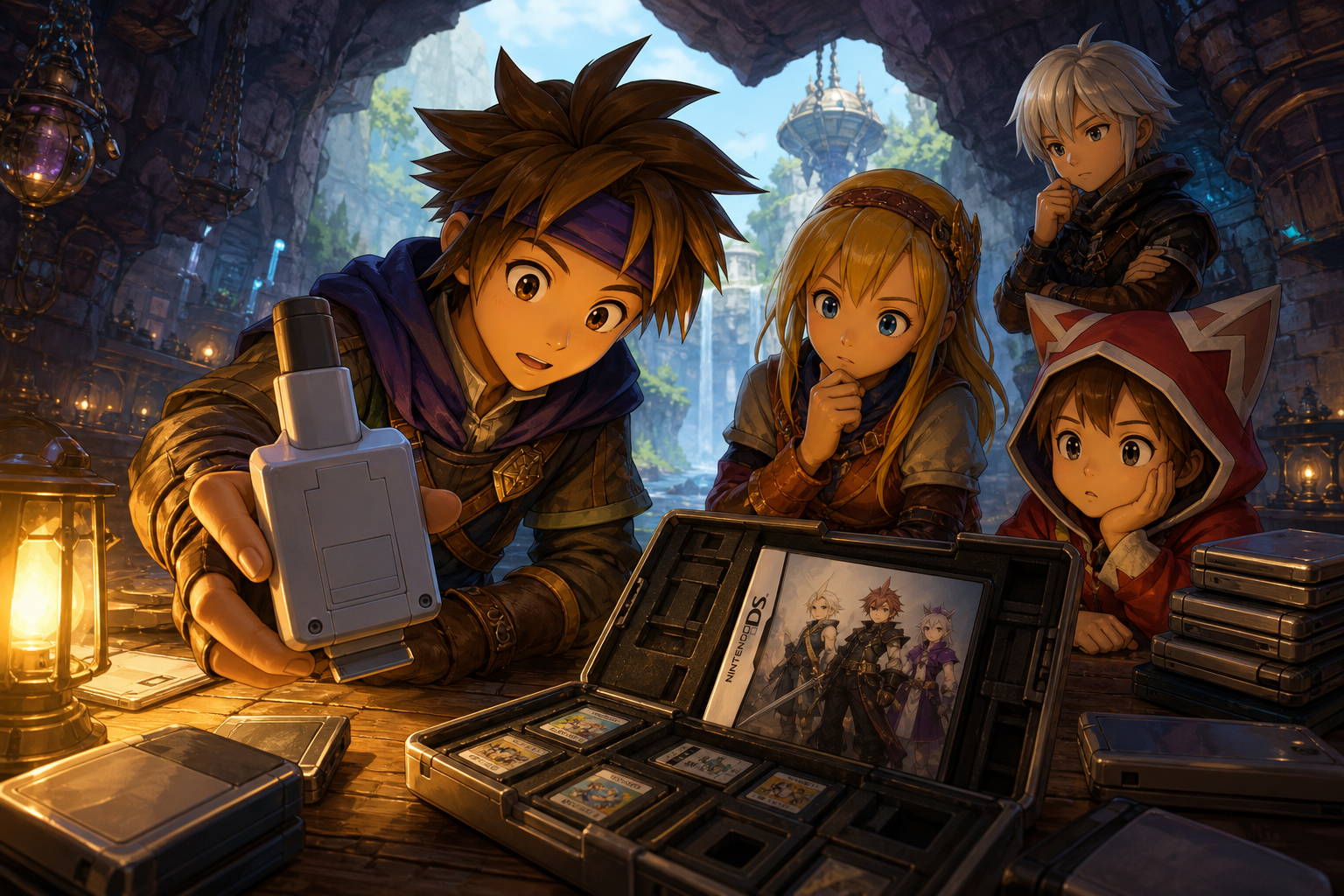
The official Nintendo DS Rumble Pak is model NTR-008, also described in Japanese materials as the DS Vibration Cartridge. It occupies the system’s Game Boy Advance cartridge slot, commonly called SLOT-2, rather than the slot used by Nintendo DS Game Cards. That distinction matters: the accessory is not a game cartridge with a rumble feature hidden inside it, and it does not make ordinary Game Boy Advance software vibrate.
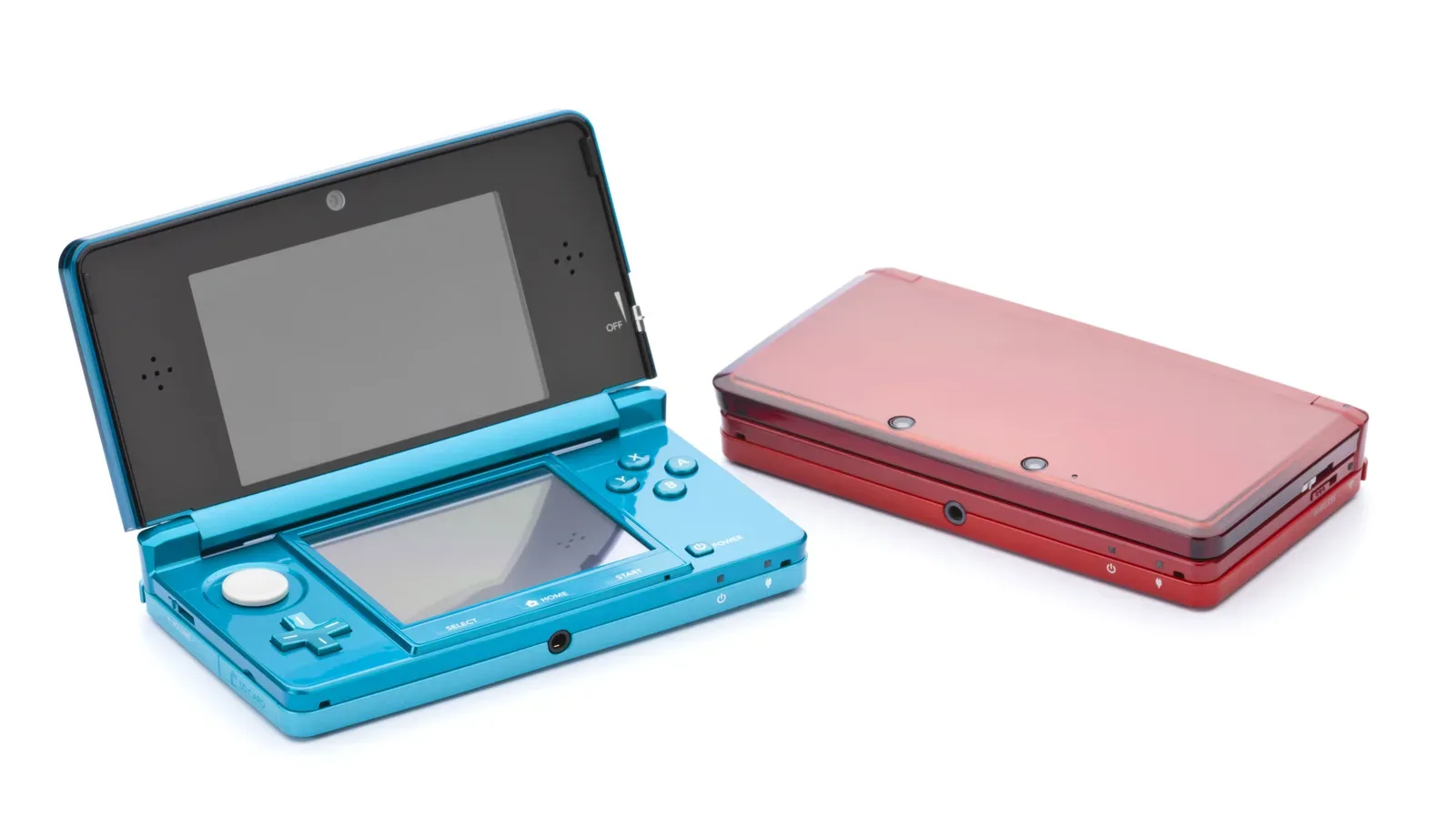
The original Nintendo DS and the slimmer Nintendo DS Lite both retained SLOT-2, allowing compatible Nintendo DS software to detect the accessory and control its motor. Nintendo’s documentation identifies NTR-008 as compatible with those two systems. The later Nintendo DSi and DSi XL removed the slot, ending compatibility at the hardware level rather than through a software update.
Physically, NTR-008 follows the approximate shape of a Game Boy Advance cartridge. Its purpose, however, is exclusively to add tactile feedback to specially programmed Nintendo DS software. A game needs to recognize the accessory and send the appropriate commands; inserting it into the console does nothing by itself. Nintendo’s own accessory page also makes clear that the cartridge only works with software carrying the appropriate compatibility indication.
- NTR-008 is the original Nintendo DS Rumble Pak model.
- It uses SLOT-2, not the Nintendo DS Game Card slot.
- It is an accessory for compatible Nintendo DS software, not a Game Boy Advance game.
The first documented software connection was Mario & Luigi
Nintendo’s Japanese compatibility material identifies Mario & Luigi RPG 2, released in Japan on December 29, 2005, as supported software. That game is known outside Japan as Mario & Luigi: Partners in Time, giving the accessory an early connection to one of the DS’s most characterful role-playing series.
The pairing made design sense. Nintendo’s comedy-focused RPG already relied on timed actions and exaggerated character animation, so vibration could reinforce a successful input or a physical gag without becoming the sole basis of play. Yet the game’s support also demonstrated the central limitation of the accessory: players could complete the experience without owning it.
The European instruction manual for Mario & Luigi: Partners in Time explicitly marks the game as designed to use the Nintendo DS Rumble Pak and includes a dedicated section for it. Nintendo’s Japanese material explains that the game exposes an Options setting when the cartridge is detected, allowing the player to turn vibration on or off. This was not an enthusiast discovery or an undocumented hardware trick. Nintendo and its developers presented rumble as a recognized enhancement while keeping the main game available to players with a standard DS setup.
- Mario & Luigi RPG 2 is the Japanese title listed by Nintendo.
- Mario & Luigi: Partners in Time is the corresponding European and North American title.
- The manual and Nintendo’s support material treat rumble as an optional feature rather than a required mechanic.
Metroid Prime Pinball made the accessory easy to understand
Metroid Prime Pinball became the clearest showcase for the Rumble Pak because its subject was already physical. The game translated the Metroid Prime setting into pinball tables, where impacts, table activity and ball movement naturally invite tactile feedback. A vibration motor could communicate a hit or event without needing a complicated explanation of what rumble was supposed to add.
Nintendo Europe confirmed that the Rumble Pak was included with each copy of Metroid Prime Pinball in the United Kingdom. Nintendo UK’s launch material dated the release to June 22, 2007, while Nintendo Spain lists June 29, 2007 for Spain. Those dates should not be collapsed into one universal European launch date: distribution and release schedules varied by territory.
Nintendo’s Spanish product listing also explicitly describes the included Rumble Pak as part of the game’s feature set. The official marketing language was enthusiastic, presenting the cartridge as a way to feel the action rather than as a technical footnote. That is useful evidence of how Nintendo wanted consumers to understand the accessory, even though it does not establish a broad critical consensus about the hardware.
The bundle gave NTR-008 a practical identity. Instead of asking players to understand an unfamiliar add-on before seeing its purpose, Nintendo placed it alongside a game where physical feedback was an obvious fit. The strategy did not turn NTR-008 into a standard DS component, but it gave the cartridge a memorable flagship use.
- Metroid Prime Pinball was bundled with the Rumble Pak in documented European markets.
- European release dates differed by territory.
- Pinball was a particularly legible use case for tactile feedback.
- Nintendo’s own product descriptions promoted the feature, but do not prove universal critical acclaim.
A surprisingly broad, but shallow, software footprint
Nintendo’s Japanese compatibility list shows that support was not confined to one genre. The documented software includes role-playing games, puzzle titles, action games, mystery software, shooters, rhythm games and other releases. Mario & Luigi RPG 2 used feedback within an adventure-driven RPG structure, while Star Fox Command connected it to a more conventional action game.
The European Star Fox Command manual identifies NTR-008 compatibility, explains that the cartridge belongs in SLOT-2 and describes separate control approaches with and without rumble. That last detail is important. The game was designed around two possible hardware conditions rather than assuming every player had the accessory. Its manual also warns that the Rumble Pak can make sounds during play, making the motor’s audible operation part of the documented experience rather than an unexpected defect.
Nintendo’s Japanese list includes Metroid Prime Hunters, Star Fox Command, Custom Robo Arena, Picross DS, Puyo Puyo!, Chokkan! Puzzle Loop and Space Invaders Extreme, among many others. These examples demonstrate interest from several development teams, but not a common design language. In one game vibration might confirm an impact; in another it might punctuate a puzzle event or add atmosphere. Support existed as a series of small enhancements rather than a platform-wide standard.
Actionloop is particularly revealing because it was a Touch! Generations puzzle game rather than a conventional action spectacle. Nintendo UK’s January 24, 2007 announcement confirmed that the game was sold with the Rumble Pak included, showing that the accessory could be used as a promotional extra even when the game’s core appeal was accessible touch-based play. Actionloop should be treated as a documented European bundle example, not as one of the Japanese titles on Nintendo’s Japanese compatibility list.
- Star Fox Command documents separate play options with and without rumble.
- Nintendo’s Japanese list spans multiple genres and publishers.
- Actionloop paired the accessory with a puzzle-oriented Touch! Generations release in Europe.
- Regional software lists should not be treated as identical.
Japan, Europe and North America did not get the same story
The clearest primary-source record of standalone availability comes from Japan. Nintendo’s Japanese accessory page identifies NTR-008 as the model bundled with Metroid Prime Pinball and says it could also be purchased separately through Nintendo’s online sales channel. Nintendo’s Mario & Luigi material likewise states that the cartridge was not bundled with that game and was available through Nintendo’s online store rather than ordinary retail outlets.
Europe’s approach was more visible through packaged software. Metroid Prime Pinball supplied the accessory in its box, and Actionloop received a separate European bundle announcement. These promotions placed rumble in front of players as part of a complete software proposition rather than presenting it only as an additional peripheral.
The retrieved primary material is less precise about a North American standalone retail history, so it would be misleading to describe one universal launch plan. Bundle contents, release dates and retail availability were region-dependent. The safest historical conclusion is that Nintendo used a mixture of accessory sales and software bundles, with Japan providing clear evidence of online standalone availability and Europe providing especially clear evidence of bundled releases.
That regional variation affected visibility. A player who encountered the accessory through one bundle was more likely to know it existed than someone whose local market offered no comparable package. At the same time, developers had to support every DS owner, not only customers who had received a rumble cartridge. The result was a peripheral with an uneven audience before the hardware family itself began to change.
- Japan has documented online standalone sales information.
- Europe has documented Metroid Prime Pinball and Actionloop bundles.
- North American standalone history should not be stated more confidently than the surviving primary evidence allows.
- Regional bundle claims require edition-specific evidence.
Nintendo’s rules kept rumble optional
Nintendo’s development guidelines explain why the accessory never became essential. Developers were instructed to make rumble optional because not every Nintendo DS owner would have the hardware. A game could use vibration to improve feedback, but it could not require the player to possess the cartridge in order to progress.
The guidelines also required software to handle removal of the Rumble Pak without stopping or otherwise being adversely affected. Nintendo recommended an in-game rumble toggle as another way to give players control over the experience. These requirements turned optionality into a formal design rule rather than a casual suggestion.
There were technical and presentation limits as well. Developers were advised to avoid continuous vibration, stop rumble during pauses and sleep mode, and avoid simultaneous microphone use because the motor could create audible interference. The Star Fox Command manual likewise warns that the accessory can make sounds during play.
These restrictions were sensible for a small battery-powered handheld accessory, but they reduced the design space. Rumble could emphasize an event, not carry a central mechanic. It also had to coexist with the DS’s other unusual features, including microphone input, touch controls and sleep behavior. Nintendo’s rules show that the company understood the accessory’s limits even while promoting its novelty.
- Rumble could not be required for progression.
- Games were expected to handle accessory removal.
- Nintendo recommended toggles and discouraged continuous operation.
- The motor could interfere audibly with microphone use and needed to be disabled during pauses and sleep mode.
The DS Lite exposed a physical compromise
The DS Lite retained the Game Boy Advance slot, but its slimmer body created a visible mismatch with the original NTR-008. The full-size accessory protrudes from a DS Lite when inserted, much like a standard Game Boy Advance cartridge. That did not make it unusable, but it made the accessory feel like a leftover from the original DS form factor rather than a perfectly integrated part of the redesign.
Nintendo separately documented a DS Lite Vibration Cartridge, model USG-006. That product was intended for the DS Lite shape and is not interchangeable with NTR-008 in every direction: Nintendo’s accessory information distinguishes the system compatibility of the two models. USG-006 is listed as incompatible with the original Nintendo DS, while NTR-008 is listed for both the original DS and DS Lite. The original Rumble Pak was not simply resized through a universal revision.
This split created an awkward ownership story. Original DS players had the accessory that matched their console, while DS Lite owners could use the original with a protruding fit or use the model intended for the slimmer system. Neither option helped build a single, instantly recognizable standard.
The arrival of DSi systems made the question more decisive. Because DSi and DSi XL removed SLOT-2, neither NTR-008 nor USG-006 could carry the accessory forward. The DS family’s most successful later hardware therefore had no physical route for this particular experiment.
- NTR-008 is documented for the original DS and DS Lite.
- USG-006 was a separate DS Lite Vibration Cartridge.
- The two models have different system limitations.
- The DSi and DSi XL removed the slot required by both cartridge-based solutions.
Why the library stayed small
The Rumble Pak faced a structural adoption problem. Developers could spend time adding vibration, but they could not assume that players owned the accessory. That meant the feature had to be implemented alongside a complete non-rumble experience. For a brief effect, the extra testing, interface work and removal handling could be difficult to justify.
Packaging also mattered. A bundled accessory could reach a meaningful group of players, but only within one market and one release. A standalone accessory required customers to understand why they wanted it, while many DS games already had distinctive feedback through sound, animation, touch input and stylus interaction.
The hardware’s physical changes narrowed the window further. The original DS and DS Lite supported SLOT-2, but the DSi generation removed it. Developers planning for the broader DS audience could not treat rumble as a lasting family feature when newer systems could not use the cartridge at all.
The documented compatibility list is therefore best understood as evidence of experimentation, not evidence of a failed concept in every individual game. Nintendo found uses across several genres and promoted the accessory through multiple bundles. What never emerged was a sufficiently large, stable audience for rumble to become a normal part of DS design.
None of this proves that players universally disliked the Rumble Pak. The evidence supports a more measured conclusion: Nintendo made adoption optional, distribution varied by region, the hardware fit changed between DS models and the feature’s benefits were usually additive rather than essential. Those conditions naturally produced a small but real software footprint.
- Optional hardware shifts development costs without guaranteeing a large audience.
- Bundles could expand access, but only within particular releases and regions.
- The DSi ended physical compatibility before rumble could become a DS-wide norm.
- The historical evidence supports limited adoption, not a universal negative reception.
A bridge between controller rumble and integrated feedback
The DS Rumble Pak extended an idea Nintendo had already popularized with the Nintendo 64 Rumble Pak: tactile feedback could be added through removable hardware rather than built into every controller. On the DS, the approach was more unusual because the accessory occupied a cartridge slot and had to coexist with a handheld’s limited space, power budget and changing body designs.
Its legacy is therefore less about a long list of must-play rumble games than about what it reveals about Nintendo’s design habits. The company was willing to test a feature through an add-on, attach it to different genres and use bundles to explain its appeal. At the same time, Nintendo’s guidelines show an awareness that experimental hardware could not be allowed to divide the audience.
Metroid Prime Pinball remains the neatest demonstration of the concept, while Mario & Luigi: Partners in Time and Star Fox Command show how the feature could be folded into very different games. Actionloop demonstrates that the accessory was also a retail and audience experiment, not merely a tool for action games.
The Rumble Pak ultimately became a footnote because the DS’s most important innovations were already inside the system: dual screens, touch input, wireless communication and a microphone. Its vibration cartridge added texture to selected games, but the console’s identity did not depend on it. That modest role is precisely what makes the accessory historically interesting.
- NTR-008 continued Nintendo’s removable-rumble approach in a handheld format.
- Its strongest uses were enhancements rather than required mechanics.
- The accessory illustrates both Nintendo’s hardware experimentation and the limits of optional peripherals.
The Nintendo DS Rumble Pak was neither a failure hidden from the public nor a feature that transformed the platform. It was a documented, regionally promoted accessory whose best matches made vibration immediately understandable, while Nintendo’s own rules prevented it from becoming necessary.
Its short lifespan reflects the tradeoff built into removable hardware. Optional rumble protected the millions of DS owners who lacked NTR-008, but that same protection discouraged developers from designing around it. When the DSi removed SLOT-2, the experiment ended with the feature still interesting, useful in places and peripheral to the DS story.