Strategy on Nintendo DS means more than having turn-based battles. For this ranking, a game must make planning, positioning, resource allocation, army composition, defensive preparation or strategic victory conditions central to play. That includes traditional tactics games, strategy RPGs, civilization builders, puzzle-strategy hybrids and tower defense, while excluding ordinary RPGs whose battles are mainly about leveling and equipment.
The ranking weighs tactical clarity, strategic variety, campaign structure, meaningful choices, replayability, use of Nintendo DS hardware and how effectively each game communicates its systems. Strategy RPGs are included, but they are judged on battlefield decisions and party construction rather than story alone. Regional notes refer to the original Nintendo DS releases, and discontinued online features are described historically rather than as currently available services.
10. Lock’s Quest
Lock’s Quest is one of the Nintendo DS library’s most distinctive strategy games because it divides each battle into two very different jobs. During the preparation phase, players build walls, position turrets, lay traps and decide how to channel incoming attackers. Once the assault begins, Lock can move around the defenses, repair damage and fight threats that break through. The result is more active than conventional tower defense without abandoning the satisfaction of planning a fortified position.
The campaign covers 75 days of warfare across a dozen maps, giving the game a clear rhythm: prepare the battlefield, survive a timed Clockwork assault and improve the defenses for the next encounter. Building choices matter because a strong installation is not simply a collection of the most powerful objects. It needs routes that buy time, protect vulnerable structures and leave room for the player character to respond when the enemy breaches the line.
The Nintendo DS format makes the construction layer readable, and the touchscreen is a natural fit for selecting spaces and placing defensive equipment. The limitation is the same feature that makes Lock’s Quest memorable. Real-time assaults can interrupt careful thinking, and later battles may feel repetitive if a player prefers pure turn-based tactics. It is best for players who want strategy with urgency, visible fortifications and a hands-on hero rather than a detached commander.
- Best for: players who enjoy building defenses before surviving an assault.
- Tradeoff: timed attacks offer less room for deliberation than a traditional turn-based strategy game.
9. Age of Empires: Mythologies
Age of Empires: Mythologies translates the broad shape of the PC series into a turn-based Nintendo DS strategy game. Its three civilizations—Greek, Egyptian and Norse—develop through three ages while balancing economic growth, scientific progress and military pressure. The shift to turns changes the feel considerably: scouting, expansion and combat become deliberate exchanges rather than a contest of mouse speed.
The three factions are not merely visual variants. Their units, technologies and mythological powers encourage different priorities, while god powers add another layer to deciding when to spend a limited advantage. The three campaigns provide structured objectives, and skirmish play gives the systems room to breathe beyond the story. Custom rules and starting armies also give experienced players reasons to revisit the maps.
The DS format imposes clear limits. Maps, armies and economic systems are smaller and less fluid than in the main PC games, and the touchscreen cannot fully reproduce the convenience of a mouse and keyboard. That is not a failure of the handheld version so much as a useful expectation-setting point. Players seeking a focused portable interpretation of historical-fantasy strategy will find more here than those expecting the full scale of the desktop series.
- Best for: players who want economy, technology and military planning in a turn-based format.
- Tradeoff: the streamlined DS design has less scale and immediacy than the PC games.
8. Might & Magic: Clash of Heroes
Might & Magic: Clash of Heroes occupies a productive border between puzzle game, RPG and strategy title. Its battles revolve around arranging units into formations, creating defensive lines, launching attacks and responding to opposing formations. A good turn is not simply about choosing the strongest unit. It is about anticipating how a row will combine, when a counterattack will become available and whether a short-term defense creates a better position for the next exchange.
The formation system gives army composition genuine importance. Different units fill different tactical roles, while heroes and progression systems add a longer-term layer around individual encounters. Battles are easy to read once the basic logic is understood, but the best decisions involve several steps of preparation: set up a chain, protect a vulnerable line, force the opponent to respond and convert that response into a stronger formation.
The limitation is central to its identity. Players looking for open maps, terrain control and free movement may find the structured battlefields restrictive. Clash of Heroes is closer to commanding formations through a tactical puzzle than to directing a conventional army. That makes it an excellent choice for players who like compact, highly legible decisions and a less traditional route into strategy.
- Best for: players who enjoy formation puzzles, counters and readable tactical exchanges.
- Tradeoff: battles feel more structured than the open-ended maps of Advance Wars or Fire Emblem.
7. Sid Meier’s Civilization Revolution
Civilization Revolution condenses the 4X formula into a handheld-sized loop of exploration, city development, technology, diplomacy and conquest. Players choose from sixteen civilizations, establish cities, produce units and pursue several possible victory conditions, including domination, cultural, technological and economic success. That range prevents every game from becoming a simple race to build the largest army.
The DS edition’s shorter scale is a strength when approached on its own terms. Its two-dimensional presentation keeps the strategic map easy to parse, while touch-pen controls support inspecting cities, moving units and reviewing information. Exploration reveals opportunities and threats; city placement affects production and growth; diplomacy can buy time or create an opening; and technology determines which military or economic plans are realistic.
It is not a substitute for the full PC Civilization experience. The technology tree, diplomacy and empire management are simplified, and long-term development has less complexity than in the desktop games. The right audience is therefore someone who wants a clear, approachable 4X structure on a handheld, not someone seeking exhaustive simulation. Its strongest strategic quality is how much variety it preserves after cutting away the intimidating excess.
- Best for: newcomers to 4X games and players who want several victory routes.
- Tradeoff: its streamlined systems offer less empire-management depth than PC Civilization.
6. Disgaea DS
Disgaea DS turns strategy RPG progression into a system of unusual breadth. Grid-based battles are only the foundation. Players recruit characters, experiment with party roles, improve equipment, manage spells and build a group whose strengths can be shaped in many different directions. The appeal is not just winning the next map; it is discovering how character development, equipment and party composition can combine into a more specialized force.
That freedom creates a different kind of tactical depth from Advance Wars. A battlefield still rewards positioning and target selection, but preparation outside combat can be just as important. A carefully developed unit may solve a problem that brute force cannot, while a flexible roster gives the player more answers to unusual scenarios. The separate Item World provides another route for strengthening equipment and experimenting with the game’s progression systems.
Disgaea’s weakness is its barrier to entry. Its progression layers can overwhelm newcomers, and the temptation to build power through repeated battles may dilute the tactical challenge of individual maps. The DS version also presents a large game within the technical limits of the handheld. It ranks below the cleaner tactical packages here, but it remains one of the best choices for players who regard customization itself as a strategic playground.
- Best for: players who enjoy party construction, experimentation and long-term character planning.
- Tradeoff: dense systems and power-building can distract from the battlefield tactics.
5. Advance Wars: Days of Ruin
Advance Wars: Days of Ruin is the more severe and focused sibling to Dual Strike. Its post-disaster setting is reflected in a darker presentation and a redesigned cast, but the important difference is mechanical: the game asks players to engage with terrain, unit matchups, fuel, ammunition, production and fog of war without relying on the earlier game’s same combination of exuberant presentation and layered gimmicks.
The fundamentals remain wonderfully clear. Infantry capture properties, vehicles exploit terrain and range, indirect-fire units punish careless movement, and air and naval forces create new logistical problems. Commanding officers add identity to armies, while campaign maps teach concepts through increasingly demanding objectives. The result is a game where a victory often comes from preserving tempo and information rather than simply assembling the largest force.
Days of Ruin can be a poor first choice for someone seeking the colorful tone of earlier Advance Wars games. Its atmosphere is deliberately restrained, and its character presentation is less playful. Some players may also prefer Dual Strike’s greater abundance of modes and powers. For anyone who wants a more concentrated study of battlefield fundamentals, however, its discipline is precisely the attraction.
- Best for: players who want demanding map tactics, fog of war and a more focused campaign.
- Tradeoff: its darker tone and redesigned systems may not satisfy fans of the earlier games’ lighter identity.
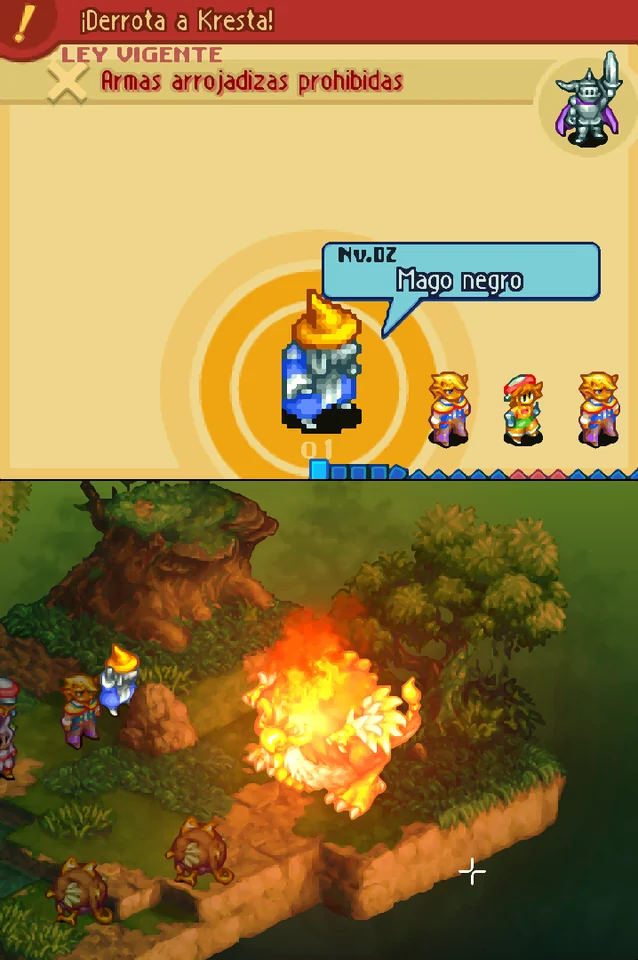
4. Final Fantasy Tactics A2: Grimoire of the Rift
Final Fantasy Tactics A2 offers the Nintendo DS’s broadest traditional strategy-RPG toolkit. Battles take place on grids where elevation, movement, range and unit roles matter, but the campaign’s real depth comes from the interaction of jobs, races, equipment and clan development. Building a party is an ongoing strategic project rather than a one-time selection screen. A unit’s current job is only part of its identity; learned abilities and future combinations can change how it contributes.
The large mission structure gives the game a different rhythm from a tightly authored tactical campaign. Optional missions, varied objectives and a wide selection of jobs encourage experimentation, while the Ivalice setting supplies recognizable visual and mechanical language. Laws add another layer by restricting certain actions in battle, sometimes forcing a player to rethink a favorite solution rather than repeating the same powerful routine. The Nintendo DS’s two-screen layout also supports the dense information involved in managing a large clan.
Its size can become a weakness. The mission list may feel diffuse, and the abundance of customization can make the story less emotionally concentrated than a smaller strategy RPG. Players who want a focused campaign should approach it differently from Fire Emblem. A2 is for those who want a long tactical workshop with many viable party-building projects, not a short sequence of carefully authored character dramas.
- Best for: players who want jobs, races, equipment and a large mission structure.
- Tradeoff: the sprawling campaign can feel less focused and less character-driven than Fire Emblem.
3. Fire Emblem: Shadow Dragon
Fire Emblem: Shadow Dragon brings the first Famicom Fire Emblem campaign to Nintendo DS in an expanded remake. Its strategic identity rests on unit roles, terrain, weapon matchups and the permanent consequences of defeat. Losing a character is not merely a temporary setback; it changes the roster, the available future options and sometimes the emotional shape of the campaign. That pressure makes every attack range and rescue decision matter.
The remake adds systems that broaden the original design, including reclassing, weapon forging, touchscreen control and multiplayer functions that were tied to Nintendo Wi-Fi Connection during the game’s original life. Reclassing allows a roster to be adapted to a player’s needs, while forging turns resource use into a question of improving a trusted weapon or spreading materials across the army. Terrain, direct and indirect attacks, healing roles and the weapon triangle keep the maps readable even when the consequences are severe.
Shadow Dragon is less welcoming than later Fire Emblem games. Its presentation is comparatively spare, some maps are uneven, and the recruitment and class systems can feel unusual to players accustomed to newer entries. Those limitations do not erase its tactical value. It is a strong recommendation for players who want the series’ foundational campaign structure and are comfortable treating casualties as meaningful strategic events rather than reloading every mistake.
- Best for: players who want permanent loss, careful unit roles and classic Fire Emblem structure.
- Tradeoff: sparse presentation and uneven design make it a less gentle introduction than later entries.
2. Pokémon Conquest
Pokémon Conquest succeeds because it makes its crossover premise mechanically useful. It combines Pokémon type advantages and individual abilities with a kingdom-conquest structure inspired by Nobunaga’s Ambition. Battles are turn-based, terrain changes the value of movement and attacks, and each side can field up to six Pokémon. The result is not simply a Pokémon battle placed on a grid; the battlefield gives familiar matchups new positional consequences.
The campaign moves through seventeen kingdoms with different layouts and strategic pressures. Recruiting suitable Pokémon, matching them with Warlords, using facilities and deciding which territory to challenge next all matter outside individual fights. A strong type advantage may still be wasted if terrain blocks movement or a unit is forced into a poor engagement. Warlord abilities, training grounds, shops and mines add further reasons to think about preparation between battles.
Its main limitation is repetition after the central campaign, where the episode-based structure can feel less varied than the initial conquest. The Pokémon selection is also narrower than in the mainline series. Even so, Conquest is one of the DS’s clearest examples of a license improving a strategy design instead of merely decorating it. It is approachable for Pokémon fans and substantial enough for tactics players.
- Best for: players who want approachable grid tactics with type matchups and kingdom management.
- Tradeoff: the later episode structure and limited roster can feel repetitive.
1. Advance Wars: Dual Strike
Advance Wars: Dual Strike is the best overall Nintendo DS strategy package because it combines an exceptionally readable ruleset with remarkable breadth. Terrain, unit production, capture objectives, fog of war, transport logistics and commanding-officer powers create decisions that are easy to understand but difficult to master. A new player can see why a tank beats infantry in one situation, while an experienced player will keep finding better ways to manipulate range, timing and terrain.
The campaign supplies a strong introduction, but the game’s value extends well beyond it. Different map objectives change what counts as a successful opening, while additional modes and skirmishes support repeated experimentation. The DS hardware contributes more than a novelty: the dual-screen layout separates the map from unit and enemy information, touchscreen input supports selecting units and reviewing maps, and DS Battle mode allows two battlefields to be viewed together. Map editing and local wireless play add further variety for players with compatible hardware.
Dual Strike is not perfectly balanced. Some commanding-officer combinations and power interactions can overwhelm the careful economy of a map, and its abundance of content can feel excessive to players seeking a tightly curated campaign. Original wireless features are also historical rather than active online services, since Nintendo Wi-Fi Connection was discontinued on May 20, 2014. Those quirks are outweighed by the total package. Dual Strike offers the clearest path from beginner fundamentals to advanced tactical planning, making it the strongest starting point and the most complete strategy game on the system.
- Best for: nearly anyone seeking a first Nintendo DS strategy game, from beginners to experienced tacticians.
- Tradeoff: powerful officer combinations can disrupt the balance of otherwise excellent maps.
The best entry point depends on the kind of decisions you want to make. Choose Dual Strike or Days of Ruin for map-based military tactics, Shadow Dragon for high-stakes unit management, Tactics A2 or Disgaea for character development, Civilization Revolution for compact 4X planning, Clash of Heroes for formation puzzles, or Lock’s Quest for defensive construction. Pokémon Conquest is the most accessible hybrid for players who want familiar creatures attached to a genuine conquest system.
Most of these recommendations received English-language Nintendo DS releases. The notable regional point is that Tactics A2 was originally a Japanese Nintendo DS release, while the other nine games were released in English-language markets. Original wireless functions in several games are historical features rather than active official services. The important distinction is that a strategy game earns its place here through meaningful planning—not simply because it has turn-based combat, levels, equipment or a famous RPG name.