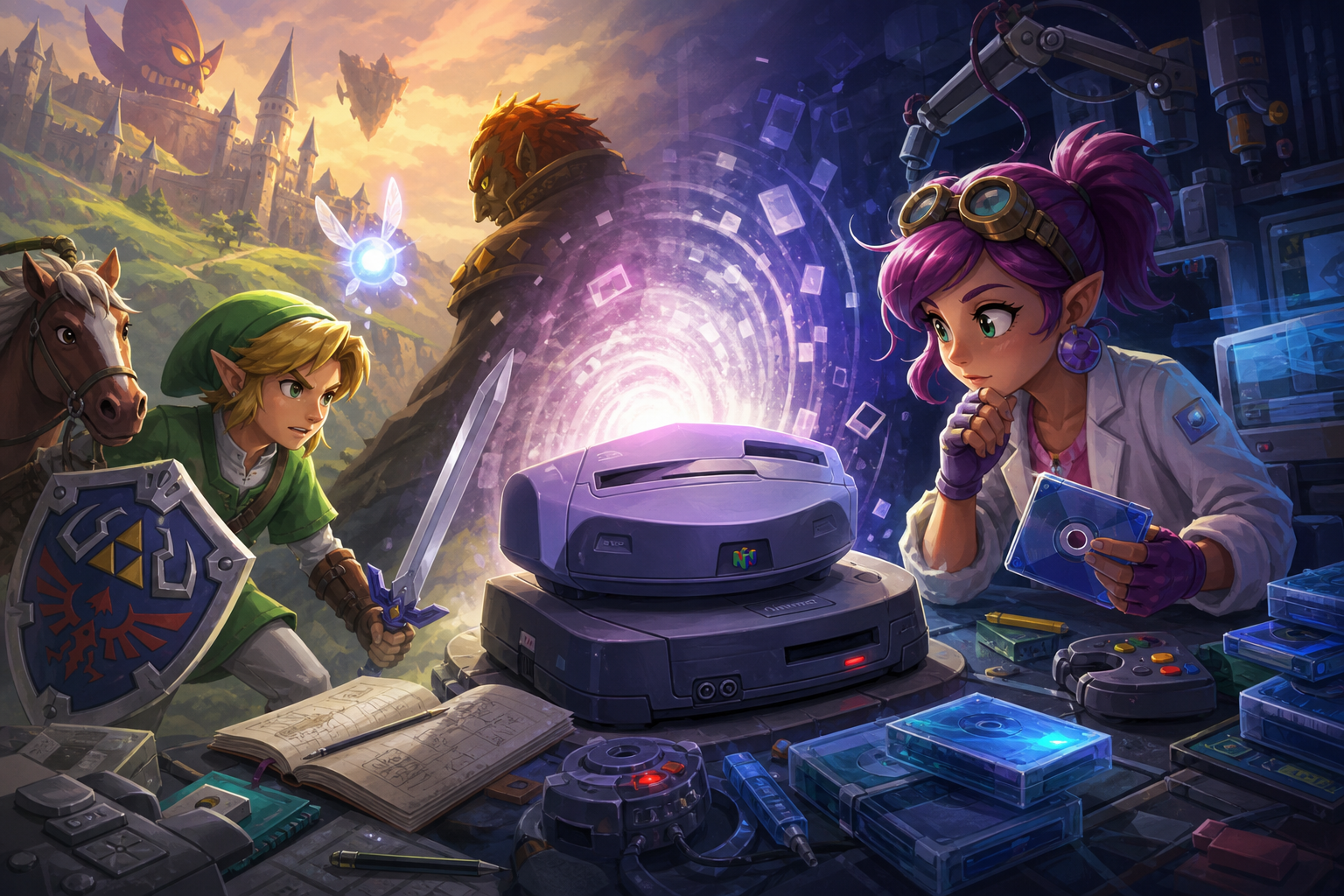
The Nintendo 64DD was designed as more than a larger storage device. Nintendo presented it as an expansion platform for a console whose cartridges were fast and reliable but expensive to produce in larger capacities. The proposed answer was a proprietary magnetic disk with rewritable storage, a real-time clock and a path toward networked services and user-created content.
The 64DD finally reached consumers in Japan in December 1999, several years after its first public presentation. By then, many of its most ambitious software ideas had been redirected, redesigned or abandoned. The result was a specialized add-on whose published library was small, but whose design anticipated later discussions about downloadable content, creator tools, persistent worlds and console networking.
This history follows the hardware from its public unveiling through the Japanese launch, Randnet service, published software, technical compromises and eventual shutdown. The key question is not whether the 64DD replaced the N64. It did not. The more useful question is what Nintendo was trying to make possible, and why those ambitions proved difficult to deliver.
A disk drive imagined before the N64 arrived
Nintendo first showed the 64DD publicly at the Shoshinkai event in November 1995, before the Nintendo 64 reached consumers. The timing mattered. The company was presenting the add-on as part of the platform’s future identity, not as an emergency response to a failed cartridge strategy.
Nintendo’s pitch combined several ideas that were unusual for a home console. The 64DD would use proprietary magnetic disks, provide writable space for changing data, include a clock that could track time while the system was switched off and support a network service. The company also imagined software that could let players create, revise and exchange material.
The add-on was therefore meant to complement the Nintendo 64’s strengths. Cartridges offered quick access for action games, while disks could hold larger bodies of changing data at a lower manufacturing cost than the largest ROM cartridges of the period. That division sounded practical on paper: use cartridges for speed and disks for persistence, expansion and creation.
What the hardware actually added
The 64DD connected beneath the Nintendo 64 through the console’s expansion port. Its media were proprietary magnetic disks, not CD-ROMs. Each disk held approximately 64 MB in total, with a smaller portion available as writable space. The format was closer in spirit to a protected, high-capacity removable disk than to the optical media used by the PlayStation and Sega Saturn.
A built-in real-time clock gave software a way to track dates and time-based changes. That feature supported Nintendo’s interest in worlds that could feel persistent rather than resetting completely whenever the console was switched on. It was an important part of the concept, although individual disks used the hardware differently.
The 64DD also formed part of a larger network package. Randnet used a modem cartridge and a service disk to connect the console to a members-only online portal. The drive itself did not automatically turn every N64 game into an online title. Rewritable data, the clock, creation tools and network access were separate capabilities brought together in one unusually ambitious package.
A 4 MB Expansion Pak was bundled with the 64DD hardware, increasing the Nintendo 64’s memory from 4 MB to 8 MB. That memory upgrade was useful to the system as a whole, but it should not be confused with the disk drive’s storage function.
Delays changed the product before launch
Nintendo originally discussed a 1997 launch, with a North American release discussed for the following year. Those targets slipped repeatedly. The consumer hardware finally appeared in Japan in December 1999, several years after its first public presentation.
That delay changed the competitive and creative context. Standard N64 cartridges had continued to ship, and projects once associated with the add-on could be redesigned for cartridge release, moved to another system or abandoned. A delayed accessory also had to explain why customers should enter a new ecosystem after already buying the main console.
The result was not simply a late version of the original plan. The 64DD reached the market as a specialized Japanese experiment with a narrower software proposition. Its launch model had to carry both the hardware and the promise of a service that was still taking shape.
The delay also changed how the format was perceived. Earlier demonstrations had encouraged people to imagine a major second wave of N64 software. The final product instead arrived near the end of the console’s commercial life, when Nintendo was already preparing the transition to its next generation.
Randnet made the add-on a service, not just a peripheral
Nintendo formed RandnetDD with Recruit for the launch structure. The commercial package combined the drive, modem hardware and online software through a subscription-based arrangement. This was a substantially more complicated proposition than selling a cartridge and plugging it into an existing console.
The Randnet Disk arrived after a launch delay and enabled the service’s broader online functions. Randnet offered email, bulletin boards, newsletters, digital publications, online content and ways to exchange or share material made with compatible software. It also included Get Mall, an online shopping channel for selected products and software.
Randnet was not equivalent to a modern broadband service. It was a Japan-specific, dial-up-era network built around a closed portal and a subscription arrangement. Contemporary plans included online interaction and content exchange, but the service’s practical reach depended on a relatively small installed audience and the continued availability of compatible disks.
The requirement to understand both the hardware and the service made adoption harder. A player was not simply buying an expansion drive for familiar games. The value proposition depended on joining a network, receiving content and finding reasons to return to a specialized software library.
A small library with a very different identity
The 64DD is often discussed as though it were another N64 game catalog. A more accurate description is a published set of ten commercial software disks whose center of gravity was creation software, simulation, expansion content and online functions. The exact count can vary depending on whether service disks, bundled items and limited distribution products are counted separately, so the ten-disk figure is best used for the commercial retail library rather than every known disk image or prototype.
The Mario Artist suite included Paint Studio, Talent Studio, Polygon Studio and Communication Kit. Together, these applications covered drawing, character creation, 3D modeling, scene construction and communication. They treated the console as a creative workstation as much as a game machine.
Other software made different arguments for the disk. SimCity 64 used the platform for long-form city building, while Doshin the Giant focused on changing land, nature and settlements. Japan Pro Golf Tour 64 represented a more conventional game, but its presence did not transform the library into a broad replacement for cartridge releases.
The limited catalog is not evidence that the idea had no substance. It shows that Nintendo launched a specialized platform without the volume or variety normally needed to make a new format feel unavoidable. The 64DD’s identity came from what its software did differently, not from how many ordinary games it offered.
Mario Artist turned the N64 into a creator platform
Mario Artist: Paint Studio is the clearest expression of Nintendo’s user-creation ambition. Rather than merely consuming finished levels, players could draw, assemble scenes and work with assets in ways that connected to the broader suite. Talent Studio emphasized character and avatar creation, while Polygon Studio moved into 3D modeling and animation-oriented work.
Communication Kit supplied the bridge between making content and sharing it. That relationship was central to the 64DD’s design. Rewritable disks mattered because projects could be saved and revised; the network mattered because those projects could travel beyond the individual console.
The software also explains why comparing the 64DD only with later high-capacity game media misses the point. Nintendo was testing a social production loop: make something, save it, exchange it and see what other users made. The loop was technically modest and geographically restricted, but its underlying structure would become familiar on later platforms.
The suite also made the 64DD unusual within Nintendo’s hardware history. Most console accessories are built around a new input method, a display trick or a specific genre. Mario Artist instead treated the console as a small creative computer, with the disk acting as a workspace and Randnet providing a route for distribution.
F-Zero X showed the expansion-kit idea
F-Zero X Expansion Kit demonstrated another role for the drive. Instead of replacing the original cartridge, it extended it with additional courses, a course editor and a machine editor. It also supplied a rearranged or expanded audio presentation, giving the disk a mixture of creative tool and enhancement package.
This was a persuasive use of removable expansion media because it preserved the fast cartridge game while adding content that was less practical to fit into the original release. The course editor made the expansion more than a passive data supplement: it gave players a way to produce new race layouts.
The model also exposed a commercial limitation. An expansion kit works best when a large installed audience already owns the base game and understands why the new material matters. With a Japan-only accessory and a small user base, the audience for that experiment was necessarily narrow.
F-Zero X Expansion Kit therefore captured both sides of the 64DD. It demonstrated how a disk could extend a cartridge, but it also showed that a technically convincing idea still needed a large enough audience to sustain a separate format.
Doshin and SimCity made persistence visible
Doshin the Giant used the disk’s room and time-aware design for a world-shaping simulation. Its central appeal was not a conventional sequence of stages but the ability to affect land, nature and settlements over time. A separately sold companion disk expanded that concept.
SimCity 64 offered another long-form use of the platform. City building benefits from saved state, accumulated decisions and a large amount of changing information, so it was a natural match for rewritable media. Japan Pro Golf Tour 64 similarly occupied a space between ordinary play and the 64DD’s broader interest in persistent data.
The second Doshin disk and Japan Pro Golf Tour 64 were sold through Randnet’s Get Mall rather than simply being part of the main starter bundle. That distribution detail illustrates how hardware, subscription service and software availability were intertwined.
These games also reveal why Nintendo emphasized the 64DD’s clock and writable storage. The attraction was not merely fitting a larger game onto a disk. It was creating software whose state could accumulate, change and remain meaningful between sessions.
The famous games that escaped the disk
Several important N64 projects intersected with 64DD plans without becoming 64DD releases. The clearest example is Ura Zelda, a project developed for the add-on but never published on that hardware. Part of its legacy later appeared as Ocarina of Time: Master Quest on a GameCube bonus disc.
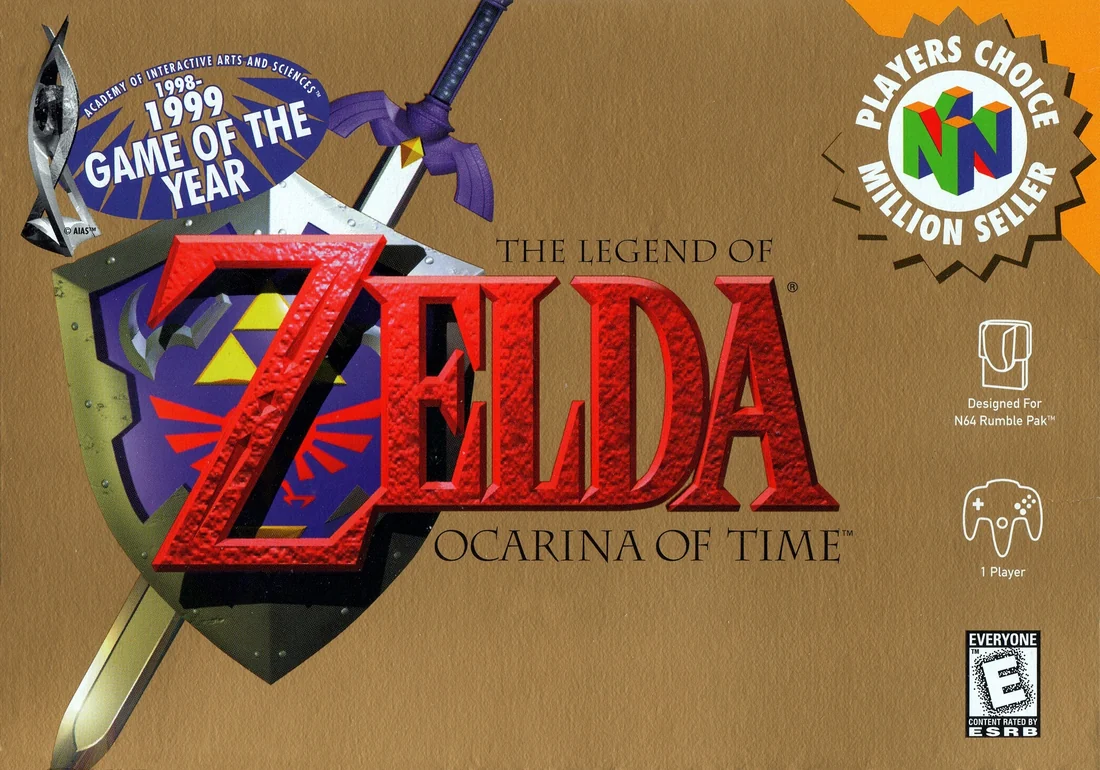
That history should not turn Ocarina of Time into a 64DD game. The commercially released N64 adventure was a cartridge title, as were other major releases whose development histories are sometimes mixed into discussions of the drive. Similar caution applies to Majora’s Mask, Pokémon Stadium and Mother 3-related plans.
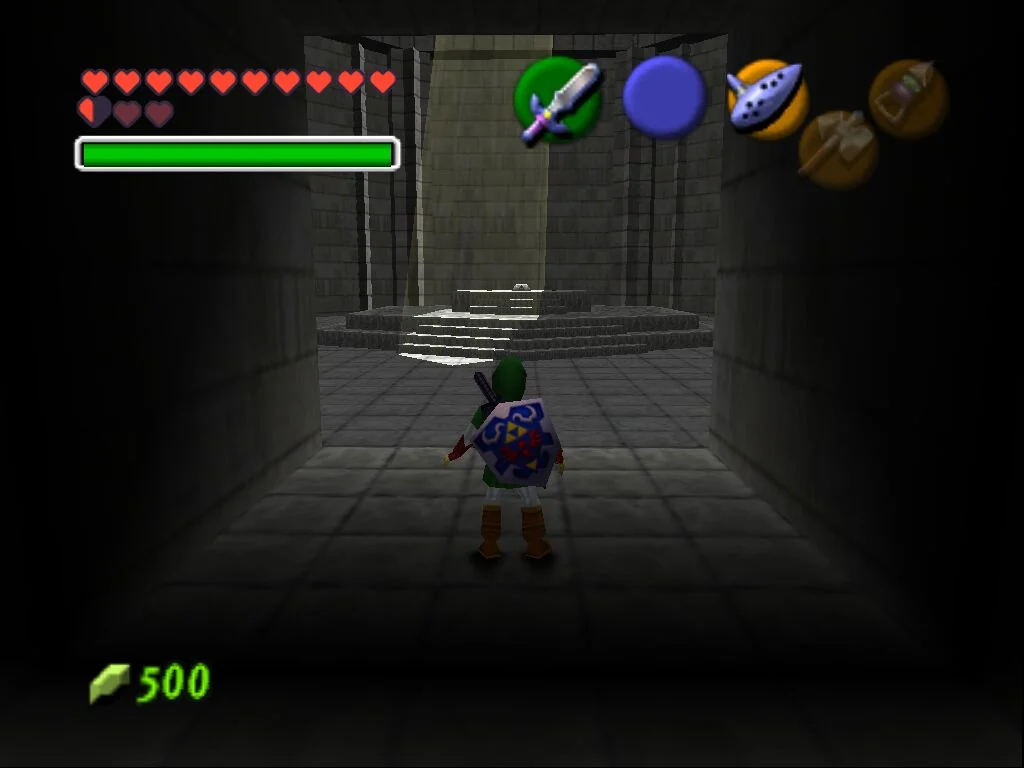
Ocarina of Time’s development history also documents a practical problem with the format. Nintendo’s developers later explained that magnetic-disk access made it difficult to retrieve movement and animation data quickly enough. Cartridge ROM had no moving mechanical parts, while the disk had to position its mechanism before reading data from a particular location.
The pattern was broader than one Zelda project. As the peripheral slipped, software teams had to reconsider the format, schedule and audience. Announced features could be reduced, projects could move to cartridges, and ideas could survive only in altered form. The 64DD’s delayed timetable therefore affected software even when no disk reached stores.
Mechanical access created real technical compromises
The 64DD’s magnetic media offered flexibility, but mechanical access introduced complications that cartridge ROM did not. The Zelda development discussion is especially revealing: the team had many movement and animation patterns, and retrieving them from a disk at the wrong moment could interrupt Link’s movement. Moving the project to cartridge made those frequently accessed assets easier to retrieve.
This distinction helps explain why the 64DD library favored creation tools, simulations and expansions. Those formats could benefit from capacity and saved projects without requiring every moment of a fast action game to depend on disk access. The hardware’s strengths were real, but they were specialized.
The disk was not simply inferior to a cartridge in every respect. It offered writable space and a different cost structure, while the cartridge offered speed and predictable access. Nintendo’s dual-format strategy made sense when software could divide its data between both media, but that approach required developers to design around the mechanical drive.
It is also important not to treat every advertised feature as equally important in every release. The clock, disk capacity, modem functions and creation tools each served different purposes. The 64DD was a collection of compromises around several related ideas, not a single technical solution.
Japan-only availability narrowed the experiment
The 64DD launched commercially only in Japan. Nintendo demonstrated it internationally and discussed releases outside Japan, but those plans did not become North American or European retail editions. That regional limitation sharply reduced the potential audience and made the software library even more dependent on a specific local service model.
The subscription requirement added another barrier. A conventional accessory can be understood from its games and hardware alone; Randnet required customers to participate in a network arrangement whose value depended on other users, continuing service and available content. A small audience made that network less compelling, while a weak network made the hardware harder to justify.
This was especially awkward for international players who had seen the 64DD discussed for years. Demonstrations and planned software created expectations, but no Western retail ecosystem appeared. The distinction between an announced product and an available product is essential to understanding the device’s legacy.
The combination of exclusivity, delays and specialized software explains why the 64DD never became a normal second catalog for the N64. Its design was more interesting than its commercial reach.
Randnet closed as Nintendo moved on
Randnet service ended on February 28, 2001. The shutdown came as Nintendo’s attention moved toward the GameCube and as computer and mobile networks were developing more quickly than a closed console service could comfortably match.
The end of Randnet did not erase the software’s historical value, but it removed the social layer that gave several applications their intended context. A creation tool could still be studied as software, yet the original promise involved making and exchanging material through a living service.
The 64DD’s commercial proposition depended on hardware, software, network access and a sufficiently large community arriving together. Those parts never aligned for long. The service ended only a little more than a year after the hardware’s Japanese launch, leaving the add-on with a short commercial life and a library that could not compensate for the missing network audience.
Nintendo’s transition to GameCube also changed the company’s priorities. The 64DD was not replaced by one direct successor, but several of its ideas continued through later experiments with downloadable content, connected services, user-created material and hardware-specific expansion.
A failed product with durable ideas
The 64DD’s direct legacy is small, but its design questions were not. User-created content, downloadable additions, data exchange, persistent worlds and specialized hardware expansion all returned repeatedly in later Nintendo platforms and in the wider games industry.
Its strongest lesson is about timing. Nintendo identified several directions that would eventually become normal, but it tied them to an expensive-to-explain accessory, a delayed catalog, a regional subscription service and media with mechanical limitations. A good idea did not guarantee a good platform launch.
The add-on also shows why hardware history cannot be reduced to sales performance. A commercial failure may still document a company’s thinking at an important moment. The 64DD reveals Nintendo trying to move beyond the finished cartridge game toward software that could be made, altered, exchanged and revisited.
The 64DD therefore deserves neither dismissal as a curiosity nor promotion as a hidden N64 successor. It was an ambitious extension that reached consumers in a reduced form. Its surviving importance comes from showing Nintendo experimenting openly with networked creation and expandable game worlds before those concepts had a stable home.
The Nintendo 64DD took a different path because it tried to solve several problems at once: cartridge capacity, persistent data, player creation, online exchange and time-aware worlds. Its ten-disk commercial library could not support the scale of that promise, and the Japan-only Randnet model made the audience smaller still.
Yet the add-on’s failure does not make its ideas trivial. Mario Artist, F-Zero X Expansion Kit, Doshin the Giant and SimCity 64 document a platform built around making, changing and sharing rather than simply finishing packaged games. Ocarina of Time’s move from a planned 64DD project to a cartridge also records the technical reality that fast access still mattered.
The 64DD did not define Nintendo’s future, but it gave that future an unusually clear early draft. Its most lasting achievement was not a hit game or a successful service. It was an early demonstration that a console could be a place to create, connect and maintain changing worlds, even when the hardware of the moment was not ready to make that vision practical.