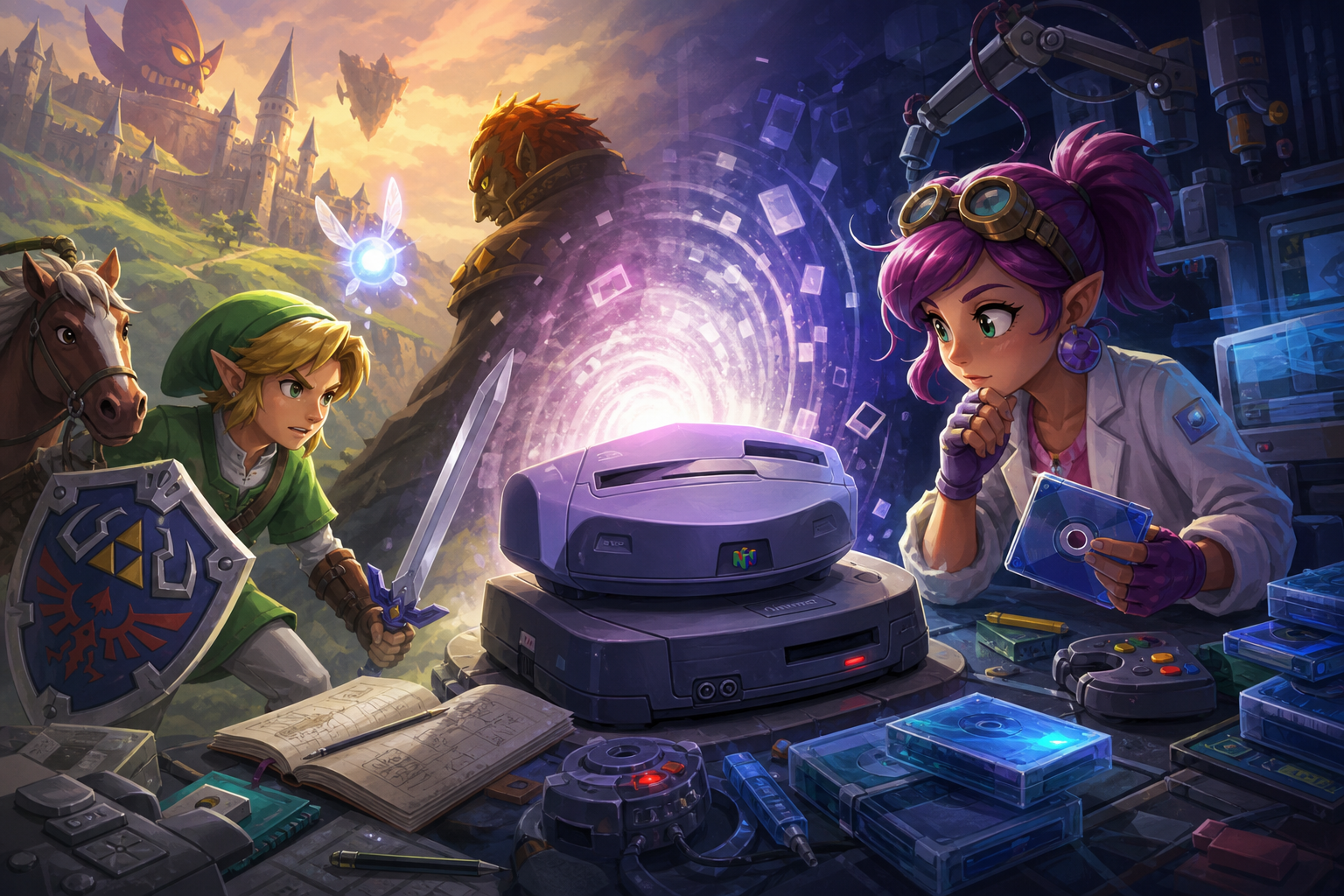
In the late 1990s, Nintendo was interested in making its handheld and home-console businesses feel less separate. The Nintendo 64 Transfer Pak was one of the clearest expressions of that idea. A Game Boy or Game Boy Color cartridge could sit in an adapter beneath an N64 controller, allowing compatible N64 software to read selected data and, in some cases, turn a handheld game into part of a larger console experience.
The accessory deserves a more precise description than “a Game Boy adapter.” It was not a universal way to play handheld cartridges on an N64. The Transfer Pak supplied a connection between cartridge hardware and the console software; each compatible game decided what that connection actually did. The most important example was Pokémon Stadium, but the same principle produced very different results in Mario Golf, Mario Tennis, Perfect Dark and several Japan-only releases.
A 1998 accessory with two names
Nintendo introduced the hardware in Japan as the 64GB Pack, written as 64GBパック. Western markets used the name Transfer Pak. Nintendo’s corporate product history places the 64GB Pack and Pokémon Stadium in the 1998 section of its company timeline. That pairing explains much of the accessory’s identity: although it had wider ambitions, Pokémon supplied the clearest reason for players to understand why the device existed.
The timing mattered. Game Boy Pokémon cartridges already held teams, progress and collected creatures that players had invested in for months. Pokémon Stadium promised a more spectacular home-console presentation, with polygonal battles and a larger television display. The Transfer Pak connected those two forms of play without asking Nintendo to make the N64 itself run every Game Boy title.
Japan received the idea first, while North America and Europe encountered it most visibly through Pokémon Stadium releases that included the adapter. Regional rollout should not be flattened into one global date, however. The name, bundle details, supported cartridges and software availability varied by market, and Japanese N64 software generally followed different cartridge-compatibility rules from Western editions.
The design put the connection in the controller
The Transfer Pak plugs into the expansion port on the underside of an N64 controller. A Game Boy or Game Boy Color cartridge then fits into the Transfer Pak’s own slot. This arrangement made the accessory portable between controllers, but it also made the connection part of the controller setup rather than a permanent console connection.
That choice reflected the N64’s modular design. The same controller expansion area could accommodate devices with entirely different jobs, including the Controller Pak and Rumble Pak. The Transfer Pak was not a memory card, vibration unit or extra system memory, despite the similar naming and physical relationship. Its job was to expose a connected handheld cartridge to software that knew how to communicate with it.
The division of responsibilities is important. The Transfer Pak itself did not contain the hardware needed to emulate ordinary Game Boy games. A supported N64 cartridge supplied the software and interpretation required to read the handheld cartridge. In practical terms, an adapter could connect the two systems, but it could not make every N64 game into a Super Game Boy.
Pokémon Stadium made the idea understandable
Pokémon Stadium was the accessory’s defining application. Nintendo’s Pokémon product description confirms that players could import Pokémon from Pokémon Red, Blue and Yellow into the N64 game. The original Western release also included a Game Boy Tower feature that could display and play the connected Game Boy Pokémon cartridge through the N64 system when the required connection was present.
That feature gave the Transfer Pak more meaning than a conventional unlock key. A player’s handheld team could appear in N64 battles, with its levels, attacks and technical machines carried into the console experience. Pokémon Stadium could also provide storage functions through its laboratory features, allowing Pokémon and items to be managed within the N64 software rather than treated as permanently tied to one handheld session.
The connection was not a replacement for the Game Boy games. It was a bridge between them and a separate N64 program. Players still needed compatible Pokémon software, and the N64 game controlled which data could be read or used. That selective approach made the feature technically and commercially practical, but it also established the Transfer Pak’s central limitation: every meaningful function depended on a specific software partnership.
Trading and storage turned a controller port into a network
Pokémon Stadium also demonstrated how the Transfer Pak could support interactions that were difficult to present on a single handheld screen. With two Transfer Paks and compatible Game Boy cartridges, the N64 software could support trading between connected Pokémon games. The console became a meeting point for handheld save data, rather than merely a larger display.
This was an early form of platform connectivity built around physical media. The Game Boy cartridge remained the source of the player’s existing progress, while the N64 cartridge supplied a different environment for battles, management and presentation. The arrangement preserved the value of both products: Pokémon Stadium was more compelling with a compatible handheld game, and the handheld game gained new uses when brought to the television.
The design also made the limits visible. Trading, storage and Game Boy Tower access were not universal operating-system features. They were functions programmed into Pokémon Stadium. A different N64 cartridge could read a Game Boy cartridge in a completely different way, or not recognize it at all. The Transfer Pak connected hardware, but the software relationship determined the experience.
Pokémon Stadium 2 expanded the same model
Pokémon Stadium 2 extended the concept to the Game Boy Color Pokémon games. Its Game Boy Tower supported Pokémon Gold, Silver and Crystal in compatible releases, while its laboratory and trading features used data from those handheld cartridges. The move from the first Game Boy generation to Game Boy Color showed that Nintendo and its partners viewed the Transfer Pak as a platform for continuing data relationships, not merely a one-game novelty.
The compatibility story was edition-sensitive. Japanese and Western Pokémon Stadium releases were designed for their respective cartridge regions, and Japanese or Korean Game Boy cartridges were not automatically interchangeable with Western software. Pokémon Crystal also requires care in historical descriptions because it arrived later than Gold and Silver in some markets, so contemporary packaging and documentation did not always list it in the same way.
That complexity is easy to miss when the accessory is described through a modern compatibility list. A cartridge may be physically accepted while still failing to provide the intended feature because the N64 software expects a different regional or game version. The Transfer Pak’s promise was broad, but its actual behavior was tightly controlled by software identifiers and regional product planning.
Mario Golf made progression the star
Mario Golf connected the Nintendo 64 and Game Boy Color versions in a different way from Pokémon Stadium. Instead of importing a team into a separate battle environment, the link allowed developed golfers and related progress to move between the handheld and console games. The two versions were companion experiences, with the Transfer Pak helping players carry the results of one style of play into the other.
This approach suited the games’ structure. A handheld role-playing layer could provide character development and long-term progression, while the N64 version offered a more expansive presentation and multiplayer setting. The connection made the versions feel related without making either one a simple portable copy of the other.
Mario Golf also illustrated why a compatible game could be valuable even when it did not include a full handheld emulation mode. The Transfer Pak did not need to reproduce the entire Game Boy Color cartridge to matter. Reading selected save information was enough to change what the N64 game could offer. In that sense, the accessory was less a second console inside the controller than a controlled data pathway.
Mario Tennis used connectivity as progression and access
Mario Tennis pushed the companion-game idea further. The Nintendo 64 and Game Boy Color versions could exchange developed characters and related progress, while the connection could unlock characters and courts across the two games. That gave the Transfer Pak a more direct effect on the N64 content than a simple save transfer.
The design encouraged players to see the handheld game and N64 game as parts of one product family. A character earned or developed in one version could become relevant in the other, giving the portable release a role beyond being a smaller edition. It also showed Nintendo experimenting with asymmetric design: the same fictional sport could support different progression structures on different hardware.
There was a tradeoff. Content that depended on another cartridge could feel unusually rewarding for players who owned the full combination, but less complete for everyone else. This was not a defect unique to Mario Tennis; it was a recurring tension in link accessories. Connectivity created a premium relationship between products, while simultaneously making the standalone boundaries of each game harder to understand.
Perfect Dark and the ideas that did not survive intact
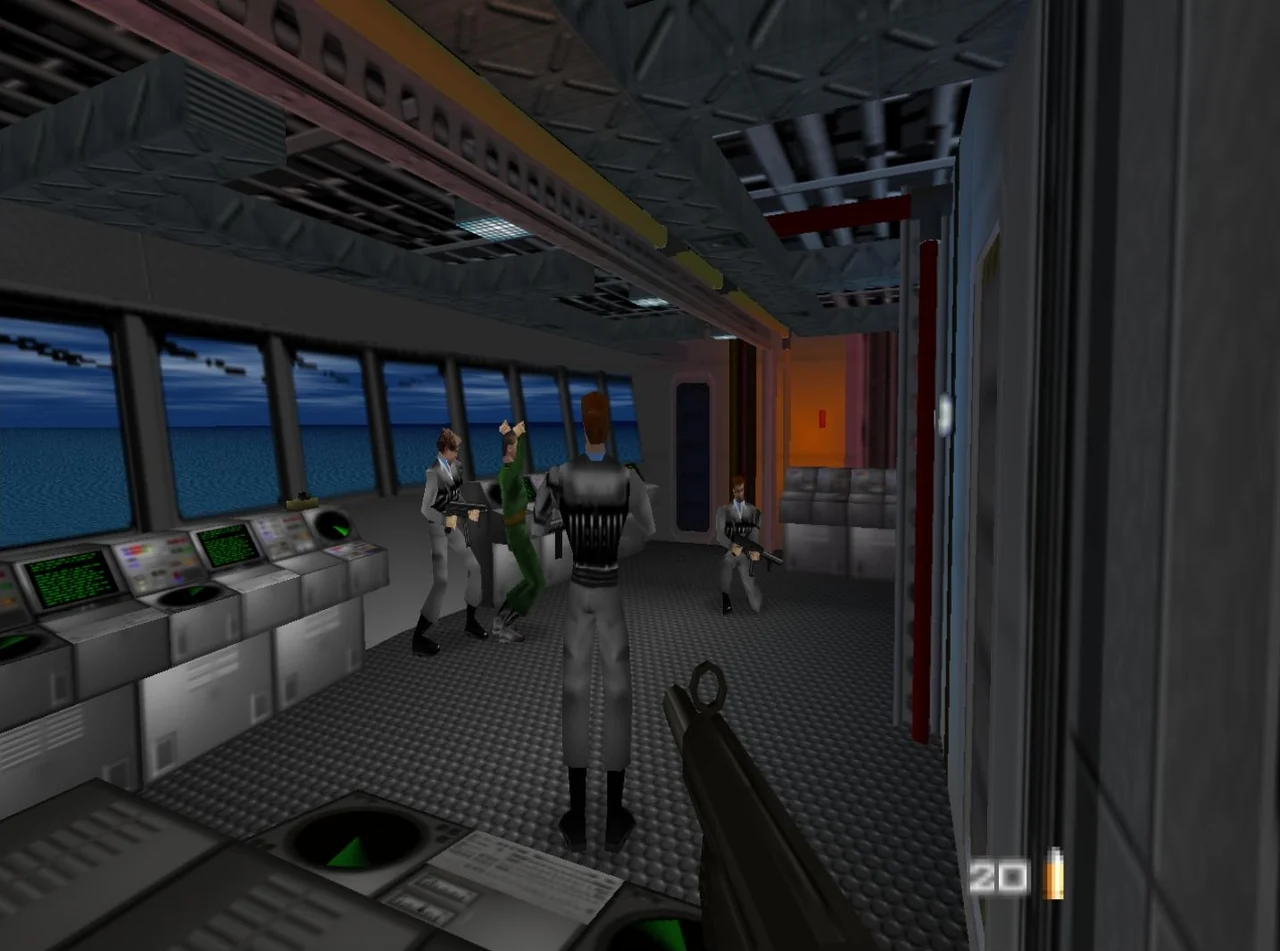
Perfect Dark is useful because it shows the gap between an accessory’s surrounding design discussion and its released feature set. Early concepts associated with the Game Boy connection included a Game Boy Camera face-mapping idea. That was not the public Transfer Pak experience delivered in the finished game.
The released Game Boy Color connection provided narrower unlockable content, including a Cloaking Device, Hurricane Fists, the R-Tracker and an All Guns cheat. That result still demonstrated the value of linking the games, but it was not a miniature version of the N64 title and did not deliver the more ambitious face-scanning concept sometimes attached to the game’s development history.
This distinction matters when reconstructing hardware history. Prototypes, plans and promotional expectations can explain what developers were trying to achieve, but they should not be presented as features players received. Perfect Dark’s final connection belongs in the Transfer Pak story as an example of reduced scope: the underlying idea survived, while the technically or creatively larger version did not.
Japan-only software widened the experiment
The Transfer Pak was not limited to Pokémon and Mario. Documented compatibility references include Japanese releases such as PD Ultraman Battle Collection 64, Super Robot Taisen 64, Nushi Tsuri 64 and other software that is easy to overlook when focusing only on Western catalogues. Some lists also include 64DD software, including Mario Artist: Talent Studio.
Mario Artist: Talent Studio is especially revealing because it connected the N64-based creation environment with Game Boy Camera material. The use was not traditional game progression. It treated handheld imagery as an input for a broader creative tool, showing that Nintendo saw the cartridge slot as a way to move content between formats as well as a way to unlock game features.
Mickey’s Speedway USA is another documented example. The N64 and Game Boy Color versions could exchange data and unlock Huey in the N64 game. The exact scope of Transfer Pak support varied from title to title, and lists differ depending on whether they count only commercial Western N64 games, Japanese releases or 64DD software. The safest historical conclusion is not that the accessory had one fixed catalogue, but that Nintendo and third-party developers tested several kinds of connection: data transfer, unlocks, imagery and companion progression.
Why it never became a universal Game Boy solution
The Transfer Pak’s biggest limitation was conceptual. It did not turn the Nintendo 64 into a general-purpose Game Boy player. Only supported N64 software could communicate with a connected cartridge, and each title had to define its own handling of saves, unlocks or gameplay.
That made the accessory powerful when the partnership was carefully designed, but invisible in games that did not support it. A player could own the hardware and still find that most of the N64 library had no use for it. The controller-mounted design also meant that the relevant accessory had to be connected to the controller and port arrangement expected by the software, rather than functioning as a simple console-wide feature.
Regional compatibility added another barrier. Japanese N64 and Game Boy releases were not interchangeable with Western versions by default, and Korean cartridges introduced further boundaries. Broad online lists can therefore give a misleading impression if they combine every regional title without identifying the required editions.
Nintendo’s approach was also changing. A universal adapter would have required more hardware, more software support and clearer expectations across two cartridge families. The Transfer Pak instead remained a targeted accessory whose best results came from first-party partnerships.
Reception centered on Pokémon’s value
Contemporary coverage treated the Transfer Pak as central to Pokémon Stadium rather than as an independent reason to buy an N64. Reviews and product descriptions emphasized the appeal of bringing Pokémon Red, Blue and Yellow teams into a more visually elaborate console setting. Pokémon Stadium’s value increased substantially for players who already owned compatible handheld games and could use their existing progress.
Coverage of Pokémon Stadium 2 followed a similar pattern. The N64 game was more attractive when paired with a compatible Game Boy Color Pokémon cartridge and the required adapter, while players without that combination encountered a more limited version of the overall proposition. Contemporary criticism did not necessarily reject the connectivity; instead, it questioned how much of the game remained compelling without it.
The accessory therefore had an unusual reputation. It was memorable because its strongest feature was excellent, but it was not broadly useful across the library. Calling it a failure would overstate what the evidence supports; calling it a universal bridge would be equally inaccurate. Its reception makes more sense as a successful specialized idea attached to a small catalogue.
A direct ancestor of later Nintendo connections
The Transfer Pak’s legacy is easier to see in Nintendo’s later hardware than in the size of its own software catalogue. The GameCube–Game Boy Advance Cable pursued the same broad goal through a newer connection: a handheld could provide data, controls or a companion view for a home-console game. The specific hardware and software relationships changed, but the design question remained familiar: what becomes possible when one Nintendo system knows that another is present?
The Transfer Pak also anticipated a more integrated strategy. Later Nintendo hardware increasingly treated handheld and home play as related parts of one ecosystem, eventually making the distinction between portable and television gaming less rigid. The 1998 adapter did not solve that problem by itself, but it provided a practical experiment in transferring progress, characters, images and ownership value across systems.
Its most enduring achievement remains Pokémon Stadium. There, the accessory transformed a handheld save file and collection into playable 3D console content rather than limiting the connection to a cosmetic bonus. That is why the Transfer Pak still matters in gaming history: its physical design was small and its compatibility list was selective, but its most successful use demonstrated a much larger future for linked hardware.
The Nintendo 64 Transfer Pak was neither a universal Game Boy player nor a disposable novelty. It was a software-defined bridge, and its results depended on how thoughtfully each compatible game used the connection. Pokémon Stadium made the idea famous by turning handheld Pokémon into a television-based battle and management experience; Mario Golf and Mario Tennis explored shared progression; Perfect Dark and Japanese software tested more specialized possibilities.
Its limitations explain why the accessory did not become a standard part of every N64 game, while its best applications explain why players remember it. The Transfer Pak showed Nintendo that a handheld cartridge could carry more than a save file into a home-console experience. It could bring identity, progression and collected content with it — a principle that Nintendo would continue refining through later system-to-system connections.