
Major spoilers for The Rings of Power season 3 follow.
The Rings of Power season 3 closes by declining the most immediate kind of spectacle. Rather than delivering a decisive battle between Sauron, Númenor and the Elves, the finale has Sauron surrender. It is an apparent defeat that plays more like a tactical change of position—and it points the series toward one of the darkest prospects connected with Númenor.
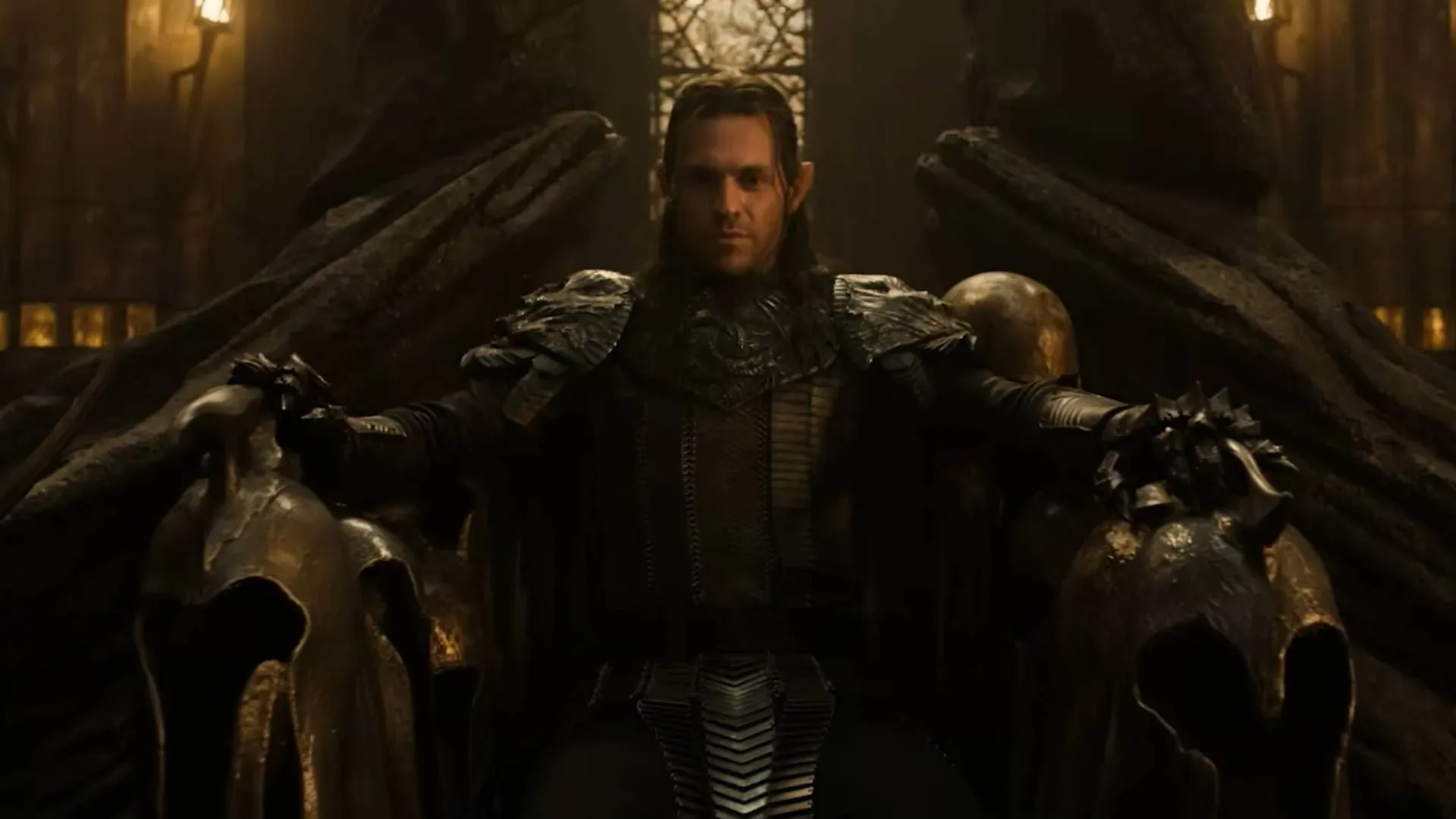
Before giving himself up, Sauron removes the One Ring, which the season establishes he forged in episode 7. Pharazôn reacts to the surrender with open satisfaction. Gil-galad, however, sees something far more alarming in the moment, warning of the “doom of men.” The contrast is the finale’s central warning: Pharazôn believes he has neutralized a rival, while Gil-galad recognizes that a prisoner can be more dangerous than an enemy across a battlefield.
The final image reinforces that interpretation. Sauron ends the season smirking as his musical theme plays, making the surrender feel neither accidental nor reluctant. It is a choice made after his forces have been diminished, but it is also a choice that appears to exploit the boastful worldview Númenor has already put on display.
A surrender built around Pharazôn’s arrogance
The episode gives Sauron a specific reason to reconsider confrontation. He receives a letter from Pharazôn declaring Númenor the “king of men.” That language matters because it frames the island kingdom’s leader not simply as confident, but as someone eager to place himself and his realm above other peoples. Sauron appears to read that pride as an opening.
In practical military terms, surrender removes him from a weakened position against opposing forces. In political terms, it puts him inside the structure of power led by a ruler who is delighted to have won. The finale’s tension comes from the gap between those two readings. Pharazôn can celebrate a captive. Viewers have reason to see an infiltrator.
This is also why sidestepping the battle is more than a way to postpone action. A battle would make Sauron’s threat visible and external. Captivity changes the kind of conflict at stake. The danger becomes persuasion, access and the ability to turn a ruler’s existing flaws into policy. That is a slower threat, but potentially a far wider-reaching one.
Sauron’s identity as the Deceiver is especially relevant here. Deception does not require him to invent every weakness around him. The finale suggests he can achieve more by identifying Pharazôn’s hunger for dominance and giving it room to grow. Númenor’s ruler has already supplied the boast; Sauron’s apparent submission offers the flattering proof of superiority that Pharazôn wants to see.
Related coverage includes Rings of Power Season 3 Finale Points Sauron Toward Númenor’s Fall.
Why Númenor is the real story behind the cliffhanger
The ending carries weight because Tolkien’s wider mythology gives Númenor an exceptionally bleak destination. In that material, the island is destroyed by Eru Ilúvatar, the deity-like supreme power of Middle-earth. Its downfall stems from hubris: Númenor invades the Undying Lands, also called Valinor, in pursuit of immortality, and is punished for doing so.
Two terms are useful in understanding what the finale is positioning. Hubris means destructive overconfidence or excessive pride, especially the belief that normal limits do not apply. The Undying Lands, or Valinor, are not merely a faraway territory that can be conquered to obtain eternal life. In the story’s moral framework, Númenor’s attempt to seize immortality represents a profound transgression. The issue is not just expansionism; it is the attempt to overcome a boundary that power and force cannot legitimately erase.
That background gives Pharazôn’s reaction to Sauron a much larger significance. His gloating may seem like the response of a victorious ruler, but it also fits the early shape of the arrogance that defines Númenor’s disaster. The finale does not need to portray the fall itself to make its direction clear. It establishes the conditions: a proud king, a captured enemy with a talent for manipulation, and a kingdom confident enough to mistake dominance for safety.
Sauron’s prison is a position of influence
In Tolkien’s works, Sauron is held captive in Númenor but uses that status to work his way into becoming Pharazôn’s adviser. The season 3 finale now appears designed to bring the series to that phase of the story. If season 4 follows the trajectory implied by the ending, Sauron’s imprisonment will not be a pause in his plans. It will be the mechanism through which he gains proximity to the person most able to steer Númenor toward ruin.
That makes the title’s villainous strategy unusually economical. Sauron does not have to destroy Númenor through immediate conquest. By placing himself at the center of its leadership circle, he could encourage the kingdom to become its own instrument of destruction. For him, this would remove a powerful threat without requiring him to win a conventional war against it.
The logic is cold but clear. Númenor has strength, influence and a ruler whose self-image is already grandiose. An external attack may rally such a kingdom against Sauron. An internal campaign built around Pharazôn’s ambitions could instead redirect all of that strength toward an impossible goal. The more certain Pharazôn is that he has mastered Sauron, the less likely he may be to recognize when Sauron is shaping his decisions.
Gil-galad’s warning therefore functions as more than ominous dialogue. It identifies the true scale of the danger. The word “doom” points beyond an individual political loss or military setback. The concern is for men collectively, fitting the larger catastrophe associated with Númenor rather than a single confrontation between competing leaders.
What the finale deliberately leaves unresolved
Season 3 ends at the point where this strategy becomes possible, not at the point where it has succeeded. The available setup strongly suggests Sauron intends to exploit Pharazôn and the kingdom’s pride, but the details of how the series will stage that campaign remain unknown. The finale establishes motive, access and vulnerability; it does not yet show the full course of Númenor’s descent.
That distinction matters. Knowing the broad mythological destination does not automatically reveal the show’s scene-by-scene route. The key development is Sauron’s choice to enter Númenor under the conditions Pharazôn believes he controls. From there, the drama can focus on how power is legitimized, how advice becomes influence, and how a ruler’s triumphalism can make manipulation easier rather than harder.
It also gives season 4 a strong political engine. The question is no longer simply whether Sauron can survive pressure from the Elves and Númenor. It is whether Pharazôn can recognize that possessing Sauron is not the same as defeating him. The finale’s answer, signaled by that final smirk, is not encouraging.
For a different example of how major franchise storytelling can use an expanding cast and shifting narrative focus to prepare its next stage, see our look at Avengers: Doomsday’s crowded handoff.
When season 4 may move the story forward
Amazon has confirmed that The Rings of Power season 4 is in pre-production, with cameras set to begin rolling in the UK in spring. No release date has been announced.
Until then, season 3’s ending leaves a precise and unsettling picture: Sauron has traded battlefield pressure for access to Númenor; Pharazôn thinks the exchange proves his greatness; and Gil-galad has named the kind of catastrophe that may follow. The massive battle was avoided, but the finale makes that absence feel intentional. The most consequential fight may be for the judgment of a king who does not yet realize how completely his pride can be used against him.