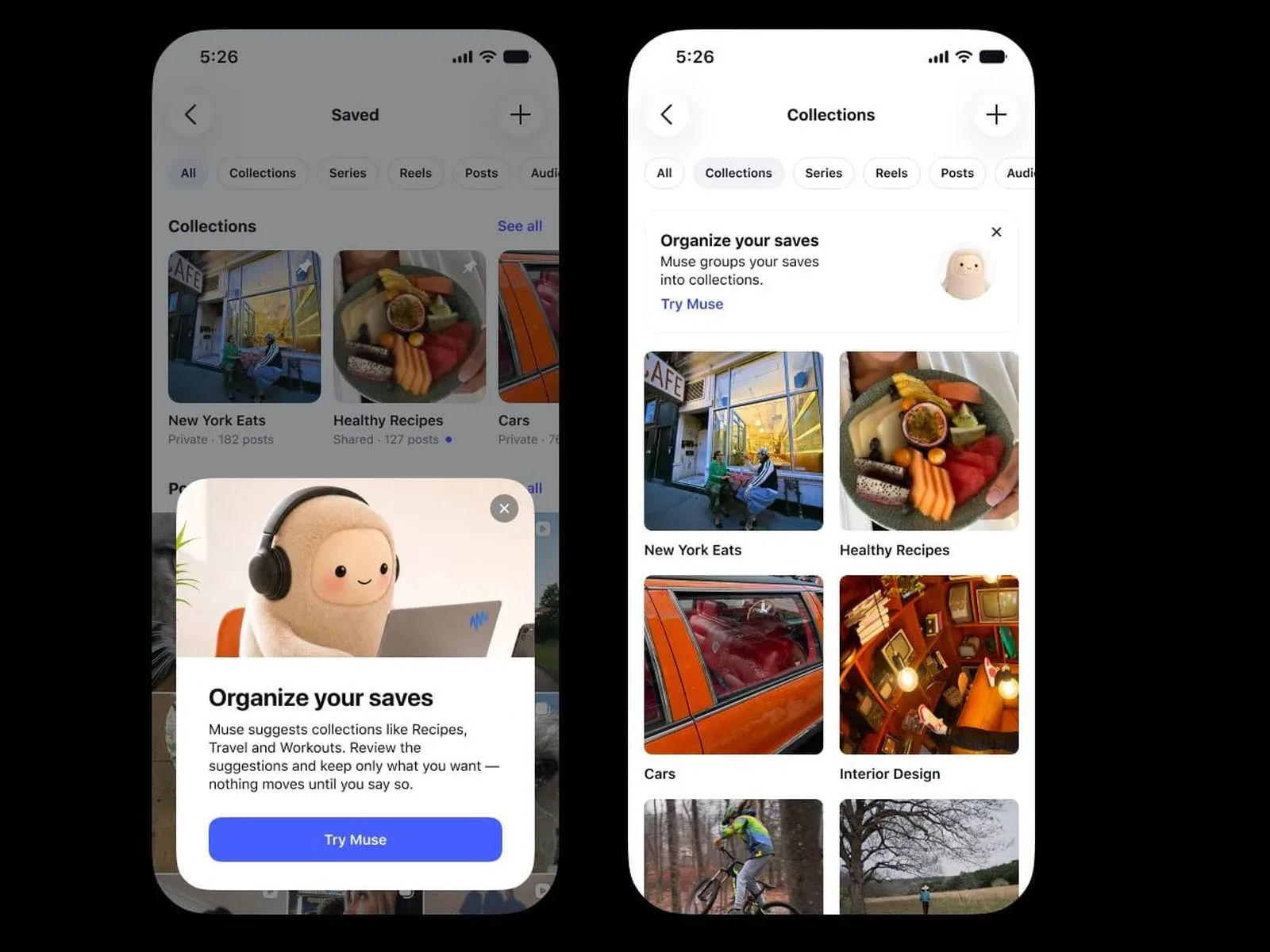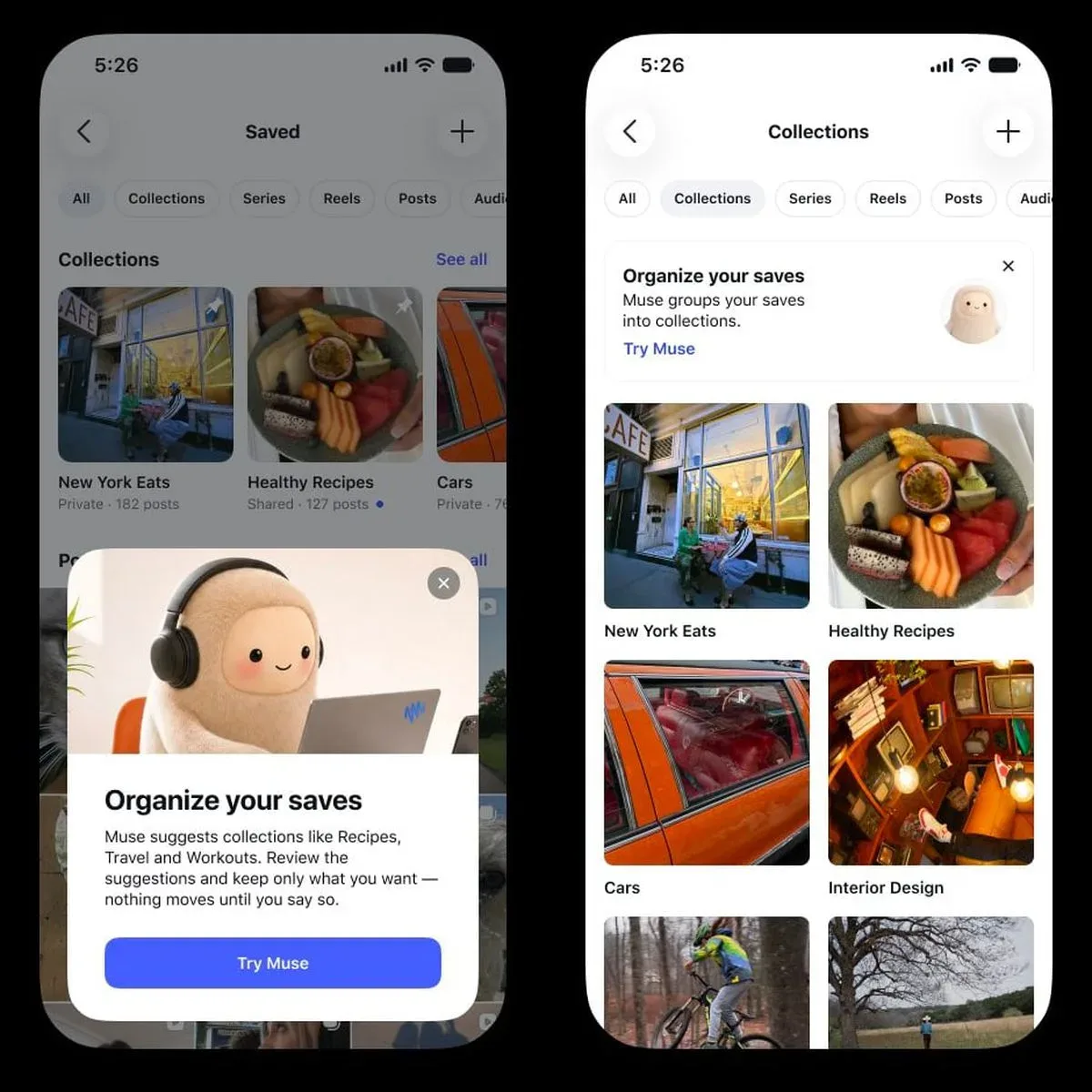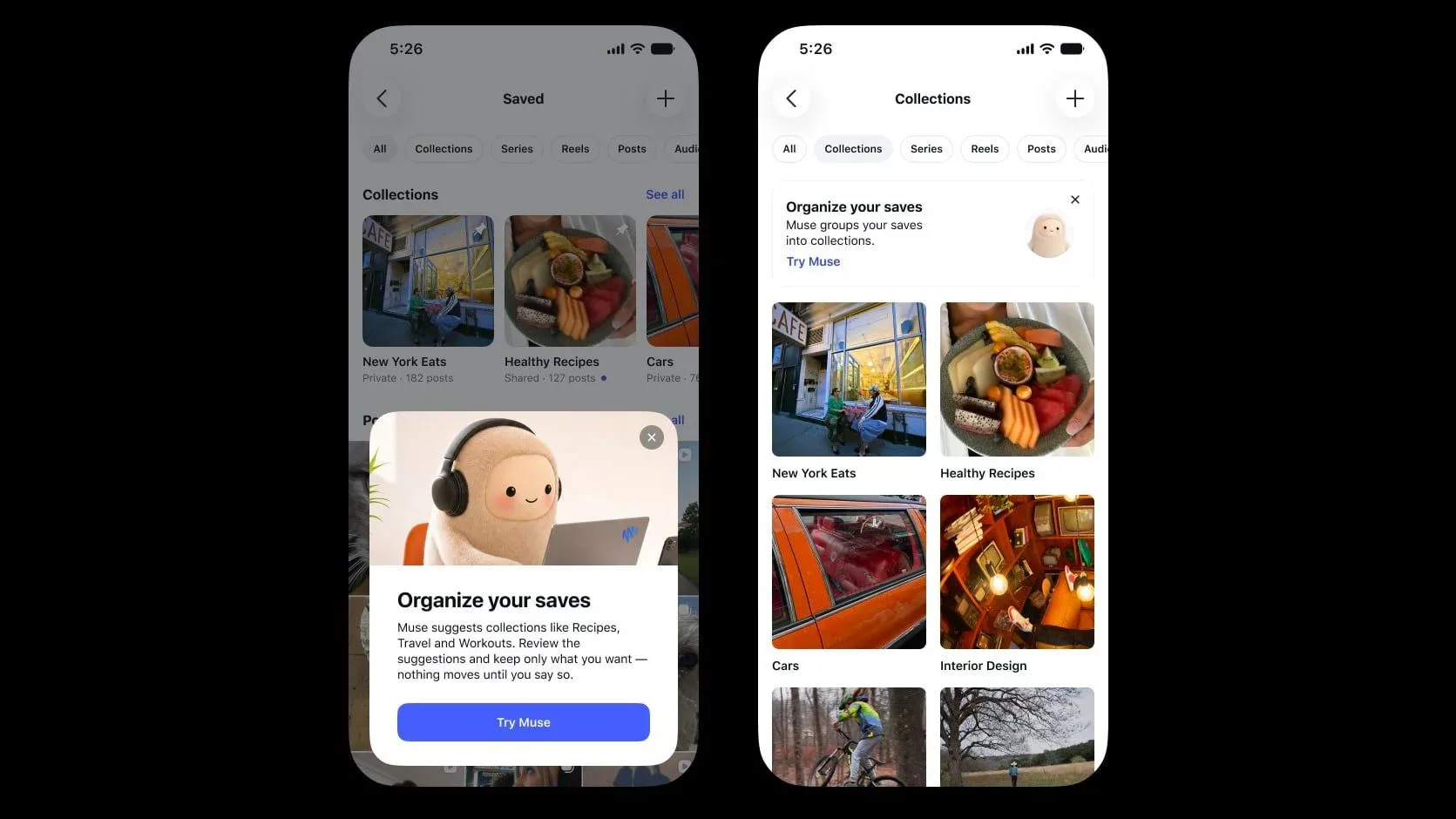
Meta is expanding Muse inside Instagram, putting its personal AI agent directly into DMs and connecting it more closely to the posts people save. The update is intended to turn the familiar act of bookmarking a post into something more useful: a collection that can be sorted, a possible travel itinerary, or a grocery list built from a recipe encountered while scrolling.
Muse will also be available as a regular conversation in Instagram DMs. That means a user can ask about a post, seek more information, or request a catch-up on material they missed without leaving Instagram to open the separate Muse app. Conversations begun with Muse through Instagram will appear as a side chat in the Muse app as well.
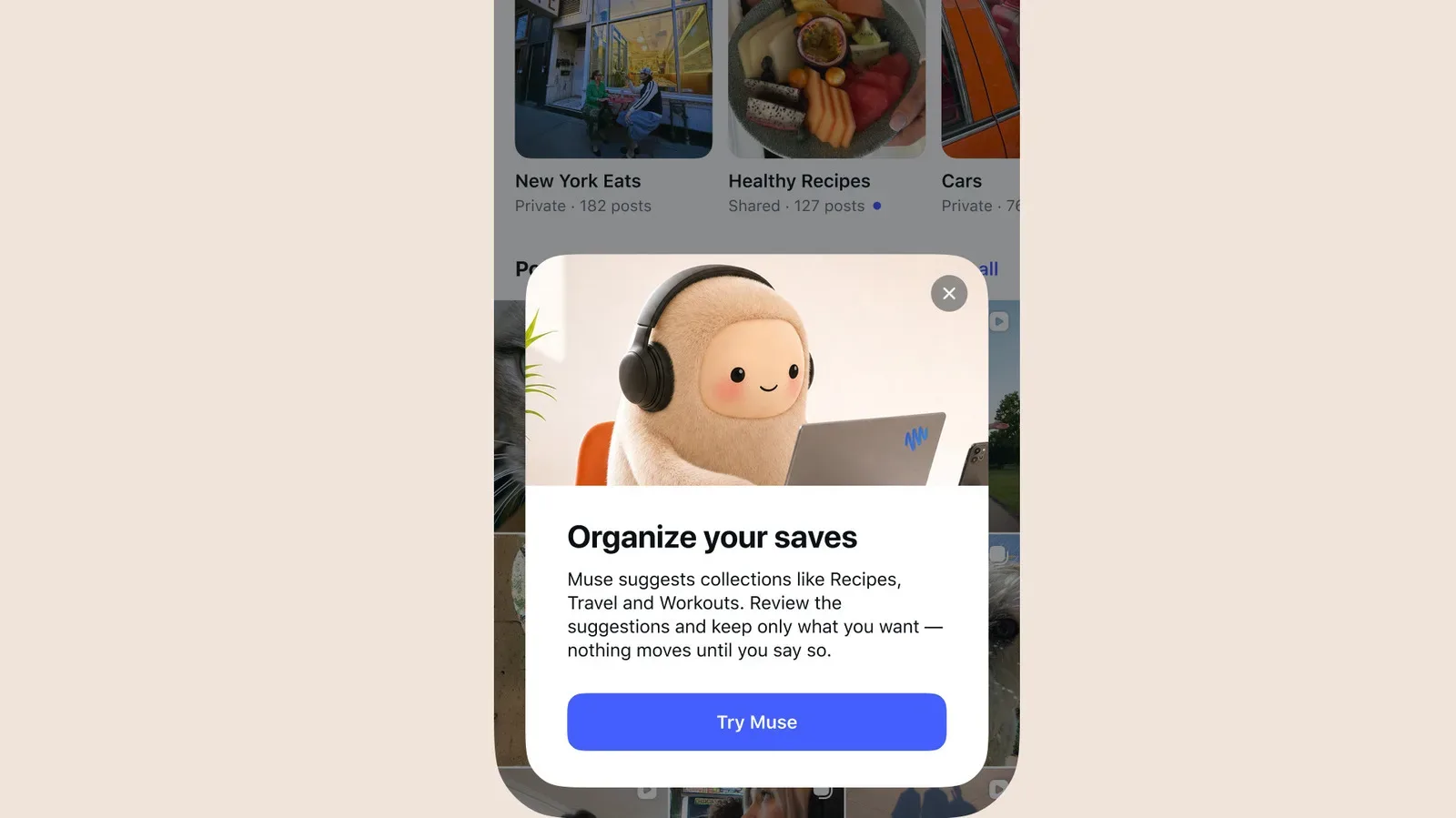
The rollout starts today in the United States, Canada, Mexico, Japan, and Singapore. The saved-post organization option specifically appears for people in the U.S. and Canada when they save an Instagram post. Meta says Muse will not make changes or carry out actions without the user’s permission.
What Muse can do with saved Instagram posts
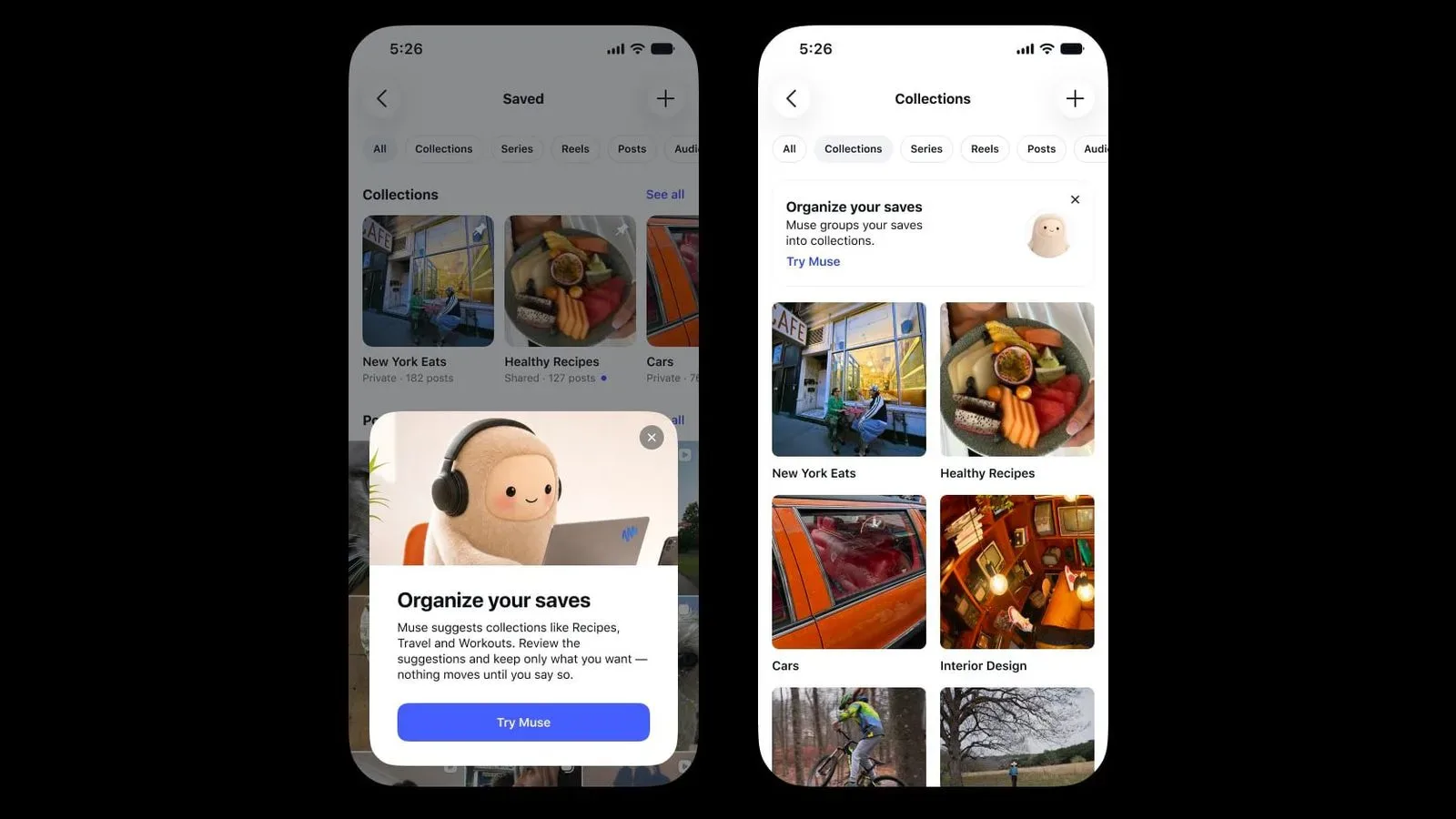
The clearest practical use is organization. Instagram’s saved-post feature can quickly become an unstructured pile: a restaurant recommendation next to a recipe, a short travel video next to a product, and perhaps several posts intended for a future project. Muse is being positioned as a layer that can interpret those saved items and group them into a more purposeful format.
Meta identifies three examples:
- Collections: Muse can organize saved Instagram content into collections.
- Travel itineraries: Saved material can be used to assemble an itinerary.
- Recipe grocery lists: Muse can make a grocery list for recipes found on Instagram.
These functions are related, but they are not identical. A collection is primarily a method of sorting. An itinerary turns relevant saved posts into a plan-oriented format. A grocery list extracts a practical shopping task from recipe content. In each case, the agent is intended to reduce the work involved in moving from discovery to organization.
That distinction matters because “AI agent” can sound broader than the actual announced tools. Here, Muse is not described as independently conducting purchases, editing an account, or making decisions on a user’s behalf. Its disclosed role is to help arrange information and produce planning aids from things a person has already encountered or saved.
DMs become the place to ask follow-up questions
Instagram’s new Muse conversation works as a standard DM chat. A person can chat with the agent to learn more about a post or catch up on missed material. The convenience is not merely that an assistant exists; it is that the conversation is located in the same app where the post was found.
In practical terms, that removes a context switch. Instead of seeing a post, leaving Instagram, opening Muse, and then trying to recreate the relevant question, users can continue from the Instagram environment. The cross-app link still exists, however: the conversation is also visible as a side chat in the Muse app.
“Catch up” is a useful but necessarily broad description. Meta has said Muse can help users catch up on what they missed, but has not detailed exactly how those catch-ups are structured, how much content they cover, or what control a user has over the scope. Users should therefore treat it as an AI-assisted way to revisit missed material, rather than assume a particular kind of feed summary or notification system.
Permission is the key boundary
Meta’s stated safeguard is straightforward: Muse will not make changes or take actions without permission. This is especially relevant for an agent that can transform saved content into collections, itineraries, and lists. An action in this context means an operation that changes something or creates something on the user’s behalf, rather than simply replying with information in a chat.
The promise does not eliminate the need for users to review what the tool produces. A grocery list is only helpful if it reflects the recipe and a traveler’s needs; a saved-post grouping is only useful if the selected posts belong together. Permission provides a checkpoint before an action is completed, while review remains the sensible human step after the output appears.
It is also a meaningful difference between an assistant and an autonomous system. Muse is being framed as a tool that can propose, organize, and help execute a task after approval—not as something that should silently reorganize a person’s saved material or act without a prompt.
Availability varies by feature and country
The launch footprint has an important wrinkle. Muse support in Instagram DMs is rolling out in five countries: the U.S., Canada, Mexico, Japan, and Singapore. But the option to ask Muse to organize a post at the moment it is saved is specified for the U.S. and Canada.
Those are separate claims and should not be treated as confirmation that every Muse capability is immediately identical in every rollout market. People in Mexico, Japan, and Singapore are included in the DM support rollout, while the in-save organization prompt is specifically described for the U.S. and Canada.
For eligible U.S. and Canadian users, the new option should appear while saving a post. For others in the initial group, Muse’s DM presence is the announced entry point. As with many staged software releases, the wording indicates a rollout rather than a guarantee that every eligible account sees every feature at the same moment.
Why this matters for social-media discovery
Instagram is often used as a discovery tool as much as a publishing platform. People encounter food ideas, destinations, products, tutorials, and recommendations in a rapid stream, then save some of them for later. The difficult part is often “later”: finding the right saved post again, remembering why it mattered, and converting it into a concrete plan.
Muse’s new jobs target that gap. A recipe can become a shopping list. Multiple travel-related saves can become an itinerary. A post can become the starting point for a question in DMs. The AI is therefore being placed after discovery but before execution, where saved content risks becoming forgotten content.
There is a broader product implication, too. Keeping the interaction in DMs makes Muse feel less like a standalone destination and more like an assistant embedded in the social app’s ordinary flow. The linked side chat in the Muse app preserves continuity for anyone who wants to continue the conversation there, but Instagram is now a direct access point rather than merely a source of material.
This kind of integration is part of a wider debate about where AI-generated assistance belongs in consumer apps. Some services are tightening their approach to fully AI-made material, as seen in Tidal’s planned removal of fully AI-generated music. Muse’s Instagram role is different: it is described as an organizational and conversational layer applied to posts, saved items, and user requests rather than a tool for populating the platform with fully generated media.
Useful expectations for people trying it
People who receive the feature can get the most direct value by being specific about the desired outcome. Rather than treating every save as one undifferentiated archive, they can use Muse for a bounded task: organize a group of restaurant posts, turn saved destination ideas into an itinerary, or make a grocery list from a particular recipe.
Users should also check the final result before relying on it. A post can be short, ambiguous, or missing key context, and the announced information does not establish that Muse will always infer every detail accurately. The sensible use is to let the agent handle initial organization and then confirm the list, itinerary, or grouping matches the person’s own intent.
Finally, the permission requirement should be treated as a control worth using. If Muse offers to make a change or take an action, users can decide whether the proposed result is appropriate before authorizing it. That is particularly helpful when saved posts have personal relevance, when a list will be used for a real purchase, or when travel planning depends on details that need individual verification.
Meta’s update is a focused expansion rather than a declaration that Instagram’s DMs have become a fully autonomous planning service. But it does give Muse a more immediate role in the moments that follow a save, a question, or a missed stretch of content—without requiring users to leave Instagram to begin the conversation.