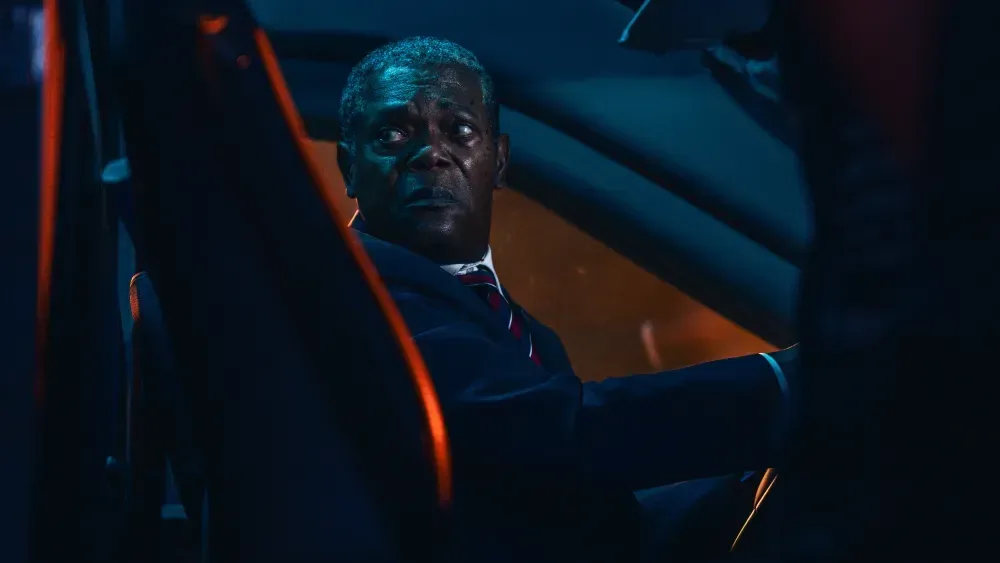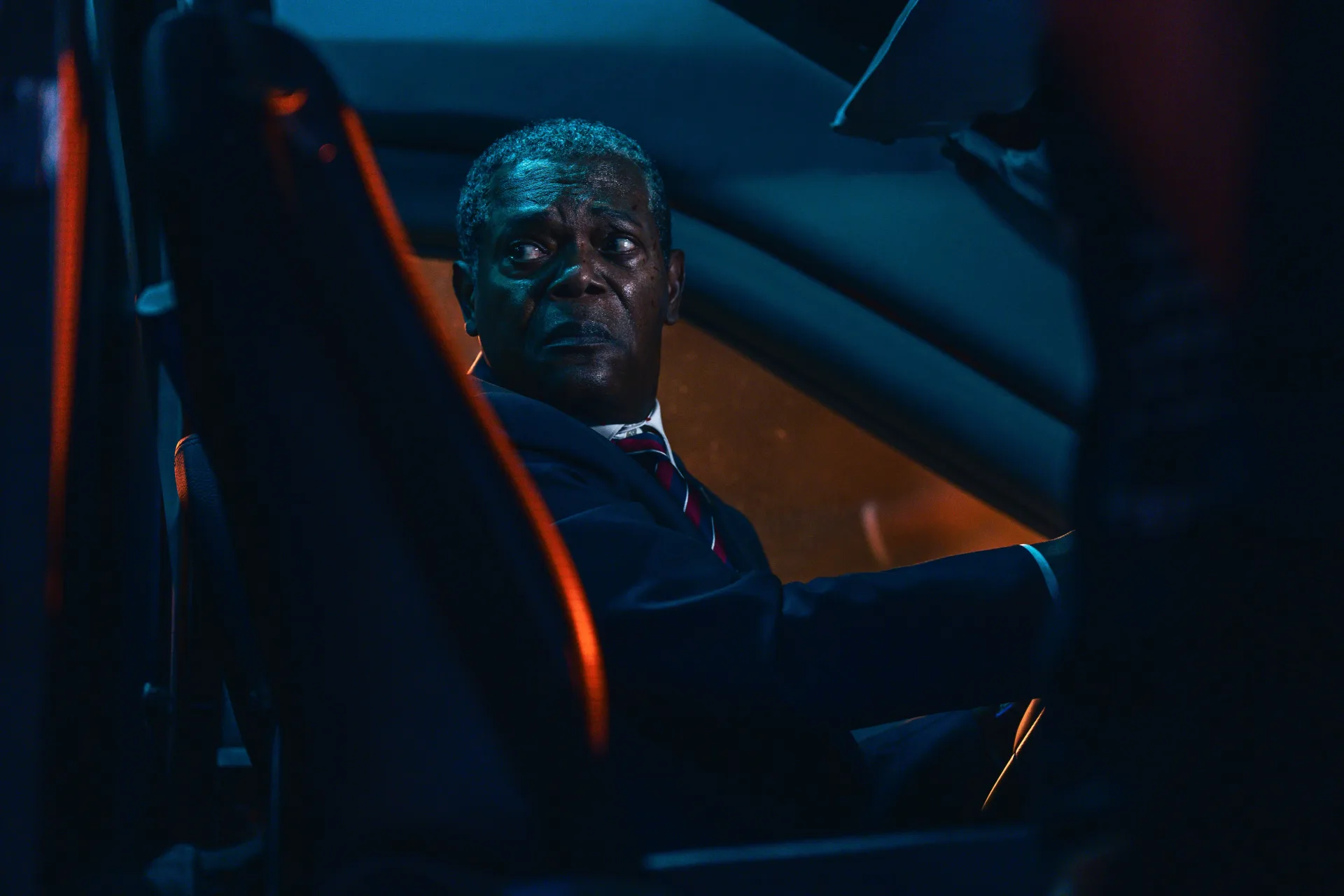
The Beast has an inherently outrageous action-movie setup: Samuel L. Jackson plays U.S. President Oscar Palladin, who must personally pilot an advanced presidential security vehicle through a city devastated by a coordinated attack. His remaining Secret Service protection, Taft, played by Joel Kinnaman, is gravely wounded in the back seat. The president’s principal companion is therefore a vehicle system called Command—and the result is a largely single-location survival thriller where the car is meant to function as both bunker and battlefield.
It is a premise with enough moving parts for gleeful pulp. The title vehicle is not treated as an ordinary limousine, but as a fortified mobile command center with autonomous functions and its own emergency capabilities. Palladin is forced into the driver’s position after the wider protective operation is wiped out, then has to navigate threats in the streets while attempting to keep Taft alive and communicate with Command.
But the film’s big idea apparently becomes its biggest constraint. At 99 minutes, The Beast is built around the prospect of spending most of its runtime inside that vehicle. The available critical assessment finds that the tight setting does not develop into mounting pressure, inventive action geography, or satisfying character drama. Instead, the confined concept is described as repetitive, noisy and ultimately inert.
A vehicle designed as a character, but not quite a setting
Action thrillers set inside a restricted space have a particularly difficult assignment. The limitation must create possibilities rather than merely reduce them. A train, elevator, airplane, safe room or car needs clear rules: what can the protagonists see, control, repair, use as a weapon, or lose? The audience also needs to understand the physical stakes outside it. Without that sense of space, motion can start to feel like an endless loop rather than a pursuit.
The Beast gives its presidential car several tools. It can drive itself, respond to spoken commands and relay information through Command. Yet one noted rule is particularly mundane: when Palladin uses its autonomous mode while trying to sew up Taft’s injuries, he must touch the steering wheel every 120 seconds so the system recognizes that he remains present. That is a real-world-style driver-monitoring inconvenience transplanted into a very unreal action scenario.
On paper, that is exactly the kind of restriction that can generate suspense. A timer, a bleeding passenger, an automated vehicle and incoming attackers should force a character to make hard choices under pressure. The criticism here is not that the film lacks gadgets, but that its gadgets and obstacles do not appear to build a compelling rhythm. The car behaves partly like a survival capsule and partly like a voice assistant, with Palladin issuing commands and Command delivering directions or updates.
That leaves the film with a practical challenge: Command can provide exposition, but exposition is not automatically drama. Information about an attack, a route, or a new threat has to materially change what a character can do. When it only marks another stretch of driving, the technological centerpiece risks becoming a device for keeping the plot in motion without making the journey more engaging.
Jackson’s president is both action hero and haunted veteran
Jackson’s Palladin is not presented as a conventional civilian politician abruptly forced into danger. He has combat training from his Vietnam service, which the film uses to justify his resourcefulness in a crisis. He also draws on Zen practices learned from his wife, while profanity becomes another of his pressure-release valves. The character is written to accommodate Jackson’s familiar blend of caustic humor, righteous irritation, pop-cultural riffing and sudden menace.
Much of the movie rests on whether that voice can carry the enclosed format. Palladin speaks to Taft even when the agent is barely conscious, shares memories of war, and tries to reassure him that he will survive. The material also asks Jackson to shift from crisp competence into trauma-driven hallucinations and flashbacks. Wide-angle close-ups reportedly emphasize those turns toward psychological instability.
The central metaphor is direct: Palladin sees a younger, vicious soldier in the rear of the vehicle, a manifestation of the violent part of himself that he has tried to keep suppressed. The title therefore refers to more than armored machinery. It points to a buried wartime identity that the president may need to revive to escape.
There is a workable emotional engine in that idea. A leader responsible for national stability being confronted with the personal cost of violence could give the film a subject beyond explosions and presidential wish fulfillment. Yet the assessment of the finished film is that the execution does not elevate its ingredients. Jackson’s performance is characterized as overly broad, while the script’s talk-heavy construction turns the star’s persona into a substitute for escalating drama.
The video-game comparison is not automatically a compliment
The chaos beyond the Beast includes anonymous attackers in Purge-style masks, chainsaws, bloodied civilians and an urban landscape in ruins. That imagery leads to an obvious gaming comparison: a president driving through an apocalyptic open-city scenario can sound like an absurd mission pitch from Grand Theft Auto. For readers following how that series handles scale and player navigation, Joking Joystick has also covered the timeline behind GTA VI’s changed release date.
But the criticism aimed at The Beast is more specific than simply saying it resembles a game. The movie is said to use streets and civilians in a way that makes them feel like background entities rather than people or places with tangible narrative weight. In game-design terms, non-player characters are often there to give a world visual activity, react to the player or offer mechanical friction. In a film, the equivalent can look empty if the camera and story do not establish why a location matters or how the characters’ movement changes their options.
Games also possess an advantage a film cannot casually borrow: agency. A player can choose a route, test a system, make a mistake, explore a space or improvise. A movie has to replace that agency with especially lucid staging. Viewers must understand where the protagonist is, what they want, what blocks the path and why the next turn matters. The review’s complaint is that Palladin often seems to be driving from one spot to another without that needed spatial clarity or sense of play.
That distinction matters because “video-game-like” is often used as a vague shorthand for digital effects, destruction or high-speed spectacle. Here it points instead to a mismatch. The film has the appearance of an action sandbox without the interactive logic that makes a sandbox interesting, and without the carefully mapped escalation that can make a linear chase picture work.
A reunion without the earlier spark
The Beast reunites Jackson with director Renny Harlin, whose earlier work with the actor includes The Long Kiss Goodnight and Deep Blue Sea. Those films differ considerably in tone, but both give their outrageous premises a defined sense of momentum. The Long Kiss Goodnight positions its action around a shifting identity and a string of escalating set pieces, while Deep Blue Sea embraces creature-feature absurdity with an unpredictable survival structure.
That history makes this pairing an understandable prospect. Harlin has long worked in broad, high-impact genre modes, and Jackson can make heightened dialogue feel like an event when the movie around him is calibrated to his energy. The negative assessment of The Beast is therefore less about a mismatch in theory than a failure of calibration: the movie reportedly offers little of the earlier collaborations’ mischievous camp or clean propulsion.
Umair Aleem wrote the screenplay. His listed prior credits include Extraction and Kate, and his next credited work includes The Beekeeper 2. In The Beast, the script combines several recognizable action-thriller ingredients: a beleaguered official, a technologically advanced vehicle, a wounded partner, a catastrophic conspiracy, buried war trauma and a reluctant return to lethal instincts. Familiar components are not necessarily a defect; genre filmmaking often depends on their arrangement. The issue identified by the review is that the arrangement feels assembled from recognizable reference points without finding a distinctive pulse of its own.
What viewers should know
- Rating and length: The Beast is rated R and runs 99 minutes.
- Lead cast: Samuel L. Jackson plays President Oscar Palladin, with Joel Kinnaman as Secret Service agent Taft. Colin Morgan and Guy Burnet also appear.
- Key creative credits: Renny Harlin directs from a screenplay by Umair Aleem. Jacques Jouffret is credited as cinematographer, Alex Rodriguez as editor and Tuomas Kantelinen as composer.
- Content and tone: Expect violent attack imagery, a seriously injured character, coarse language, armed attackers and war-related flashbacks or hallucinations.
- Structure: This is predominantly a contained automobile thriller, not an ensemble political drama or a sprawling disaster epic.
For an audience hoping to see Jackson cut loose in a knowingly ludicrous vehicle—or more precisely, a mobile fortress—the basic proposition is easy to understand. The president is the driver, the world has fallen apart around him, and the machine meant to protect him becomes the only place he can operate from. Yet the reported verdict is unforgiving: the digital spectacle looks cheap, the threats lack texture, the setting grows monotonous, and the personality-driven dialogue never compensates for the absence of sharply developed action.
The Beast thus sounds like a movie whose title promises brute force but whose more intriguing possibility was containment: a commander-in-chief locked inside a symbol of American power, facing systems that no longer guarantee control. That is a potent genre image. The film’s difficulty, as described, is that it does not turn that image into a sustained ride.