South Park Season 29 continues to build its newly renamed setting, “South America,” around whatever cultural vocabulary is currently most ready to be stretched into nonsense. Episode 3, “You Like That On Your Face,” makes internet status slang, beauty products, livestream performance and backrooms-style horror part of one escalating plot: Ike has to face Chad in an aura battle at school, and the adults and children around him respond with exactly the kind of disproportionate panic the series favors.
The episode’s central setup is intentionally ridiculous, but it has a clear comic engine. Kyle wants to help his younger brother, Ike, before the live-streamed contest, yet he is also disturbed by the whole idea. Cartman, improbably, becomes Ike’s most active supporter. The result is a story where a schoolyard appearance contest is approached as though it were a high-stakes competitive event requiring a beauty-store supply run, mentorship and a rescue from a strange alternate space.
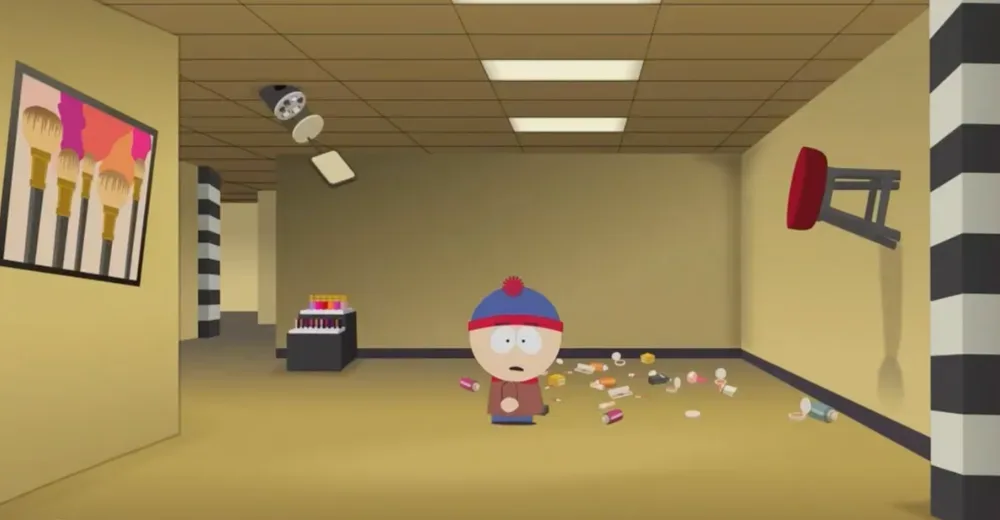
Stan’s dad also gets pulled into the beauty-product premise, shrinking himself with an item from Sephora. Meanwhile, a Sephora location overrun by the town’s kids becomes the route into a “Backroom,” and Stan’s prior trip into that space makes him the person who knows how to guide Cartman and Ike out. The episode’s pieces are deliberately mismatched: an online-era beauty competition, retail-brand parody, horror-internet imagery and a rushed effort to make it back for a school stream. That collision is the joke.
Ike’s aura battle is the episode’s real arena
Ike is scheduled to battle Chad, with the contest presented as a livestreamed test of social presence. Kyle identifies the problem early when he calls aura battling and looksmaxxing a bad combination. That concern distinguishes him from Cartman, who sees the situation less as something to question than an opportunity to help Ike win.
For more context, explore Lanterns Season 2 Is Still Undecided as DC Weighs a Story Worth Continuing.
The episode uses a cluster of online slang that is familiar in short-form video, memes and status-driven online communities. The words are not treated as a stable or carefully defined language; their instability is part of what makes them useful comic material. In broad terms, the episode’s vocabulary includes:
- Aura: an informal way of describing a person’s perceived coolness, confidence or social presence.
- Aura battle: a face-off in which that perceived presence becomes a contest, here formalized into a livestreamed school event.
- Looksmaxxing: an online term for attempting to optimize one’s physical appearance, often through grooming, styling or products.
- Mogging: slang for seeming to outclass or overshadow someone else in appearance or presentation.
- Mewing: another piece of internet appearance jargon invoked alongside the rest of the episode’s terminology.
- Chad, cringe and rizz: shorthand respectively associated with an idealized confident man, embarrassment or social awkwardness, and personal charm.
Putting all of those terms in the mouths and ambitions of children turns them into a kind of competitive rulebook. The humor is not simply that the language is current. It is that the language can make image management sound like a discipline with strategies, equipment and winners. Ike’s predicament takes the diffuse pressure of being judged online and gives it a literal opponent, a scheduled broadcast and an anxious older brother.
Cartman’s role sharpens that satire. He comforts Ike by suggesting Kyle may want to help deep down but does not know how. The sentiment is unexpectedly tender on its surface, particularly coming from Cartman, and it quickly becomes the foundation for his makeover mission. He effectively treats the aura battle as something Ike can prepare for by acquiring the right products. South Park has long found comedy in characters taking a flimsy social trend with absolute seriousness, and Cartman’s certainty is what lets the premise grow far beyond a normal sibling disagreement.
Why Sephora and the Backroom belong in the same plot
The beauty-store setting does more than provide a place to shop. In the episode, it has been taken over by South America’s kids, positioning the store as a hub for an increasingly intense youth culture of presentation. Cartman and Ike head there for items meant to improve Ike’s prospects against Chad. Instead, they are drawn into the Backroom.
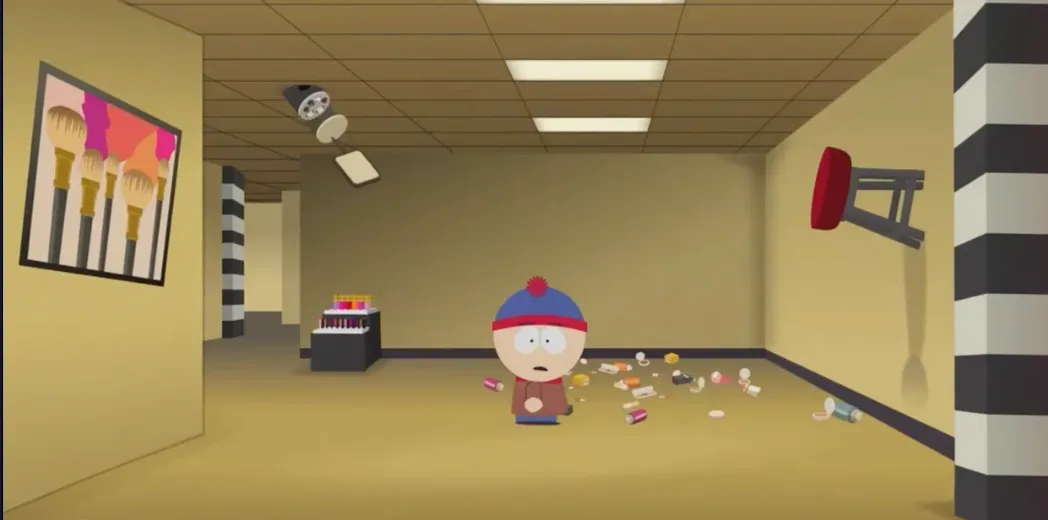
“Backrooms” imagery has become a recognizable kind of internet horror: ordinary or commercial-looking spaces become unsettling when they appear empty, endless, inaccessible or governed by unclear rules. Here, the Backroom is described with imagery reminiscent of Kane Parsons’ horror film. The reference gives the sequence a specific cultural texture while preserving the episode’s broader gag: retail space and nightmare maze are only a few steps apart.
This is an effective fit for the beauty-store storyline because both sides of the plot involve an environment that seems to promise transformation. Ike and Cartman enter expecting a straightforward way to improve his public image. Instead, they find themselves lost in a space where the normal logic of shopping no longer applies. Stan’s earlier accidental journey matters because it turns him into the group’s practical guide when they need to escape before the battle begins.
Stan’s dad shrinking himself with Sephora product pushes the same premise into physical absurdity. Rather than merely arguing that beauty culture makes people feel smaller or more insecure, the episode literalizes the result. It is a compact example of the show’s preferred method: take a metaphor embedded in a trend and make it a plot event.
Season 29 is moving between targets instead of staying on one
“You Like That On Your Face” is also notable for what it does not include. The episode is Trump-less. That is a contrast with the prior season, in which the president was central to the show’s most outlandish storylines. So far, Season 29 has mentioned Trump more briefly while putting its energy into other subjects.
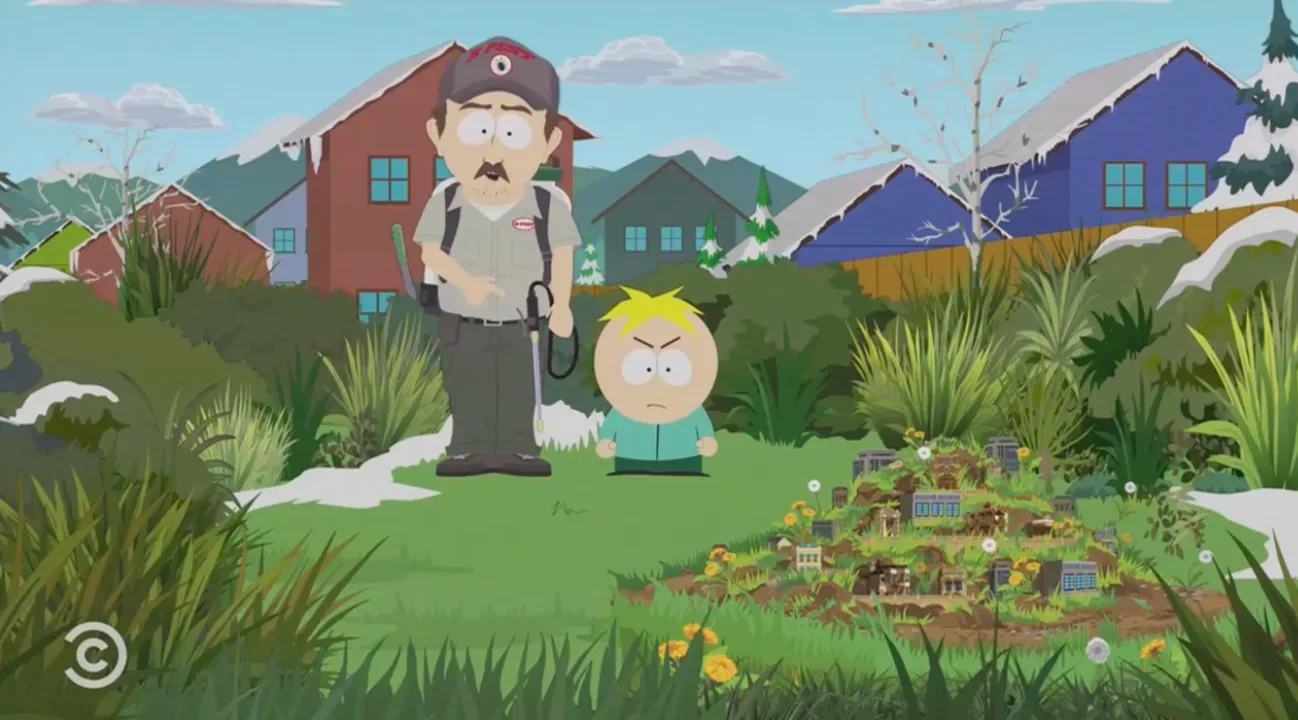
The first three episodes point to a broad, fast-changing set of targets. The season premiere focused on Cartman, Stan, Kyle and Kenny embracing e-bikes. Episode 2 followed Butters as he tried to remove “billionaire weenies” from South America—literal penises connected to data centers affecting the area’s electricity. That episode also targeted anti-vaccine rhetoric through Butters’ parents, who blamed his views on billionaires and AI on a measles vaccine rather than engaging with what he was saying.
Episode 3 moves from infrastructure, AI and misinformation to status anxiety and online-coded self-presentation. The subjects differ, but the format is consistent. Each story begins with a cultural irritant or recognizable phrase, then treats it as a civic emergency in the town. A data-center complaint becomes a grotesque physical invasion. An appearance trend becomes an organized combat sport. This is less a promise that the show has a single Season 29 thesis than evidence that it is willing to treat each week’s obsession as its own miniature disaster movie.
That approach also makes the new “South America” name part of the season’s ongoing framing rather than a one-off gag. The change was announced ahead of the Season 29 premiere, and the show is proceeding with it. The premiere was the first episode under the new name and reached 4.2 million viewers over three days. By Episode 3, the renamed town is not merely the backdrop for a title-card joke; it is the place where a Sephora can become an arena for children pursuing a highly online idea of social value.
The practical joke: performance has become the activity
There is an important distinction in the episode between looking good, feeling good and being judged in public. The aura battle collapses all three. Ike is not simply trying a new style or buying something from a beauty retailer. He is preparing to appear in a livestreamed confrontation where appearance is framed as proof of status. The “battle” language makes social approval feel measurable and adversarial.
That is why Kyle’s unease matters even if Cartman provides the practical assistance. Kyle recognizes the trap in accepting looksmaxxing as the answer to Ike’s problem. Cartman, conversely, accepts the contest’s premise immediately and focuses on optimization. Neither response can be separated from the episode’s exaggeration, but they give the plot its tension: one brother sees a harmful combination, while Cartman sees a winnable challenge.
For viewers following the season, the episode also suggests that South Park is using online language less as a glossary of trends than as a set of props with which to build an absurd situation. “Aura,” “rizz,” “mogging” and similar words work because they can sound both oddly grand and oddly hollow once they are repeated around adults, retail shelves and a livestreamed school rivalry. The show does not need to settle their meanings permanently; it needs the characters to behave as though every term carries immediate, life-altering stakes.
The Backroom detour gives that idea a visual form. The effort to manufacture a winning image sends the characters somewhere detached from ordinary reality, while the deadline of Ike’s battle keeps the absurdity moving. A small social-performance problem becomes a mission involving a maze, a rescue and last-minute preparation. That escalation is the episode’s clearest comic promise.
For another look at the episode’s Ike-centered premise, read this coverage of the aura battle storyline.
What Episode 3 establishes for the renamed town
Three episodes into Season 29, South America is functioning as a place where digital habits, consumer products and conspiracy-adjacent thinking can quickly become collective crises. The premiere’s e-bikes, Episode 2’s data-center and anti-vaccine plot, and Episode 3’s aura battle all work from the same exaggeration principle: people encounter a contemporary fixation and immediately grant it enormous social power.
“You Like That On Your Face” uses Ike’s vulnerability to make that pattern more pointed. He is the child facing the contest, but the surrounding characters are the ones who inflate it—through anxiety, product-driven advice and a bizarre detour into horror imagery. Cartman’s apparent kindness, Kyle’s doubts and Stan’s useful prior experience in the Backroom ensure that the plot has more moving parts than a simple makeover gag.
The final effect is a satire of an environment in which being watched can turn personal grooming into competition and competition into a public identity test. South Park’s answer is not subtle: send the kids into Sephora, make the store portal into a nightmare space, shrink an adult, and make everybody scramble to return in time for a livestream. For Season 29, that is the operating logic of South America.