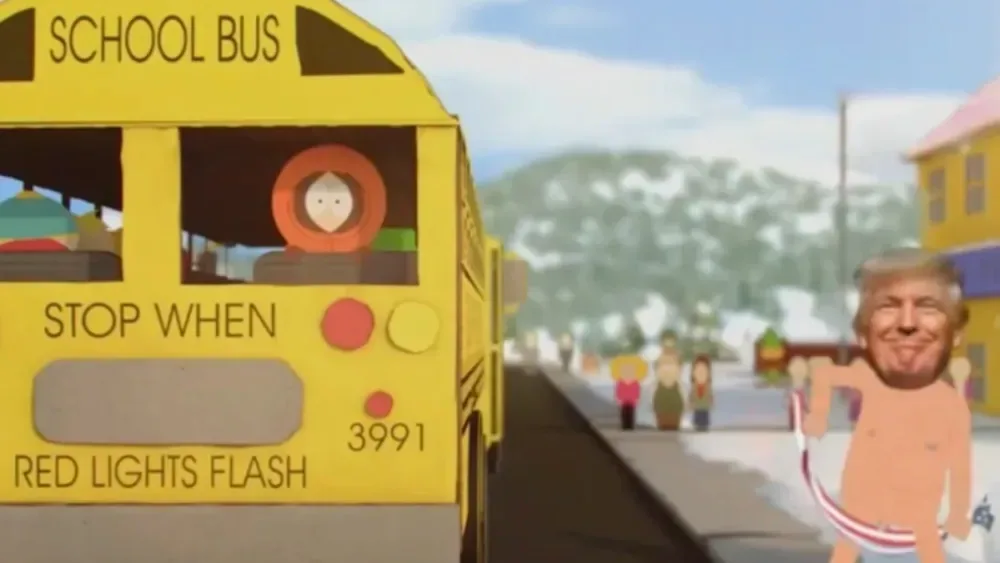
Season 29 of South Park arrives with a deliberately incorrect new identity: “South America.” The premiere, “South American Biker Gangs,” treats the name swap not as a stray promotional gag but as the opening premise. Its revised theme lyric announces, “I’m goin’ down to South America, have myself a time!” before the episode moves on to e-bikes, an adult biker-gang response, an appearance by Donald Trump and a familiar terrible outcome for Kenny.
That is a very compact statement of intent. The town’s supposedly new name is not meant to make geographic sense. It is satire built around the power of a label: change the words on the sign, repeat them with enough official-sounding confidence, put them in an anthem, and suddenly everyone is expected to act as if the altered name has always been natural.
The premiere’s story is more grounded in its immediate comic machinery. Cartman, Stan, Kyle and Kenny become enthusiastic e-bike riders. Their motorized bikes carry the kids into the streets, prompting the adults of “South America” to organize an opposing biker gang. When Kenny’s e-bike explodes and kills him, the town unifies around a quick civic reaction: e-bikes are outlawed, and “South America Strong” shirts go on sale.
A fake rebrand becomes the episode’s first joke
Trey Parker and Matt Stone had previously said that the long-running animated comedy would henceforth be called “South America.” Their statement framed the decision as being inspired by the “bravery and patriotism” of Apple and Google, while also referring to Paramount as “Skydance Capitulation.” The language is plainly satirical, and the premiere’s new theme song turns that announcement into an on-screen running bit rather than leaving it as an outside-the-show stunt.
The target is a cluster of renaming disputes attributed to Trump: Lake Ontario becoming Lake America, New Mexico becoming New America and the Gulf of Mexico becoming the Gulf of America. In that context, “South America” is designed as an escalation. It takes a familiar place name, replaces it with something grander and much less sensible, then asks the audience to accept the replacement at face value.
That distinction matters because a satirical rebrand is not a genuine format change. The series remains South Park; “South America” is the joke being performed by the title, the town and now the song. By repeating the substitution in prominent places, the show is parodying the way names can be made to feel authoritative through repetition, institutional adoption and branding.
E-bikes, biker gangs and a compressed panic cycle
Once the altered theme has set the tone, “South American Biker Gangs” narrows its attention to the children’s e-bike obsession and the parents’ backlash. An e-bike, short for electric bicycle, is a bicycle with motorized assistance. The episode’s premise specifically identifies the children’s vehicles as motorized bikes, making their use in the streets the spark for the conflict.
The parents’ answer is intentionally disproportionate: they form their own biker gang in opposition. The setup makes the generation gap visible in a single image. Children gain a new way to travel; adults respond not merely with household rules or debate, but with a performative, organized counterculture of their own. The premise lets the show contrast kid-level enthusiasm with grown-up escalation.
Related coverage includes ‘South Park’ Season 29 Opens as ‘South America’ With E-Bikes, Biker Gangs and Trump.
Kenny’s death then supplies the event around which the town can rally. The character’s e-bike explodes, killing him. The response is a package deal: a ban on e-bikes and “South America Strong” T-shirts. The joke is not only that officials act quickly after a disaster, but that grief, regulation and merchandise arrive together. In this story, a public tragedy produces both a prohibition and a slogan that can be printed and sold.
That is a recognizable satirical panic cycle: an emerging behavior or technology becomes alarming, a vivid incident consolidates the fear, and a simplified public response follows. The episode does not need to argue that this is how every real policy decision works. It instead uses a fast, extreme version of the sequence to make the incentives and emotional theater easy to see.
What the title is doing
“South American Biker Gangs” carries two separate comic ideas. First, it turns the town’s temporary name into an adjective, making the rebrand sound even more official. Second, it applies biker-gang imagery to a feud centered on e-bikes and parents. The mismatch is central to the setup: motorized bicycles and children’s recreation are inflated into the vocabulary of territorial gang conflict.
The title also signals that the renamed-town gag will not be quarantined to a single opening-card joke. If the community is now called “South America,” then its civic conflicts, shirts and biker gangs must apparently inherit that terminology too. That total commitment to a knowingly absurd premise is what gives the name change room to work over a full episode.
Trump remains part of the show’s political frame
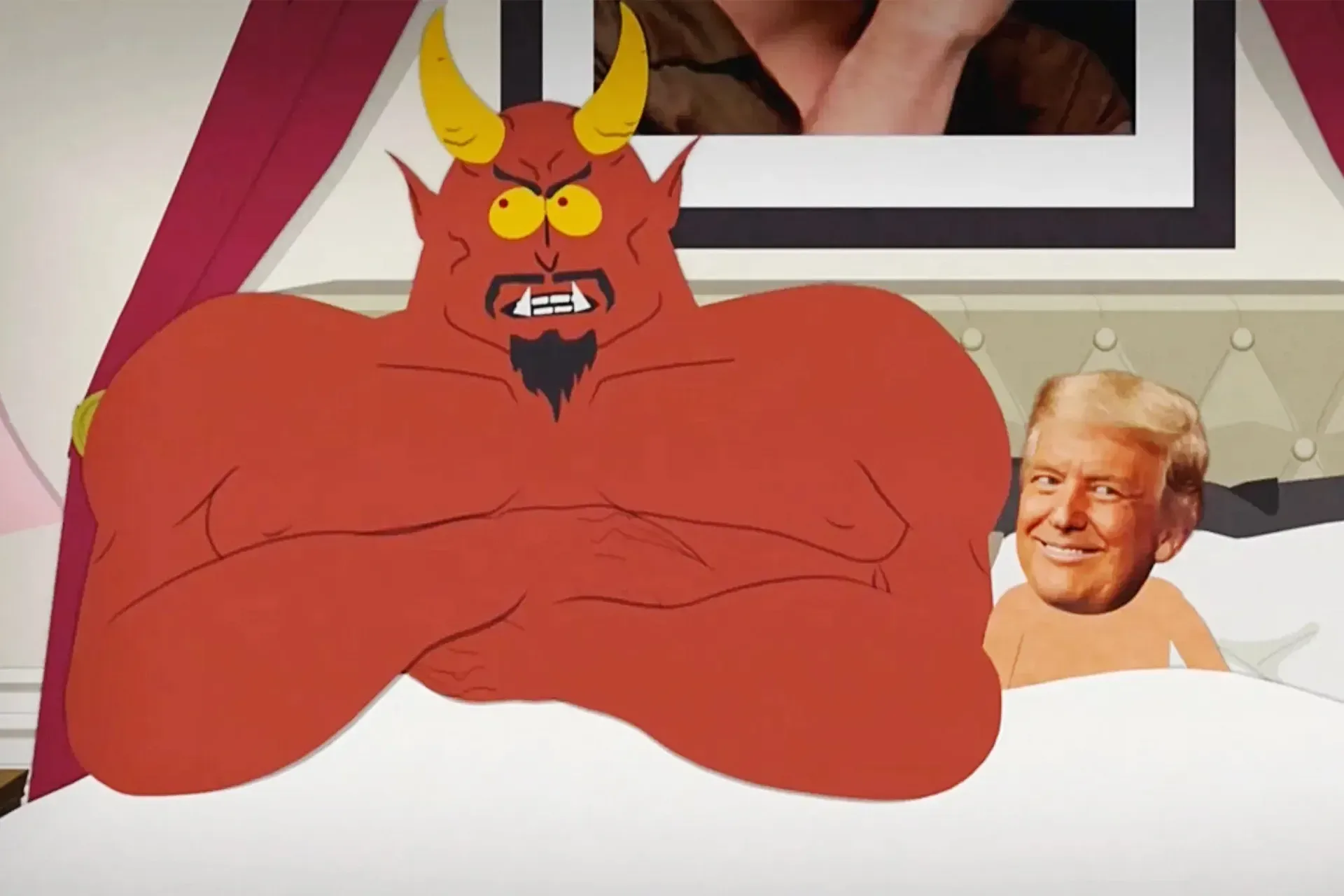
The Season 29 opener includes a Trump cameo, extending the political focus that defined Season 28. Earlier episodes in that run used stories involving JD Vance, Trump, Satan, Pete Hegseth and Peter Thiel. The new premiere does not abandon that mode in favor of a purely local e-bike plot; it places a Trump appearance alongside the rebrand and the town’s reactionary biker-gang story.
Political satire is most effective here when understood as a method rather than a claim of neutrality or realism. The series uses exaggeration, taboo and deliberately ridiculous literalization. A name-change debate becomes an entire town renamed after a continent. A disagreement over kids’ electric transport turns into a biker-gang standoff. The plot’s comedy comes from making each cultural gesture bigger, more ceremonial and more marketable than it could plausibly be.
The show’s renewed emphasis on Trump follows its 2026 Creative Arts Emmy win for outstanding animated program. Its official X account marked the award with a graphic depicting Trump with his pants and underwear around his ankles. Together with the Season 29 premiere’s rebrand joke and cameo, that image indicates that the series’ political material is continuing across both the episodes and its public-facing comedy.
The useful takeaway: the premise is about language as much as bikes
It would be easy to describe “South American Biker Gangs” simply as an episode about e-bikes. That is the vehicle for the story, but the renamed town is its first and broadest satirical move. The premiere pairs two examples of public overreaction: a place name is treated as mutable through forceful repetition, and an accident becomes grounds for an immediate ban and a branded civic campaign.
Both ideas hinge on language. “South America” is a label repeated until its absurdity becomes the point. “South America Strong” is a slogan that turns communal feeling into a product. “Biker gang” recasts parents and electric-bike-riding kids as rival factions. The episode’s words constantly enlarge the situation before the plot has even finished escalating it.
For viewers following the business backdrop around the show, the Paramount reference in Parker and Stone’s statement also lands during a period of broader uncertainty around the company. Paramount’s wider corporate situation has itself been the subject of ongoing scrutiny, which gives the “Skydance Capitulation” phrasing an additional industry-facing sting. The episode details, however, keep the immediate focus squarely on the fictional town, its new fake name and its latest overblown emergency.
In practical terms, the premiere establishes a few clear expectations for Season 29. The “South America” designation has crossed from an advance joke into the show’s text through the theme song and episode title. Trump continues to be present in the series’ political satire. And the core quartet—Cartman, Stan, Kyle and Kenny—remain the entry point for a story that spins youthful enthusiasm into a community-wide spectacle.
Most importantly, Kenny’s exploding e-bike provides the kind of sharp reset the series is built to exploit. A trend becomes a crisis; a crisis becomes a ban; a ban becomes apparel. The premiere’s renamed setting ensures that every step carries one more layer of absurdity: the town is trying to look unified and resolute while calling itself something it plainly is not.