South Park is continuing to operate under its newly adopted South America banner in Season 29, and its second episode trains its fire on billionaire power, data centers, artificial-intelligence anxiety, anti-vaccine rhetoric and the urge of wealthy public figures to argue loudly in public.
The episode’s engine is Butters, whose ordinary need to watch Dr. Pimple Popper becomes a wildly disproportionate civic grievance. In the story, data centers built in his backyard repeatedly disrupt the electricity powering his television. Butters concludes that billionaires are consuming local resources while residents are left with the consequences, then launches a campaign to remove what he calls “billionaire weenies.” The show, naturally, makes that phrasing literal: the billionaires are depicted as penises.
That is the key move in the episode’s satire. It does not approach an argument about infrastructure, immense computing facilities or billionaire influence as a sober policy discussion. Instead, it reduces a complicated, emotionally charged set of concerns to a gross visual pun and lets the town react to that absurdity. The result is a plot that can skewer frustration with powerful people while also ridiculing the public language and media habits surrounding the frustration.
Butters’ outage becomes a bigger complaint
Butters begins with a concrete, personal annoyance: he cannot reliably watch the program he uses to unwind because the power keeps cutting out. From there, he assigns responsibility to the data centers and the billionaires behind them. His complaint is framed in broad terms—wealthy builders taking resources and leaving everyone else with less—rather than as a technical explanation of electrical systems or data-center development.
That distinction matters. A data center is, in general terms, a facility housing computing equipment used to store, process or distribute digital information. In the episode, “data center” functions less as an engineering subject than as a symbol for an enormous modern system that has suddenly entered the characters’ physical surroundings. It is something opaque, resource-intensive and connected to the current AI boom, making it a perfect object for Butters’ blunt anger.
The comedic escalation also keeps the show from presenting Butters as a straightforward spokesperson. His immediate stake is not a community planning dispute, an energy bill or a public meeting. It is uninterrupted access to pimple-popping videos. That tiny motivation is intentionally at odds with the scale of the rhetoric that follows, a familiar setup for a series that tends to make sincere outrage and ridiculous self-interest arrive together.
AI worries and vaccine misinformation collide at home
The episode broadens its target when Butters’ parents attempt to explain his anti-billionaire and anti-AI outlook. Rather than engage with what he is saying, they turn their disagreement into an argument about the measles vaccination he received to attend school. His father claims podcast listening gave him insight into what vaccination would do and treats Butters’ views as proof of a political transformation.
The scene links several strains of contemporary discourse: fear of AI, distrust of institutions, vaccination misinformation, podcast-driven certainty and the habit of treating politics as a diagnosis of one’s family members. The joke is not that there is an actual causal connection between a measles vaccine and Butters’ beliefs. The joke is that the adults seize on an unsupported explanation because it fits their preexisting argument.
By putting this exchange in a domestic fight, the episode emphasizes how broad political labels can consume a situation before anyone gets to the smaller fact at its center. Butters is upset about his TV power cuts. His parents transform that complaint into a culture-war crisis, complete with accusations that one parent failed to listen to enough podcasts. It is an intentionally irrational chain of reasoning, and that irrationality is the point.
The show’s willingness to poke at how comedy intersects with political identity is part of a larger entertainment conversation, including debates about whether performers can keep a clean boundary between the two. That tension has also surfaced in recent discussions of comedy and politics, though South Park takes the opposite route here: the political argument is inseparable from the gag.
The billionaire characters fear attention, not accountability
Inside the literal billionaire colony, the episode flips perspective. The wealthy “weenies” are not primarily worried about whether the public’s criticism is justified. They are worried about becoming too conspicuous. Their leader warns that their growing numbers could start to irritate people and argues for avoiding attention.
This is where the episode’s attacks on podcast culture and celebrity feuds enter the story. The billionaire group is alarmed when members become public-facing, including appearances on Joe Rogan’s podcast and arguments with Mark Ruffalo. When Butters calls an exterminator, the exterminator describes this as a new breed of billionaire that likes podcast appearances and public disputes with celebrities.
The joke is built on a contrast: these characters supposedly possess immense wealth and influence, yet they cannot resist the smaller reward of visibility. Their problem is not a lack of access to public platforms. It is an inability to stay off them. In the episode’s logic, a discreet billionaire is strategically safer, while a billionaire who constantly posts, podcasts or picks fights gives critics an easy target.
That idea becomes even sharper when the group decides to buy the local news media to improve its public image. The action is presented not as a shocking revelation but as a routine item on a billionaire’s checklist. The show’s satirical premise is that money can purchase a megaphone, but it cannot stop a reckless member of the group from creating a fresh public-relations problem.
A Macklemore reference gives the satire a specific target
One billionaire’s public argument with Macklemore becomes a particular source of irritation for the group’s leader, who complains that the effort to make billionaires seem more likable has been undermined by somebody deciding the rapper needed a talking-to. The joke refers to Robert Kraft, the New England Patriots owner, after headlines earlier in the month concerning what amounted to a ban on Macklemore performing at a number of stadiums on his tour with Ed Sheeran.
Rather than replay the underlying dispute in detail, the episode uses the reference as evidence of its larger point: wealthy figures attempting to control their reputations can be defeated by their own urge to enter culture-war arguments. The billionaire leader’s exasperation is funny because the character understands optics perfectly well but cannot enforce restraint among fellow billionaires.
There is also a structural joke at work. The show depicts the characters as literal penises, then has them pursue increasingly recognizable corporate reputation-management tactics: minimize unwanted attention, shape favorable coverage and contain embarrassing public behavior. The visual is crude; the behavior is calculated. Putting those elements together is what turns a throwaway insult into the episode’s central metaphor.
Trump returns at the episode’s end
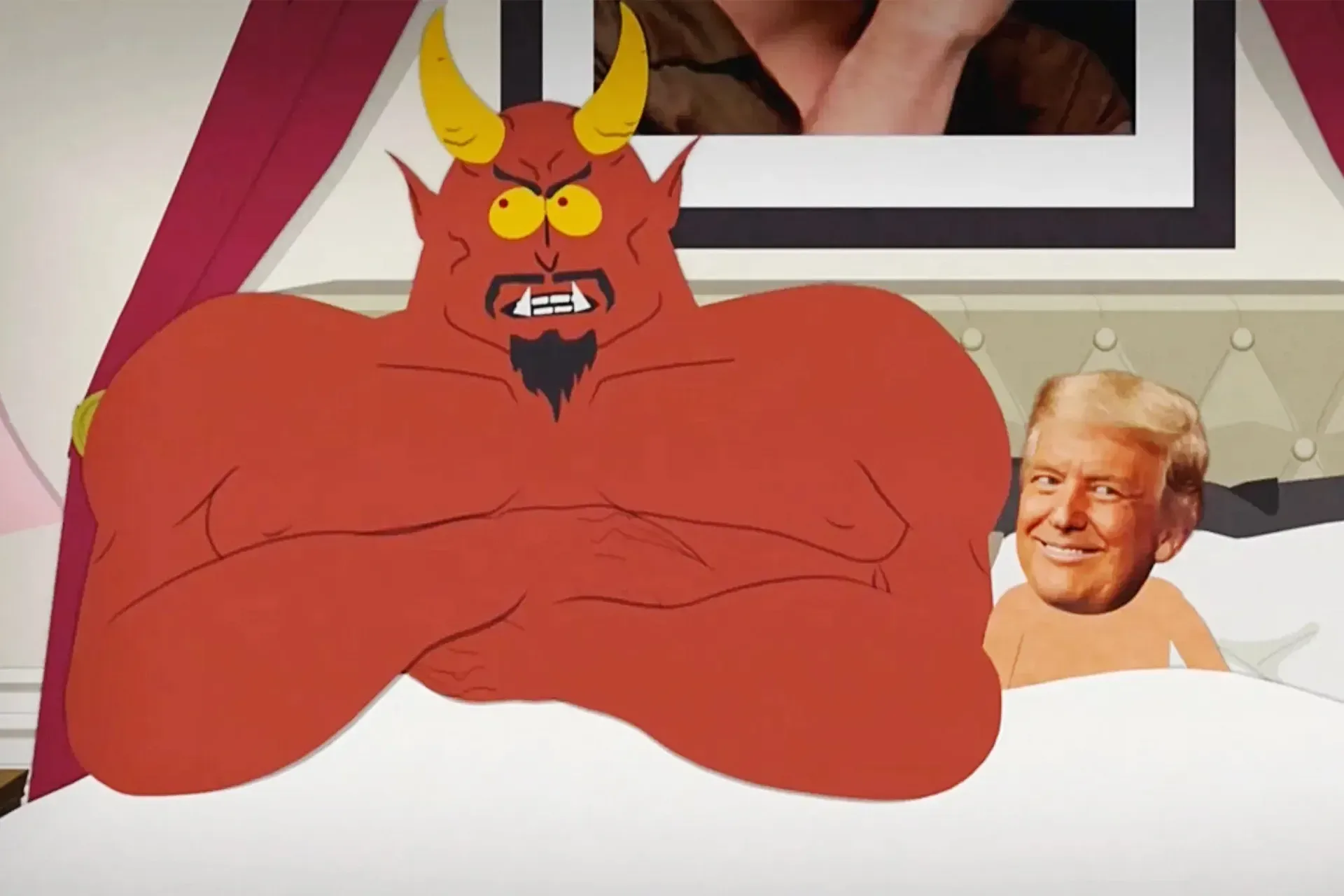
Donald Trump appears at the end of the episode, continuing the season’s use of the president as a recurring target. While sitting down to use the bathroom and listening to recordings of his own speeches, Trump’s own billionaire “weenie” flies from his unzipped pants.
It is a brief scene, but it connects the episode’s various threads. Trump is not inserted to deliver a separate policy debate or to resolve Butters’ campaign. He is folded into the same visual device used for the fictional billionaire settlement, making the final beat a compact extension of the episode’s larger mockery of status, ego and public spectacle.
Why the ‘South America’ title remains part of the joke
The second episode also suggests that creators Trey Parker and Matt Stone are committed to the South America name change announced ahead of the Season 29 premiere. The renamed title is itself a parody of Trump’s recent moves to rename locations, including Lake Ontario as Lake America, New Mexico as New America and the Gulf of Mexico as the Gulf of America.
That framing lets the series turn its own branding into part of its satire. A long-running show changing its familiar name would ordinarily be treated as a major identity shift. Here, the change is a deliberately flimsy gag: the title becomes another item in a universe where renaming something is treated as a theatrical assertion of power.
The first episode released under the South America name reached 4.2 million viewers across its first three days. With the second installment, the season is signaling a format of rapid-response satire: taking recognizable arguments about AI infrastructure, vaccine misinformation, billionaire influence, media ownership and celebrity disputes, then pushing them into an intentionally grotesque cartoon premise.
Whether viewers agree with every target is separate from the episode’s basic strategy. It does not offer a neat political position on data centers or a carefully reasoned hierarchy of villains. It makes Butters’ electricity problem the spark, turns billionaires into an anatomical insult, lets adults repeat bad information with confidence and portrays reputation management as futile when the people seeking it cannot stop demanding attention. That is the episode’s actual through line: in a media environment built around outrage and exposure, everybody wants control of the story—and almost nobody can resist making it worse.