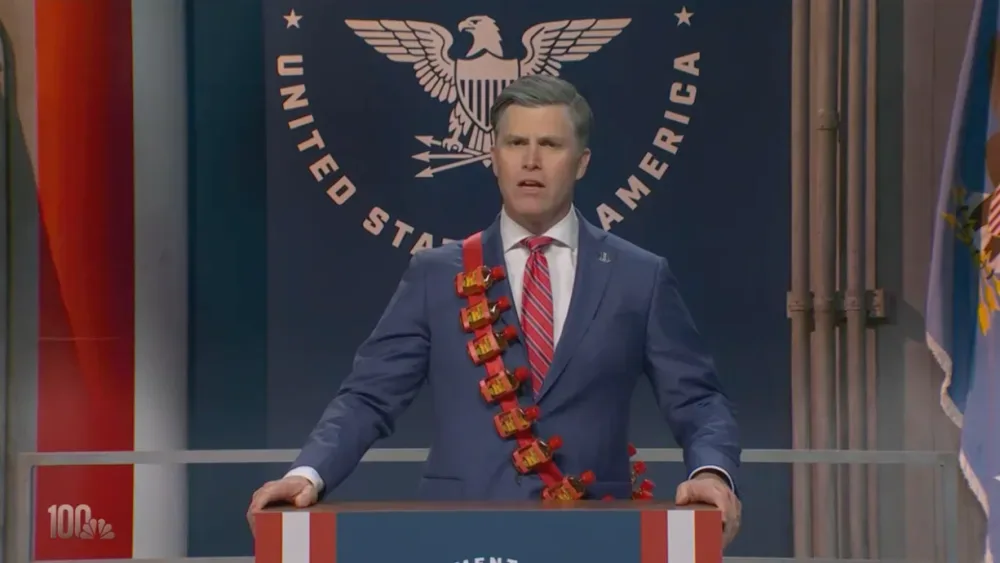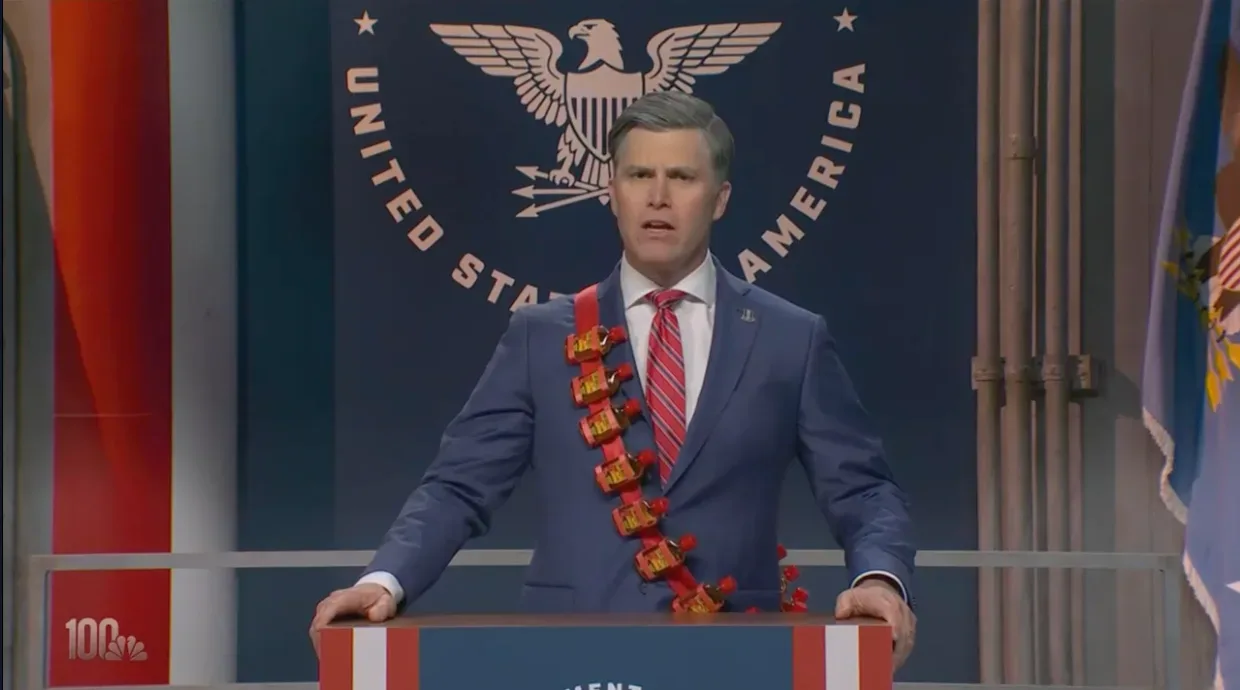
Saturday Night Live opened its Oct. 10 episode by turning a military homecoming into an intentionally uncomfortable pep rally. Colin Jost returned as Pete Hegseth to greet sailors from the USS Abraham Lincoln, playing the defense secretary as a loud, dismissive official who converts every sign of strain into a brag and every question into a worse answer.
The premise is direct: before the returning sailors can reunite with their families, they must listen to the person presented as responsible for sending them away. That setup gives the sketch a clear comic engine. The sailors state a plain problem; Jost’s Hegseth either misunderstands it on purpose, celebrates it as proof of toughness, or pivots to an even more bizarre piece of supposed news from ashore.
It is a cold open with a notably grim real-world foundation. The USS Abraham Lincoln returned to San Diego two days earlier after a 322-day deployment tied to the U.S. war with Iran. The carrier reportedly spent more than 260 consecutive days at sea without a port call. Reports cited supply shortages, broken plumbing and eight suicide attempts among crew members. The show uses those circumstances not as a throwaway detail, but as the central pressure point of the scene.
A welcome home that refuses to hear the sailors
Jost enters wearing an ammunition belt loaded with miniature bottles of Fireball Cinnamon Whisky, immediately establishing the character’s reckless, frat-house version of martial swagger. The costume gag is doing more than decorating the impersonation: this Hegseth treats professionalism, care and basic dignity as obstacles to be laughed away.
His first exchange with the sailors lays out the pattern. Asked how they are doing, they answer that they are bad. He declares that he heard “awesome.” The laugh is rooted in the bluntness of the reversal, but the construction matters. The sailors’ perspective is not debated or refuted; it is simply overwritten by the official at the microphone.
That dynamic sharpens when the material reaches the deployment’s reported conditions. Jost’s character congratulates the crew for thousands of combat missions, no casualties and no flight mishaps, then folds the lack of functioning toilets into the same list of accomplishments. It is deliberately warped management-speak: measurable operational outcomes are treated as the only outcomes that count, while the people who made those outcomes possible are reduced to background equipment.
The sketch also references the reported mental-health crisis. Its joke is not that sailor well-being is funny. Its target is the Hegseth character’s monstrous inability to recognize a crisis even when it is named directly in front of him. That is a difficult area for satire, and the scene’s choice is to make the official’s callousness—not the sailors—the object of ridicule.
One sailor is singled out as supposedly heroic for enduring hundreds of days without using a bathroom rather than complaining about broken facilities. When he asks whether he can finally go, Hegseth points him toward a Starbucks several blocks away. The absurdity comes from the bureaucratic non-solution: a problem created and sustained onboard is answered with an irrelevant errand offsite.
Related coverage includes ‘SNL’ Cold Open Sends Colin Jost’s Hegseth to USS Abraham Lincoln Homecoming.
Why the deployment context changes the sketch
A port call is a ship’s stop in port, typically allowing opportunities for resupply, maintenance and, depending on circumstances, crew time ashore. In the context of the reported 260-plus days without one, the phrase conveys more than a scheduling statistic. It helps explain why shortages and failed facilities would loom so large in the sailors’ imagined testimony.
The show’s term “Operation Hell Cruise” is fictional within the sketch. It is a satirical label, not the reported name of the deployment. Calling attention to that distinction matters because the cold open intentionally blends real conditions with invented official slogans, invented policy updates and character exaggeration. Its comedy depends on that collision.
The real deployment details provide the scene’s stakes; the fictional Hegseth supplies its escalating nonsense. Rather than presenting a conventional homecoming with proud speeches and applause, the sketch imagines what happens when the person charged with leading ignores every warning sign. Each new response tells the audience that the character sees endurance as a resource to extract rather than a human cost to address.
That is why the working-toilet line lands as more than a gross-out joke. It is an attack on the tendency to celebrate mission success while refusing to account for whether the people completing the mission had workable living conditions. The gag is broad, but the underlying criticism is specific.
The cold open keeps widening its target
After establishing the sailors’ circumstances, Jost’s Hegseth begins updating them on events at home. Here the sketch moves into more openly surreal political satire. He mentions a fictional plan for a televised execution, treats its outcome as entertainment programming, and pivots to influencer-boxer Jake Paul as an imagined contingency. The joke is structured as escalation: public policy is reduced to spectacle, then spectacle is reduced further into fight-card logic.
The scene takes a similar route with a newly unveiled Department of War eagle logo. A sailor asks whether it resembles Nazi imagery; Hegseth responds that it is an American eagle with a Nazi “vibe.” This is not presented as a real branding explanation. It is an intentionally indefensible response designed to show the character’s instinct to normalize the alarming rather than confront it.
That progression is central to the cold open’s pacing. It begins with an official ignoring a simple expression of distress. It advances through broken plumbing and a disastrous pseudo-homecoming. Then it expands outward into a version of national leadership in which cruelty, branding and television spectacle have become interchangeable.
In that sense, the sailors are not merely an audience inside the sketch. They are witnesses trapped at the podium while the official tells them their sacrifice is valuable mainly because it can be turned into a victory lap. Their increasingly weary reactions give the scene its anchor, even as the dialogue grows more cartoonish.
James Austin Johnson’s RFK Jr. brings another layer of institutional chaos
James Austin Johnson then arrives as Robert F. Kennedy Jr., extending the cold open’s portrait of a government unable to communicate basic competence. Johnson’s Kennedy announces that the country is healthier than ever, only to rename cold and flu season with a sprawling list of illnesses. The contradiction is the gag: the declaration of success is immediately undone by the details.
His comments about recalled meat and unusual “valuable proteins” push the sketch’s food-safety material into absurd territory before he claims the sailors themselves were used for testing. Like “Operation Hell Cruise,” that experiment is a fictional element of the bit. But it keeps the writing attached to the same satirical idea: people exposed to hardship are treated as data points for someone else’s triumphant presentation.
Johnson’s impression is also useful structurally. Jost’s Hegseth is booming, physically rowdy and aggressively pleased with himself. Kennedy’s contribution is more rambling and detached. Putting them together gives the scene two distinct forms of indifference: one loudly reframes suffering as strength, while the other calmly buries it in strange wellness language.
Jost’s Hegseth is becoming a recurring cold-open weapon
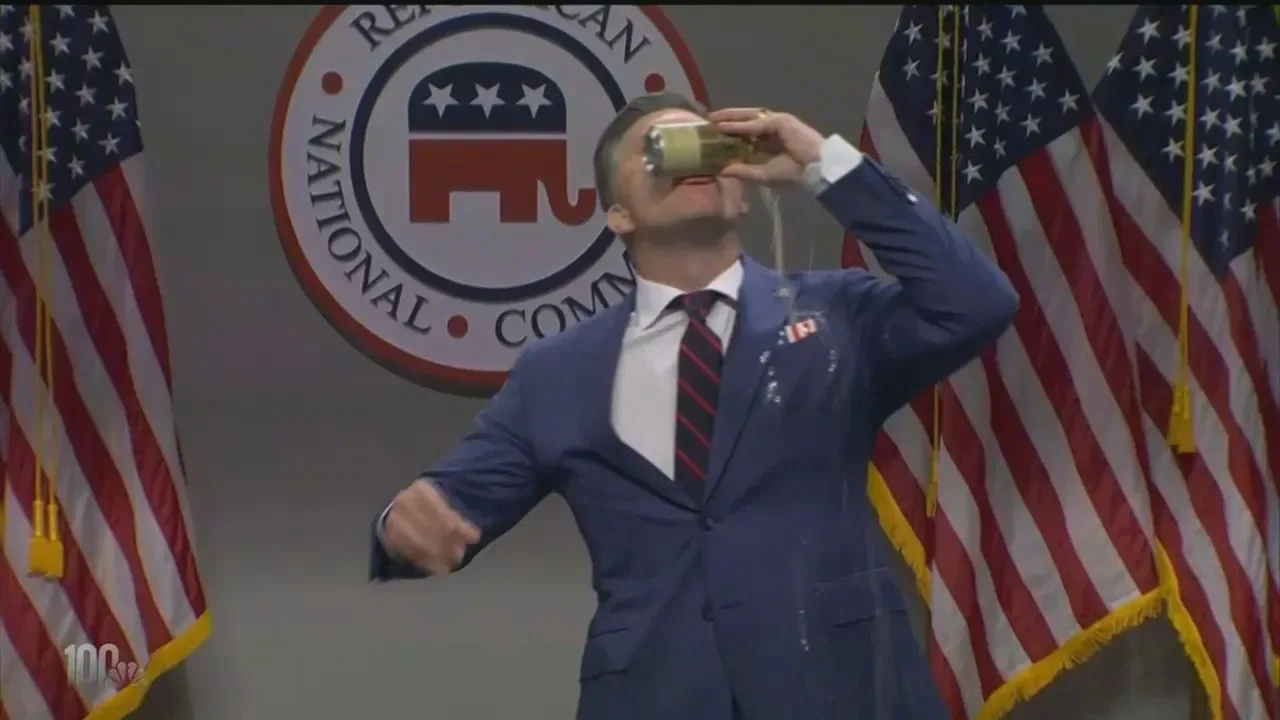
This is Jost’s second consecutive cold-open appearance as Hegseth. The prior week’s sketch had him drinking Tom Holland’s non-alcoholic Bero beer while joining other Republican officials trying to manufacture enthusiasm ahead of the November midterm elections.
The repeat appearance suggests that the show has found a broad comic lane for Jost’s version of the character: an official whose confidence becomes more glaring as the situation becomes more indefensible. In the USS Abraham Lincoln scene, that persona is deployed less as a one-note impression than as a delivery system for the episode’s largest concerns.
Its closing musical beat takes Linkin Park’s “In the End” and uses the refrain as a bleak farewell to the crew. Jost follows the song fragment with a crude personal aside about going down with the ship. The final joke is intentionally tasteless in character, consistent with an entire speech that treats sailors’ hardships as material for the speaker’s ego.
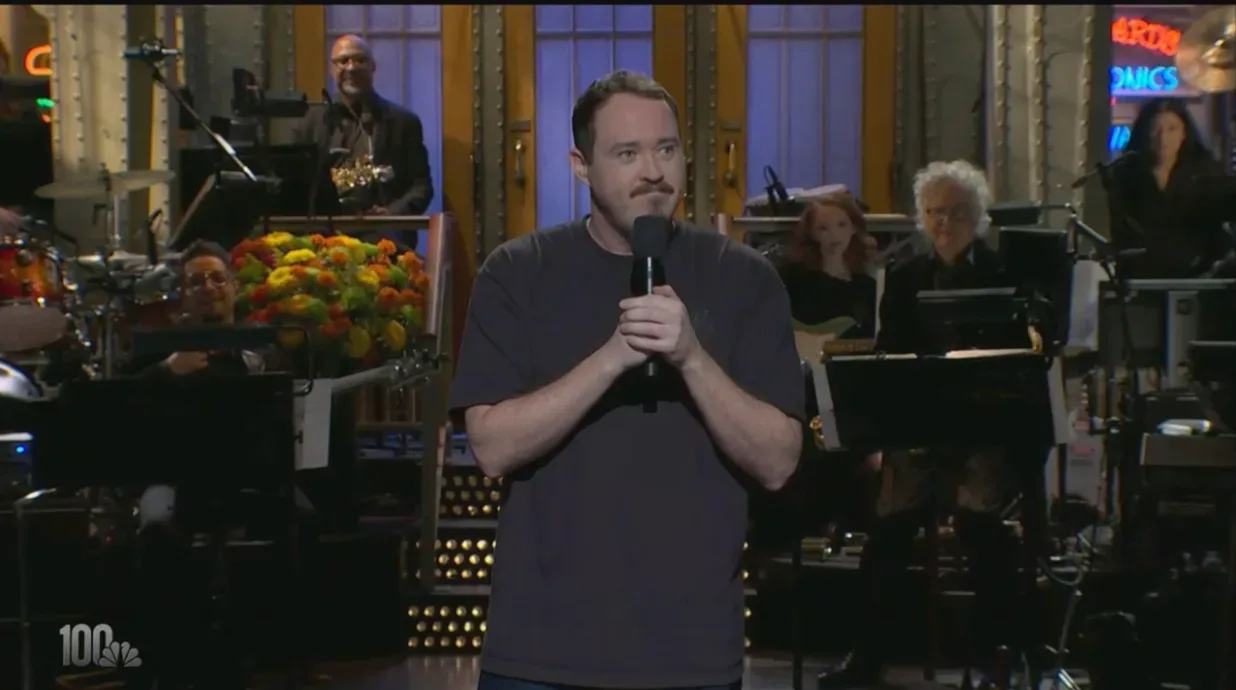
The episode is hosted by Shane Gillis, his third time hosting the series after he was fired as a cast member in 2019 over resurfaced racist and homophobic remarks. Rosalía serves as musical guest. For more on the unusual expectations surrounding Gillis’s return to the show, read our look at what the series appears to want from his third monologue.
What the sketch is actually arguing
The cold open’s most effective choice is that it does not ask viewers to admire the fictional Hegseth’s outrageousness. It asks them to sit with the gap between a ceremonial “welcome home” and the unaddressed conditions described by the sailors. The fancy dress of a public tribute—microphone, applause, military language, inspirational song—becomes a cover for evasion.
Satire often works through compression, putting multiple anxieties into a single room and raising each to an absurd level. This scene compresses extended deployment, reported shortages, broken ship infrastructure, mental-health strain, political messaging, public spectacle and institutional mistrust into one speech. Not every element is meant to be read literally. The force comes from the throughline: officials speaking confidently while everyone in front of them can see that confidence is disconnected from reality.
For a cold open that begins with a recognizable impersonation and an ammunition-belt gag, it ends up being unusually focused. Its recurring question is simple: what does praise mean if it arrives alongside denial? Jost’s Hegseth has an answer—louder praise, a worse joke and a song. The sailors’ silence and disbelief make clear how inadequate that answer is.