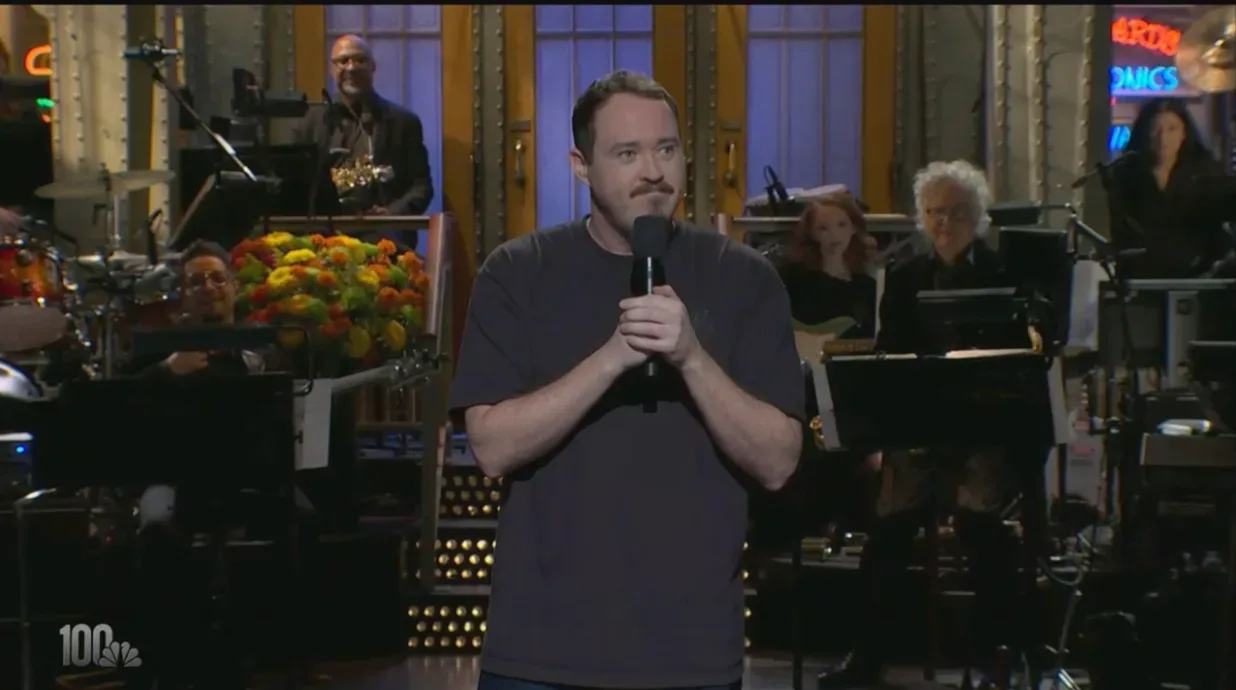
Shane Gillis’ third time hosting Saturday Night Live was supposed to have one major advantage: familiarity. The comedian is no longer an unknown performer whose name arrives with a built-in casting controversy. Since his brief and turbulent connection to the show began in 2019, he has built a larger profile through podcasting, stand-up specials, the Netflix comedy Tires, and an upcoming role in the biopic Madden.
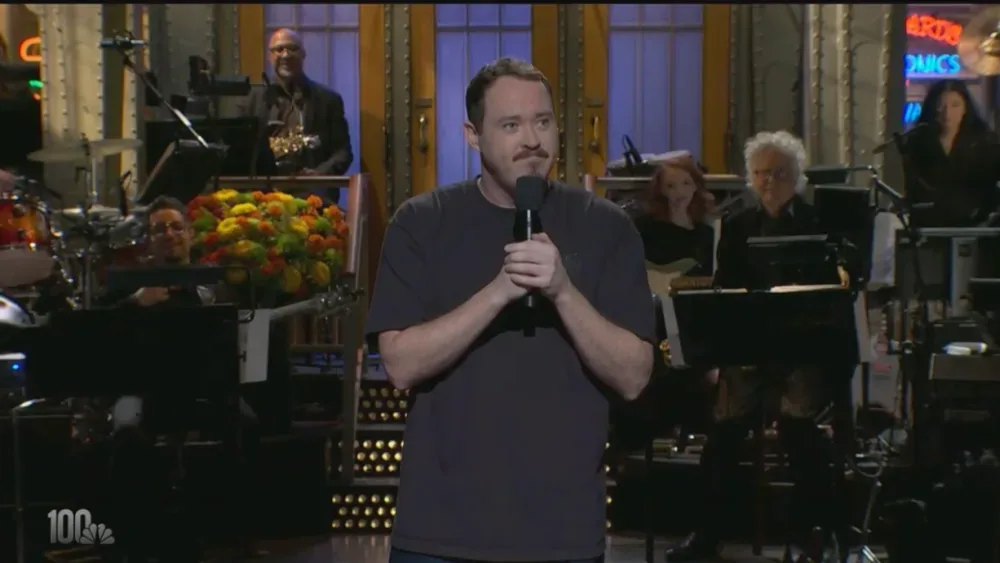
Yet the opening monologue once again made the relationship between Gillis, the studio audience and the institution of SNL feel unsettled. His set moved through weight, public gyms, hiking, his sisters’ insults and a receding hairline. The material was deliberately abrasive, with repeated gay jokes and a broad, demeaning description of women’s gym clothing. Reports from the studio describe groans during the segment and only scattered laughter by its closing lines.
That does not mean every viewer will react identically, nor does a quiet studio automatically settle whether a joke works. But an SNL monologue is an unusually exposed form of live comedy. There is no character costume, elaborate premise or edited pacing to create distance between the comedian and the audience. The opening is an immediate negotiation: the host establishes a voice, the room decides whether to follow, and every uneven beat becomes audible.
For Gillis, that negotiation remains particularly fraught. His comedy has found a substantial audience outside the show, while his appearances on the show carry an unavoidable history. That contrast helps explain why an ordinary uneven monologue can become a larger story when he is holding the microphone.
An opening built on discomfort, without a clear release
Gillis entered in a black T-shirt and black pants and began with material about needing to lose weight, misery and feeling unthreatening to women while hiking. The gym section positioned him as the embarrassed outsider among fit men, before turning toward women’s clothes and the social risk of staring. The later hairline material pivoted to a comparison with Adolf Hitler, landing on a crude either-or formulation involving being gay or resembling the Nazi leader.
Technically, the set uses a familiar stand-up mechanism: self-deprecation as a license to observe everyone else. Gillis starts by casting himself as physically outmatched, socially insecure and the object of ridicule from his family. In a stronger version of that structure, the comic’s humiliation creates enough goodwill for the audience to tolerate the escalation that follows. The comic looks foolish first; the larger target arrives second.
Here, the escalation appears to have worked against the set. The language about women’s clothes turns the observation away from the narrator’s own insecurity and toward a group being described from the outside. The hairline material similarly begins at Gillis’ expense, but ends in a forced provocation rather than a more precise punchline. A joke can be confrontational, offensive or uncomfortable and still earn a big response; the issue is not simply whether a topic is taboo. The practical problem is whether the audience can identify the target and recognize a turn in the premise that justifies the discomfort.
There was little indication in the reported room response that those turns arrived. The monologue ended abruptly after the final line, a difficult outcome for a segment meant to launch a live sketch show with momentum.
Related coverage includes Shane Gillis Returns to ‘SNL’ With Uneven Third Hosting Monologue.
Why the room matters on ‘SNL’
A studio audience is not a perfect audience. It can be more restrained than a crowd that bought tickets specifically for a comedian’s tour, and live television comes with timing pressures that are different from a club set. Still, its response matters because the opening monologue must serve several audiences at once: people in the room, viewers at home and the performers who will follow it.
That is why the format rewards economy. A successful monologue does not necessarily need universal agreement or even continuous laughter. It needs a reliable rhythm of setup, surprise and release. When the room goes quiet after a controversial premise, the next beat needs to sharpen the comic’s point, redirect the target or acknowledge the tension. Simply doubling down can work, but only if it gives the crowd a stronger reason to laugh than to recoil.
Gillis has demonstrated that he can be effective in the show’s sketch format. His earlier hosting work included the popular “CouplaBeers” sketch, where character, situation and other performers could help carry the comic engine. Sketch comedy distributes the pressure. A performer can disappear into an exaggerated role, and the writing can make the intended target clearer through visual details and scene construction.
The monologue leaves nowhere to hide. It asks an audience to take the comedian’s point of view directly. For a performer whose public persona is built around blunt, provocative delivery, that can be powerful. It also means a misjudged line has no character frame around it.
A return shaped by 2019
Gillis’ SNL story began with an announcement in September 2019 that he would join the cast alongside Chloe Fineman and Bowen Yang. Five days later, he was dismissed after old podcast clips resurfaced in which he mocked Asians and used anti-gay slurs.
The timing made the episode especially conspicuous. Yang had just joined the cast as the show’s first cast member of full Asian descent and its third openly gay male cast member. Gillis’ dismissal was therefore not simply a general debate about an edgy comedian’s old material. It was bound up with who the show was publicly bringing into its ensemble at that exact moment, and what standards it was signaling for a major network program.
Lorne Michaels later said that the decision had been strongly pushed by executives at NBC, while adding that he understood the decision even though he did not share that position. The show has since brought Gillis back as host three times. Michaels also offered Gillis the role of Donald Trump during the show’s 50th season, which Gillis declined.
Those facts make each return more than routine booking. Hosting is not the same thing as being hired as a cast member, and neither is it a full erasure of what happened in 2019. But the repeated invitations plainly communicate that the show considers Gillis a valuable enough performer to place at the center of its biggest weekly platform.
That is the context in which the latest monologue lands. Jokes employing gayness as an insult are not received in a vacuum when the performer was originally removed after anti-gay slurs resurfaced. Nor are they separated from the broader question of whether a comedian has changed, refined his material or merely gained a larger platform without altering the instincts that first created the conflict.
None of that requires a claim that every Gillis joke has the same meaning, or that comedy must avoid sensitive subjects. It does mean that framing matters. A comic asking audiences to see a slur-adjacent line as a throwaway provocation has to contend with the record audiences already know.
The mismatch between a comic’s audience and a television institution
Gillis’ broader career makes the latest response more complicated than a simple narrative of failure. He has built an audience after the original dismissal, released two stand-up specials, developed a popular podcast and created and starred in Tires. That record suggests his appeal is real and durable. A rough SNL opening does not negate it.
But success in one comedy environment does not guarantee success in another. Stand-up audiences may arrive expecting a particular performer’s sensibility. Podcast listeners develop familiarity with a host’s rhythms over many hours. A sitcom lets a creator build tone across scenes and episodes. SNL, by contrast, gives a host a few minutes at the top of a broadcast watched by people with radically different expectations, including many who may know Gillis chiefly through the 2019 firing.
This is an institutional mismatch as much as an artistic one. The show’s live monologue format can reward hosts who make their perspective quickly legible and establish a shared target. Gillis’ material often relies on the audience accepting a persona that says the unacceptable thought out loud, then finding humor in the bluntness, the embarrassment or the collision between social rules and private speech. That persona can be productive when the angle is sharply constructed. It can feel rudderless when the premise remains at the level of insult.
His first hosting monologue in 2024 was also widely viewed as an unsuccessful start. Gillis later attributed that response to a younger audience failing to understand his Civil War jokes. That explanation places the failure outside the material, on the demographic composition of the room. The third hosting turn offers a stronger reason to look at a different possibility: the challenge may be the specific demands of this format, not merely the age of those listening.
That distinction is useful for viewers, even those who like Gillis’ work. Audience friction is not automatically proof that comedy has become too cautious, just as applause is not automatic proof that a routine is insightful. The more practical question is whether the comic has created a clear premise, selected an intelligible target and delivered a surprise that changes the audience’s relationship to the setup.
In this case, the reported groans and thin laughter suggest those elements did not align. The monologue’s strongest throughline was not a developed idea about body image, gym culture or modern social anxiety. It was Gillis testing how far the room would follow him. When that becomes the primary subject of a set, the audience is asked to applaud the test itself.
What another return would need to solve
The show has already given Gillis more than one chance to prove that the 2019 rupture does not define his value as a performer. His sketch work has shown why producers keep inviting him back. Yet the opening monologue remains the part of the hosting job where that reconciliation looks least complete.
A more effective Gillis monologue would not require him to become a different comedian. It would require more control over the difference between a provocative observation and a blunt insult. Self-deprecation can be a genuine comic tool, but it has to lead somewhere beyond permission to make someone else the punchline. A controversial reference can be part of a joke, but the audience needs to understand the comic idea that makes the reference necessary.
The recurring tension surrounding Gillis also sits within a wider conversation about what SNL is willing to platform and what it expects in return. The show has long used hosts and performers with divergent comic styles, which is part of its appeal and part of its volatility. Its responsibility is not to guarantee that every viewer feels comfortable. Its challenge is to put live material on the air that has a discernible comic purpose rather than treating discomfort as a substitute for one.
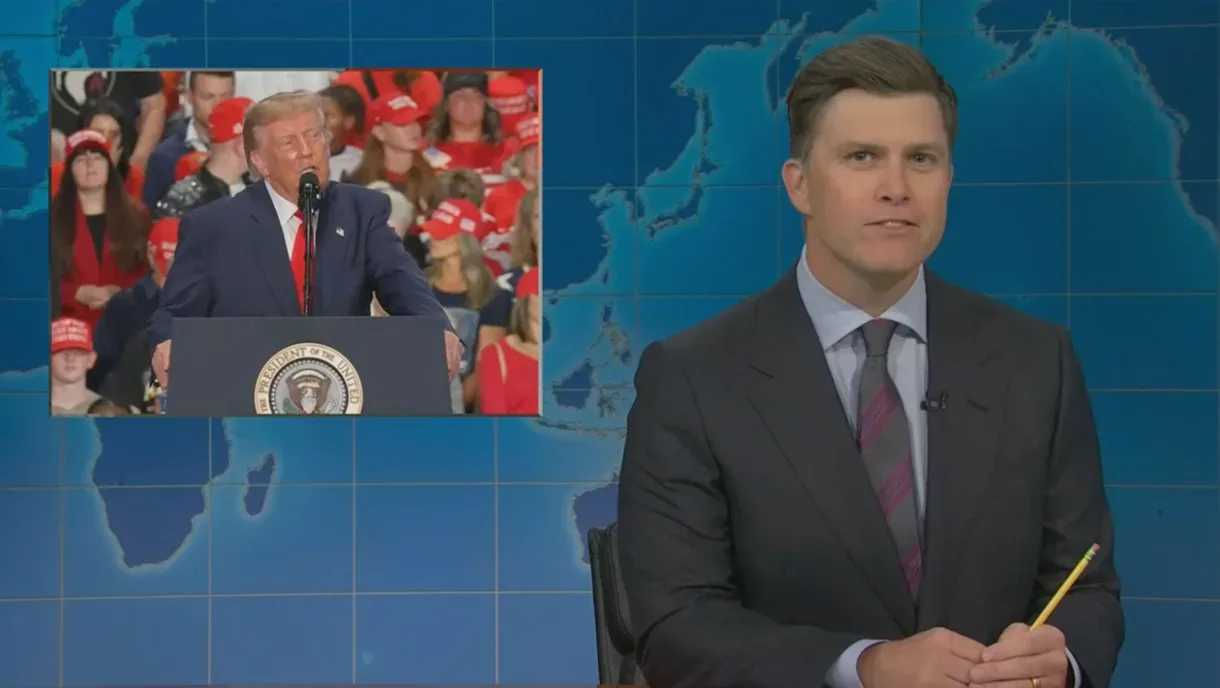
For another look at how the program’s political comedy can find a more focused target, see ‘SNL’ Weekend Update Uses Trump’s Nobel Peace Prize Loss as Its Sharpest Punchline.