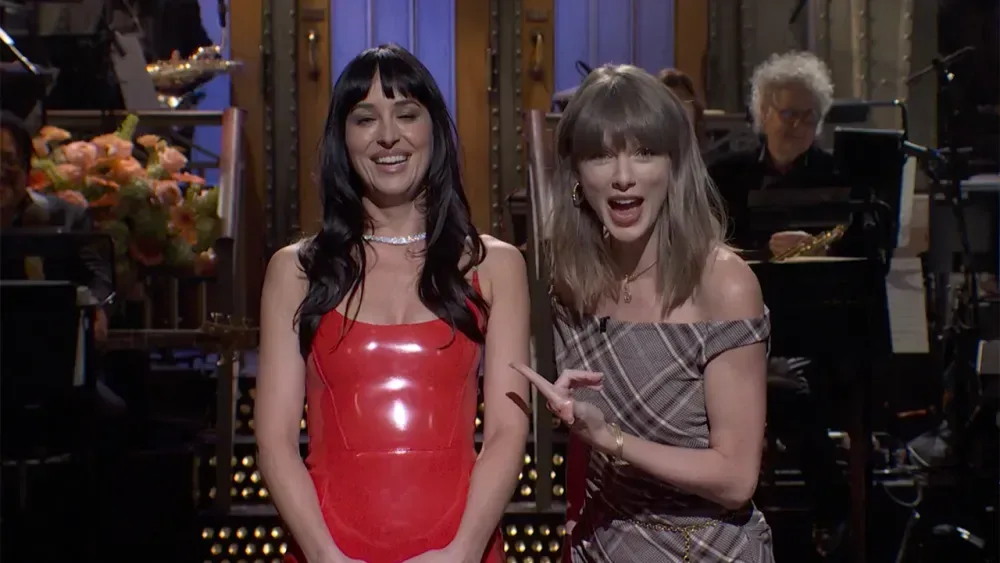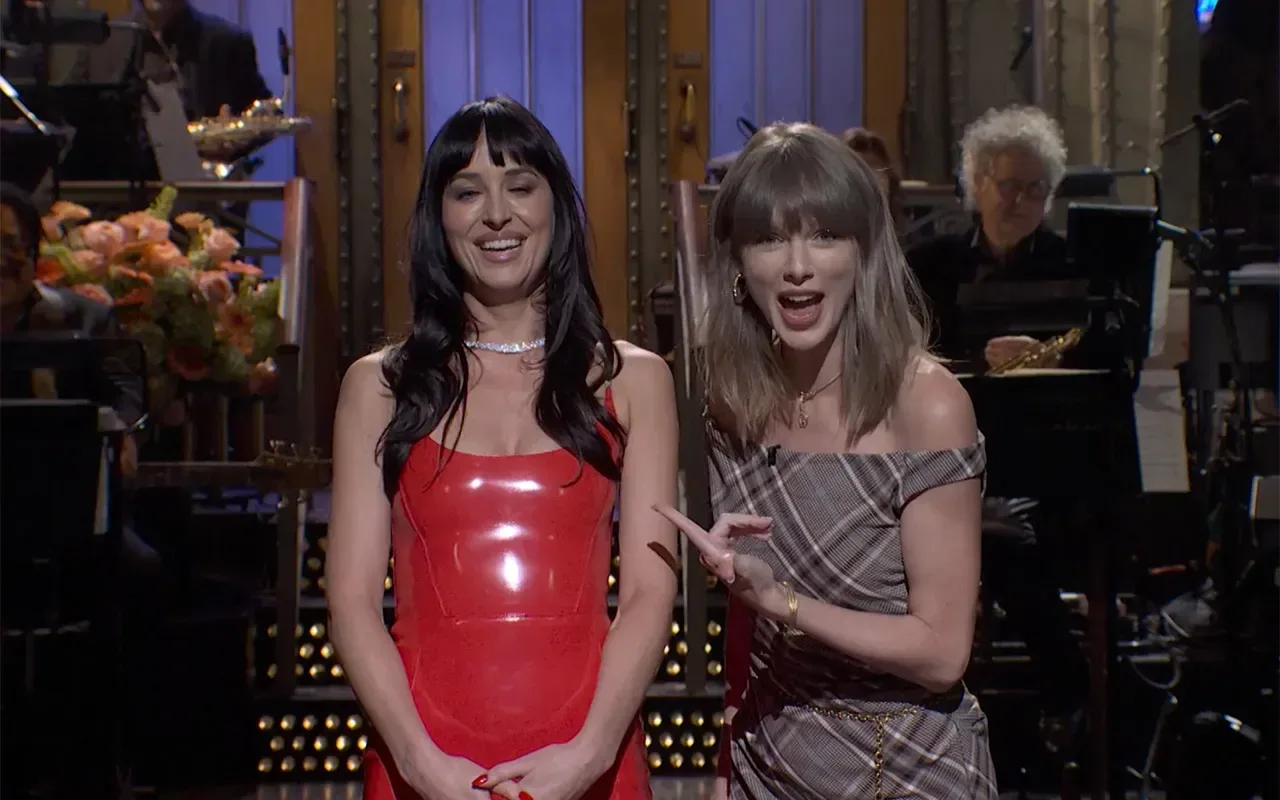
Taylor Swift made a cameo during Dakota Johnson’s opening monologue on Saturday Night Live, appearing as the host’s supposed “literal therapist” and turning the premise into a compact, self-aware friendship sketch.
Johnson’s monologue had already moved through jokes about her public relationships, her new film Verity, and dating musicians. She introduced Swift as a supportive friend who would not judge her. Swift immediately undercut the label: she was not Johnson’s therapist, she explained, but rather the person Johnson visits with wine, oversharing, a couch nap and an enthusiastic request for a sleepover. The imagined arrangement ends with Pedialyte and a ride home from Swift’s security team.
It is a deliberately mundane setup made funny by the mismatch of celebrity scale and familiar friend behavior. The joke is not that Swift possesses any therapeutic expertise. It is that Johnson has promoted an extremely recognizable late-night catch-up ritual into a formal mental-health service, while Swift calmly supplies the less glamorous version of events.
A cameo built around Johnson’s monologue
The appearance served the host’s material rather than functioning as a musical detour. Turnstile was the episode’s scheduled musical guest, and Swift did not perform. Instead, the cameo gave Johnson a scene partner at the exact point where her monologue’s dating-musician jokes could become more pointed.
Johnson had referred to two highly visible breakups with musicians and joked that she was looking for a third. She also framed Verity as a psychosexual erotic thriller before comparing that description to dating musicians. With Swift beside her, Johnson extended the bit by saying that dating musicians was effectively a public service that could save other women money on Zoloft. Her geographic punchline included Cleveland, an apparent nod to Travis Kelce. Swift’s response: “Allegedly.”
That one-word reply matters because it keeps the sketch’s rhythm intact. A monologue cameo can easily derail into applause, a broad promotional plug or a reference so specific that it ends the joke. Here, Swift’s brief line operates as a button: it acknowledges the audience’s expected association without expanding the moment into a statement about her private life.
Swift then exclaimed that it was Johnson’s birthday, slightly ahead of schedule; Johnson had said earlier that the birthday would arrive at midnight. Swift also returned during the episode’s goodnights with a birthday cake for Johnson. The two appearances gave the segment a beginning and an affectionate closing beat, rather than leaving the cameo as a single entrance-and-exit gag.
Why the joke plays like a good live-TV surprise
Live comedy often benefits from what might be called expectation management: the audience receives enough setup to recognize an incoming payoff, but not so much that the reveal loses force. Rumors and fan anticipation had made Swift’s presence plausible, yet Johnson’s therapist introduction still creates a clean entrance cue. Swift arrives as the answer to a setup, not merely as an unexplained famous face passing through Studio 8H.
The scene also relies on status reversal, a standard comic device in which the person with apparent authority is revealed to be in a much less official role. Johnson calls Swift a therapist; Swift describes herself as a patient listener who occasionally says something equivalent to “that’s wild.” The comedy comes from reducing a grand label to a low-stakes friendship dynamic that viewers can recognize.
Neither performer needs to overplay it. Johnson’s contribution—“Sleepover, yay!”—recasts the whole arrangement as a childlike, impulsive ritual. Swift’s account of hydration and a security-assisted trip home puts an orderly, adult cap on the chaos. The exchange gives each performer a sharply defined role, which is especially useful in a monologue where the host remains the central figure.
Recent Swift and Johnson connections supplied context
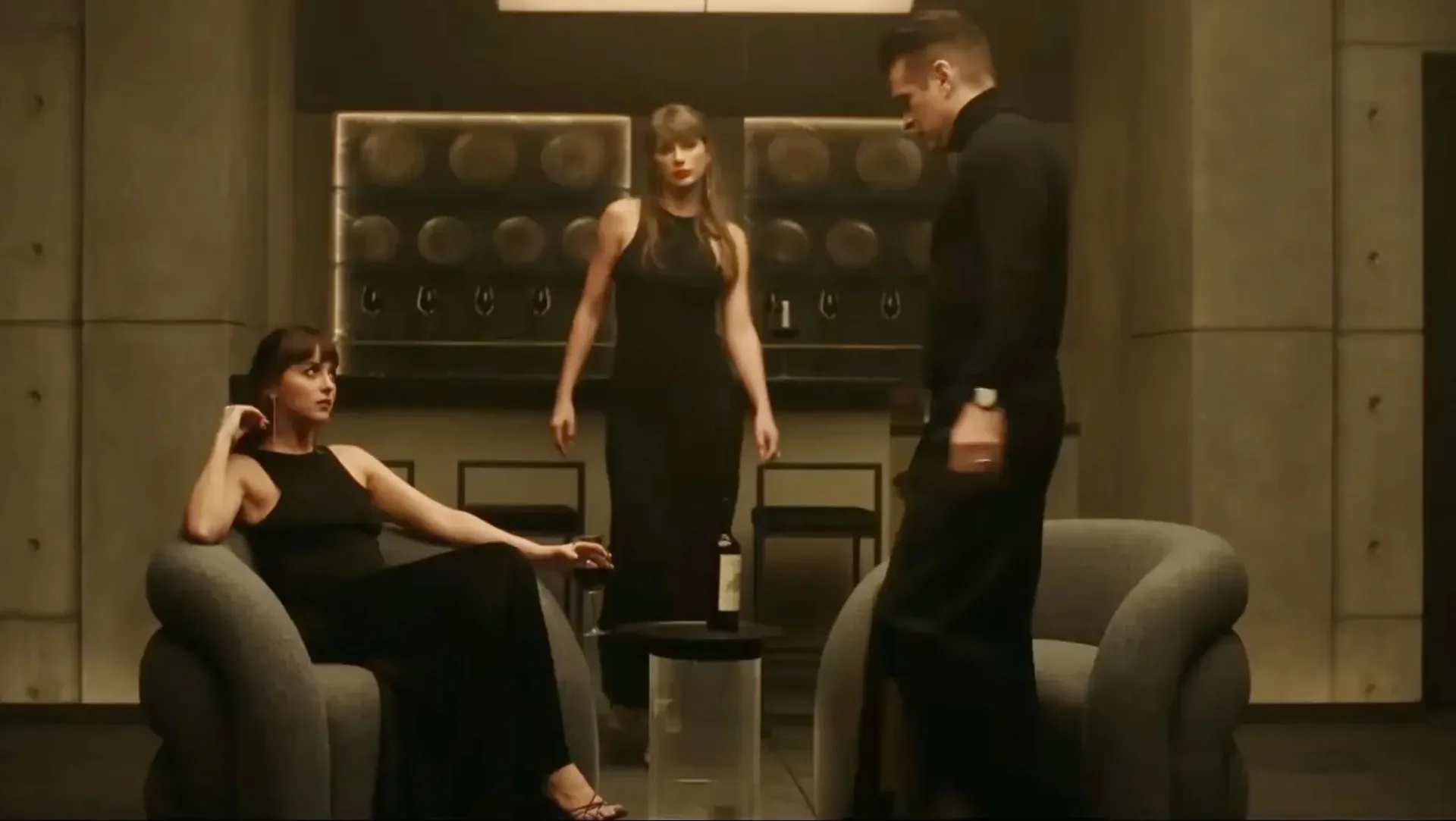
The pairing did not emerge from nowhere. Swift and Johnson recently appeared together in the video for “Patient Zero,” a single Swift directed as well as co-starred in. In the video, Johnson and Colin Ferrell play an affluent couple whose marriage appears unstable, while Swift plays a spectral presence attempting to warn Johnson’s character about her husband.
On the same Saturday as the SNL appearance, Swift released “Patient Zero (Expanded Video)” exclusively through Apple Music. The eight-minute version adds behind-the-scenes material to the original video, and Swift directed viewers to it through Instagram Stories. Against that immediate backdrop, the monologue cameo reads as another high-profile public moment for two collaborators, although the comedy segment itself is not presented as a direct promotion for the video.
Swift’s recent awards-show participation had also invited speculation about an SNL return. In a Law & Order: SVU sketch at the Emmys, a large Saturday Night Live logo appeared on a bulletin board behind her. That visual detail was widely treated as an Easter egg—a deliberately planted clue or reference designed for attentive fans to notice. In this case, it supplied a playful breadcrumb ahead of an actual Studio 8H cameo.
For more on another recent SNL sketch built around fast-moving topical material, see the show’s rapid-fire political cold open.
Swift’s ‘SNL’ history, in brief
The appearance marked Swift’s first on-screen return to the show since October 2023, when she introduced Ice Spice, her collaborator on a remix. Her relationship with the program reaches back much further: she hosted in 2009 and also served as musical guest that year, then returned as musical guest in 2017, 2019 and 2021.
She has also made cameo appearances in a monologue in 2014 and in a “Californians” sketch in 2015. That history helps explain why a short, non-musical appearance can still create a large reaction. Swift is not a first-time visitor being folded into the show’s format; she is a recognizable returning presence whose arrival carries its own built-in audience memory.
There is a practical difference between a musical-guest booking and this kind of cameo. A musical guest is usually expected to anchor two performance slots and participate in the episode’s promotional cycle. A cameo is more flexible: it can be designed around one joke, placed precisely where it best helps the host, and leave before it changes the overall shape of the episode. Swift’s turn with Johnson followed that latter model.
The timing alongside Swift’s current release cycle
Swift’s latest project, The Life of a Showgirl: The Encore, arrived September 25 as an expanded edition of her 2025 album with four additional tracks. The new songs were reported to have been co-written and co-produced by Swift, Max Martin and Shellback roughly a year after the original album was completed, during a celebratory trip to Sweden.
That release activity, the “Patient Zero” video rollout and an SNL cameo place several different forms of Swift visibility close together: recorded music, a directed narrative video, behind-the-scenes footage and live comedy. They are different formats with different demands. A song release asks listeners to spend time with the music; a video gives a performer control over mood and imagery; live television prizes timing, spontaneity and a clear joke that can land in seconds.
The Johnson appearance chose the smallest of those canvases. It did not attempt to explain a project, debut a song or turn the stage into a spectacle. It simply used the pair’s visible familiarity to sharpen a host monologue about dating, friendship and the absurd ways people describe the friends who reliably hear every story. The cake at goodnights made the final gesture even simpler: a surprise cameo, followed by a birthday celebration.