Saturday Night Live opened its Oct. 3 episode with a campaign-war-room sketch built around a simple comic problem: Republican strategists, played by Andrew Dismukes and Ashley Padilla, are trying to generate enthusiasm for their party while a succession of prominent political caricatures makes their job look increasingly impossible.
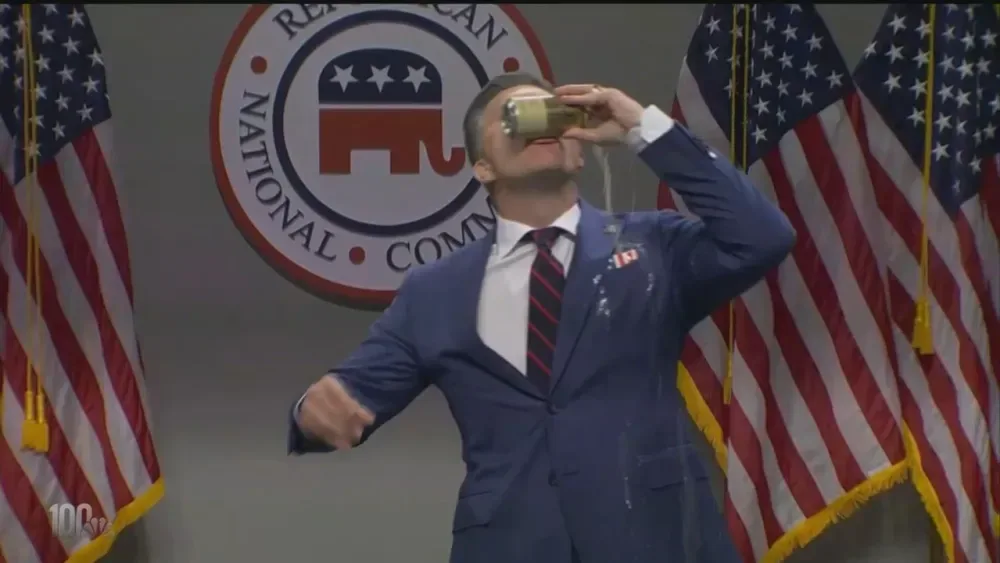
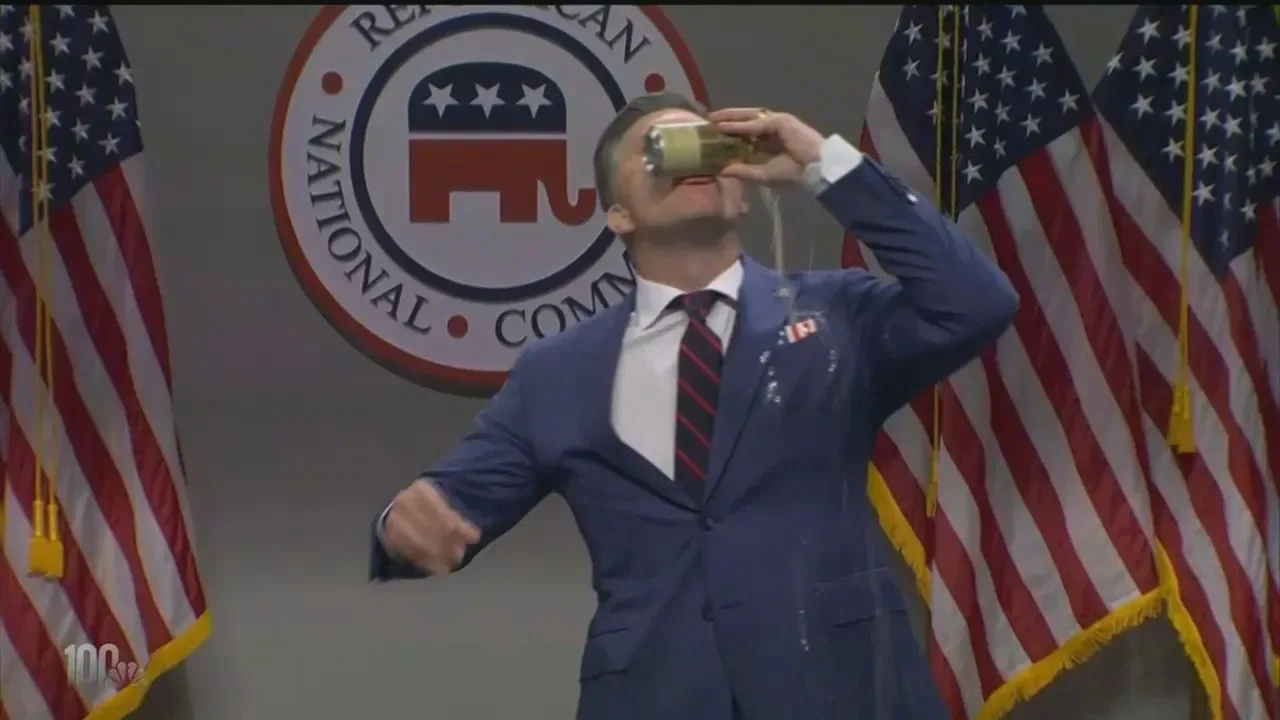
The cold open moved quickly through familiar late-night tools—broad impersonation, intentionally awkward interruptions and exaggerated political messaging—but its most conspicuous pop-culture detour came when Colin Jost returned as Pete Hegseth. Jost’s Hegseth promptly chugged a Bero, the non-alcoholic beer associated with Tom Holland, and described it with a crude Spider-Man-themed insult.
That gag is a useful example of how the sketch operates. Rather than spending time explaining a product or a superhero connection, it drops a recognizable celebrity association into an abrasive character bit and lets the collision do the work. Spider-Man is not the subject of the scene; the reference is shorthand for the type of macho performance the sketch is ridiculing.
A crowded war room by design
Marcello Hernández appeared as Marco Rubio, speaking to constituents in Spanish and portraying Rubio as unusually frank about Donald Trump falling short of expectations and an ongoing war not improving matters. The bit gives the strategists another problem to manage: a political surrogate saying the quiet part out loud.
Mikey Day followed as Mitch McConnell, presented as frozen in place and limited to flashing a peace sign. The sketch then makes the mechanics of live television part of the joke when Day nearly says the show’s signature “Live from New York” line before the cold open has actually reached its ending. That is a fourth-wall gag: the performer momentarily acknowledges, or seems to acknowledge, the constructed TV format instead of remaining fully inside the fictional political setting.
Jeremy Culhane’s JD Vance is similarly framed as a media problem. His camera test begins with the plain introduction, “Hi, I’m JD Vance,” before he is dismissed for having too little charisma. The joke is deliberately unglamorous. A camera test is ordinarily a routine production check; here, its basic purpose becomes a miniature audition the character cannot pass.
James Austin Johnson also arrives as Trump with “Let me cook,” a phrase used online to mean someone should be allowed to continue an approach before people judge the result. In this setting, the phrase becomes a setup for a promise of $5,000 to everyone if Republicans win, followed by the admission that the promise would not be fulfilled. The sketch’s point is not policy detail. It is the gap between attention-grabbing campaign language and credibility.
Why the Hegseth material stands out
Jost’s Hegseth segment parodies a “State of the Force” address and treats its speaker as someone whose aggressive rhetoric has escaped any conventional political guardrail. He says he is putting God back in war because soldiers are praying more, turning a claim of success into an unsettlingly literal punch line.
He also urges viewers to vote using a homophobic phrase. The line is written as part of the characterization, not as an endorsement: the comic tension comes from presenting civic participation—normally a standard campaign request—as incompatible with the exaggerated masculinity this version of Hegseth is performing. The character wants political action while treating the act itself as a threat to his own persona.
Then comes the Bero can. The joke is especially compact because a non-alcoholic beer is the opposite of the tough-guy image this Hegseth is trying to sell, at least in the sketch’s heightened logic. Adding Tom Holland’s Spider-Man persona makes the contrast sillier and more specific. Holland is being invoked as a pop-culture symbol, while the character’s hostility toward the drink is an extension of his insecure bravado.
It is worth separating the layers here. Bero is the real product named in the sketch, and Tom Holland is the real actor attached to that reference. The crude description is fictional dialogue delivered by Jost’s Hegseth, not a factual statement about either Holland or the beverage. Political comedy often depends on that compression: real names supply immediate recognition, while the impersonation supplies the absurdity.
From political parody to pop-culture shorthand
The cold open does not appear interested in constructing a realistic debate over campaign strategy. Its war room is a pressure cooker for impressions. Each arrival is designed to destabilize the strategists’ effort to make a coherent message: Rubio is too candid, McConnell is physically stuck, Vance is untelegenic, Hegseth is wildly overcommitted, and Trump offers a promise whose unreliability is immediately stated aloud.
That structure explains the unusually abrupt Bero reference. In a sketch that keeps switching targets, a superhero-adjacent product gag functions like a quick costume change for the joke itself. It changes the texture of a political impression without forcing the scene to become a discussion of movies, beverages or celebrity entrepreneurship.
For viewers tracking the broader relationship between celebrity brands and comedy, the bit also shows the downside of instant recognizability: once a celebrity connection is familiar enough to be understood in a few words, it can be repurposed as a punch line in a completely unrelated setting. That is not necessarily commentary on the product. It is evidence that the association has become usable cultural shorthand.
Pop culture frequently works this way on sketch television. The audience is expected to recognize a name, a product, an image or a signature persona faster than the scene can explain it. The payoff comes from placing that familiar element beside a character or situation where it plainly does not belong. Here, a Spider-Man-linked non-alcoholic beer is put in the hands of a figure written as an avatar of belligerent machismo.
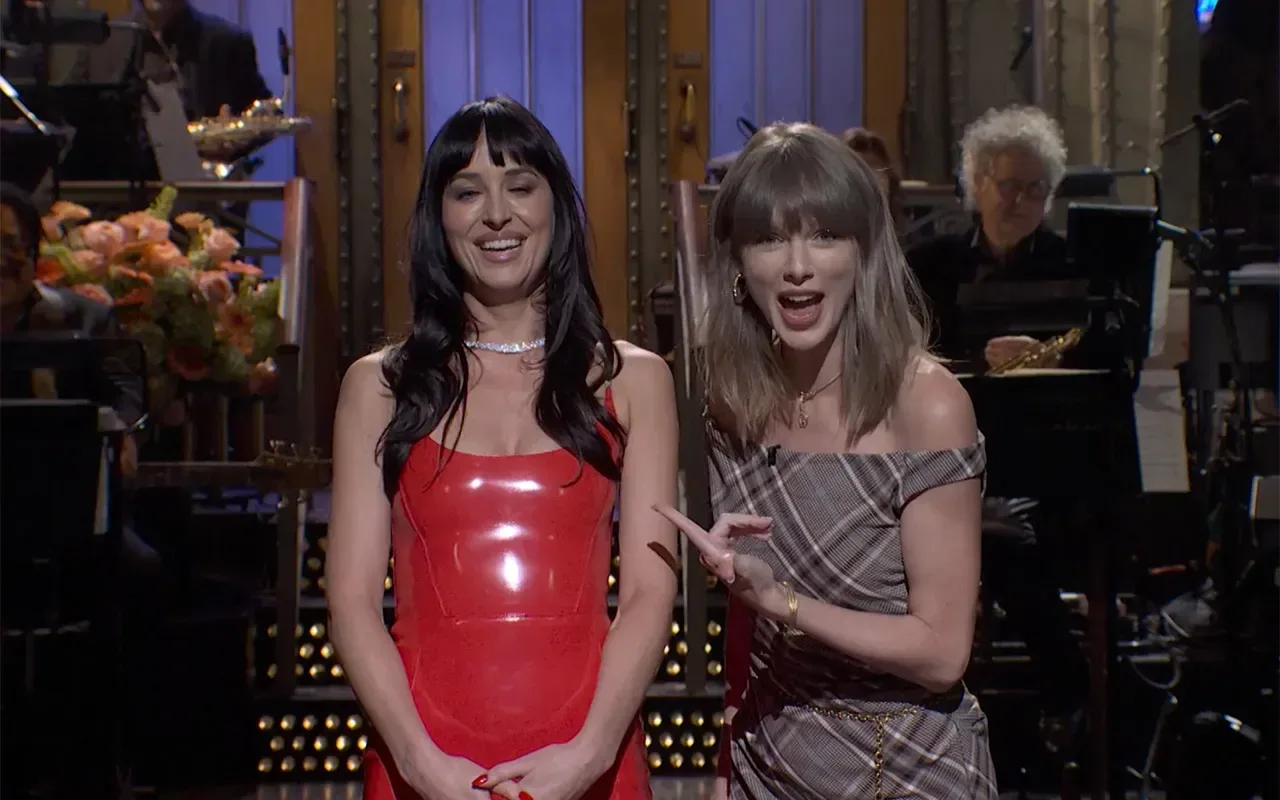
The episode was hosted by Dakota Johnson, with Turnstile serving as musical guest. Its cold open’s larger target was political messaging under strain, but the Jost segment ensured that the scene also had a sharply contemporary entertainment hook. A short product mention became one more sign that the strategists’ campaign operation had lost control of the room.
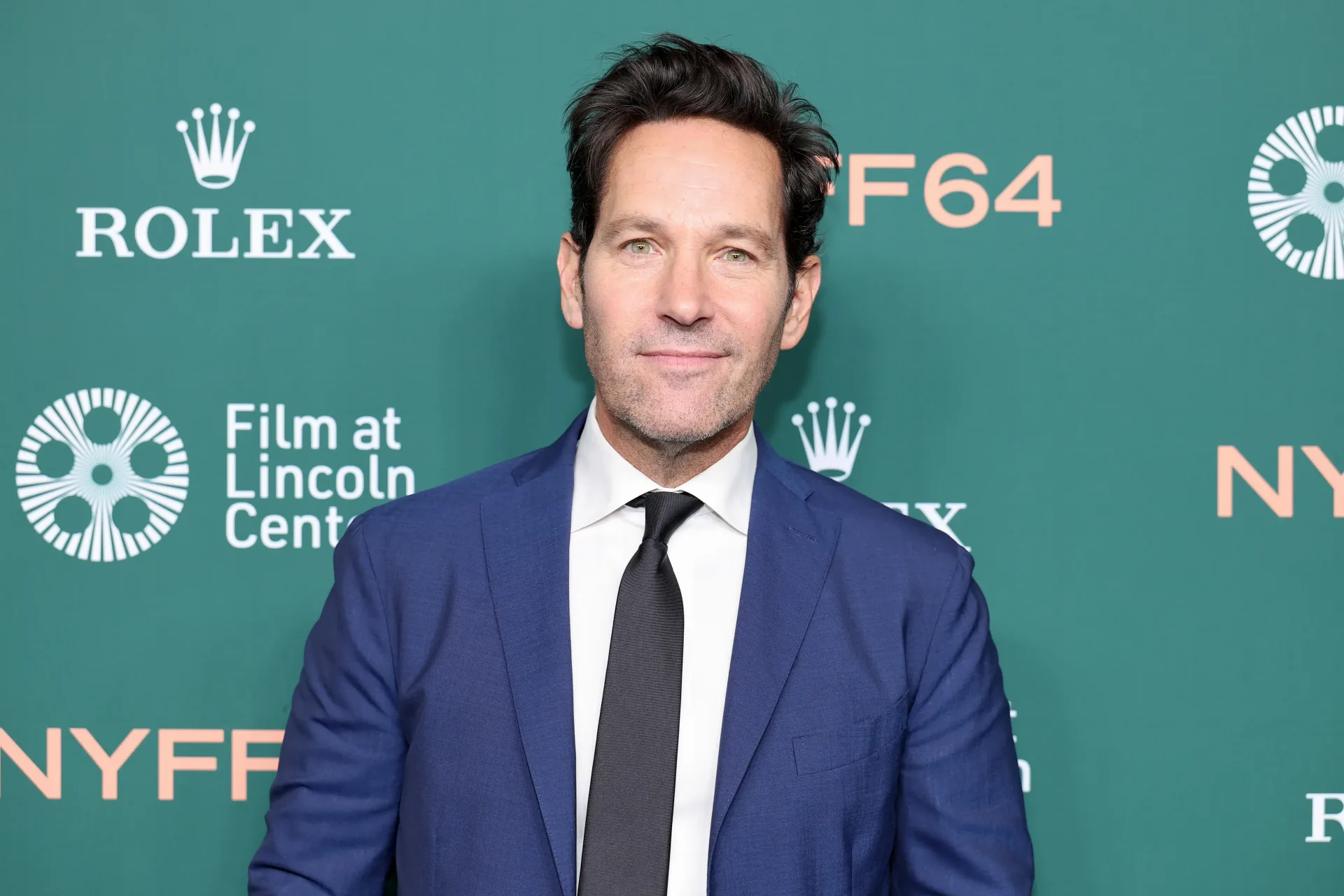
For more entertainment-world coverage, see our look at Paul Rudd’s comments on the phone-free set of A Statement.