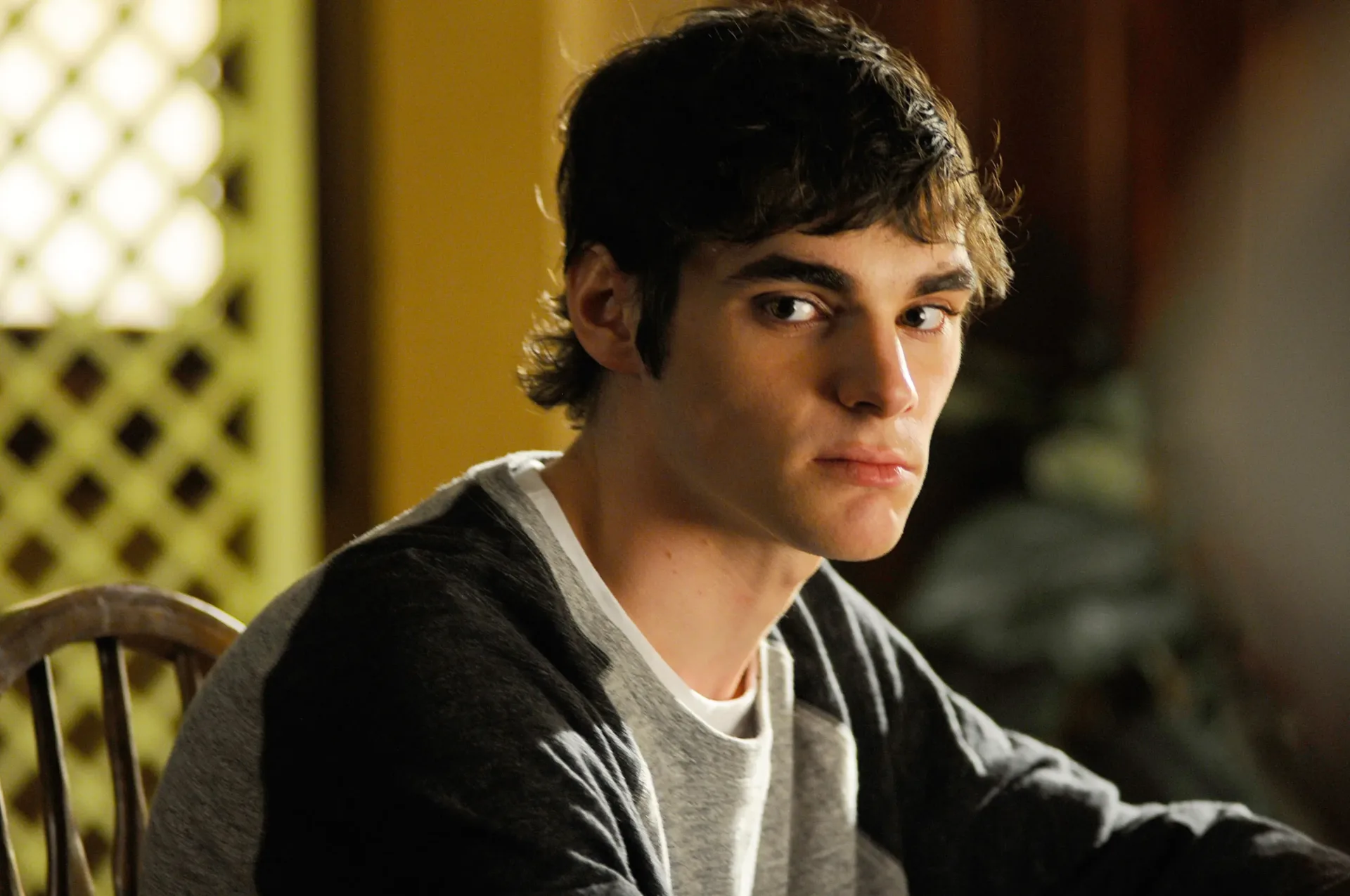
RJ Mitte, the actor widely known for playing Walter White Jr. on Breaking Bad, has died at the age of 34. A representative confirmed his death. A cause of death was not immediately disclosed.
Mitte’s most visible role placed him at the center of one of television’s defining family dramas. As Walt Jr., the son of Bryan Cranston’s Walter White and Anna Gunn’s Skyler White, he played a teenager trying to make sense of a household destabilized by secrecy, illness, money and escalating danger. The character was frequently called Flynn on the series, a choice that became part of his struggle to establish an identity independent of his father.
His performance mattered for reasons beyond the enormous reach of the show. Mitte had cerebral palsy, as did Walt Jr., and his work gave a major television audience an opportunity to see a disabled character portrayed as a full member of a complicated family rather than as a fleeting symbol or a background detail. Through his career, Mitte also became an advocate for disability awareness and inclusion in entertainment.
A role built around character, not a shortcut
Breaking Bad is often discussed through its high-stakes crime plot and the transformation of Walter White. But its tension also depended on the ordinary family life that Walter repeatedly endangered. Walt Jr. was essential to that emotional structure: he was observant, funny, frustrated, loyal and, at points, openly furious. Mitte’s work gave those scenes a human scale amid the show’s increasingly extreme circumstances.
That distinction is important when considering disability representation. Representation is not simply the presence of a disabled person or character on screen. Meaningful representation also concerns who gets to embody the role, how much interiority the character is given, and whether disability is treated as the character’s only defining trait. Mitte’s role put a young person with cerebral palsy within a story about family, adolescence and betrayal without reducing Walt Jr. to a single narrative function.
Walt Jr.’s cerebral palsy was part of the character’s life, but it was not presented as a device to explain every choice he made. He had his own arguments, loyalties, sense of humor and relationships. That is a practical standard audiences can apply when thinking about inclusive casting: a character should be allowed to be specific and complicated, not forced to stand in for an entire community.
Mitte’s performance therefore carried a dual significance. It helped shape a major television drama, while also making disability visible in a role that was neither incidental nor confined to a story about diagnosis. For viewers with cerebral palsy and other disabilities, the value of that visibility can be direct: seeing a recognizable aspect of one’s own life in a prominent cultural work. For the broader audience, it can challenge assumptions about whose stories are treated as central television stories.
Advocacy beyond the screen
A representative described Mitte as an actor, philanthropist and disability-rights advocate who drew on his experience living with cerebral palsy to build a platform around awareness and inclusion. The statement emphasized the authenticity he brought to the role and the work he did to challenge stereotypes.
Related coverage includes RJ Mitte, ‘Breaking Bad’ Actor and Disability Advocate, Dies at 34.
“Drawing from his own experience living with cerebral palsy, Mitte brought authenticity to the role and built a platform on disability awareness and inclusion,” his representative said.
Mitte served as an ambassador for United Cerebral Palsy and Shriners Children’s. He was also president of the Mitte Foundation, his charity, which supported philanthropic efforts and sought to confront stereotypes about people with disabilities.
Cerebral palsy is a term for a group of conditions affecting movement, muscle tone or posture. The supplied information states that Mitte experienced brain damage at birth and was diagnosed with cerebral palsy at age 3. His public work tied that lived experience to a larger push for more equitable representation in Hollywood.
That push has consequences both in front of and behind the camera. Casting disabled performers in disabled roles can expand access to careers and bring personal knowledge to a character’s physicality, routines and interactions. It can also encourage productions to consider accessibility as a regular part of the workplace rather than a late accommodation. None of that makes one performer responsible for representing every disabled person’s experience; rather, it underlines why a wider range of performers and roles matters.
Mitte’s prominence gave those conversations a highly visible reference point. His advocacy was connected to a performance millions associated with a landmark television series, making the work legible to people who may first have known him only as Walt Jr.
Work across television and film
Although Breaking Bad remains the credit most closely associated with Mitte, his career extended across television and film. He had a recurring role on Switched at Birth, a series that also placed communication and disability-related experiences within its storytelling. He later played Mind Master in the Netflix superhero series The Guardians of Justice.
His film credits included The Recall in 2017 and The Oak Room in 2020. Before his death, he was promoting Talking to Strangers and had appeared on podcasts in the days beforehand. He also had projects in pre-production and production, underscoring that his career was still active and unfinished.
For pop-culture audiences, remembrance of an actor’s work can often begin with a signature role. In Mitte’s case, that will naturally mean revisiting Walt Jr.’s place in Breaking Bad. But his body of work and public life point to a broader legacy: an actor who continued to work in different genres while using his visibility to advocate for a more inclusive industry.
Television’s impact is often measured in awards, audience size or the longevity of a series’ online discussion. Mitte’s career illustrates another measure: whether a performer’s success changes the terms of what audiences and studios consider ordinary to see on screen. A disabled actor playing a layered, recurring character in one of television’s most discussed dramas helped make that possibility harder to ignore.
Why his television legacy endures
Long-running conversation around prestige television can sometimes flatten supporting characters into plot functions. Walt Jr. was more consequential than that. He was a son confronting the collapse of trust in his family, and many of the series’ most painful moments land because of what he does not know, then what he comes to understand. Mitte’s portrayal maintained the character’s vulnerability without stripping him of agency.
It is also worth separating authenticity from the idea that disabled performers should only be offered roles explicitly written around disability. Mitte’s casting in Breaking Bad showed the value of authentic experience in a role where cerebral palsy was one facet of a much larger character. His later credits point to the broader objective: disabled actors should have access to varied genres, tones and character types.
That remains a useful lens for viewers following modern television casting. The question is not merely whether a production includes a disabled character. It is whether the performer has a meaningful role, whether the character has desires and contradictions beyond a label, and whether disabled talent is being considered across the full range of storytelling. Those are the standards Mitte’s career brought into sharper view.
Readers reflecting on Mitte’s work may also find it meaningful to look at the ways performers shape television beyond a single famous project; recent discussion around demanding TV productions has likewise kept attention on the people who make series possible, as in this account of early American Horror Story production schedules.
Mitte was born in Jackson, Mississippi, and was adopted after suffering brain damage at birth. He was engaged to his long-term partner, Kennedy Suarez, whom he had dated since 2018.
His legacy joins two inseparable accomplishments: a memorable performance in a television series that continues to command attention, and sustained advocacy for disability awareness, opportunity and dignity. At 34, Mitte leaves behind work that was both culturally prominent and personally purposeful.