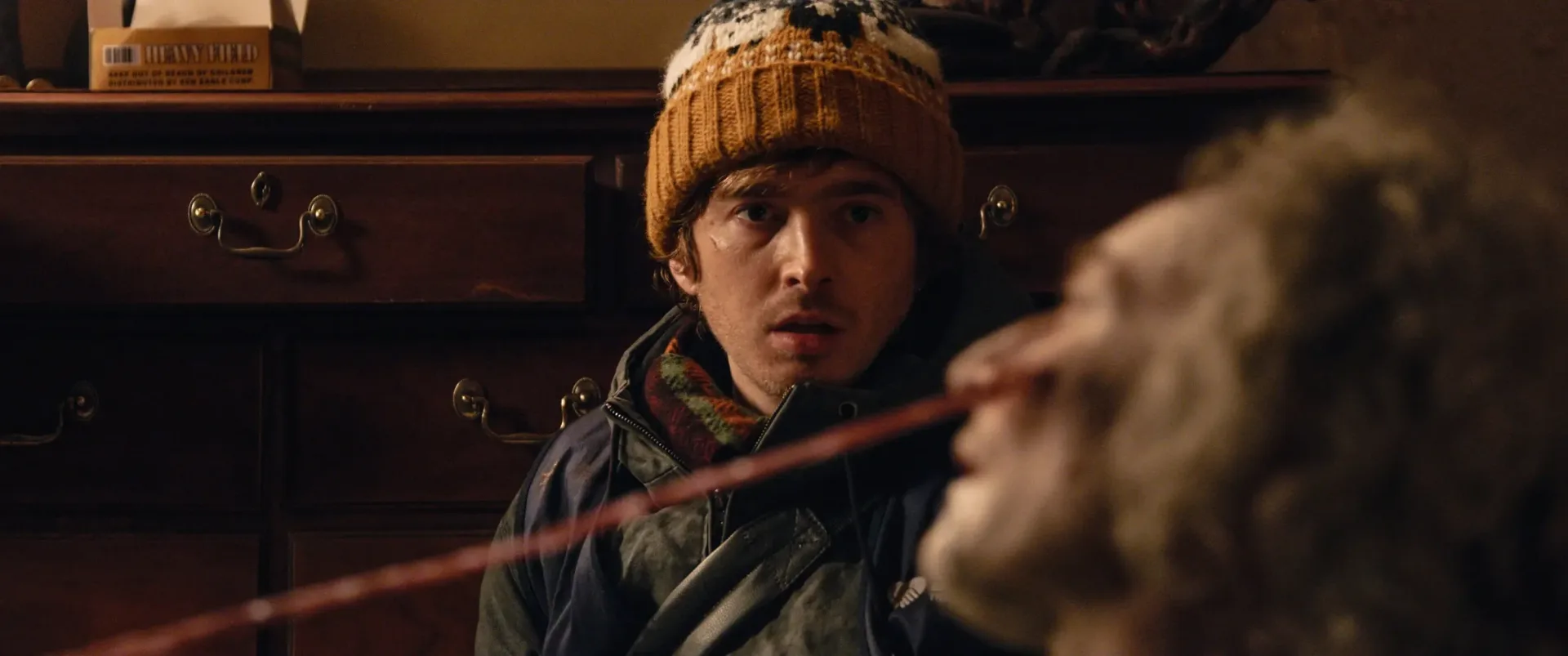
Resident Evil has taken first place at mainland China’s box office, leading the Oct. 9–11 weekend with RMB81.2 million, or $12.1 million. The horror reboot, a video-game adaptation from Constantin Film and Sony Pictures, had reached a cumulative $40.7 million after opening on Oct. 5 during the closing stretch of the Golden Week holiday.
That result places the film at the center of a notably cooler theatrical frame. Total mainland China weekend revenue came in at $30.8 million, following the elevated traffic associated with the National Day holiday period. The distinction matters: a number-one ranking describes how a title performed against its immediate competition, while the overall market total shows the scale of cinema-going across all releases. Resident Evil won the weekend even as the size of the broader weekend market normalized after the holiday rush.
The opening is also a reminder that the Resident Evil name remains a significant bridge between games and screen entertainment. For audiences that know the franchise through interactive horror, the movie is a separate adaptation rather than evidence of a new game release or an assessment of any particular game. Its box-office performance instead measures ticket sales for this specific theatrical version in one market over a defined period.
A strong lead in a quieter weekend
Resident Evil’s $12.1 million weekend haul accounted for a substantial share of the reported $30.8 million total market. Put simply, its three-day earnings were a little under two-fifths of all ticket revenue reported for the frame. That is a useful way to read the chart position: the film was not merely ahead of the runner-up; it was the dominant individual draw in a post-holiday weekend with reduced overall traffic.
The reported $40.7 million cumulative is the total earned since the Oct. 5 rollout, rather than the Oct. 9–11 figure alone. In box-office terminology, a cumulative gross, sometimes shortened to cume, is a running total across a film’s release to date. A weekend gross is narrower, covering only the specified weekend. Keeping those figures separate helps avoid making the film’s latest three-day performance look larger or smaller than it is.
The timing adds context without settling the question of the film’s eventual run. Opening during Golden Week gave Resident Evil access to the late-holiday audience, while the following weekend took place as traffic cooled. Its $40.7 million total shows a meaningful start, but the available figures do not establish its production costs, marketing spend, release plan beyond this reporting period, or future box-office trajectory. Those are all necessary pieces for any full profitability discussion.
The films behind Resident Evil
Traces of Justice held second place in its second session with $8.3 million. The period crime procedural has accumulated $73.4 million since its Oct. 1 opening. Chen Sicheng directed and co-wrote the film with Zhang Ji and Yan Zijie. Its cast includes Zhang Yi, Ma Li, Chen Minghao, Karry Wang, Fan Chengcheng and Chen Feiyu.
The film’s multi-decade story follows a veteran public-security officer investigating major historical cases based on real events. Its strong cumulative figure illustrates a different kind of chart presence from Resident Evil’s: it is not the weekend leader, but it has built a larger total over its longer time in theaters.
Related coverage includes Resident Evil Leads China Box Office as Post-Holiday Traffic Cools.
In third, the family body-swap comedy Mr. & Mrs. Pardon earned $5.7 million for a $43.6 million cumulative gross. Shen Chunyang directed the satire from a screenplay by Ma Duo. Shen Chunyang and Xiao Shenyang play an unmotivated middle-aged married pair compelled to confront their stalled relationship after exchanging bodies, alongside Jia Bing and Yu Yang.
Go for Broke 2 came fourth with $1 million in its second weekend, bringing its total to $7.9 million after launching Oct. 3. Marc Ma wrote and directed the revenge-thriller sequel, which stars Isabella Leong, Wen Junhui and Sammo Hung.
Fifth place went to Once Upon a Time in the Middle East, which added $800,000 in its ninth weekend and reached $353 million since opening Aug. 11. Directed by Wen Muye, the war comedy-drama stars Shen Teng, Jiang Qiming, Aarif Rahman and Omar Sherif. It is also China’s submission to the Oscars’ international feature category.
What the wider market figure says—and does not say
The $30.8 million combined weekend total should not be read as a direct verdict on any one film. Holiday periods frequently change the baseline for theatrical attendance, making a comparison with the immediately preceding frame difficult without more complete daily and title-by-title information. Here, the reported explanation is that cinema traffic normalized after the National Day rush.
There is, however, a broader annual backdrop. Mainland China’s year-to-date box office stands at $4.63 billion, reported as 29.4% below the equivalent point in 2025. Year-to-date means the cumulative revenue from the beginning of the calendar year through the reporting date. It is a market-level measure, not Resident Evil’s performance.
For readers tracking game properties beyond the controller, the key practical takeaway is straightforward: theatrical adaptations can have a box-office life that must be judged both by their opening and by the market conditions surrounding it. Resident Evil has begun with a $40.7 million cumulative in mainland China and a clear first-place weekend, but it did so as the total market stepped down from a holiday peak. Its next frames would be needed to show how much of that momentum continues in ordinary release conditions.
The game-to-film connection is also distinct from the development side of the business. Music, licensing, adaptation and publishing conversations can all overlap around major game franchises, but they are separate commercial tracks. For a related industry perspective on another major game series, see Mick Gordon’s comments on a possible return to Doom.
Why this result matters for Resident Evil watchers
Resident Evil’s chart win is significant primarily because it supplies a concrete early indicator of audience demand in mainland China: $12.1 million for the Oct. 9–11 weekend, following an Oct. 5 opening, and $40.7 million accumulated so far. It does not by itself reveal how viewers responded creatively, what proportion of ticket buyers are game fans, or whether the reboot will maintain its lead.
Still, the result is unambiguous within the reported frame. Resident Evil finished above a field containing a well-performing crime procedural, a family comedy, an action sequel and a long-running domestic blockbuster. As the post-holiday market settles, the next meaningful measure will be not just whether it remains first, but how its ticket sales hold relative to the changing size of the total theatrical market.