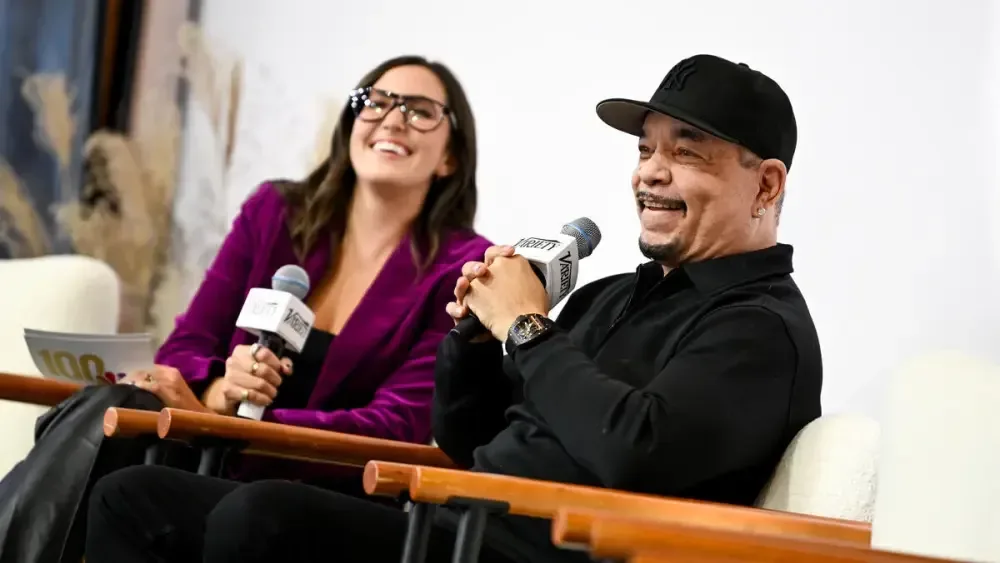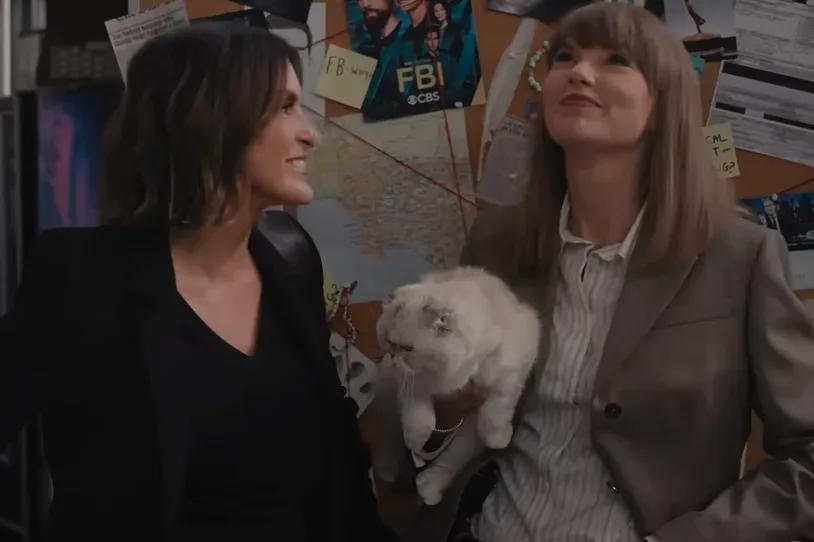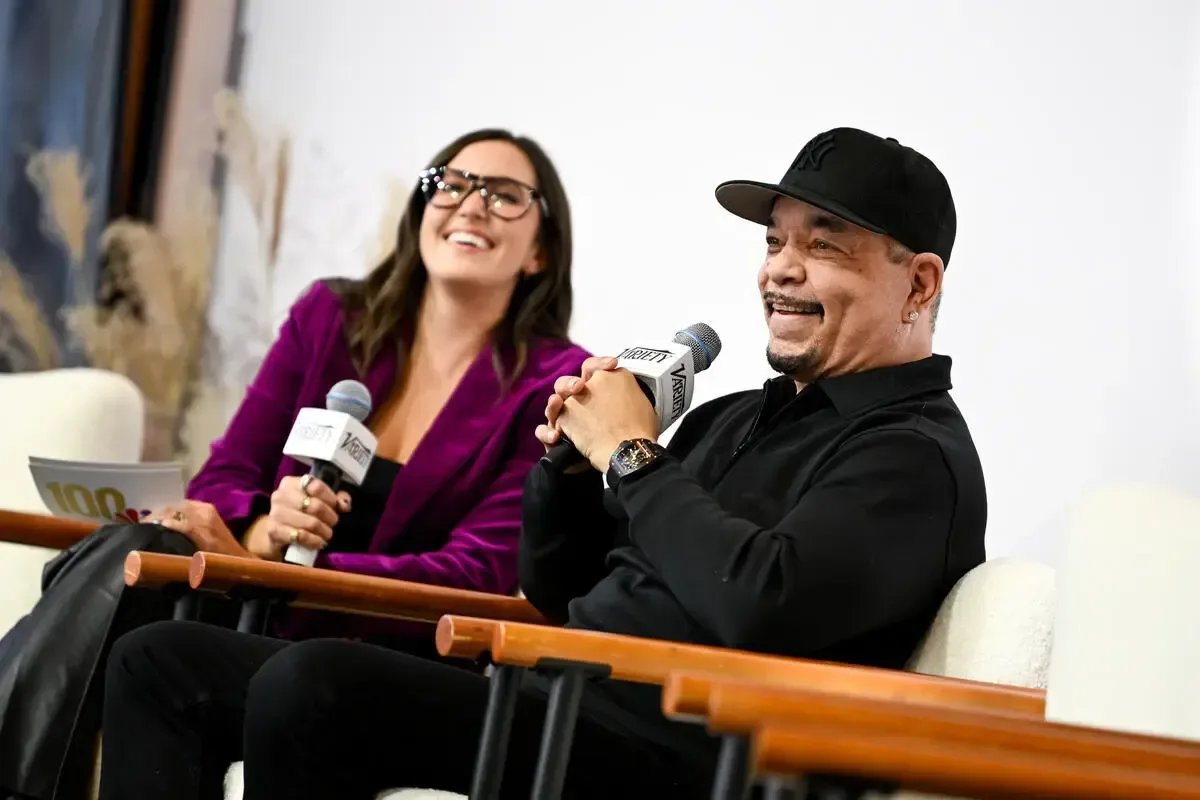
Ice-T had a straightforward verdict on working with Taylor Swift for a Law & Order: SVU spoof: she was “mad cool.” The actor and rapper recalled Swift’s tightly guarded visit to the New York set for the sketch that aired during last month’s Emmy Awards telecast, hosted by his SVU co-star Mariska Hargitay.
More than a celebrity anecdote, his remarks landed neatly alongside a wider discussion about fandom, physical presence and the growing premium placed on shared cultural moments. Marketing and entertainment leaders gathering in Manhattan on October 7 repeatedly returned to a similar idea: as artificial intelligence changes how media is made, marketed and discovered, audiences may place even greater value on experiences that feel immediate, communal and difficult to duplicate.
Ice-T said Swift brought a distinctive energy to the set and “knocked it out,” adding that he believes she could act in whatever role she chose. The appearance itself was constructed as an event: a secret production visit, a familiar TV setting and a major pop star stepping into a playful version of it for a live awards-show audience. That combination is a concise example of the day’s broader theme. A piece of entertainment can live on as video, clips and discussion, but the initial appeal comes from the sense that something specific happened in a specific cultural moment.
Fandom is becoming something audiences do, not only something they watch
The central business argument was not that digital platforms are disappearing. Rather, speakers framed in-person and physical touchpoints as complementary to online discovery. A person may find a creator, team, show or brand through a feed, but the bond can deepen through a watch party, a convention, a live show, a location-based installation or even a conspicuous physical-media placement such as outdoor advertising.
Aarti Bhaskaran of Snap described younger consumers as the “Memento Generation,” a label intended to capture an emphasis on memories over possessions. In this view, the loop is circular: social platforms can introduce the audience to an interest; an in-person experience gives that interest emotional weight; and the attendee then shares the experience back online, extending the community to people who were not there.
That distinction matters for entertainment companies, sports organizations and game publishers alike. Digital reach can be vast, but reach is not automatically loyalty. A fan who sees a trailer, highlight or streamer clip might be aware of a property. A fan who attends an event, participates in a watch party or shares a moment with other enthusiasts may be more likely to regard it as part of their identity. The discussion consistently treated that second level of involvement as strategically important.
Jimmy Knowles of Canva described experiential marketing as moving beyond a discrete budget item and becoming a primary strategy. He pointed to Canva Create fan conventions as an example. The practical message is that the experience is no longer merely decoration around a product launch or a campaign. For some audiences, it is the product of greatest immediate value.
What “experiential” and “omnichannel” mean here
Experiential marketing is a broad term for activity designed to give people a direct, participatory encounter rather than simply an advertisement to view. A convention, live watch party or interactive activation can all fit the description. It does not mean every audience interaction has to be enormous or exclusive; it means the act of participation has a role in building the relationship.
Related coverage includes Ice-T Calls Taylor Swift ‘Mad Cool’ as Marketing Leaders Spotlight IRL Fandom.
Omnichannel media, another term raised in the discussion, means using different formats and platforms as parts of one connected plan. Outdoor media, social video, live events, streaming platforms and creator-led content are not necessarily competing for the same job. In a well-coordinated plan, each can contribute something different: discovery, credibility, participation, discussion or follow-up.
Stacy Minero of Outfront argued that physical and “IRL” media should serve as a foundation within that wider mix rather than as an alternative to online media. The emphasis is on trust and visibility. A brand or entertainment property that appears in the real world can seem more tangible, while location-based placements can also bring a community together in a shared place.
AI is the pressure point, not the whole story
Several speakers positioned this renewed interest in real-world connection against anxieties around AI. Nick Brien described the current period as an “agentic age,” extending beyond advertising into commerce. Agentic AI generally refers to software capable of taking actions toward a goal with some degree of autonomy, instead of simply responding to a single prompt. In the business context discussed here, the concern is that brands may increasingly need to consider not only how a human customer encounters their message, but also how automated assistants and agents navigate information and purchasing choices.
That does not make live or physical entertainment inherently immune to technological change. It does explain why panelists repeatedly highlighted elements that are hard to reduce to a recommendation, a generated ad or a transaction: being in a room with other fans, seeing a city transform into a venue, or feeling that a one-time occasion is worth documenting and talking about.
The source discussion did not offer a prediction that AI will replace entertainment experiences. Its more measured implication was that technology could make authenticity, community and physical presence more valuable differentiators. If media becomes easier to create, personalize and distribute at scale, the event that feels genuinely shared may gain importance precisely because it cannot be fully replicated in a feed.
Sports offers a clear model for community-first programming
The sports panel supplied some of the strongest examples of how organizations are widening the definition of fan content. Radhika Duggal of Major League Soccer said the future of live games on television will be rooted in community building, particularly in an AI-heavy world. She pointed to large local watch parties staged by MLS clubs in partnership with Fox and FIFA during the summer’s World Cup excitement.
The value of the watch party is not limited to the match on a screen. It gives supporters a place to react collectively, meet other fans and participate in a local expression of a global event. It also creates material that can circulate after the event, preserving the live gathering as an online story.
Nilay Shah of the New York Giants offered a related content example. The team enlisted Eli Manning for a digital interview series connected to the Giants but featuring guests including Michael B. Jordan and Caitlin Clark. Shah said the series has generated 150 million video views across five years. The point was not that on-field action no longer matters; it was that a sports organization cannot rely on game action alone to reach casual viewers. Personality, conversation and adjacent culture can open the door to audiences with different reasons for tuning in.
Gaming has long confronted the same challenge. Players can arrive for competition, a character, a creator or a social group as much as for a particular gameplay loop. The continuing debate around physical releases illustrates how complicated the mix can be: discs and cartridges offer a tangible point of connection, while online services, updates and social spaces often shape a game’s ongoing life. The pressure around that balance is visible in the debate over physical game sales and PlayStation’s changing retail landscape.
Creators are being cast as community leaders
Christine Cassis of Twitch said viewers are seeking connection and described an approach that gives creators and livestreamers greater control over the fandoms they build. Her framing casts creators in two roles: creative directors, shaping the programming and tone, and community advocates, representing the people who gather around their channels.
That is important because a live-service mindset can be mistakenly reduced to constant content output. The panel’s comments point to something more relational. The goal is not just to give users more material; it is to let the people closest to a community help define its rituals, expectations and identity. In practice, that can make a livestream, interview series or event feel less like a message delivered from a company and more like a place people return to.
Paul Caine of On Location emphasized that audiences are increasingly led by access to experiences tied to their passions, whether sports, music or dining. He cited the appetite for hidden, speakeasy-style venues as an example of consumers wanting an experience that feels like a discovery. The appeal, in other words, can exceed the functional value of what is purchased. The story around the access, the setting and the memory becomes part of the value.
New York remains part of the entertainment proposition
The city itself was another thread in the conversation. Rafael Espinal of New York City’s Mayor’s Office of Media and Entertainment pushed back on the perception that filming in New York is prohibitively expensive. He said the state has made its production tax incentive easier to use on a faster timeline and that the city has increased credits for post-production work, drawing projects that shoot elsewhere to complete post work in New York.
Espinal also spoke about the creative value of the city on screen, naming Past Lives, Vanilla Sky and Die Hard With a Vengeance among New York-set films he admires. That perspective reinforces the broader IRL argument: a setting is not only a backdrop. A recognizable location can carry mood, memory and cultural meaning before a character even speaks.
For Ice-T and Swift, New York was likewise more than a production address. The secret SVU visit took place on the set of a series closely associated with the city, then became part of an Emmy broadcast and a larger conversation about entertainment fandom. It was a small but telling example of the premise repeated throughout the gathering: audiences may discover culture through screens, but real-world context still gives many of those moments their spark.