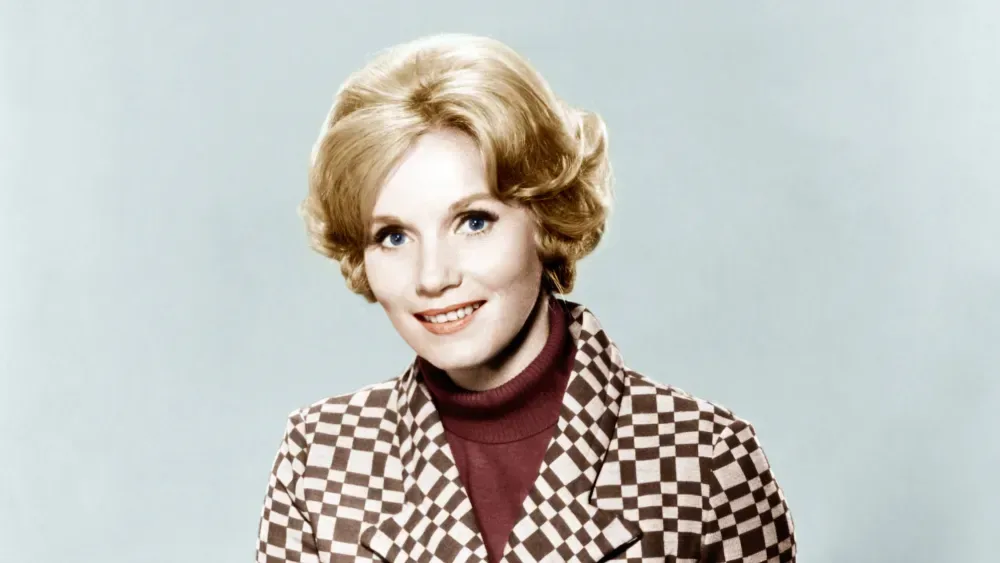
Eva Marie Saint, the Academy Award-winning actor whose work moved confidently between early live television, Broadway, Hollywood drama and Alfred Hitchcock suspense, has died at her Los Angeles home. She was 102.
For many film fans, Saint’s legacy begins with two permanently influential pictures: 1954’s On the Waterfront, which earned her the Oscar for supporting actress, and Hitchcock’s 1959 thriller North by Northwest, in which she played Eve Kendall opposite Cary Grant. But those roles tell only part of the story. Saint built a career across media at a moment when television was rapidly becoming a place where actors could develop serious dramatic credentials, then kept working intermittently in theatre, television movies, series television and features for decades.
Her career also offers a reminder that screen history is not made solely by the largest role or the longest filmography. Saint was consistently valued for precision, intelligence and emotional control. Whether playing a waterfront resident drawn into a dangerous moral conflict or a secretive figure in Hitchcock’s high-stakes chase story, she gave characters an inner life that resisted easy labels.
An Oscar-winning film debut
Saint played Edie Doyle in On the Waterfront, the Budd Schulberg drama directed by Elia Kazan and starring Marlon Brando. The film received 12 Academy Award nominations and won eight, including best picture, director, actor and supporting actress for Saint.
Her award was presented in 1955, and she later became the oldest living Oscar winner. Edie is essential to the film’s human dimension: her connection with Brando’s character, Terry Malloy, makes its account of corruption, violence and conscience more than a procedural conflict. A contemporary appraisal of her work praised the tenderness and sensitivity she brought to the romance amid the film’s brutal setting.
The part was a major opportunity for a performer with a notably strong television background rather than an extensive Hollywood résumé. Saint had appeared with Lillian Gish in Horton Foote’s 1953 television play The Trip to Bountiful. That production subsequently moved to Broadway for 39 performances, and Saint’s performance attracted Kazan’s attention. He cast her in On the Waterfront despite the role being sought by more experienced actors.
That trajectory matters because live and anthology television had become a proving ground for performers. An anthology series is a programme in which separate installments tell different stories, often with different casts and creative teams. Saint’s work in programmes including Philco Playhouse, Robert Montgomery Presents and Studio One gave her repeated opportunities to take on distinct dramatic material rather than remain fixed in one continuing role.
Eve Kendall was never just a passenger
Saint’s Eve Kendall in North by Northwest remains one of her defining performances. On the surface, Eve is a glamorous stranger encountered by Grant’s advertising executive Roger Thornhill on a train. As the plot expands, she is revealed to be much more complicated: a spy with her own capacity for deception, strategy and risk.
The distinction is central to why the character has endured. Eve has the visual polish audiences expect from a Hitchcock thriller, but she is not simply there to be protected while Thornhill takes action. She routinely understands more than he does and can manipulate dangerous people around her. Saint’s coolly composed performance supports the film’s changing balances of knowledge and power.
Spy thriller is a useful term here. It describes stories built around espionage, false identities, secret information and shifting loyalties. In the best examples, suspense does not come only from physical danger; it comes from uncertainty over who knows what, who can be trusted and whether a character is acting freely. Saint’s Eve is a key engine for that uncertainty.
Her work helped make the role feel more substantial than a conventional damsel-in-distress part. That is especially notable in a film often remembered for its famous set pieces and Cary Grant’s increasingly desperate flight through a conspiracy. Eve is not an accessory to that momentum. She is one of the figures directing it.
From radio and early television to the Actors Studio
Born in Newark, New Jersey, Saint later lived in Delmar, New York, near Albany. She attended Bowling Green State University in Ohio intending to become a teacher, but developed an interest in acting and pursued the profession after earning her bachelor’s degree.
Her early work included radio, modelling and radio serials such as Rosemary and Young Doctor Malone. Her first paycheque was $10 for off-camera applause on The Borden Show. That modest start preceded a wide range of television roles, beginning with Camp Hoop La and a regular part on One Man’s Family.
In 1947, she was cast in Mister Roberts but was moved into an understudy position when director Joshua Logan felt she lacked sufficient experience; Jocelyn Brando played the roles. A year later, Saint began studying at the Actors Studio. The institution is associated with actor training that emphasizes detailed emotional and psychological work, an approach that suited the naturalistic force of much of her early television and film material.
She received Emmy nominations for the 1954 television presentation of Paddy Chayefsky’s Middle of the Night and a 1955 musical adaptation of Thornton Wilder’s Our Town, which co-starred Paul Newman and Frank Sinatra. Other early work included Yellow Jack and Claudia.
A career that did not follow a single studio path
After her Oscar success, Saint chose not to commit herself to a studio contract. Instead, she returned to the theatre in stock productions of The Rainmaker and Desire Under the Elms. That decision is a useful corrective to the idea that an Academy Award automatically leads to one linear, studio-driven career. Saint worked in varied forms and stepped back at times while raising her family from the late 1950s onward.
Her film credits after On the Waterfront included the Bob Hope vehicle That Certain Feeling, A Hatful of Rain, Raintree County, Exodus and John Frankenheimer’s All Fall Down, co-starring Warren Beatty. She later appeared in The Sandpiper, Norman Jewison’s comedy The Russians Are Coming the Russians Are Coming, Loving with George Segal, 36 Hours and Grand Prix.
Her stage work continued as well. She appeared on Broadway in The Lincoln Mask in 1972 and opposite Henry Fonda in The First Monday in October in 1979. A Chicago production of Duet for One followed in 1983.
The breadth of these credits is also a case for preserving screen and theatre history beyond a handful of canonical titles. The conversation around private media archives and the material conditions of preservation remains urgent, as seen in a recent debate over a developer’s archive and game preservation. Saint’s body of work spans formats whose survival and accessibility can shape how future audiences understand an actor’s contribution.
Television remained a major part of her work
Saint never treated television as a detour from film. Her later credits included School for Bachelors, A Carol for Another Christmas, Mrs. Epenshade, Taxi and the miniseries How the West Was Won; the latter two brought further Emmy nominations. She received strong notices for television projects including A Christmas to Remember, When Hell Was in Session, The Curse of King Tut’s Tomb, The Best Little Girl in the World, Malibu, My Antonia and Jane Doe.
In the 1980s, she had a recurring role on Moonlighting as the mother of Cybill Shepherd’s character. She returned to film in 1986 in Nothing in Common, with Tom Hanks and Jackie Gleason. During the 1990s she appeared in TV movies including I’ll Be Home for Christmas, Kiss of a Killer, After Jimmy and Open House, and made a cameo as Roz’s mother on Frasier.
After four earlier Emmy nominations, Saint won the supporting actress Emmy in 1990 for the NBC miniseries People Like Us. The award underscored a career in which television was not merely an early launching pad, but a sustained creative home.
Later audiences knew her as Martha Kent
Saint continued to appear in features in the 2000s, including I Dreamed of Africa, Because of Winn-Dixie and Don’t Come Knocking. In 2006’s Superman Returns, she played Martha Kent, Clark Kent’s adoptive mother. For viewers who encountered Saint first through that film, the role connected a classic Hollywood actor to a modern superhero production without reducing her presence to a cameo-like novelty.
Her final big-screen appearance came in 2014’s Winter’s Tale, written and directed by Akiva Goldsman. She had also hosted the 2000 documentary The Making of North by Northwest, appeared in the documentaries Broadway: The Golden Age, by the Legends Who Were There and Broadway: Beyond the Golden Age, and returned to the Academy Awards stage in 2009 to present the supporting actress Oscar, 55 years after winning it herself.
Saint received two stars on the Hollywood Walk of Fame, one for motion pictures and one for television. The dual recognition neatly reflects the unusual continuity of her career across both forms.
Life beyond the screen
Saint supported the Motion Picture and Television Fund and the Epilepsy Foundation of Los Angeles. She also advocated against cell-phone use while driving, creating and distributing bumper stickers that read, “Get Off The Phone Or Get Off The Road.” She served on the Academy of Motion Picture Arts & Sciences’ Nicholl Screenwriting Fellowship Committee.
Her husband, television director Jeffrey Hayden, died in 2016. Saint is survived by her children, Darrell and Laurette; four grandchildren, Eli, Tyler, Molly and Stella; and two great-grandchildren, Arlo and Finley.
Across more than six decades of credited screen work, Eva Marie Saint left a legacy that reaches from live television’s formative years to one of cinema’s great thrillers, from award-winning drama to superhero mythology. Edie Doyle and Eve Kendall may remain her most famous characters, but the larger achievement is the range and durability of the career behind them.