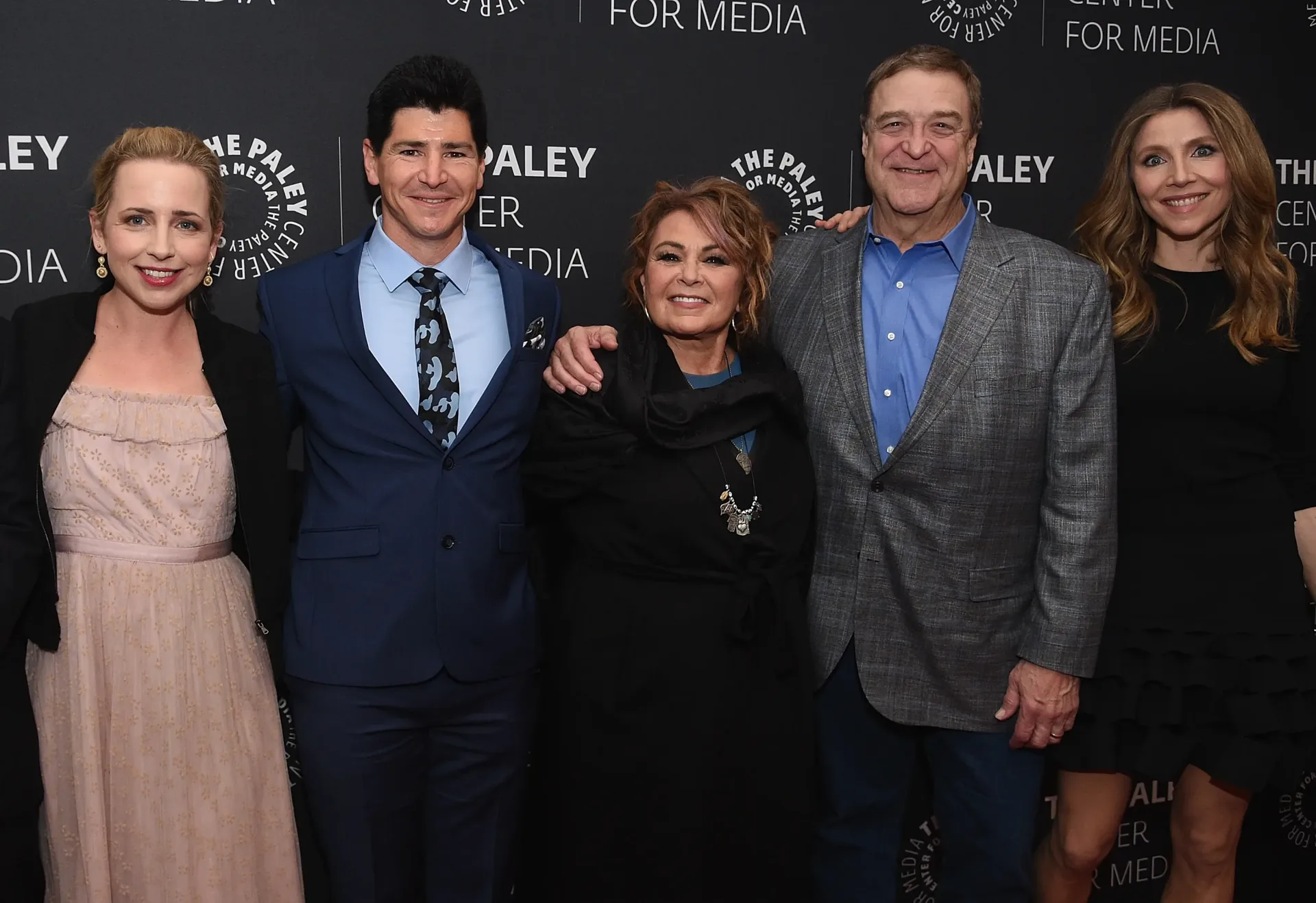
Chuck Lorre has offered a stark account of his time in the Roseanne writers’ room, characterizing the environment as defined by “malice” and describing workweeks that ran from 60 to 70 hours. The producer and creator, who wrote on two seasons of the ABC sitcom before leading a lengthy run of his own hit series, discussed the experience during an appearance on Dinner’s on Me, hosted by Jesse Tyler Ferguson.
Lorre’s central point was not merely that the room was demanding. It was that he saw a basic creative conflict at the heart of it: Roseanne Barr, in his telling, resented having other writers craft dialogue for her character. Lorre connected that friction to her roots as a stand-up comedian, where a performer’s voice and authored material can be inseparable from the public persona that made them successful.
That distinction matters because television is built very differently. A half-hour comedy may center on one star’s personality, but its production depends on a network of writers, performers, producers and crew members meeting an unforgiving schedule. Lorre’s recollection is therefore a window into a classic television tension: individual ownership of a comic voice versus the collaborative machinery required to make an episodic series.
Lorre’s account of a difficult job
Asked how he endured a famously turbulent writing environment, Lorre said financial precarity was a major reason. He described having spent roughly 15 to 20 years dealing with poverty, health problems and instability, and said he was unwilling to return to worrying about rent. In that context, remaining in a punishing job was, for him, about security as much as career ambition.
For more context, explore Red Sonja: She-Devil With a Sword #6 Brings a Very Unusual Wedding to the Ongoing Rising Sun Fallout.
“That is why I put up with it,” Lorre said, after describing 60- and 70-hour weeks. “And it was malice. It was absolute.”
The comments represent Lorre’s personal recollection of the workplace and his interpretation of its dynamics. They do not establish every participant’s view of the room. Still, the specificity of what he identifies—long weeks, the pressure to retain a stable income and conflict over who gets to write a star’s lines—helps explain why the experience stands out in the story of a writer who later built an enormous television résumé.
He said Barr “hated that there were writers,” framing the issue as a fundamental objection to other people supplying words she would speak. Lorre’s explanation was that Barr had become a star through her own writing as a comedian. For a stand-up, material is not only content; it is often the performer’s signature, their point of view and the direct link between stage persona and audience.
Why sitcom writing is not stand-up writing
Lorre’s comments point to a practical difference between comedy formats. Stand-up is commonly associated with a comedian refining an individual act and performing it in their own voice. Television comedy, by contrast, has to serve numerous characters and a continuing narrative while satisfying production deadlines. Even when a show is closely identified with its lead actor, every episode needs scenes, jokes, revisions, transitions and story structure that work across the cast.
A writers’ room is the group of writers who develop and rewrite that material. Its exact setup varies from show to show, but the purpose is collective: shape stories, solve jokes and produce scripts at a pace that one writer generally cannot sustain alone. The process also means dialogue may pass through many hands before an actor delivers it.
That can make authorship feel complicated. A performer may have an acute sense of what sounds authentic for their character, particularly if that character emerged from a distinctive comic identity. Writers, meanwhile, have to think beyond a single speech or punchline. They must maintain the rhythm of an episode, give other characters meaningful material and keep a season’s larger story moving.
Lorre argued that the transition from solo comic authorship to TV’s team-based structure could not work in this case. “She made herself a superstar based on her words, her writing,” he said of Barr. “Then transition to a television show where you can’t do it alone. It’s impossible.”
His wording should not be read as a broad rule that comedians cannot lead television shows. Rather, it explains how he understood the specific clash he encountered on Roseanne: a performer accustomed to personally authored comedy placed within a form that inherently distributes creative labor.
A legacy complicated by its scale and aftermath
Roseanne originally aired from 1988 to 1997. Its revival returned in 2018 for a nine-episode season, demonstrating that the show and its central family remained a substantial draw decades after the first run ended. That revival was canceled in 2018 following a racist tweet from Barr.
The revival’s first season finished as the top scripted primetime program among viewers ages 18 to 49. That demographic is frequently treated as a key audience measure in American television because it has long been important to advertisers. In simple terms, the performance showed the revival was not just a nostalgia project with a small legacy audience; it was competitive in a major current television metric.
The franchise continued with The Conners, which ran for seven seasons from 2018 through 2025. The continuation is a reminder that a television series can be larger than any one production moment. Its characters, format and audience relationship can persist through substantial cast and creative changes, even after a defining star exits.
That larger history also gives Lorre’s remarks added perspective. He is discussing an earlier period in a property that has had multiple lives: its original 1988–1997 run, its short 2018 revival and a seven-season follow-up. His story is not a newly reported account of the revival’s cancellation or a reassessment of the later continuation. It is a look back at the pressures behind one of the original show’s creative relationships.
From staff writer to defining sitcom creator
After his stint on Roseanne, Lorre became one of the most prolific creator-producers in mainstream American sitcoms. His subsequent credits include Grace Under Fire, Cybill, Dharma & Greg, Two and a Half Men, The Big Bang Theory, Mom, Young Sheldon and The Kominsky Method.
That career arc does not turn a bad workplace memory into a neat lesson, but it does make the recollection notable. Lorre later led productions where the responsibility he described—organizing a television series around a consistent creative voice while relying on many contributors—became central to his own work. The experience he recounts occurred before he was best known as the person steering long-running hit comedies.
For viewers, writers’ room disputes are usually invisible. Audiences see performances, stories and finished jokes, not the negotiation that determines whose line survives a rewrite or how a star responds to dialogue. Lorre’s account pulls back the curtain on that hidden layer without changing an essential fact about sitcom production: collaboration is not optional at the scale of network television.
It also underlines why “creative control” is not a simple on-or-off concept. A lead performer can have strong instincts, a public identity tied to their material and a major role in setting a show’s tone. A staff of writers can be indispensable at exactly the same time. The hard part is not proving that either contribution matters; it is building a process in which those contributions can coexist without the level of hostility Lorre says he experienced.
More detail on the recent discussion is available here.