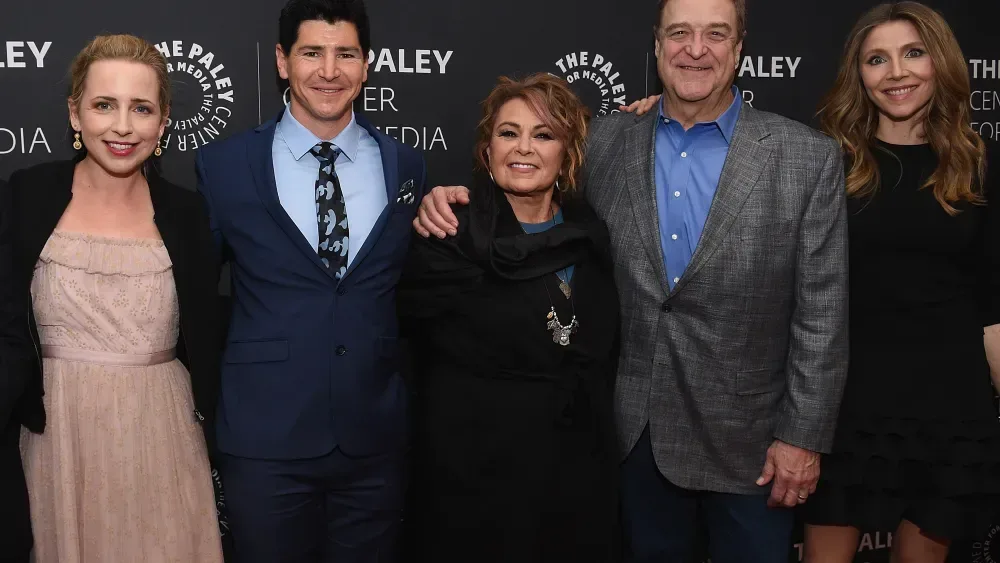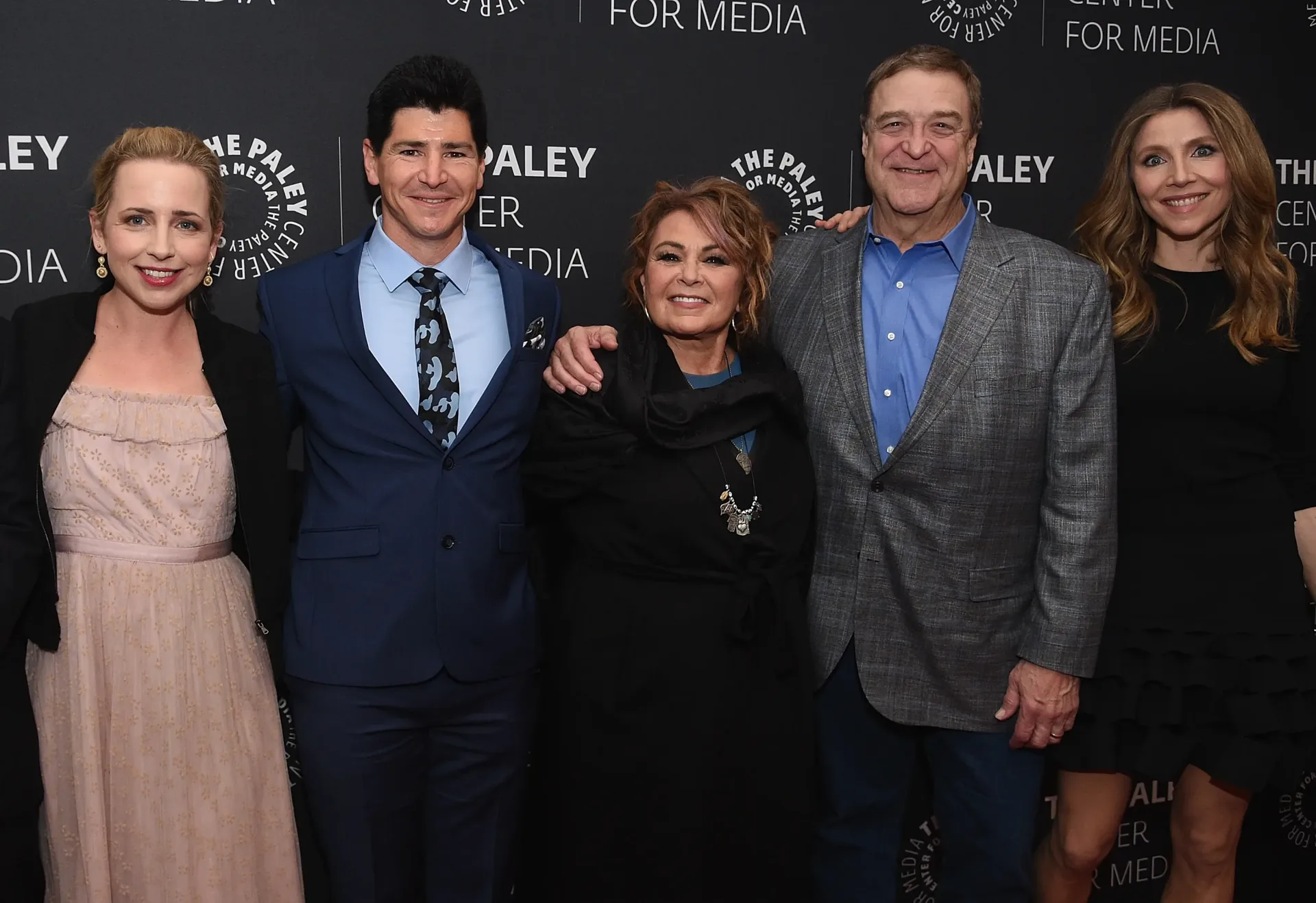
Roseanne Barr and Michael Fishman are publicly at odds again over the cancellation of the 2018 Roseanne revival, a dispute that has never been merely about a network programming decision. It is a continuing argument over the meaning and consequences of Barr’s social-media post about Valerie Jarrett, and over whether the event should be understood as a political controversy, a racial insult, or both.
In a recent appearance on the Can’t Be Censored podcast, Barr responded angrily to Fishman’s recent statement that the show was “rightfully canceled.” Fishman played D.J. Conner on the original series and returned for the revival. Barr called him a bigot, claimed he had not listened to her explanation of the post, and said his stance reflected a lack of geopolitical context. Her remarks included repeated profanity and personal attacks.
Fishman’s position has been consistent since the revival was pulled. He condemned Barr’s post in 2018, calling the remarks intolerable, and said in an Instagram video in August that claims the cancellation was caused by “woke” culture distort what happened. In his view, comedy can address dark material, but the disputed message was not a joke and the cancellation was justified.
The post at the center of the dispute
The conflict stems from Barr’s 2018 tweet, which referred to “muslim brotherhood & planet of the apes” in connection with Valerie Jarrett, a former adviser to Barack Obama. Jarrett is Black. The post was widely read as a racist comparison, and ABC canceled the Roseanne reboot afterward.
Barr has repeatedly rejected that interpretation of her intent. In the new interview, she said the post referred to the 2015 Iran nuclear deal and maintained that “Planet of the Apes” was terminology she used in reference to Iran’s Islamic Revolutionary Guard Corps. That is Barr’s explanation of what she meant; it does not change that the wording was broadly understood as a racist insult toward Jarrett, nor that this response drove the public and corporate fallout at the time.
That distinction is the central fault line between Barr and Fishman. Barr argues that critics, including Fishman, have ignored the political framing she says was behind her language. Fishman argues that rationalizations around dehumanizing language are harmful, whatever political explanation is later attached to the post.
Fishman said that comedy can make people laugh at some of the darkest subjects, but that, in this instance, “there was no joke.”
Why intent and impact remain separate questions
Much of the renewed argument turns on two concepts that often get flattened into one online debate: intent and impact. Intent concerns what a speaker says they were trying to communicate. Impact concerns how the language was reasonably received, whom it harmed or targeted, and what consequences followed. They can be related, but they are not interchangeable.
Related coverage includes Roseanne Barr and Michael Fishman Clash Again Over 2018 Reboot Cancellation.
Barr’s comments focus overwhelmingly on intent. She says her language invoked geopolitical issues, not Black people. Fishman’s response focuses on impact: a message combining Jarrett’s identity with an “Apes” reference carried a long and ugly racial implication to readers, and attempts to explain it away perpetuate damaging ideas.
For a network, that distinction has practical importance. Broadcasters and studios do not assess a controversy only through an individual performer’s stated private meaning. They must also weigh public interpretation, workplace ramifications, advertiser concerns, the effect on colleagues, and the association between a show’s brand and the remarks at issue. The source material establishes that ABC canceled the revival after the tweet; it does not provide a detailed account of the network’s internal deliberations. Still, the result demonstrates how quickly a performer’s public speech can become inseparable from an ensemble production.
Fishman directly challenged the notion that criticism of the post is just partisan spin. In his August video, he said people use a political “smokescreen” to defend the indefensible, warning that dehumanizing rhetoric has real-world consequences. His argument is not that comedy must avoid difficult topics. Rather, it is that labeling speech as comedy or political commentary does not automatically remove responsibility for its effect.
What happened to the franchise after the cancellation
The end of the Roseanne revival did not end the wider Conner-family franchise. ABC continued it as The Conners, without Barr. The follow-up sitcom ran for seven seasons.
Fishman returned as D.J. Conner for four seasons, before revealing in 2022 that he had been told he would not return for season five. The reason for his departure has not been publicly confirmed. During her new criticism, Barr said she had been responsible for bringing Fishman back for the reboot and claimed the production had wanted to drop him. Those are Barr’s claims about behind-the-scenes circumstances; the available information does not independently establish them.
That later casting change gives the current exchange an additional personal edge. Barr framed Fishman’s support for the cancellation as disloyalty, while Fishman has treated the issue as a moral boundary rather than a disagreement between former co-workers. Neither position suggests an easy route to reconciliation, especially because the dispute concerns an event that reshaped both the series and the public identities of people associated with it.
A familiar pattern in franchise controversies
Long-running television franchises can make individual controversies unusually durable. A show’s characters, cast relationships, revival plans, cancellation, replacement series, and later interviews all become parts of one continuing public narrative. In this case, the original sitcom’s cast history made the disagreement between Barr and Fishman more visible than a standard dispute between a network and a single star.
It also shows why calls to “move on” rarely settle a disagreement over the original facts. Barr believes her explanation has been ignored for years. Fishman believes the recurring explanations themselves are part of the problem because they minimize the harm caused by the post. They are not debating a new development so much as restating incompatible readings of the same one.
For audiences, the useful distinction is between confirmed events and claims made by participants. It is confirmed that Barr made the tweet, that it was widely perceived as racist, that ABC canceled the 2018 revival, that The Conners continued without her, and that Fishman later exited that series without a confirmed public explanation. Barr’s account of her meaning and of internal casting discussions remains her account; Fishman’s assessment of why the cancellation was necessary remains his assessment.
The latest exchange does not resolve the underlying dispute. Instead, it makes clear that the cancellation still represents two entirely different lessons to the two former co-stars: Barr sees a political misreading that has been unfairly preserved, while Fishman sees a necessary response to language he considers dehumanizing. For more television and streaming coverage, see our report on Netflix’s upcoming The Conjuring: Unspoken.