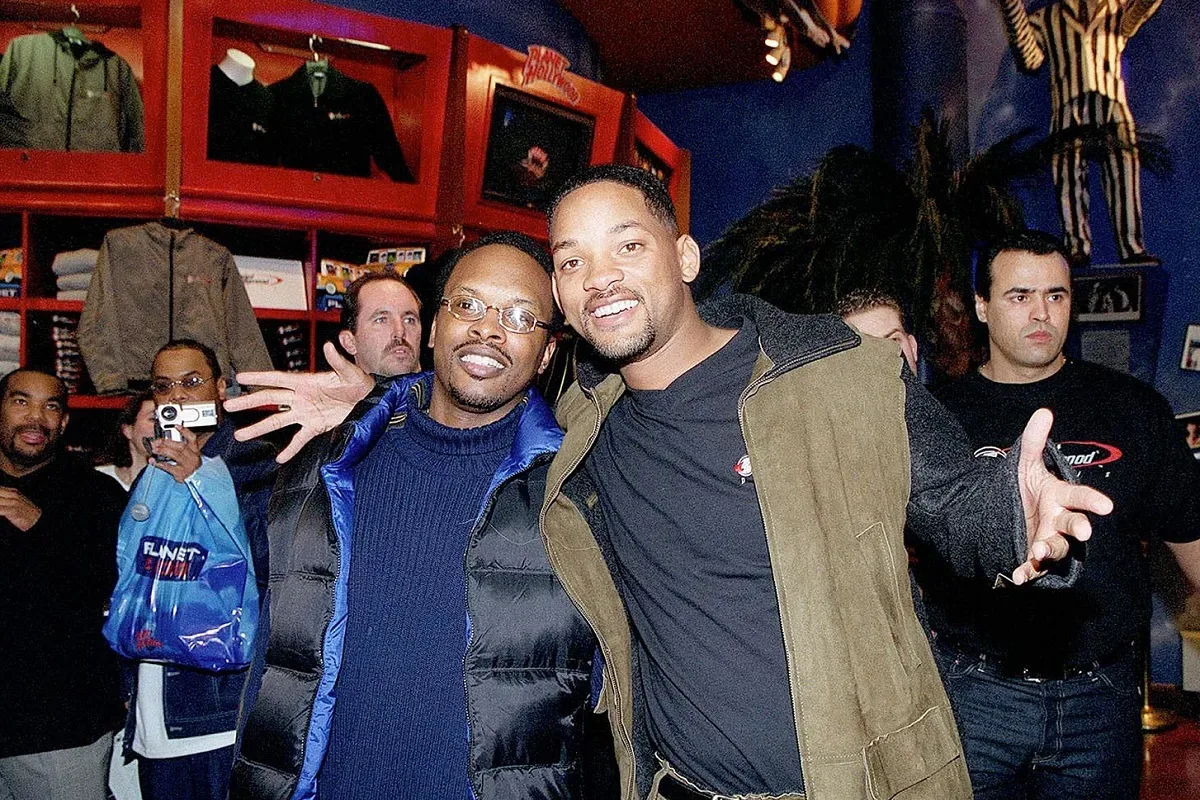
Will Smith’s path from West Philadelphia rapper to global screen star is set to become television material again, but the new project is looking past the mansion, the taxi ride and the television theme song. 215, a scripted series in development from Smith’s Westbrook Studios and The Malar Group, will focus on the formative rise of DJ Jazzy Jeff and the Fresh Prince.
The title refers to Philadelphia’s well-known 215 area code, which gives the project a clear sense of place before a scene has even been described. Its stated focus is the late 1980s, when the two friends from West Philadelphia were attempting to make their way through the music business. The series is expected to examine label meetings, the disorienting consequences of rapid success, outside industry pressure and the loyalty at the center of their friendship.
That framing matters. An origin story can easily become a greatest-hits parade: a string of famous landmarks politely waving at the audience as it passes. 215 instead appears designed to spend time on the less polished material behind a breakthrough—the decisions, uncertainty and relationships that exist before success turns into public mythology.
A Philadelphia story before it is a fame story
Philadelphia is not just a label on the project. Westbrook’s television head Terence Carter described 215 as a celebration of the city during a defining period in its late-1980s and early-1990s hip-hop scene. That makes the setting central to the premise, rather than a convenient backdrop for a celebrity biography.
The supplied details do not identify a network or streaming platform, release date, cast, episode count, writers or director. They also do not establish how closely individual scenes will track documented events. What is confirmed is narrower, and more useful: this is a scripted development project about the rise of DJ Jazzy Jeff and the Fresh Prince, anchored in their friendship and their Philadelphia beginnings.
“Scripted” is an important distinction here. It means the program is being conceived as a dramatic series rather than a documentary or archival retrospective. That format can use performers and constructed scenes to explore character and period. It also means viewers should not assume that every eventual scene, conversation or timeline beat will be a literal recreation. Until further creative details are disclosed, the title’s stated themes are the firmest guide to what 215 intends to cover.
The pair at the center of the series
DJ Jazzy Jeff and the Fresh Prince are the partnership at the heart of the project, not merely a stepping stone to Smith’s later television career. The development description emphasizes two friends dealing with the practical and emotional costs of a sudden ascent: navigating meetings with record labels, holding onto a sense of home, and testing whether personal loyalty can survive professional pressure.
That is potentially the strongest dramatic engine available to the show. The music industry material supplies the external stakes—opportunities, gatekeepers and expectations—while the friendship supplies the internal ones. A series built around both can ask a more interesting question than “how did someone get famous?”: what has to be protected when the pace of a life changes faster than the people living it can process?
There is a built-in tonal challenge, too. DJ Jazzy Jeff and the Fresh Prince are widely associated with an enormously recognizable pop-culture legacy. A show about their earlier years will have to balance the audience’s familiarity with the pair against the premise of two young artists who have not yet become cultural fixtures. The premise’s interest in the grind and the chaos surrounding success suggests that contrast is deliberate.
Why Westbrook is a natural home for the project
Westbrook Studios’ involvement gives 215 a direct connection to Smith’s production operation. Carter said the company is drawn to stories with strong characters, distinct worlds and a defined point of view, and positioned this project as especially meaningful because of its relationship to the rise of DJ Jazzy Jeff and the Fresh Prince and to Philadelphia’s hip-hop culture in that era.
The company has already produced Bel-Air, the dramatic reworking of the classic sitcom associated with Smith. That prior series is relevant less because it predicts exactly what 215 will be, and more because it demonstrates a willingness to revisit familiar Smith-adjacent material through a more dramatic lens. 215 is not described as a remake, sequel or prequel to Bel-Air; it is its own project with a real-life music partnership as its subject. Still, the two projects share an interest in looking at recognizable cultural territory from a different angle.
Westbrook’s listed credits also include Cobra Kai and Women of the Movement. The company has upcoming films including I Am Legend 2 and Netflix’s Fast and Loose in its pipeline. Those projects span very different subject matter, while 215 stands out for its direct connection to Smith’s hometown and early artistic career.
For viewers following television projects built around legacy, the broader calendar remains busy; the planned reunions and anniversary programming at the ATX TV Festival 2027 are another reminder that TV’s past is often being reconsidered in new formats. The difference with 215 is that its focus is not a reunion of a completed series. It is a dramatization of the road before a familiar public legacy fully took shape.
A new partnership behind the camera
215 is the first collaboration between Westbrook Studios and The Malar Group. The two companies plan to develop additional film and television projects together, making this series the opening effort in a wider partnership.
That detail places the show in two contexts at once. Creatively, it is a Philadelphia-set music-industry drama about a celebrated partnership. On the business side, it is also the first test of a new producing relationship. Neither factor guarantees a finished series, particularly while the project remains in development, but it does explain why the announcement carries significance beyond a single title.
“In development” is another term worth keeping clear. It indicates active work on shaping a project, not confirmation that production has begun or that a premiere is scheduled. Development may encompass creative planning and the process of moving a show toward a home and production. The information available for 215 does not say where it will air, when cameras might roll, or who will portray Smith, DJ Jazzy Jeff and the other figures in the story.
What the premise can—and cannot—promise yet
There is enough in the stated concept to identify the thematic territory: creative ambition, hometown identity, business pressure, abrupt visibility and a friendship challenged by success. Those subjects fit a serialized format because they are not isolated events. Each can evolve across the same period: a career opportunity may create a new source of strain, while a private disagreement can reshape how two collaborators face a public moment.
But the most specific details remain unknown. There are no announced music clearances, no confirmed use of particular songs, no casting information and no word on whether the series will concentrate on a single season of the duo’s life or cover a wider timeline. It would be premature to treat any of those possibilities as settled.
For now, 215 is best understood as a Philadelphia-rooted, scripted origin story with a deliberately personal center. It aims to show the rise of DJ Jazzy Jeff and the Fresh Prince through the pressures surrounding it, rather than treating fame as the whole plot. If the series keeps that focus, its most meaningful material may be found not in the already-famous milestones, but in the bond that had to survive long enough for those milestones to happen at all.