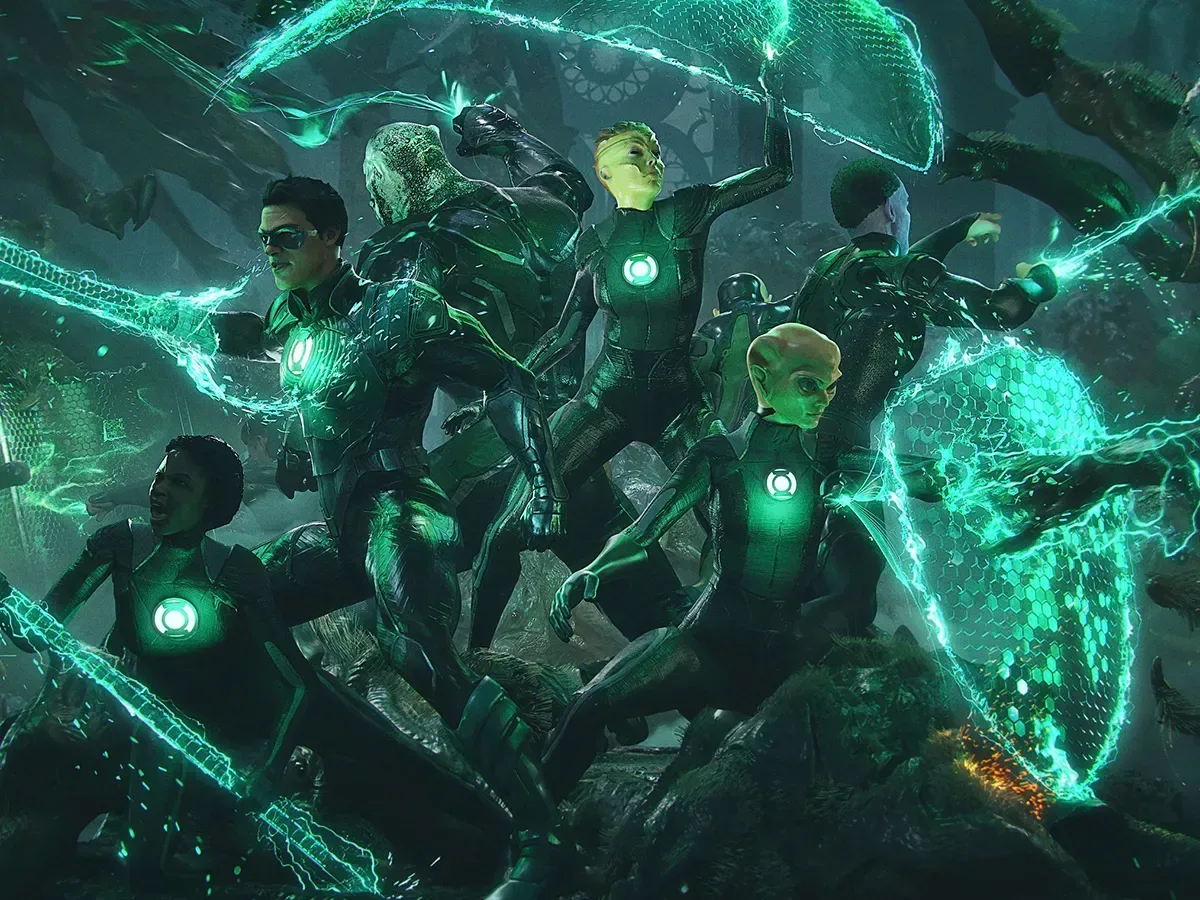
New concept art has opened a window onto Emerald Knights, a Green Lantern television project that was developed for HBO but ultimately never moved forward. The artwork, shared by Marc Guggenheim, presents the clearest public image yet of a series built around the Green Lantern Corps as an ensemble rather than solely around one or two ring-bearers.
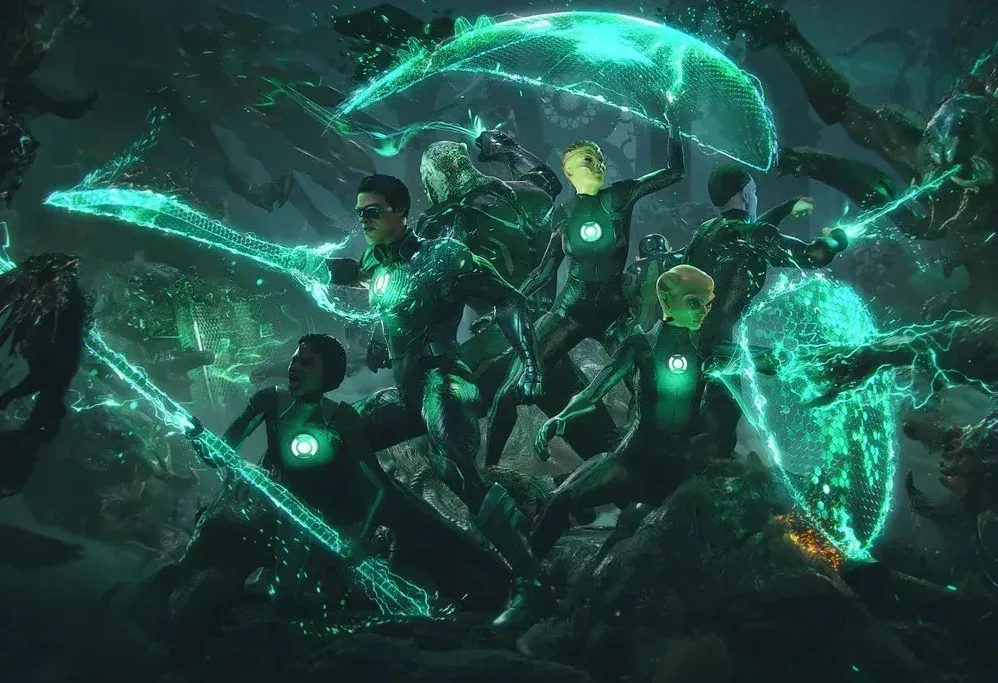
That distinction matters. Green Lantern stories can be structured as intimate character dramas, cosmic police procedurals, interplanetary war stories, or massive team adventures. Emerald Knights appears to have been leaning firmly toward the last of those options. Its newly seen art depicts seven Lanterns in what looks like a desperate confrontation with alien creatures, suggesting a show designed to convey the scale of the Corps and its many worlds from the outset.
The project did not make it through development, but its ingredients make it an interesting alternate route for DC television. It reportedly would have centered on Guy Gardner alongside Bree Jarta, an original character, while also reaching backward through Green Lantern history to Alan Scott. The series was conceived as a multi-period story, splitting material between Gardner in the 1980s and Scott in the 1940s.
That is a notably broader premise than simply asking who gets a power ring and what they do with it. It suggests a show interested in legacy: how different people carry the Green Lantern idea across decades, and how the organization behind the rings can change while retaining a recognizable purpose.
What the newly revealed art shows
The centerpiece is an ensemble scene of seven Lanterns facing a pack of hostile alien beings. Identifiable figures in the composition include Guy Gardner and Kilowog. There also appears to be a figure who may be Sinestro, seen from behind with a pink-toned head, though that identification is necessarily tentative when the artwork itself is only a pre-production glimpse.
Concept art is not a binding promise of a finished screen image. It is commonly used to establish tone, explore costumes, test character groupings and help a creative team communicate the intended scale of a project before cameras roll. Designs can change substantially, characters can be removed, and a single striking tableau may never correspond to an actual episode. Still, it can reveal the creative priorities of a pitch better than a one-line logline can.
Here, the priority appears to be a full Corps presence. Gardner’s look reportedly reads less like his familiar screen interpretation and more like a visual echo of 1990s-era Kyle Rayner. The Gardner and Bree Jarta designs also resemble Finn Wittrock and Janelle Monáe, respectively. That resemblance is useful as a clue to the artwork’s visual thinking, but it should not be treated as confirmation that either performer was cast.
For fans, the important takeaway is not that this was a nearly completed production frozen at the finish line. Rather, it is that a distinct Green Lantern framework had been seriously explored: multiple Lanterns, historical eras and a premise spacious enough to move between Earth-bound period drama and a much larger science-fiction setting.
Related coverage includes Marc Guggenheim Reveals the ‘Emerald Knights’ Green Lantern Series That Never Reached HBO.
Guy Gardner, Bree Jarta and the choice to build an ensemble
Guy Gardner is a familiar Green Lantern name, and selecting him as a lead would have given Emerald Knights a character with a strong, potentially abrasive identity at its center. The available details do not establish exactly how the series would have handled him, but placing him alongside Bree Jarta rather than making him a solitary protagonist signals a partnership-driven format.
Bree Jarta is particularly notable because she was created for the project rather than drawn from the established list of Green Lantern characters named in the material. Original characters can serve several practical storytelling purposes in an adaptation. They can give writers a perspective not constrained by decades of pre-existing stories; they can offer an entry point for viewers unfamiliar with continuity; and they can create dramatic relationships without inviting assumptions that every beat must lead toward a known comic-book outcome.
That does not make an original character inherently better or worse than an adaptation of an existing one. It simply indicates that the series was not attempting to be a checklist of recognizable names. A project can use a well-known hero such as Gardner as an anchor while making room for a character built specifically for the television story it wants to tell.
The seven-Lantern artwork reinforces that apparent approach. Gardner may have been one of the leads, but the visual pitch does not place the entire concept on one individual’s shoulders. It instead sells the idea of a Corps: a collection of characters facing a threat together, each presumably bringing their own outlook to the uniform and the ring.
A story split between the 1940s and 1980s
The proposed time structure may be the project’s most intriguing feature. Emerald Knights would have moved between Guy Gardner in the 1980s and Alan Scott in the 1940s. In practical terms, a dual-period format means the narrative is divided between two distinct settings rather than treating the past only as an occasional flashback.
That approach can create several kinds of storytelling tension. Events in one era can reframe an event in another. A threat that appears new in the later timeline may have roots in the earlier one. Characters separated by decades can be connected by a shared mystery, a legacy, or consequences neither fully understands. None of those specific plot mechanics have been confirmed for Emerald Knights, but the two-era setup would have made them available.
Alan Scott’s inclusion is significant because it places the show’s attention on Green Lantern history rather than only the better-known contemporary Corps model. In a franchise setting, “legacy” is more than a decorative use of old costumes or dates. It can give an adaptation a reason to compare different values, different institutions and different responses to the same danger. The 1940s and 1980s settings could have created a large visual and cultural contrast without requiring the entire series to be set in the present.
The revealed premise also demonstrates that a Green Lantern television story need not choose between a grounded human period setting and cosmic material. A show can use the former to give the characters texture and use the latter to supply the impossible stakes. Whether that balance would have worked on screen will remain unknowable, but it was clearly part of the project’s ambition.
The Manhunters were positioned as the main danger
Another major point of overlap between the abandoned concept and the eventual Lanterns series is the use of the Manhunters as the key antagonistic force. The details describe them as the primary villains of Emerald Knights, rather than making Sinestro the core enemy. Sinestro seems to have been considered visually, at least, but the concept did not place him at the center of the conflict.
This is an important choice in terms of story design. A personal arch-rival tends to focus a superhero narrative around one hero’s moral opposite. An unstoppable collective threat, by contrast, naturally favors an ensemble. It gives several Lanterns a reason to cooperate, allows danger to emerge across multiple locations and makes the size of the Corps feel relevant rather than ornamental.
The eventual Lanterns version reportedly gave the Manhunters an Invasion of the Body Snatchers-like quality. That comparison points to a kind of threat defined by infiltration, mistrust and uncertainty over who is safe, rather than only by straightforward physical combat. The available information does not say whether Emerald Knights would have used precisely that same approach, but its Manhunter focus places it in a similarly ominous territory.
For viewers who expected Sinestro to be the automatic centerpiece of every Green Lantern adaptation, this is a reminder that the character library permits other structures. A villain does not have to be the most famous adversary to be useful. The Manhunters could support a story about systems, scale and the vulnerability of a group whose defining strength is supposed to be its unity.
How Emerald Knights fits beside Lanterns
Emerald Knights should not be mistaken for a discarded Arrowverse installment. Guggenheim is associated with that long-running DC television world, but the Green Lantern pitch was commissioned by HBO in 2020 and was intended for the same destination later occupied by Lanterns. It subsequently fell apart around 2022.
That development history matters because it separates creative lineage from continuity. A project can share a writer or producer with one franchise universe while being designed for a different platform and a different corporate plan. It also helps explain why the surviving artwork feels like a parallel possibility rather than an omitted chapter viewers were meant to slot between existing episodes of another show.
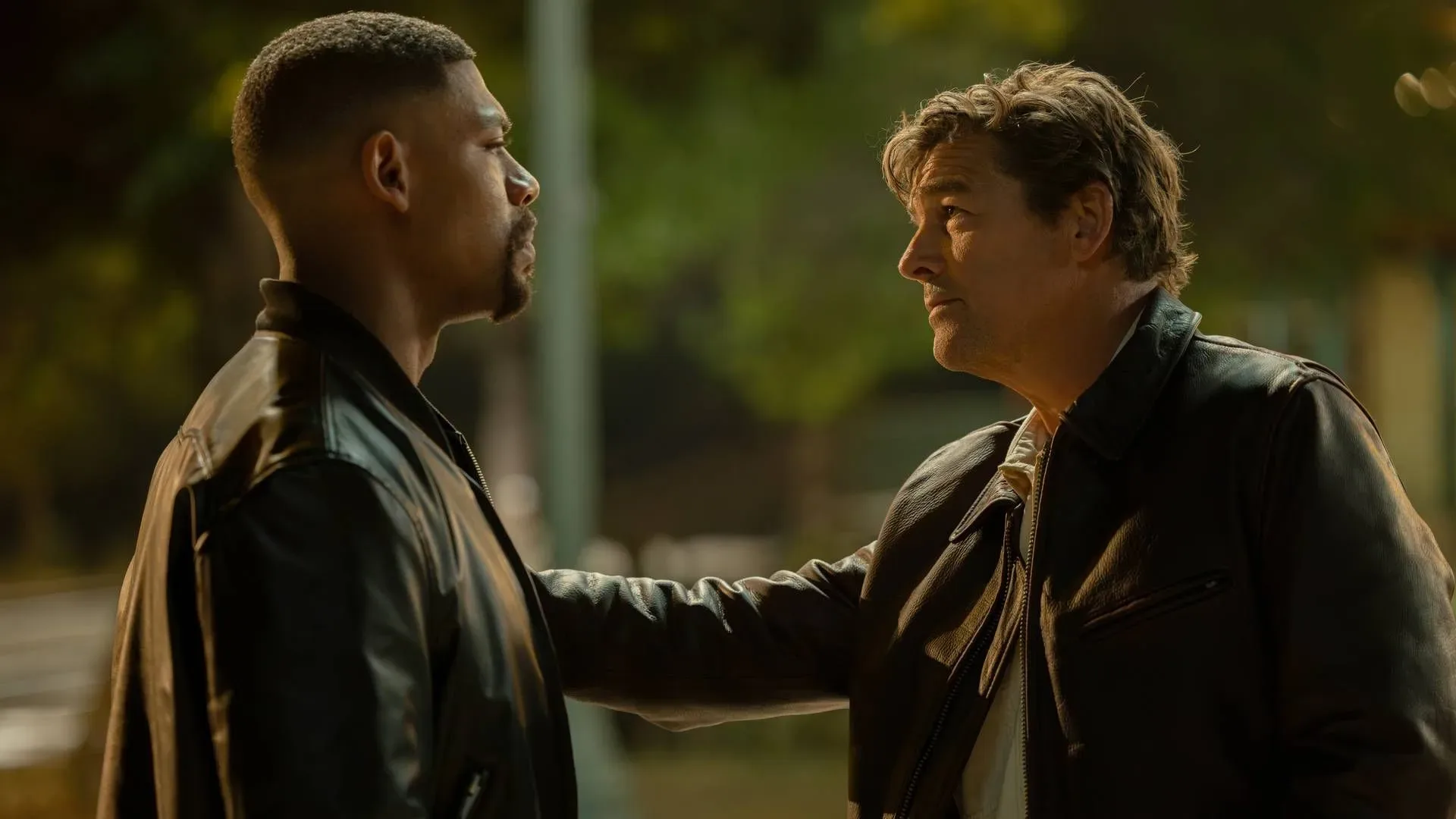
In 2024, James Gunn, now leading the DCU, took up the Green Lantern television torch with the series that became Lanterns. The finished show took a more restrained route in both tone and budgetary scale. Its central dramatic energy came from the contentious relationship between Hal Jordan and John Stewart, with emotional friction taking precedence over a constant succession of giant space-set pieces.
That contrast is useful without requiring either project to be framed as the “right” answer. Lanterns concentrated attention on two leads and their conflict. Emerald Knights, on the evidence now available, was prepared to spread that attention across a larger roster, several decades and a broader confrontation. One is built around a close character dynamic; the other appears built around a Corps-scale canvas.
Some criticism of Lanterns focused on the relative scarcity of major fights and comic-book spectacle. The existence of Emerald Knights concept art does not prove that the cancelled series would have satisfied every desire for action or comic accuracy. But it does show that another creative team had contemplated a version of Green Lantern television where the group image, the period-hopping structure and the monster-scale threat were central from the pitch stage.
Why cancelled-project art is still worth examining
It is easy to look at unused concept art only as a source of regret: a tantalizing fragment of something audiences will never see. That is part of the appeal, but it is not the only value. These images also make the development process more legible. They show that major franchise adaptations do not proceed in a straight line from character ownership to final episode. Different interpretations can coexist, and sometimes a project can get far enough to establish its cast of characters, its visual vocabulary and its story architecture without becoming a completed series.
For Green Lantern fans, Emerald Knights now occupies that fascinating in-between space. It was not merely an abstract proposal, since the art offers a concrete image of its intended ensemble. Yet it remains incomplete enough that its precise plot, final designs and possible casting cannot responsibly be filled in with guesswork.
The most durable lesson is that the Green Lantern concept continues to support radically different scales of adaptation. A tense two-character drama can use the mythology. So can a period-spanning story of Guy Gardner, Alan Scott, Bree Jarta, Kilowog and a wider Corps confronting the Manhunters. The newly surfaced artwork does not rewrite the version that reached audiences, but it gives fans a sharper look at the road not taken.
DC’s screen future remains full of competing interpretations of its characters, while its publishing side continues to broaden the universe in other directions; Zatanna’s expanding comic-book role is another example of how many corners of DC can be developed at once. In the case of Emerald Knights, what survives is a compelling piece of visual evidence for a Green Lantern show that aimed to think bigger, older and more collectively than the one audiences ultimately received.